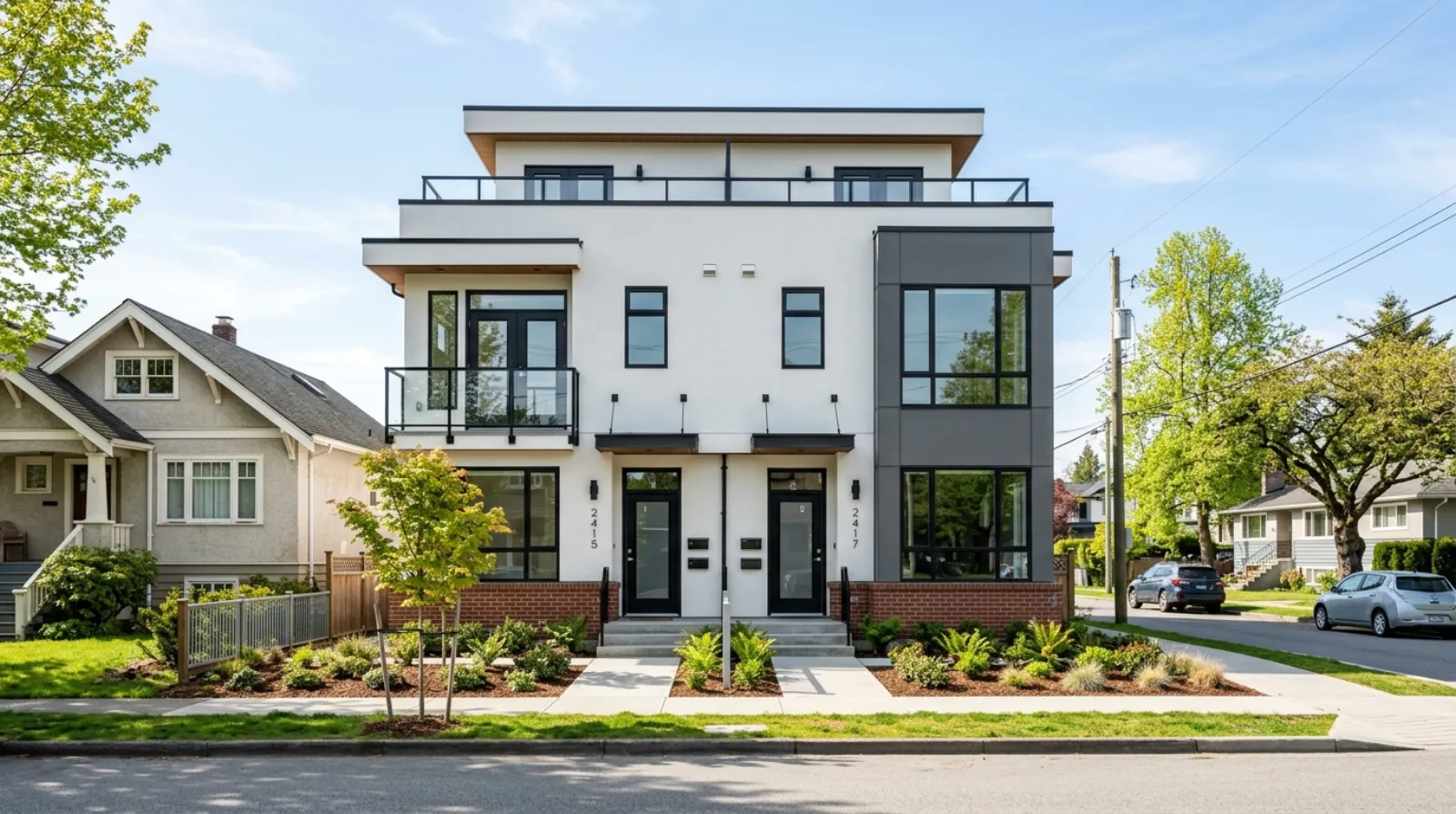
Prefab vs traditional: cost, speed & quality
Should you build your multiplex in a factory or the traditional way, on site from the ground up? Here is how the two compare on cost, speed, and quality in BC, and the trade-offs to weigh before you decide.
Should you build your multiplex in a factory or the traditional way, on site from the ground up? Here is how the two compare on cost, speed, and quality in BC, and the trade-offs to weigh before you decide.
Both methods produce a real, permanent home built to the BC building code. The difference is where the work happens. Traditional building does almost everything on your lot. Prefab moves much of it into a factory. Here is how that plays out across the things families care about most.
Cost
In Greater Vancouver, the land is the single biggest cost in any multiplex project, and that price is the same no matter how you build. Prefab can trim the building cost by using factory labour more efficiently and wasting less material, but it does not change what the lot, the design, the permits, or the finishes cost. So the total saving is real but modest, and it varies a lot by project. The most reliable payoff from prefab is a shorter schedule, which saves on financing and gets you moved in sooner. For real numbers, see our prefab multiplex cost guide for BC.
Speed
This is where prefab clearly wins. In a traditional build, the steps happen one after another: prepare the site, then frame, then finish. With prefab, the factory builds your home while your lot is being prepared at the same time. Modular units can be built in a matter of weeks and set on the foundation in a day or two. Weather causes fewer delays because the building happens indoors. See the full prefab multiplex timeline for a step-by-step view.
Quality
Factory homes are built indoors, on level surfaces, with tools and jigs that keep everything square, and they are checked during production. Materials stay dry rather than sitting in the rain. For these reasons, quality can be more consistent than a home framed outdoors. Both methods must meet the same building code, so prefab is not a lower standard. It is a different, often more controlled, way to reach the same standard.
Side by side
| Factor | Prefab / modular | Traditional site-built |
|---|---|---|
| Build speed | Faster (parallel work) | Slower (steps in sequence) |
| Weather delays | Fewer (built indoors) | More (built outdoors) |
| Cost saving | Modest, varies by project | Baseline |
| Design flexibility late in the build | Lower | Higher |
| Building code | Same code | Same code |
| Site access needed | Road + crane space | Standard site access |
General comparison for guidance. Actual cost and time depend on your lot, design, and builder. Confirm with quotes.
So which should you choose?
If speed and a predictable schedule matter most, and your layout is fairly standard, prefab is often the stronger choice. If you want maximum design freedom on an unusual lot and you are not in a hurry, traditional building may suit you better. Many families end up somewhere in between with a hybrid approach. The best way to decide is to compare real quotes for your exact lot. Tell us your plan and we will match you with BC builders who do both.
Questions people ask
Get matched with a prefab builder
Tell us about your family and your lot. Free, no obligation, one business day reply.
More on prefab multiplexes
The options explained
Modular, panelized, and kit built, in plain words.
Read moreWhat it costs in BC
Real price ranges for a prefab multiplex here.
Read moreHow long it takes
From first call to move-in, step by step.
Read morePrefab duplex
A two-home building for you and one more family.
Read morePrefab triplex
Three homes on one lot, close but private.
Read morePrefab fourplex
Four homes for a larger family or income.
Read moreBC builders
Who builds prefab multiplexes in our area.
Read morePaying for it
How families fund a prefab multiplex build.
Read more