Prefab multiplex timeline in BC
A prefab multiplex takes many months from first call to move-in, but the building stage is much faster than a traditional build because the factory works while your lot is being prepared. Here is the whole timeline, step by step, and where the real time savings come from.
A prefab multiplex takes many months from first call to move-in, but the building stage is much faster than a traditional build because the factory works while your lot is being prepared. Here is the whole timeline, step by step, and where the real time savings come from.
People often hear that prefab is fast and picture the whole project finishing in a few weeks. The factory stage really is that quick. But a full project has several stages, and some of them, like permits, take the same time no matter how you build. Here is the honest, end-to-end picture.
The stages, start to finish
- Plan and design. You settle how many homes, the layout, and the budget, and the design is drawn up. Getting matched with the right builder happens here.
- Permits and approvals. The city reviews the plans and issues a building permit. In Greater Vancouver this is often the longest single step, and it is similar for prefab and traditional builds.
- Factory build and site prep at the same time. This is the key to prefab. The factory builds your modules or panels while your crew prepares the foundation and services on the lot. Two slow steps happen in parallel.
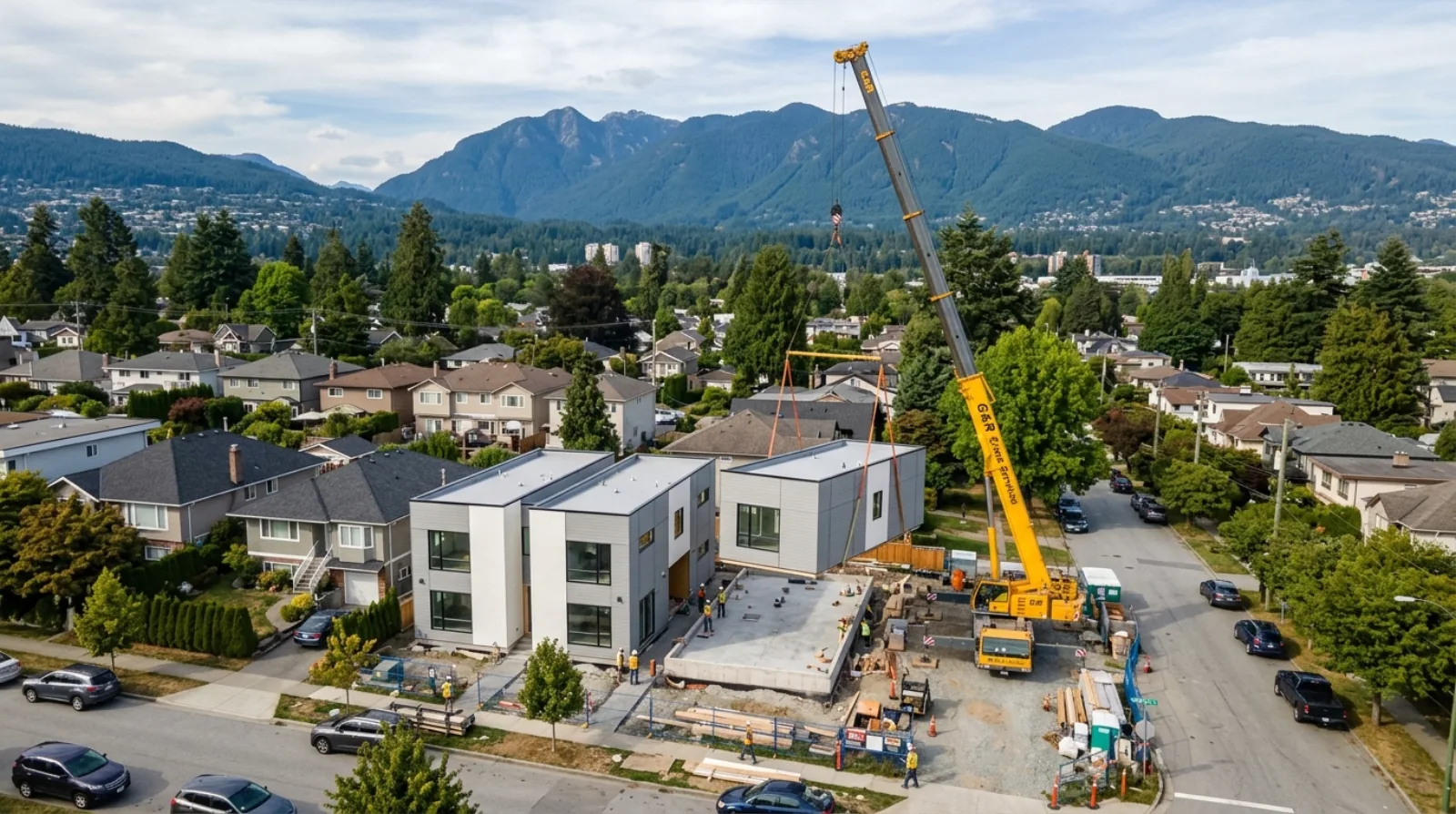
- Delivery and set. The finished modules are trucked in and craned onto the foundation, usually in a day or two for a modular build.
- Finishing and connections. A crew joins the sections, finishes the joins, connects the services, and completes any on-site work before final inspection.
- Move in. After the final inspection and occupancy approval, the homes are ready.
Where prefab saves time
The saving comes from stage three. In a traditional build, you prepare the site and then build on it, one after the other. With prefab, the building is made off-site at the same time the lot is prepared, so the two overlap. Because the work happens indoors, rain and cold cause far fewer delays. Modular building in particular can turn months of on-site framing and finishing into weeks in the factory plus a day or two to set the modules.
Where prefab does not save time
Design, financing, permits, and approvals take their usual time either way. If anything, prefab asks you to lock the design a little earlier, because once the factory starts, changes are harder. So the smart way to think about it is this: prefab shortens the build, keeps the schedule more predictable, and reduces weather risk, but it does not shortcut the paperwork.
Plan your timeline with a builder
The exact number of weeks depends on your city, your design, and the builder's factory schedule. The best way to get a realistic timeline is to talk to builders who work in your area. Tell us your plan and we will match you with prefab builders in BC who can map out the dates for your project. While you are here, see what a prefab multiplex costs and the different prefab methods, since the method you choose affects the schedule.
Questions people ask
Get matched with a prefab builder
Tell us about your family and your lot. Free, no obligation, one business day reply.
More on prefab multiplexes
The options explained
Modular, panelized, and kit built, in plain words.
Read morePrefab vs traditional
How the two compare on cost, speed, and quality.
Read moreWhat it costs in BC
Real price ranges for a prefab multiplex here.
Read morePrefab duplex
A two-home building for you and one more family.
Read morePrefab triplex
Three homes on one lot, close but private.
Read morePrefab fourplex
Four homes for a larger family or income.
Read moreBC builders
Who builds prefab multiplexes in our area.
Read morePaying for it
How families fund a prefab multiplex build.
Read more