Financing Your Multiplex Purchase
CMHC now covers owner-occupied multiplex purchases up to 4 units: 5% down on the first $500K for a single unit or duplex, 10% for a whole triplex or fourplex. Rental income from the other units boosts your mortgage qualification — on a $1M duplex, one tenant at $2,363/month adds over $100K to what you can borrow. Here is every number you need to buy a multiplex in Greater Vancouver.
Key Topics
Down Payments Demystified
For a single unit or duplex: 5% on the first $500K, 10% on the rest up to $1.5M. A $750K unit needs $50,000 down; a $1M unit needs $75,000. A whole triplex or fourplex you live in needs a flat 10%. Above $1.5M, you're looking at 20% minimum and no CMHC insurance.
Mortgage Rates Right Now
Best 5-year fixed rates sit around 3.94% for insured mortgages. Variable rates start near 3.30–3.35%, tracking below fixed for the first time in a while. The Bank of Canada has held at 2.25% through every decision in 2026, most recently on July 15.
Stack Your Down Payment
FHSA: $8K/year tax-deductible, $40K lifetime, tax-free withdrawals. HBP: $60K per person from your RRSP ($120K per couple). Combined, that's up to $200K for a couple — before you touch your savings account.
BC Property Transfer Tax Savings
First-time buyers pay zero PTT on the first $500K of homes up to $835K — saving up to $8,000. Newly built homes get full exemption up to $1.1M. These stack with federal programs.
Rental Income Changes the Math
Lenders count 50–80% of projected rental income toward your qualification. On a duplex with a $2,400/month suite, that's $14,400–$23,040 added to your annual qualifying income. GDS limit: 39%. TDS limit: 44%.
30-Year Amortization Is Real
Since December 15, 2024, all first-time buyers and all buyers of new construction can get 30-year amortization on insured mortgages. That drops monthly payments roughly 10% compared to 25-year terms.
Down Payment & CMHC Insurance Costs for a Multiplex in BC
The minimum down payment for a CMHC-insured multiplex in BC is 5% on the first $500,000 and 10% on the portion above that — up to a maximum purchase price of $1.5M. On a $900K multiplex that means $65,000 down. CMHC then adds a 4% insurance premium to the mortgage balance.
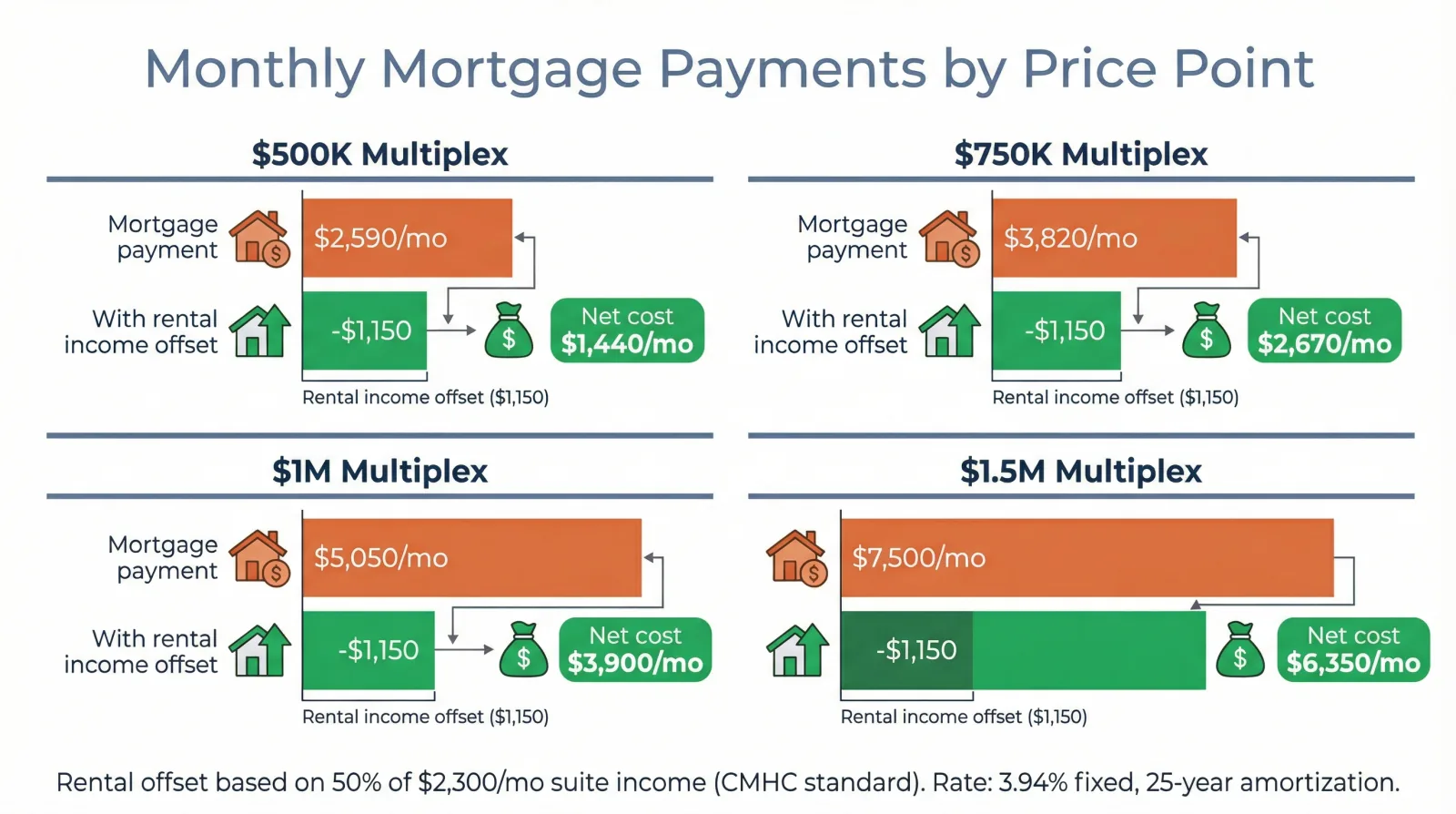
Real numbers at four price points. CMHC premiums are added to your mortgage balance, so you don't pay them upfront — but you do pay interest on them for the life of the loan.
| Purchase Price | Min. Down Payment | Down % | CMHC Premium Rate | CMHC Premium $ | Total Mortgage | Monthly Payment |
|---|---|---|---|---|---|---|
| $500,000 | $25,000 | 5.0% | 4.00% | $19,000 | $494,000 | $2,590 |
| $750,000 | $50,000 | 6.7% | 4.00% | $28,000 | $728,000 | $3,820 |
| $1,000,000 | $75,000 | 7.5% | 4.00% | $37,000 | $962,000 | $5,050 |
| $1,500,000 | $125,000 | 8.3% | 4.00% | $55,000 | $1,430,000 | $7,500 |
Monthly payments based on 3.94% 5-year fixed rate, 25-year amortization. Down payment: 5% of first $500K + 10% of remainder per CMHC rules for a home with 1-2 units, including a single multiplex unit; a whole 3-4 unit building requires a flat 10% down. CMHC premium at 4.00% (highest tier, 5–9.99% down). At 10% down the premium drops to 3.10%; at 15% down it's 2.80%. Sources: Ratehub.ca best insured rates, March 2026; CMHC premium schedule.
Source: CMHC mortgage loan insurance premium schedule. Premium rates identical across CMHC, Sagen, and Canada Guaranty.
Government Programs at a Glance
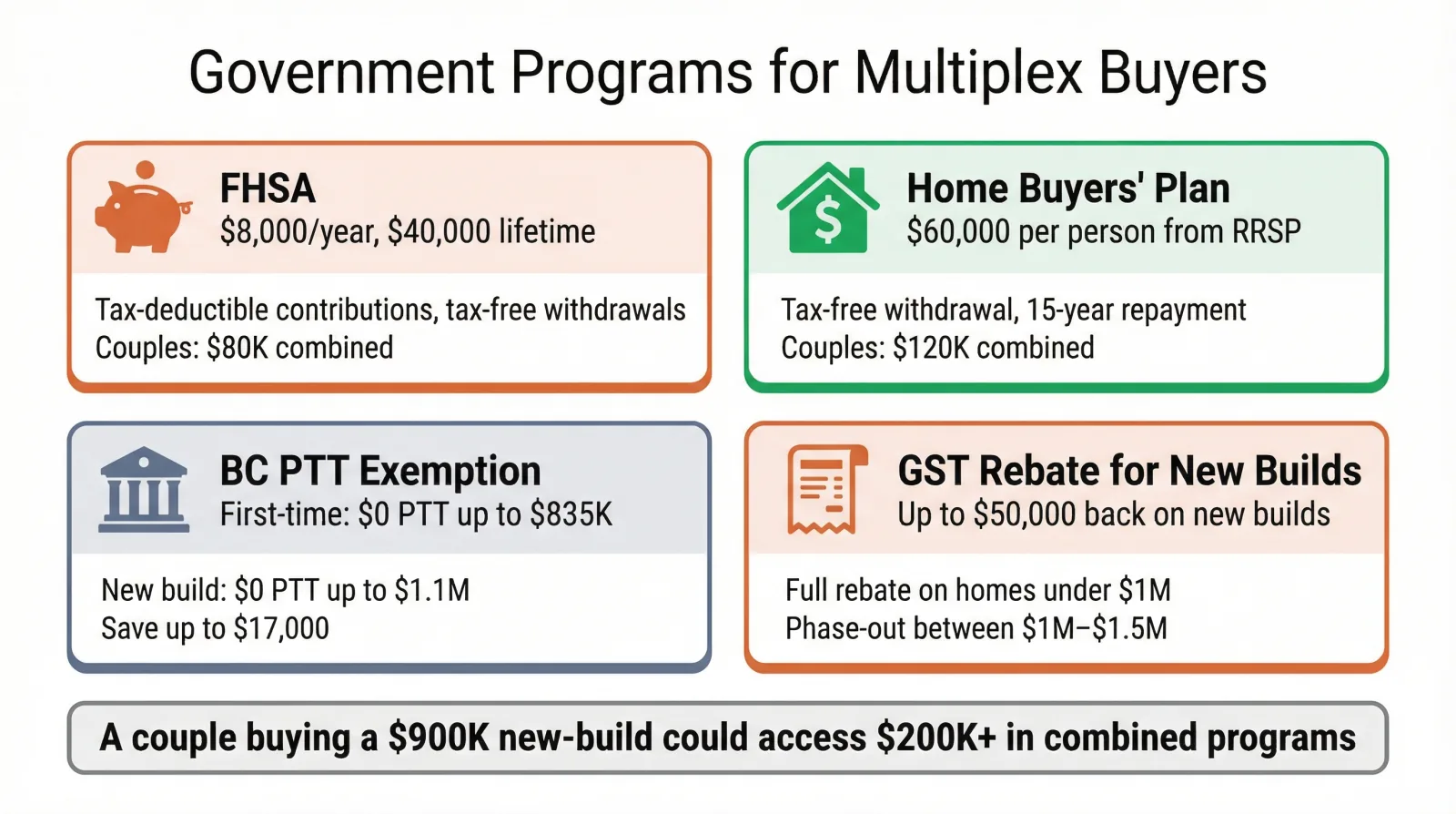
Four programs that can save you anywhere from $8,000 to $50,000 on a multiplex purchase. All numbers verified against federal and provincial sources as of March 2026.
First Home Savings Account (FHSA)
Tax-deductible contributions, tax-free growth, and tax-free withdrawals for your first home. Unused room carries forward up to $8K/year — so you can contribute $16K in year two if you missed year one. Couples each open their own FHSA for $80K combined.
Home Buyers' Plan (HBP)
Withdraw from your RRSP tax-free for a first home. Limit raised from $35K to $60K in April 2024. Repay over 15 years. Temporary relief: withdrawals made between 2022–2025 get an extra 3-year grace period before repayment starts.
BC Property Transfer Tax Exemption
First-time buyers pay zero PTT on the first $500K of a home priced up to $835K. Partial exemption phases out between $835K–$860K. Must have lived in BC for 12 consecutive months or filed 2 tax returns in the last 6 years.
First-Time Buyer GST Rebate (New 2025)
Brand new: eliminates GST on newly built homes up to $1M for first-time buyers. Phases out between $1M–$1.5M. Replaces the old $6,300 max rebate with up to $50,000 back. Applies to purchase agreements signed on or after March 20, 2025.
What stacking looks like for a couple
A couple buying a $900K new-build multiplex unit could bring $200K from FHSA + HBP alone — well above the $65K minimum down payment. Add up to $50K back in GST rebate and $8K in PTT savings. These programs are designed to stack.
Tax Rebates & Savings
Beyond CMHC and mortgage programs, new multiplex buyers in BC can reduce their upfront costs through several tax rebates that stack on top of each other. The GST rebate introduced by Bill C-4 removes the full 5% goods and services tax on newly built homes under $1M for first-time buyers — a saving of up to $50,000 that arrives at closing rather than years later.
BC's Property Transfer Tax (PTT) rules add another layer: newly built homes are fully exempt from PTT up to $1.1M, which can save buyers $18,000 to $22,000 in closing costs compared to a resale purchase at the same price.
First-time buyers can also stack savings accounts before closing. An FHSA holds up to $40,000 tax-free per person, and combining it with the RRSP Home Buyers' Plan (up to $60,000 per person) gives a solo buyer access to $100,000 in tax-sheltered funds — or $125,000 if they have also claimed the GST rebate on a qualifying new multiplex.
For the full breakdown of every buyer savings program available in BC right now, read our Tax Rebates & Savings Guide.
How Rental Income Changes Your Qualification
This is where multiplexes pull ahead. Lenders count a portion of projected rental income toward your debt service ratios — which means you qualify for a larger mortgage than you would buying a condo or a house.
Without Rental Income
With Duplex Rental Income
Gross Debt Service. Your housing costs (mortgage, taxes, heat, half of strata fees) can't exceed 39% of gross income. This is the CMHC maximum for insured mortgages.
Total Debt Service. All debts (housing + car payments, credit cards, student loans) can't exceed 44% of gross income. Lenders stress-test at the higher of your rate +2% or 5.25%.
Rental income offset varies: most lenders use 50% of gross rent; some allow up to 80% or use a full offset method (100% of rent minus 100% of costs). OSFI's 2025 guidance prohibits double-counting income across multiple properties. Sources: CMHC debt service guidelines; OSFI B-20 rental income clarification, September 2025.
25 vs. 30-Year Amortization
Since December 15, 2024, all first-time buyers and all new construction buyers can choose 30-year amortization on insured mortgages. Here's what that looks like on an actual multiplex purchase.
| Mortgage Amount | 25-Year Monthly | 30-Year Monthly | Monthly Savings |
|---|---|---|---|
| $500,000 | $2,620 | $2,370 | $250 |
| $700,000 | $3,670 | $3,320 | $350 |
| $900,000 | $4,720 | $4,270 | $450 |
| $1,200,000 | $6,290 | $5,690 | $600 |
Based on 3.94% 5-year fixed rate. The trade-off: 30-year amortization means slower equity building and roughly 15–20% more total interest over the life of the mortgage. Source: Ratehub.ca, March 2026, amortization comparison.
The bottom line
The financing environment for multiplex buyers is the best it's been in years. The Bank of Canada cut from 5.00% down to 2.25% through 2024-2025, and variable-rate mortgages are pricing below fixed for the first time in a while — around 3.30% vs. 3.94% fixed. On a $700K mortgage, that difference puts real money back in your pocket every month.
The qualification math works harder for multiplex buyers than any other housing type. CMHC's rental income offset means lenders count 50% of projected suite income toward your application. A couple earning $130K with no other debts qualifies for roughly $585K-$695K depending on rental income — enough for a multiplex unit in Surrey, Burnaby, or East Vancouver. The stress test at 5.94% keeps you safely within your means.
The government programs are stacking up in your favour. FHSA + HBP can get a couple to $200K in down payment funds. The GST rebate delivers up to $50K back on new builds. FHSA contributions max at $8K/year and HBP draws from your existing RRSP — so start early and let those programs compound. The earlier you begin, the stronger your position at closing.
For first-time multiplex buyers, the path is clear: rates are favourable, programs are generous, and CMHC insurance on properties up to $1.5M means you can get in with as little as 5% down on the first $500K of a single unit (a whole triplex or fourplex takes 10%). OSFI's 2025 guidance on income qualification is worth understanding, but it doesn't change the math for a first purchase — it mainly affects portfolio investors. See our dedicated first-time buyer guide for a step-by-step walkthrough of CMHC rules, down payment programs, and what to expect on your first multiplex purchase in Vancouver.
Every month you wait, you're leaving government incentives and favourable rates on the table. Explore the full Playbook for more guides, or talk to our team to get matched with a mortgage broker who specializes in multiplex financing.
Data: Bank of Canada policy rate decisions, March 2026. Ratehub.ca best mortgage rates, March 2026. CMHC insured mortgage rules, December 2024. Canada.ca FHSA and HBP program details. OSFI B-20 rental income guidance, September 2025.
General information only. The mortgage payment examples, down payment calculations, program details, and qualification scenarios on this page are illustrative and based on rates and rules as of the dates noted. They are not financial advice, mortgage advice, or a guarantee of qualification. Mortgage rates, CMHC rules, government program eligibility, and lending policies change frequently. Always consult a licensed mortgage broker who can review your income, credit, and specific situation before making any financing decision.
Be first to see new projects coming soon
Get the free Buyer Guide and early access to new multiplex projects in Greater Vancouver, before they're publicly listed.
Key Takeaways
- Multiplex purchases up to $1.5M qualify for CMHC-insured mortgages: 5% down on the first $500K for a single unit, 10% for a whole 3-4 unit building.
- Lenders can count up to 50% of projected rental income to boost your qualifying amount.
- The FHSA lets first-time buyers save up to $40,000 tax-free toward a down payment.
- BC's new housing programs offer forgivable loans and exemptions specifically for multiplex buyers.
- 30-year amortization is now available for first-time buyers, lowering monthly payments by roughly 10%.
- Stacking federal and provincial programs can reduce your upfront cash requirement by $50,000 or more.
Frequently Asked Questions
What is the minimum down payment for a multiplex in Canada?
For owner-occupied multiplexes up to $999,999, the minimum down payment is 5% on the first $500,000 and 10% on the remainder — so a $750K purchase requires $50,000 down and a $900K purchase requires $65,000. Under CMHC rule changes effective December 2024, multiplexes priced between $1M and $1.5M now qualify for insured mortgages using the same tiered structure. On a $1.2M multiplex, the minimum down is $95,000 — significantly less than the previous 20% rule ($240,000). The CMHC insurance premium (up to 4% of the loan amount) is added to your mortgage balance rather than paid upfront, which lets buyers enter the market with less cash at closing.
The December 2024 CMHC rule change was significant — previously, anything over $999,999 required 20% down. Now the same purchase needs only the tiered amount. The trade-off is the CMHC insurance premium: on a $750K purchase with $50K down, that premium is roughly $28,000. You pay interest on it for the life of the loan, so the true cost is higher than the premium alone.
Can rental income help me qualify for a mortgage?
Yes — this is the most important financing tool for multiplex buyers in BC. Most lenders allow you to add 50% of projected rental income from secondary suites to your gross qualifying income. For a duplex suite renting at $2,300/month, that adds $1,150/month to your stated income — which translates to roughly $80,000–$120,000 in additional borrowing power at current mortgage rates. Some credit unions and monoline lenders use up to 80% of rental income with strong market documentation. Your mortgage broker needs to submit comparable rental listings or a rental market appraisal to support the projected rent figure.
The key is having realistic rent projections backed by comparable listings in the same neighbourhood. You cannot inflate the number — lenders will compare it against market data. Ask your broker specifically which lenders have the most favourable rental offset policies, because the difference between 50% and 80% offset can mean $40K–$60K in additional qualification room.
What is the FHSA and how does it help homebuyers?
The First Home Savings Account (FHSA) lets first-time buyers contribute up to $8,000 per year (lifetime maximum $40,000). Contributions are tax-deductible — they lower your taxable income in the year you make them, just like an RRSP. Withdrawals for a qualifying home purchase are completely tax-free, including any investment gains. You can combine an FHSA withdrawal with the Home Buyers' Plan (up to $60,000 from your RRSP), giving first-time multiplex buyers access to up to $100,000 in tax-advantaged down payment funds if both accounts are maximized. The FHSA must be open for at least one calendar year before you can make a qualifying withdrawal.
Unused annual contribution room ($8,000) carries forward to the following year, so if you miss a year you can contribute $16,000 the next. The FHSA is particularly powerful for BC buyers because multiplexes often require larger down payments — every tax-free dollar in your FHSA is worth more than a dollar saved in a taxable account.
What government programs help multiplex buyers in BC?
BC and federal programs that apply to multiplex buyers include: the BC First-Time Home Buyers' Program (Property Transfer Tax exemption on the first $500,000 of price for homes up to $835,000, saving up to $8,000 at closing); the federal Home Buyers' Plan (up to $60,000 RRSP withdrawal, tax-free, with 15 years to repay); the First Home Savings Account (FHSA, up to $40,000 tax-free); the GST New Housing Rebate (up to $6,300 back on new builds); and 30-year amortization for first-time buyers purchasing new construction. For brand new multiplexes, the PTT New Home Exemption also applies to purchases under $1.1M.
Stack these programs strategically. The BC PTT exemption + federal FHSA + Home Buyers' Plan can put $100K+ in tax-advantaged funds toward your down payment. On a new-build multiplex, add the GST rebate and 30-year amortization and the effective entry cost drops further. Talk to a mortgage broker who specializes in multiplexes — they will know which programs apply to your specific situation.
Can I really use rental income to qualify for a bigger mortgage?
Yes — and it is the reason many buyers can afford a multiplex they couldn't otherwise qualify for. Most lenders count 50% of projected rental income from the units you don't occupy toward your qualifying income. On a fourplex where three suites rent at $2,200/month each, that adds $3,300/month ($39,600/year) to your stated income for qualification purposes. At current stress-test rates, that translates to roughly $200,000–$250,000 in additional borrowing power. Some credit unions and B-lenders use 80% of rental income with proper documentation, adding even more capacity. The income must be supported by a rental market appraisal or comparable listings — you cannot project above-market rents.
Is house-hacking a multiplex actually worth the hassle?
For most buyers in their 30s and 40s who want to build equity faster, yes. Living in one unit of a duplex or fourplex and renting the others cuts your effective housing cost by 30–60%. On a $1M duplex with a $4,700/month mortgage, a $2,400/month rental suite drops your net monthly cost to under $2,300 — less than many one-bedroom rentals in Vancouver. The trade-off is that you become a landlord under BC's Residential Tenancy Act: tenant screening, rent-increase limits (2.3% in 2026), and maintenance calls are real responsibilities. For buyers who are organized and comfortable with that role, house-hacking is one of the strongest wealth-building strategies in Metro Vancouver.
The financial case is strong. Living in one unit of a duplex and renting the other can cut your effective housing cost by 30-50%. On a $900K duplex with a $4,200/month mortgage, a $2,500/month rental suite drops your net cost to $1,700. That is less than renting a one-bedroom in many parts of Vancouver. The downsides are real though. You are now a landlord under BC law, which means you must follow the Residential Tenancy Act for everything — rent increases capped at 2.3% in 2026, 4-month notice for landlord-use eviction, and mandatory use of the RTB portal for all notices. You will field maintenance calls at inconvenient times. Your tenant's noise is your noise. And the tax complexity is significant: you must declare rental income, can deduct a portion of mortgage interest and expenses, and may face capital gains implications on the rental portion when you sell. For people who are handy, organized, and comfortable setting boundaries with neighbours, house-hacking is one of the best wealth-building strategies available in Vancouver. For people who value total privacy and hate administrative work, a condo might be the better call.
Financing Articles
Your Monthly Total
How to build the real monthly cost of a specific home from documents you can get before you buy.
House Hacking a Multiplex
Live in one unit, rent the rest — cash flow math, tax implications, and landlord reality.
Co-Development Explained
How the money works when you partner with a developer — land equity, construction financing, and take-out mortgages.
More from The Playbook
Why Multiplex
The case for ground-oriented living
ExploreBuying Guide
From discovery to closing
ExploreMarket Reports
Data, trends & analysis
ExploreLiving
What ownership looks like
ExploreMulti-Gen
Families buying together
ExploreWhere to Buy (Van)
Vancouver neighbourhood data
ExploreWhere to Buy (Burnaby)
Burnaby neighbourhood data
ExploreStrata Guide
Bylaws, governance & ownership
ExploreTalk to a Multiplex Expert
Whether you're buying, building, or exploring your options, our team can help you navigate the process with confidence.
Ready to find your multiplex?
Browse duplexes, triplexes, and fourplexes across Greater Vancouver and BC.