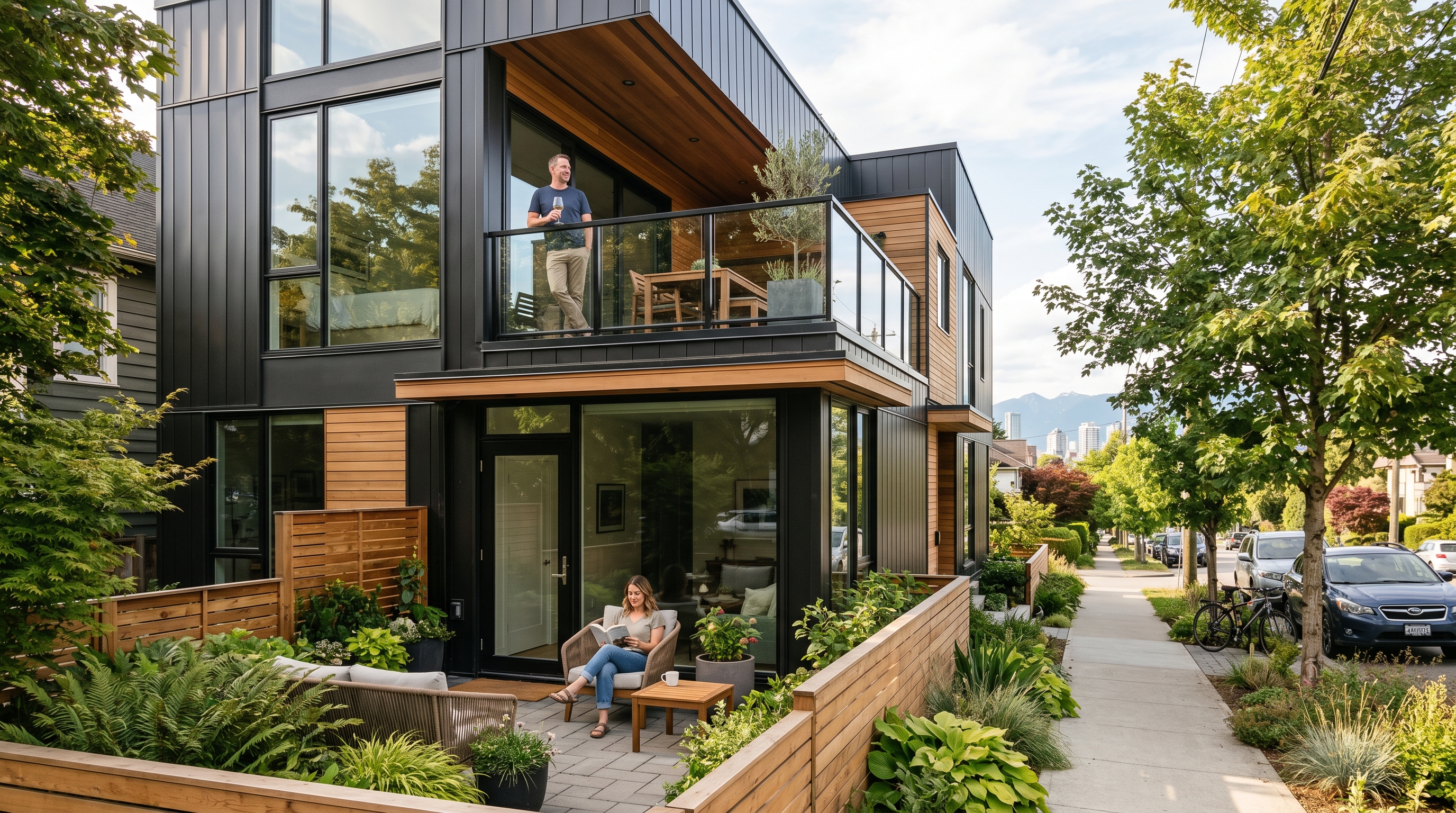
Front, Back, Corner, or Middle: Which Multiplex Unit Should You Pick?
Street-facing, lane-facing, corner, or middle: how position inside a new multiplex changes light, noise, yards, parking, and price, and how to choose yours.
By MultiLiving Editorial · August 16, 2026
Four families buy into the same brand-new fourplex on the same day. Same street, same team behind it, same finishes. A year later, one of them loves the home without reservation, two are happy, and one keeps a list of small regrets. In our experience the difference is almost never the finishes. It is the position: which unit within the building each family chose.
We wrote separately about ground-floor versus upper-floor living, so this post stays on the horizontal question: street-facing or lane-facing, corner or middle. These choices are permanent, they are priced differently on the same price sheet, and buyers routinely spend less time on them than on picking a countertop. Here is how we walk buyers through it.
Why position matters more in a multiplex than in a condo
In a condo tower, position mostly means view. In a multiplex, position decides your entrance, your yard, your parking walk, how many walls you share, where your windows face, and what you hear at 7 a.m. These are small buildings on ordinary residential lots, typically two to six homes, a format Vancouver has allowed on regular lots since late 2023 and Burnaby since mid-2024, per the two cities. Most are arranged with one or two homes facing the street, one or two facing the lane, and on wider lots, homes side by side that create true corner and middle positions.
Because every home in the building shares the same address and the same quality, position is where the units genuinely differ. It deserves the same attention you would give a $50,000 decision, because on many price sheets that is exactly what it is.
The four positions, defined in a sentence each
Street-facing (front)
Windows and usually the main entrance face the public street. You get the address, the sidewalk, and the streetscape.
Lane-facing (back)
The home faces the lane or the rear yard. Quieter from street traffic, closer to the parking, further from the sidewalk life.
Corner (end)
An end position with one shared wall instead of two, and windows on two or three sides instead of one or two.
Middle (interior)
A home between two neighbours, sharing walls on both sides, usually the lowest-priced position in the building.
Street-facing units: the address and the trade
The front unit gets the things people photograph: the front door on the street, the porch, the number on the gate. Daylight is usually generous because nothing will ever be built across a public street. If you like waving at neighbours and watching the block go by, the front is your home.
The trade is exposure. You hear the street, whatever your street sounds like, and that varies enormously between a quiet East Vancouver side street and anything near a bus route. Your front windows face the sidewalk, so you will live with blinds angled just so. And in most multiplexes the parking sits off the lane, which means the front unit has the longest walk from car to door, usually with groceries.
Our advice is unglamorous: visit the exact street at rush hour and on a Saturday morning before choosing a front unit. The street decides whether front-facing is a feature or a tax, and no floor plan can tell you.
Lane-facing units: the quiet gamble
Back units are the sleeper pick, in our opinion, and often the value pick. They are shielded from street noise, they usually sit steps from the parking, and their outdoor space tends to be more private because it is not on display to the sidewalk. Families with early bedtimes and shift workers consistently prefer them once they have lived in one.
But lanes have their own life, and you should meet it before you commit. Garbage and recycling trucks run the lane on collection morning. Headlights sweep the back windows at night where parking is busy. Some lanes are tidy and social; others collect clutter. Walk the lane in the evening, look at how it is lit, and decide with your eyes rather than the site plan. A good lane makes a back unit the best home in the building. A rough one makes it a discount you will keep noticing.
Corner versus middle: the shared-wall math
A corner unit shares one wall with a neighbour instead of two, and gains windows on the freed side. That single change does a lot of work: more daylight through the day, cross-breezes in summer, more furniture layouts that work, and one fewer surface through which you and a neighbour can notice each other. Corner units almost always carry a premium on the price sheet, and in our view the premium is usually fair. Light is the thing buyers underestimate most when shopping from floor plans.
The middle unit is the honest budget play. It is typically the cheapest way into the building, and for some buyers it is quietly ideal: it is naturally buffered from the street on one side and the lane on the other, and neighbours on both sides mean less exterior exposure. The compromise is windows concentrated at the front and back only, so the centre of the home relies on the floor plan's cleverness, and on skylights where the layout provides them. Visit at midday. If the middle of the home feels bright at noon, it passes; if it feels dim on a sunny day, believe what you see.
One more practical note: in a new multiplex the homes are covered by the same warranty and standards, so the corner premium buys position only, not better bones. Pay it for light and the missing shared wall, not from a vague sense that corners are 'better built'. They are not; they are better placed.
Yards, entrances, and who owns what
Almost every multiplex unit gets its own private entrance, which is a large part of why these homes feel like houses rather than apartments. But outdoor space is where positions differ sharply. Front units usually get the front yard or porch, back units the rear patio, corners a side yard, and middle units sometimes a smaller court or upper deck.
Here is the part buyers skip: who owns each piece is written on the strata plan, not in the brochure. A patio might be part of your strata lot, or it might be common property assigned to your unit for exclusive use, which affects what you can change and who maintains it. Before you sign, ask to see the strata plan and have someone point at your yard, your entrance path, and your parking stall on it. Five minutes with that drawing prevents years of low-grade neighbour friction.
Noise, honestly
New multiplexes are quiet compared with older homes, and every unit in a new building meets the same modern standards. Position still shapes what you hear: front units hear the street, back units hear the lane, middle units hear less of both but share two walls, corners share one. Bedroom placement matters as much as position, so open the floor plans and check what sits on the other side of each shared wall. A bedroom backing onto a neighbour's living room is a different life than a bedroom backing onto their stairwell or closets. If the building is complete, stand in the bedrooms and listen; ten quiet minutes tells you more than any document.
Resale, as an opinion
Buyers ask which position resells best, and we will answer as long as you hear it as opinion rather than data, because no statistics track resale by position within multiplexes. Our read: corner units resell most easily, because light shows well and 'one shared wall' is a sentence every buyer instantly understands. Back units with good private outdoor space have a loyal audience that has grown as buyers catch on. Front units track the appeal of their street exactly. Middle units take longest to show well but also cost you least going in, so the arithmetic can still favour them. Position premiums you pay going in tend to come back to you going out; what rarely comes back is money spent fighting a position's nature, like soundproofing a bedroom that should simply have been on the other side of the plan.
How we would choose, by household
- Light sleepers and shift workers: lane-facing, with bedrooms away from the lane side, after you have walked the lane at night.
- Home-office households: corner, for daylight across the workday. This is the buyer for whom the corner premium most clearly pays.
- Families with young kids: whichever position owns the most usable private outdoor space on the strata plan, which is often the back unit.
- Budget-first buyers: the middle unit at midday test. If it is bright at noon, take the discount and never look back.
- Social streets-and-porches people: the front, on a street you have visited at rush hour and liked anyway.
- Grandparents next door: two adjacent units, and give the elders the one with the shortest, flattest walk from parking to door.
What this comes down to
- Position decides entrance, yard, light, shared walls, parking walk, and what you hear. In a multiplex it matters more than finishes.
- Front buys streetscape and daylight at the cost of exposure; judge the actual street at rush hour before paying for it.
- Back buys quiet and parking proximity at the cost of lane life; walk the lane at night first.
- Corner premiums buy light and one fewer shared wall, and are usually fair. Middle discounts are honest if the home passes the midday brightness test.
- Ownership of yards and patios lives on the strata plan; make someone point at yours before signing.
- No data tracks resale by position, but our opinion: corners move fastest, good back units have a growing audience, fronts track their street, middles reward the price-disciplined.
Questions buyers ask us
Which multiplex unit position is usually cheapest?
The middle unit, in most buildings we list, followed by lane-facing homes. Corner and street-facing units usually carry premiums. Ask the seller for the full price sheet across all units in the building so you can see exactly what each position costs relative to the others.
Are corner units worth the extra money?
Usually yes, in our opinion, if the premium is buying you windows on an extra side and one fewer shared wall. Daylight is the feature buyers underestimate most from floor plans. If the corner premium is buying only a marginally larger yard, weigh it more skeptically.
Is a lane-facing unit less safe?
Lanes vary more than streets do. A well-lit lane with active parking and tidy yards is perfectly comfortable; a dark neglected one is not. Walk the specific lane after dark before deciding. Motion lighting and the constant coming-and-going of residents' cars change the feel of a lane completely.
Do street-facing units get too much noise?
It depends entirely on the street. A quiet residential block adds almost nothing; a bus route or school-run street adds real background sound, especially at rush hour. Visit the exact address at 8 a.m. on a weekday and judge with your own ears rather than assumptions.
Who actually owns the yard or patio?
The strata plan decides. Outdoor space can be part of your strata lot or common property assigned to your unit for exclusive use, and the difference affects changes and maintenance. Ask to see the plan and have your piece pointed out before you sign anything.
Can I pick my position when buying pre-sale?
Yes, and it is one of pre-sale's real advantages: early buyers choose first while every position is still available. The best positions in a small building can be spoken for within weeks of sales opening, so if position matters to you, move early rather than waiting for completion.
How can I judge noise between units before buying?
Check the floor plans for what sits across each shared wall from your bedrooms; living rooms and kitchens are noisier neighbours than closets and stairs. If the building is finished, stand in the bedrooms in silence for ten minutes. If it is pre-sale, ask to visit a completed building by the same team.
Does every multiplex unit have its own entrance?
Typically yes, and it is one of the format's best features: no shared lobby, no corridor, your own door. Confirm it on the plans, and check the walking route from your parking stall to that door, since the route differs a lot between front and back positions.
Which position is best for resale?
No published data tracks resale by position, so treat every answer as opinion. Ours: corner units show and sell most easily, back units with real private outdoor space have a growing following, front units track their street's appeal, and middle units trade slower but cost less going in.
Do different positions in one building really differ in price?
Yes, routinely by tens of thousands of dollars on the same price sheet. That spread is information: it tells you how the seller ranks the positions. Compare the spread against your own priorities, because the market's ranking and your household's ranking do not always match.
Is a middle unit too dark to live in?
Some are, some are not, and the floor plan decides. Skylights, light wells, and an open middle level can make an interior unit genuinely bright. Visit at midday on a sunny day if the home is finished. If it feels dim then, it will always feel dim.
Where is the parking, and which unit gets the best stall?
Multiplex parking usually sits off the lane, so back units get the shortest walk and front units the longest. Stalls are assigned, not first-come, so confirm which stall belongs to your unit on the strata plan, and check the route to your door with full hands in mind.
Should grandparents take the front or back unit?
We usually suggest whichever unit gives them the shortest, flattest walk from the parking stall or the drop-off point to their own door, which is often a back unit. Position choices inside a multigenerational purchase work best when they follow daily routines rather than status.
Walk a building with us
Position questions answer themselves fastest on site, standing in the actual rooms at the right time of day. Browse the multiplex homes we have listed, note which units in each building are still available, and then book a walk-through with us. We will show you the same building from all four positions and tell you plainly which one fits the way your household actually lives.