Vancouver or Burnaby: Where Should a Multiplex Buyer Look First?
Vancouver or Burnaby for a brand-new multiplex home? We compare July 2026 prices, SkyTrain access, schools, and where new homes are actually being offered.
By MultiLiving Editorial · August 12, 2026
Two cities, one budget, one family trying to decide where to start looking. We hear a version of this question almost every week: should we search for a new multiplex home in Vancouver, or across Boundary Road in Burnaby? Both cities now have brand-new duplexes, triplexes, and fourplexes on quiet residential streets, and both sell them as individual strata homes you can buy one at a time.
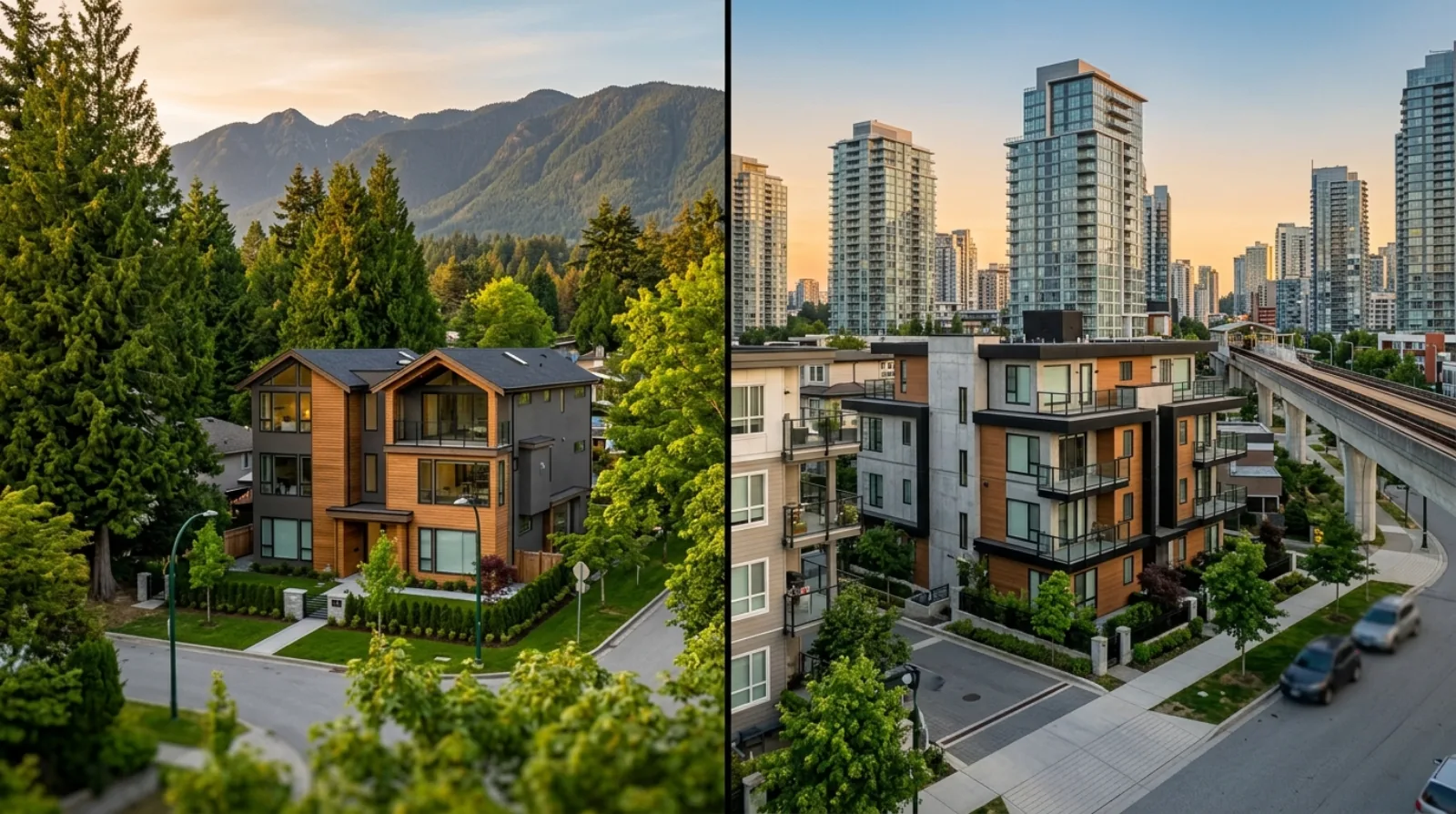
The honest answer is that neither city wins outright. They are different products. Vancouver sells you an address inside the city, with older streets, shopping streets you can walk to, and the deepest pool of finished multiplex homes in the region. Burnaby sells you more calm and, often, more home for the money, organized around three SkyTrain hubs.
This post walks through prices, commutes, schools, and character, and ends with our view on which buyer belongs where. If you want the same comparison against Coquitlam, or a street-level ranking inside Vancouver, we have written both separately. This one stays at the city level.
The short answer
In our view: start in Burnaby if your priorities are a calmer street, a shorter list of compromises on size, and a direct SkyTrain ride to work. Start in Vancouver if you already live there, your family and routines are there, and you would rather give up some square footage than give up the city. Most buyers we meet know which sentence describes them within about ten seconds.
Now the detail, because the ten-second answer is not enough to spend a million dollars on.
What homes cost right now
First, a fact most buyers do not know: there is no published benchmark price for multiplex homes. Greater Vancouver REALTORS (GVR) tracks MLS® Home Price Index benchmarks for exactly three categories: detached houses, townhouses, and apartments. Multiplexes are too new as a category to have their own line. Anyone quoting you an official multiplex benchmark is quoting a number that does not exist.
What GVR does publish is still useful, because a multiplex unit lives between a townhouse and an apartment in size and feel. According to GVR's July 2026 market report, the benchmark townhouse across the region was $1,030,400, down 6 per cent from a year earlier. The benchmark apartment was $688,000, down 7.5 per cent. Detached houses sat at $1,822,900, down 7 per cent.
Two things stand out in those numbers. Every category fell over the past year, so this is not a market that punishes patient buyers. And the gap between a townhouse and a detached house is roughly $790,000 region-wide, which is exactly the gap multiplex homes are built to fill: house-like living, on a house lot, at a price closer to the townhouse line.
The same GVR report counted 2,061 sales in July 2026, down 9.8 per cent from July 2025 and 18.6 per cent below the ten-year seasonal average. Translation for a buyer: sellers are waiting longer, and you have negotiating room that did not exist three years ago. We think that matters more than trying to guess where prices go next, which nobody can do honestly.
On the city-to-city gap itself we will be careful. GVR publishes area-level tables inside its full monthly report, but the clean summary is this: home for home, Burnaby usually costs less than the same thing in Vancouver, and the discount grows the newer and larger the home. That is our reading from the listings we work with every week, not an official statistic, because again, no official multiplex statistic exists.
Why both cities suddenly have brand-new multiplex homes
BC changed its rules in 2023 so ordinary residential lots can hold more than one or two homes, which is why multiplexes went from rare to everywhere in about two years. Each city then wrote its own version.
Vancouver moved first. City council approved multiplexes of up to six homes on a regular residential lot in September 2023, and the city began accepting applications that December, according to the City of Vancouver. Burnaby followed: from July 1, 2024, a standard Burnaby lot can hold three or four homes depending on its size, and lots within 400 metres of frequent transit, including SkyTrain stations, can hold up to six, according to the City of Burnaby.
Those dates matter to you as a shopper. Vancouver had roughly a seven-month head start on applications, so more of its multiplex homes are finished and move-in ready today. Burnaby's supply is younger, which means more of it is sold as pre-sale: you sign now, pay a deposit in stages, and move in when the home is complete. Neither is better. Finished homes let you see exactly what you are buying. Pre-sales give you time to save and first pick of the best unit in the building.
Getting around: the SkyTrain question
We think transit deserves more weight than most buyers give it, because a multiplex is usually a long-term family home, and teenagers, aging parents, and second cars all show up eventually.
Burnaby is crossed by two SkyTrain lines. The Expo Line runs through Edmonds and Metrotown on its way downtown, and the Millennium Line serves Brentwood, Gilmore, and the Lougheed corridor on the city's north side. Between them, a surprising share of Burnaby's residential streets sit within a walk or a short bus ride of a station.
Vancouver has three rapid transit lines (Expo, Millennium, and Canada Line) plus the region's densest bus grid, so almost any Vancouver address can live without a second car. The catch is that large parts of the east and south sides are a bus ride away from the nearest station, not a walk.
Here is the part that surprises people: because Burnaby allows its largest multiplexes (up to six homes) only near frequent transit, brand-new Burnaby multiplexes cluster within walking distance of SkyTrain by design. In Vancouver, multiplexes spread across the whole city, station or no station. So the average new Burnaby multiplex is often better connected than the average new Vancouver one, even though Vancouver as a city has more transit. If a downtown commute rules your household, check the walk time to a station before you fall in love with a floor plan.
Schools and everyday family life
Both cities run large public school districts with French immersion streams and specialty programs, and both have schools families move across the region for. We will not pretend one district beats the other across the board, because it is not true, and because what actually decides your child's school is the catchment of your exact address. Check the catchment map for any home you are serious about before you write a deposit cheque. A block can change the answer.
For post-secondary, Burnaby has Simon Fraser University on Burnaby Mountain and BCIT near Canada Way, which matters to families planning for kids to study from home. Vancouver has UBC on its western edge, a longer trip from the east-side neighbourhoods where most new multiplexes sit.
Parks are a draw in both. Burnaby's Central Park, Deer Lake, and Burnaby Mountain trails are genuinely excellent, and we would put Deer Lake on a Sunday against anything on the east side of Vancouver. Vancouver answers with beaches, the seawall, Queen Elizabeth Park, and Trout Lake, plus the simple fact that the ocean is never far.
How the two cities feel to live in
Vancouver's residential streets are older, with mature trees and homes from every decade of the last century. Its everyday life runs along shopping streets: a ten-minute walk usually gets you coffee, groceries, a bakery, and a school. New multiplexes slot into these streets one lot at a time, so your brand-new home sits between a 1912 character house and a 1970s special. Some buyers love that texture. Some find it messy.
Burnaby is built on a different pattern. It concentrates its height and noise around three hubs (Metrotown, Brentwood, and Lougheed) and keeps the streets in between quiet and residential. The result is a city where you can live on a street that feels almost rural on a Tuesday night, ten minutes from a mall with everything. The trade-off is that fewer Burnaby streets have a walkable main street of their own. You walk to the hub, or you drive.
Our opinion, for what it is worth: Vancouver feels like one continuous city, Burnaby feels like calm neighbourhoods with busy centres stitched in. Families with young kids often prefer the second. People who grew up walking to a corner store usually prefer the first.
Where the new multiplex homes actually are
In Vancouver, the homes we list and tour are overwhelmingly on the east and south sides of the city, where lot prices make a multiplex work. West-side multiplexes exist but are rarer and priced accordingly. You will find new projects scattered across ordinary streets rather than concentrated in one district, which means inventory in any single pocket is thin and moves fast.
In Burnaby, follow the stations. The 400-metre frequent-transit rule pulls six-home projects toward Metrotown, Brentwood, Edmonds, and the Lougheed corridor, while quieter streets farther out get three- and four-home projects on larger lots. If you want brand new and walk-to-SkyTrain in the same sentence, Burnaby is currently the easier city to do it in.
Which city fits which buyer
Pick Vancouver if
- Your work, family, and routines are already inside the city and you do not want to move them.
- You want a finished, move-in-ready home rather than a pre-sale, and you want several to compare this month.
- A walkable shopping street matters more to you than extra interior space.
- You are splitting a building with relatives and want the deepest choice of completed multiplexes to pick from.
Pick Burnaby if
- You want more home for the same budget and are honest with yourself about how often you actually used all those Vancouver restaurants.
- A direct SkyTrain ride to downtown or to SFU shapes your daily life.
- You are open to pre-sale buying and want first pick of a corner unit before a building is finished.
- Quiet streets with parks beat lively streets with cafes in your family's actual weekend.
One more scenario we see often: two generations buying two units in the same building. Both cities work for this, but the math is usually friendlier in Burnaby, where the second unit stretches the pooled budget less. If the grandparents are the ones funding the gap, that difference is not small.
What this comes down to
- No official multiplex price benchmark exists. GVR's July 2026 reference points: townhouse $1,030,400 (down 6 per cent in a year), apartment $688,000 (down 7.5 per cent), detached $1,822,900 (down 7 per cent).
- Sales in July 2026 ran 18.6 per cent below the ten-year seasonal average, so buyers currently have time and negotiating room.
- Vancouver opened multiplex applications in December 2023, Burnaby in July 2024, so Vancouver has more finished homes and Burnaby has more pre-sales.
- Burnaby's new multiplexes cluster near SkyTrain by design; Vancouver's spread across the whole city.
- School quality is decided by your exact catchment in both cities, not by the city name.
- Our verdict: Burnaby for space, calm, and transit value; Vancouver for the address, the walkable streets, and the deeper pool of finished homes.
Questions buyers ask us
Is there a published benchmark price for multiplex homes?
No. Greater Vancouver REALTORS publishes MLS® Home Price Index benchmarks for detached homes, townhouses, and apartments only. No multiplex benchmark exists yet. The July 2026 townhouse benchmark ($1,030,400) and apartment benchmark ($688,000) are the closest published reference points for judging a multiplex price.
Is Burnaby cheaper than Vancouver for a new multiplex home?
Usually, in our experience, home for home, though the gap changes street by street and no official statistic tracks it. Compare specific homes rather than city averages. A lane-facing Vancouver unit can cost less than a corner unit near a Burnaby SkyTrain station, so shop both before deciding.
Which city has more brand-new multiplex homes for sale right now?
Vancouver, in our experience, because its application window opened in December 2023, about seven months before Burnaby's rules took effect in July 2024, so more Vancouver homes have reached completion. Burnaby's supply is younger and includes more pre-sale offerings. Inventory shifts weekly, so check current listings.
Can I buy just one unit in a multiplex?
Yes. Most new multiplexes in both cities are sold as individual strata homes, the same legal setup as a townhouse. You own your home and its title, share some common costs with neighbours, and can sell independently later. You never need to buy the whole building.
What is a pre-sale, and are multiplex homes sold that way?
A pre-sale means you sign a purchase contract before the home is finished, paying a deposit in stages, with the deposit held in trust under BC law. Many Burnaby multiplex homes are currently offered this way. You get months to arrange finances while the home is completed.
How do I get downtown from Burnaby without a car?
The Expo Line runs from Metrotown and Edmonds directly into downtown Vancouver with no transfer. The Millennium Line connects Brentwood and Lougheed across the city's north side and links to the Expo Line. Frequent bus routes fill the gaps between stations and the quieter residential streets.
Are schools better in Vancouver or Burnaby?
Neither city wins outright. Both districts run strong neighbourhood schools, French immersion, and specialty programs. The catchment of your exact address decides which school your kids attend, and one block can change it. Check the district catchment map for any home before you commit.
Do new multiplex homes come with a warranty?
Yes. Brand-new homes in BC carry 2-5-10 home warranty insurance: two years on labour and materials, five years on protection against water getting in, and ten years on the structure. Ask to see the warranty details in writing before you sign anything.
Do I pay GST on a brand-new multiplex home?
Yes. The 5 per cent federal GST applies to brand-new homes, on top of the listed price unless the listing says GST is included. Some buyers qualify for rebates depending on price and intended use. Confirm the GST treatment in writing before signing the contract.
Which parts of Burnaby should I watch for new multiplex homes?
Streets within a short walk of SkyTrain, because Burnaby allows up to six homes on lots within 400 metres of frequent transit. That pulls new offerings toward Metrotown, Brentwood, Edmonds, and Lougheed. Quieter streets farther out see three- and four-home projects on larger lots.
Should I wait for prices to fall further?
Nobody can promise a direction, and we will not pretend to. GVR's July 2026 report shows every published category down over the past year, with sales well below the ten-year average. For a buyer, that already means more choice and more room to negotiate than in recent years.
Does Burnaby feel like a suburb?
Parts of it, yes, and plenty of buyers count that as a feature. Burnaby keeps its height and bustle around Metrotown, Brentwood, and Lougheed, with quiet residential streets between them. If you want a walkable main street with independent shops, Vancouver still does that better, in our opinion.
Can two generations of one family buy in the same multiplex?
Yes, and it is one of the most common plans we help with. Each home is a separate strata unit, so a parent can own one and an adult child the next, each with their own mortgage and title. Some families reserve side-by-side units at pre-sale.
Where to go from here
The useful next step is not more reading, it is looking at real homes side by side. Browse the current multiplex homes we have listed in both cities, save the ones that fit, and then talk to us. Tell us your budget, your commute, and who is moving in, and we will tell you plainly which city, and which specific homes, deserve your weekend.
Related Resources
Multiplex for Sale in Vancouver
Browse all Vancouver listings
Where to Buy in Vancouver
Neighbourhood comparison guide
Vancouver Pre-Sales
Active & upcoming projects
Multiplex for Sale in Burnaby
Browse all Burnaby listings
Where to Buy in Burnaby
Neighbourhood comparison guide
Burnaby Pre-Sales
Active & upcoming projects