Vancouver Multiplex Architectural Styles (2026)
Walk down a new East Van block and you'll see three different multiplex looks. Here's how to read them, what each means for daily life, and which suits your family.
By MultiLiving Editorial · May 22, 2026
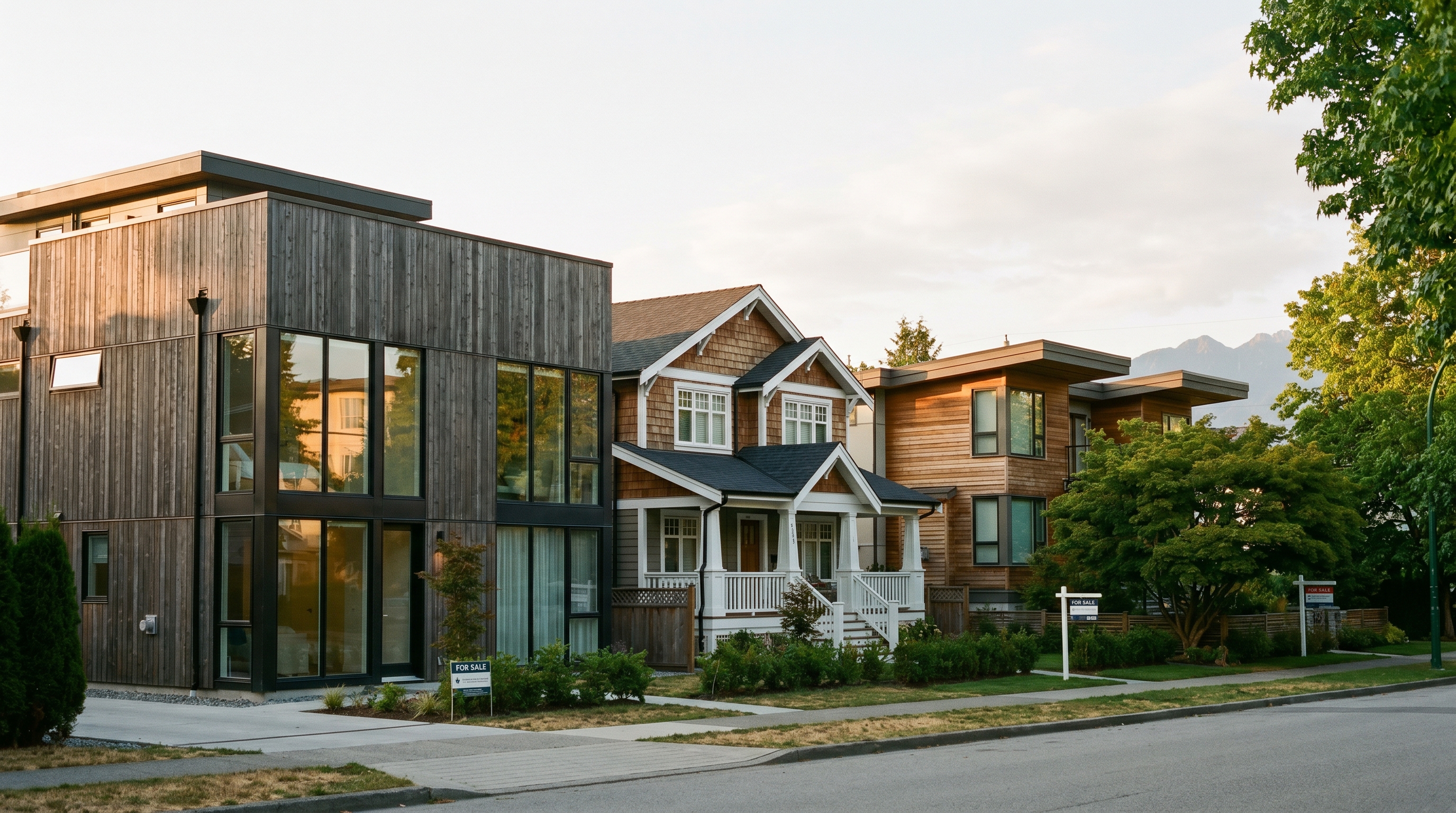
Walk three blocks south of Commercial Drive on a Saturday morning and you'll see what's happening to Vancouver's housing in real time. There's a flat-roofed dark-cedar fourplex with windows the size of garage doors. Next to it, a duplex with a wide front porch, white trim, and shingled gables that wouldn't have looked out of place in 1925. Across the street, a triplex with deep eaves, warm cedar siding, and so much glass on the back wall that you can see straight through to the dogwood in the yard.
Three multiplexes. Three completely different design languages. All of them brand new, all of them aimed at the same kind of buyer — a family pooling resources to live in a real Vancouver neighbourhood without going broke on a detached house.
If you're shopping right now, the question isn't really which style is best. It's which one fits how your family actually lives, what you want your front door to feel like when you come home, and what kind of neighbour you want to be on a street that already has its own personality. This is a guide to reading the three architectural traditions you'll see most often on new Vancouver multiplex listings — modern, traditional craftsman, and West Coast modern — and choosing between them with eyes open.
Why Vancouver multiplexes look the way they look
Vancouver has spent more than a century arguing with itself about housing. The Craftsman bungalow showed up around 1908, peaked through the 1920s, and gave many of our older streets the wood-shingled, deep-porch look that still defines neighbourhoods like Strathcona, Kitsilano, and parts of Mount Pleasant. According to the Vancouver Heritage Foundation, the style was "an architecture of abundance, enabled by the wealth of wood available in the Vancouver area," identifiable by knee brackets, exposed rafter tails, and shingled gables.
Then came the Vancouver Special. Between 1965 and 1985, more than 10,000 of these boxy two-storey stucco houses were built across the city, mostly on the East Side. The Vancouver Special was a vernacular response to a zoning quirk that didn't count basements toward maximum floor area. The city closed the loophole in 1985 and the Specials stopped, but they're still everywhere — many of the lots being redeveloped into multiplexes today are former Specials.
Running alongside both traditions is the one Vancouver actually exported to the world: West Coast modernism. Arthur Erickson, who studied at McGill before coming home to BC, made his name with houses that paired "a stately geometry" with "a minimalist cedar and glass material palette," as the West Coast Modern League puts it. Bing Thom, who worked under both Fumihiko Maki and Erickson before founding his own Vancouver firm in 1981, carried that vocabulary into civic buildings — Robson Square, the Chan Centre at UBC, Surrey City Hall — and proved you could be modern without being cold.
Today's multiplex designers are pulling from all three traditions at once. That's why the streetscape looks the way it does.
Style #1: Modern (the boxes)
The flat-roofed, dark-cedar, big-window multiplex is what most new builds look like in 2026. It's the dominant style for a reason — it maximizes interior square footage on a tight lot and photographs beautifully on listing sites.
How to spot it
- Flat or near-flat roof, often with a clean parapet edge.
- Charred or stained dark cedar, vertical board siding, or a mix of cedar and dark fibre-cement panels.
- Tall, square windows with black aluminum frames, sometimes floor-to-ceiling.
- A rooftop patio or deck with glass railings.
- Minimal trim, no shutters, no porch — just a recessed front door under a slim canopy.
What it feels like to live in
Bright. Sometimes too bright in July, which is why you'll want to ask about blinds and overhangs before you sign. The flat roof usually means an upper-floor primary suite gets cathedral-ish ceilings on the top level, plus easier access to a roof deck — this is where modern multiplexes earn their price. A rooftop with a view of the North Shore is genuinely lovely, and it's the closest thing most Vancouver buyers will get to outdoor space they actually use.
The flip side: modern designs lean hard on glass, and Vancouver gets nine months of grey. Some buyers love the light. Some find the all-grey-and-black palette starts feeling clinical by February. Visit on a rainy Tuesday afternoon, not a sunny Sunday, before deciding.
Who it suits
Couples and small families who want the look of a Dwell magazine spread without paying single-family West Side prices. People who entertain, since the open-plan main floors that come with this style are unbeatable for hosting. Anyone who wants a roof deck.
Style #2: Traditional / contemporary craftsman
Some buyers walk past three modern boxes in a row and feel relief when they see the fourth lot — a duplex with a real porch, white trim, painted siding, and a gable roof. That's the contemporary craftsman or "transitional" style, and it's having a moment with buyers who want the new-build advantages without the all-black aesthetic.
How to spot it
- A pitched gable roof with visible eaves.
- Painted lap siding or shingled gables — usually in white, navy, sage green, or warm grey.
- A real front porch with square columns and a railing, even if it's small.
- Double-hung style windows with grilles in the upper sashes.
- Visible trim around windows and doors, sometimes with knee brackets that nod to the original Craftsman vocabulary.
What it feels like to live in
Like a house, basically. That's the point. The pitched roof gives you proper attic-style spaces on the top floor, the porch gives you somewhere to drop boots and groceries before you walk inside, and the painted exterior reads as warm and settled rather than "obviously brand new." If you've spent any time in a 1920s Craftsman in Kitsilano and loved how it sat on its lot, a contemporary craftsman multiplex is the closest you'll get in a new building.
Trade-offs: pitched roofs eat usable square footage on the upper floor, you rarely get a roof deck, and painted siding will eventually need repainting (the team that built it can usually tell you on what schedule — ask).
Who it suits
Multigenerational families where one generation grew up in a craftsman and finds the modern look cold. Buyers who live in older neighbourhoods (Kits, parts of East Van, Mount Pleasant, parts of Burnaby Heights) and want the new build to fit rather than announce itself. Anyone who wants a porch they'll actually sit on.
Style #3: West Coast modern
If the modern box is loud and the craftsman is comfortable, West Coast modern is the quiet one. This is the Vancouver style — the one Erickson and Thom spent careers refining, and the one that actually answers the question of "what should a house in this climate look like."
How to spot it
- Low-pitched or flat roofs with deep, generous eaves that overhang the walls.
- Natural cedar that's been left to weather to a silvery grey, not stained dark.
- Horizontal lines — long, low windows, exposed beams, banded siding.
- Big windows on the back of the building, opening to whatever greenery the lot allows.
- Restrained colour palette: cedar, stone, soft black or charcoal trim, sometimes a touch of board-formed concrete.
What it feels like to live in
Calm. The deep eaves mean the rain rolls off without hitting your windows, the cedar warms the interior light in a way black-frame glass never quite does, and the horizontal lines pull your eye outward to the trees instead of upward to the ceiling. Erickson believed the West Coast climate made the boundary between indoors and outdoors negotiable, and a well-done West Coast modern multiplex still proves him right — even on a 33-foot lot.
In our view this is the style that ages best in Vancouver. Modern boxes in five years will start to look dated when the next aesthetic wave arrives. Cedar greys gracefully and looks better at 20 years old than it did at one.
Who it suits
Anyone who's spent time in the Gulf Islands, on the Sunshine Coast, or in older West Van and felt at home there. Buyers who care more about how a building feels in October than how it photographs in July. Families who want their kids to grow up in a place that looks like Vancouver, not Toronto.
What about the Vancouver Special?
You won't see new Vancouver Specials — the loophole that produced them closed in 1985 and the city won't let you build that footprint anymore. But you'll see plenty of new multiplexes on lots where a Special used to stand, especially in Renfrew, Killarney, Kensington-Cedar Cottage, and South Vancouver. A handful of architects have started designing multiplexes that nod to the Special's proportions — boxy, two-storey, brick or stone base, stucco upper — as a kind of love letter to the immigrant streetscape it gave us. If you grew up in one, ask about it. Some buyers are surprised by how powerful that visual familiarity feels when they're choosing where to raise their own kids.
How style maps to neighbourhood
Architectural choice isn't only about taste. It's also about whether your new home reads as part of the street or as a transplant from somewhere else. Rough rules:
- East Vancouver (Commercial-Broadway, Hastings-Sunrise, Renfrew, Cedar Cottage): you'll see all three styles, often on the same block. Modern dominates new builds. Craftsman fits beautifully into older blocks. West Coast modern stands out without showing off.
- Kitsilano, Mount Pleasant, parts of Dunbar: traditional/contemporary craftsman tends to fit best because the heritage stock is craftsman.
- North Burnaby and parts of New West: heavier modern presence, especially close to SkyTrain stations. Craftsman is rare here.
- North Shore, West Van foothills: West Coast modern is the native language. A modern box with no eaves looks wrong on a rainy mountain street.
Six things to ask the developer no matter the style
- What's the cladding actually made of? Real cedar, stained cedar, fibre-cement, or stucco — each one ages and weathers differently in Vancouver rain.
- How deep are the roof overhangs? Less than a foot in Vancouver means rain lands on your windows.
- Where do all the gutters and downspouts go? On modern flat-roof designs this is the question that separates a 30-year building from a leaky one.
- What's the roof deck access like? A pull-down ladder is not the same thing as proper stairs.
- Will the front door open onto a porch, a recessed entry, or a wet sidewalk?
- Who designed it? In our view, it's worth knowing whether the team is a quiet local studio with a portfolio or a one-off project. Look the architect up before you buy.
What this comes down to
- Vancouver's three dominant multiplex styles — modern, contemporary craftsman, and West Coast modern — pull from a real local design history that runs from 1910s Craftsman through the Vancouver Special to Erickson and Thom.
- Modern boxes maximize interior square footage and roof decks but can feel cold in winter and dated faster than other styles.
- Contemporary craftsman fits older Vancouver streets and feels familiar, at the cost of a roof deck and some upper-floor square footage.
- West Coast modern is the style most native to Vancouver's climate and ages best — deep eaves and weathered cedar were invented here for a reason.
- Visit on a rainy day before you commit. Vancouver's weather is the truest test of any exterior.
Frequently asked questions
Are West Coast modern multiplexes more expensive than modern ones?
Sometimes, slightly. Real cedar siding and deep overhangs cost more than fibre-cement panels and minimal eaves, and the architects most associated with the style charge a premium. But the gap is usually a few percent of the unit price, not a different category, and the difference often shows up at resale.
Will my unit's interior match the building's exterior style?
Not always. Many Vancouver multiplexes wear traditional or West Coast modern exteriors over completely modern open-plan interiors. Ask the team that built it whether the interior cabinetry, trim, and flooring choices echo the outside, or whether they pivoted to a more universal interior style to appeal to a wider buyer pool.
Do strata bylaws restrict how I can change the exterior of my multiplex unit?
Yes. In a strata building — which all multiplexes in BC are — exterior elements like siding, paint colour, and front-door style are common property and you can't unilaterally change them. That's actually a feature, not a bug, since it stops one neighbour from painting their unit lime green.
Is the architect's name something I should care about as a buyer?
More than most buyers think. Vancouver has a small architectural community and the names you'll see on a multiplex listing — local studios, established firms, sometimes graduates of Erickson or Thom-trained offices — tell you a lot about how thoughtfully the building was put together. We profile the firms behind the listings on our site for exactly this reason.
Ready to see them in person
The fastest way to figure out which style you actually like is to walk through three of them in one afternoon. Browse current Vancouver multiplex listings on /properties or get in touch and we'll line up a Saturday tour across all three styles. Choosing what your front door feels like is one of the best parts of buying — it shouldn't be done from photos alone.