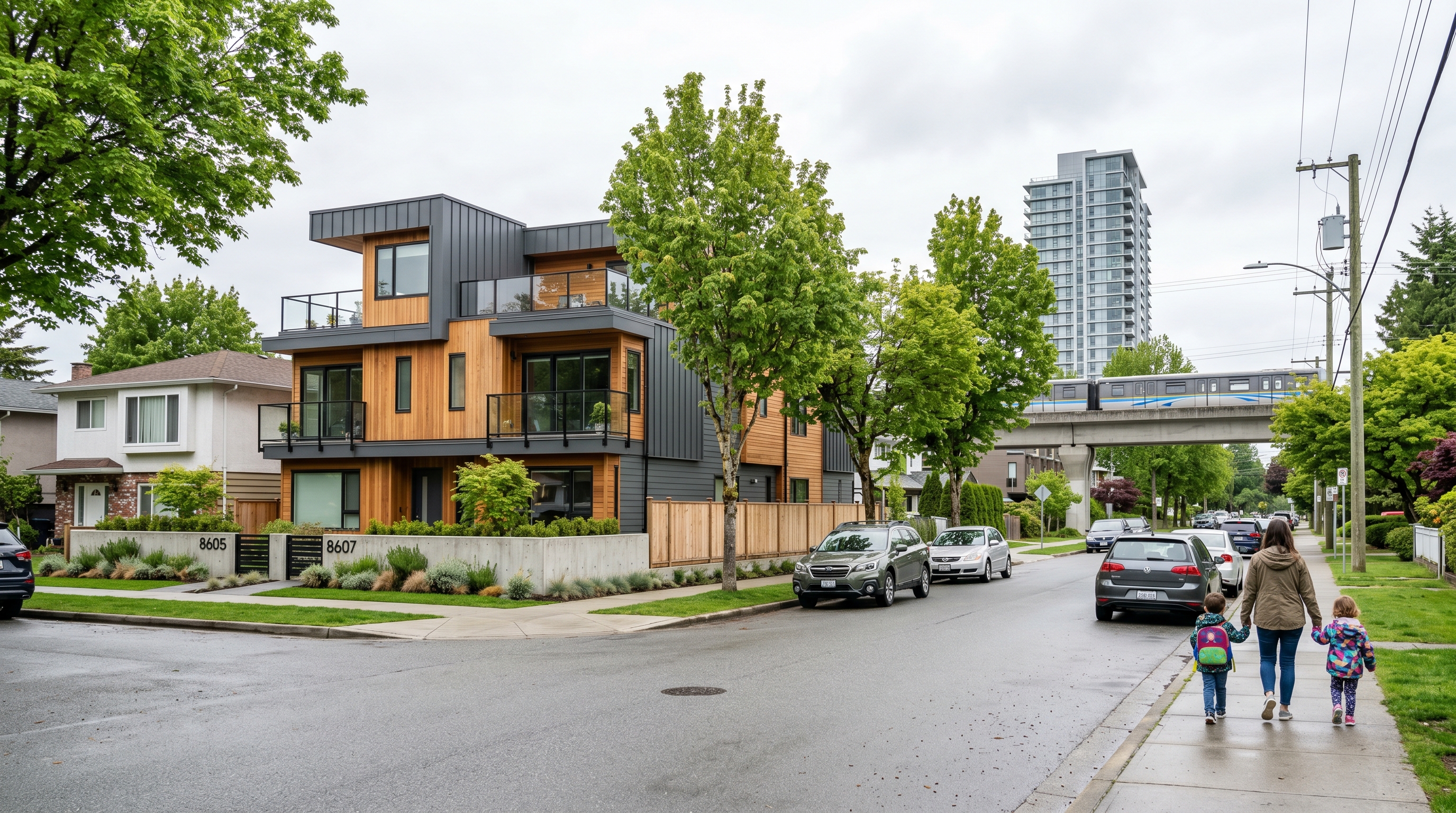
Richmond Multiplex Buyer's Guide 2026
Living in Richmond BC as a multiplex buyer: Canada Line access, schools, the food scene, the flood plain question, July 2026 prices, and where to watch for new homes.
By MultiLiving Editorial · August 14, 2026
We have written buyer's guides for neighbourhoods across Vancouver and Burnaby, but this is our first one for Richmond, and it is overdue. Richmond quietly became one of the most interesting places in Greater Vancouver to shop for a brand-new multiplex home: the city opened almost 27,000 residential lots to small multi-unit homes in June 2024, the Canada Line gives it a train ride to downtown that most suburbs would trade anything for, and the food is, in our honest opinion, the best in the region.
This guide covers what living in Richmond is actually like, what homes cost as of the July 2026 numbers, the flood plain question everyone eventually asks, and which parts of the city we would watch for new multiplex homes. As always, the reader we have in mind is a family buying a single strata unit in a new duplex, triplex, or fourplex, often two generations planning to live near each other.
Why Richmond belongs on a multiplex shopper's list
Three reasons, in order of importance.
First, supply is coming. On June 24, 2024, Richmond council changed its rules so that almost 27,000 single-family and duplex lots across the city can now hold small multi-unit homes, according to the City of Richmond. Lots larger than 280 square metres (about 3,000 square feet, which is most of them) can hold at least four homes, and lots within 400 metres of frequent bus service can hold up to six. Richmond moved later than Vancouver did, so its first wave of finished multiplexes is only now reaching the market, and pre-sale offerings are growing.
Second, the price of admission is lower than Vancouver's for a comparable brand-new home, which we will put numbers to below.
Third, and this is the underrated one: Richmond is a complete city. You can work, school your kids, buy groceries from four continents, and spend your weekends by the water without crossing a bridge. Buyers who move there tend to stay.
Getting around: the Canada Line changes the math
The Canada Line runs five stations in Richmond (Bridgeport, Capstan, Aberdeen, Lansdowne, and Richmond-Brighouse), a direct ride to downtown with no transfer. Capstan is the newest, opened December 20, 2024, according to TransLink, serving the fast-growing blocks between Aberdeen and Bridgeport.
The line also stops at the airport branch via Bridgeport, which matters more than people expect: families with relatives overseas fly often, and living fifteen minutes from YVR without needing a ride is a genuine quality-of-life feature.
Drivers have a more mixed experience. Highway 99 and the Massey Tunnel move you south, the Knight and Oak bridges move you north, and all of them back up at rush hour. Our advice is simple: if someone in the household commutes to downtown or Broadway daily, shop within a walk or short bus ride of a Canada Line station and let the train do the work.
The food, because it decides more moves than people admit
Richmond's food scene is the strongest in Greater Vancouver, and we will not pretend to be neutral about it. Alexandra Road, known locally as Food Street, packs an astonishing run of restaurants into a few blocks near Lansdowne. The summer night market beside Bridgeport Station is a family ritual for half the region. And Steveston, the historic fishing village at Richmond's southwest corner, sells fish and chips off the wharf with working boats in view. If Sunday dinner is the anchor of your family's week, and for many multiplex families it is, Richmond makes those dinners easy.
Schools and family logistics
Richmond runs its own school district with neighbourhood schools across the city, French immersion streams, and secondary schools that families specifically move for. We will spare you a ranking, because the honest rule is the same one we give in every city: the catchment of your exact address decides where your kids go, and one street can change the answer. Before you commit to any unit, put the address into the district's catchment finder and confirm both the elementary and secondary school.
Beyond school, the daily logistics are gentle. Richmond is flat, which makes it one of the best cycling cities in the region, and the dike trails double as safe riding routes for kids. Community centres, rinks, and pools are spread evenly rather than clustered in one rich corner. It is an easy city to raise children in, and it feels built for exactly that.
The flood plain question, answered plainly
Richmond sits on low, flat land at the mouth of the Fraser River, on average about one metre above sea level, and it is protected by a system of 49 kilometres of dikes and 39 drainage pump stations that the city maintains and continues to upgrade, according to the City of Richmond's flood protection program.
What should a buyer do with that fact? Two things. Ask your insurance advisor exactly what water-related coverage costs for the specific home you are considering, because policies and prices vary. And if it worries you, ask us or the seller's team how the home itself handles drainage. Then weigh it like any other trade-off. Hundreds of thousands of people live well in Richmond behind that dike system, and the city publishes its flood plans openly, which we count in its favour.
What homes cost in Richmond right now
Start with the honest caveat we give in every guide: there is no published benchmark price for multiplex homes anywhere in Greater Vancouver. Greater Vancouver REALTORS tracks MLS® Home Price Index benchmarks for three categories only (detached, townhouse, apartment), so the numbers below are reference points, not multiplex prices.
Region-wide, GVR's July 2026 report put the benchmark townhouse at $1,030,400 (down 6 per cent in a year) and the benchmark apartment at $688,000 (down 7.5 per cent). For Richmond specifically, WOWA's market report built on July 2026 board data shows a composite benchmark of $1,026,200, down 8 per cent year over year, with median sale prices around $1,748,000 for detached houses, $1,014,000 for attached homes, and $596,500 for condos.
Read those numbers the way a shopper should. Prices across every category fell over the past year, in Richmond a little faster than the region. That is not a reason to panic or to celebrate; it is a reason to negotiate. New multiplex units in Richmond generally land between the condo and attached reference points depending on size, with three-bedroom units pushing toward the attached line. Where a specific home prices depends on the street, the floor plan, and the seller's patience, which is exactly why we tell buyers to compare real listings rather than city averages.
Where new multiplex homes are showing up
Because the four-unit rule covers lots larger than 280 square metres, most ordinary Richmond streets qualify, and the six-unit rule near frequent bus service pulls the larger projects toward main corridors. Within that, here is where we would look, and this is editorial opinion from watching the listings:
- Streets within walking distance of the Canada Line. The blocks around Lansdowne, Brighouse, and the newer Capstan area combine the train, the food, and the shopping. New multi-unit homes here will always have a second life on resale, in our view.
- Steveston and the streets just north of it. The village charm is real and the housing stock around it is old enough that lots are turning over. A brand-new unit a bike ride from the wharf is a rare combination in this region.
- West Richmond (Seafair and neighbouring pockets). Quiet, established, close to the dike trails and the west-facing water. Less transit, more calm, and typically more land per project.
- Broadmoor and central Richmond. Large lots, central schools, and a short drive to everything. This is where we expect steady four-unit activity on ordinary streets.
Inventory is still thinner than Vancouver's, because Richmond's rules are two years younger. That cuts both ways: less to choose from this month, but earlier pick of buildings and less competition from other buyers who have not noticed Richmond yet.
Who Richmond suits, and who it does not
Richmond fits multigenerational families better than almost anywhere we cover. The culture is deeply family-oriented, the food and services reflect it, and a grandparent who speaks Cantonese, Mandarin, Punjabi, or Tagalog can run their whole week comfortably. Three-bedroom multiplex units with a parent's suite one unit over is precisely the arrangement these homes were designed for.
It suits airport-adjacent lives: frequent flyers, aviation workers, families with overseas ties. And it suits anyone whose weekend looks like dike walks, dim sum, and kids' swimming lessons.
It suits less well if your life points east or north. A daily commute to Burnaby, SFU, or Coquitlam from Richmond fights bridge and tunnel traffic both ways. And if you want mountains out your window and trailheads in twenty minutes, the North Shore will always call to you from across the water. Be honest about your map before you buy.
What this comes down to
- Richmond opened almost 27,000 lots to small multi-unit homes in June 2024: at least four homes on most lots, up to six near frequent buses, per the City of Richmond.
- No multiplex price benchmark exists. July 2026 reference points: GVR region townhouse $1,030,400 and apartment $688,000; Richmond composite benchmark $1,026,200 (down 8 per cent in a year) with a condo median of $596,500, per WOWA's report on board data.
- The Canada Line's five Richmond stations, including Capstan (opened December 2024), give the city a no-transfer train to downtown and the airport.
- Richmond sits about one metre above sea level behind 49 kilometres of city-maintained dikes; ask your insurer about water coverage for any specific home.
- We would watch the Canada Line blocks, Steveston, west Richmond, and Broadmoor for new multiplex homes.
- Best fit: multigenerational families, frequent flyers, and anyone whose weekly life runs on food, schools, and flat, bikeable streets.
Questions buyers ask us
Is there a published benchmark price for multiplex homes in Richmond?
No. Greater Vancouver REALTORS publishes MLS® Home Price Index benchmarks for detached homes, townhouses, and apartments only, and no multiplex benchmark exists for any city. Use the July 2026 reference points (region townhouse $1,030,400, apartment $688,000) and compare actual listings rather than averages.
Is Richmond cheaper than Vancouver for a new multiplex unit?
Generally yes for a comparable brand-new home, in our experience, though no official statistic tracks multiplex prices in either city. Richmond's overall benchmark fell 8 per cent in the year to July 2026, per WOWA's report on board data, so sellers there are negotiating.
Is flooding actually a risk in Richmond?
Richmond sits about one metre above sea level and is protected by 49 kilometres of dikes and 39 pump stations that the city maintains and upgrades, per the City of Richmond, which also publishes its flood plans openly. Ask your insurance advisor what water coverage costs for the exact home you are considering.
How do I get to downtown Vancouver from Richmond?
The Canada Line runs a direct, no-transfer train from five Richmond stations (Bridgeport, Capstan, Aberdeen, Lansdowne, and Richmond-Brighouse) into downtown. Drivers use the Oak or Knight bridges north and Highway 99 south, all of which slow at rush hour. We suggest train-first shopping if you commute daily.
Which parts of Richmond should I watch for new multiplex homes?
Our picks: the walkable blocks around the Canada Line stations, Steveston and the streets north of it, west Richmond around Seafair, and central Broadmoor. The four-home rule covers most ordinary lots citywide, so good streets outside these pockets appear every month too.
Are Richmond schools good?
Richmond's district runs well-regarded neighbourhood schools and French immersion, and several secondary schools draw families specifically. But your exact address decides your catchment, and one street can change it. Confirm both the elementary and secondary catchment for any unit before you write a deposit cheque.
Can I buy just one unit in a Richmond multiplex?
Yes. New multiplexes are typically sold as individual strata units, like townhouses. You own your home and title, share some common costs with the neighbouring units, and can sell independently later. Two generations of one family can each own a unit in the same building.
Do brand-new Richmond homes come with a warranty?
Yes. Brand-new homes in BC carry 2-5-10 home warranty insurance: two years on labour and materials, five years on protection against water getting in, and ten years on the structure. Ask for the warranty documents before signing and keep them with your contract.
Do I pay GST on a new multiplex unit in Richmond?
Yes, the 5 per cent federal GST applies to brand-new homes, on top of the listed price unless the listing states GST is included. Some buyers qualify for rebates depending on price and use. Have the GST treatment confirmed in writing before you sign anything.
Is Richmond good for multigenerational families?
It is the best fit in the region, in our opinion. The food, languages, services, and community life all support households where grandparents share daily routines with kids. A multiplex with parents in one unit and adult children next door works especially well here.
What about airport noise?
Some Richmond streets sit under flight paths and others hear almost nothing, and the difference is bigger than maps suggest. Visit any home you are serious about at two different times of day, once in the morning rush of departures, and judge with your own ears.
Are Richmond multiplexes sold as pre-sales?
Increasingly, yes. Because Richmond's rules took effect in mid-2024, later than Vancouver's, a larger share of its multiplex supply is still being finished, and sellers offer units before completion. Deposits are paid in stages and held in trust under BC law while you wait.
Do I need a car in Richmond?
Near the Canada Line and the central shopping streets, no; the train, buses, and flat cycling routes cover most weeks. In Steveston and west Richmond, most families keep a car for school runs and groceries. Many multiplex households land on one car instead of two.
See what Richmond actually has for sale
Guides are a starting point; homes decide it. Browse the multiplex homes currently listed and watch for Richmond as its new supply reaches the market, then talk to us about what you need: bedrooms, budget, school catchment, train access. We follow Richmond's new offerings closely and can flag buildings before most buyers hear about them.