
Which Mortgage Brokers in BC Help Parents and Adult Children Apply Together? (2026)
Any mortgage broker licensed in BC can arrange one mortgage for a parent and an adult child. How to check a licence, the rules, and a worked example.
By MultiLiving Editorial · November 20, 2026
Questions about this guide: Gary Paul, REALTOR®, Personal Real Estate Corporation, Grand Central Realty, 778-828-7476
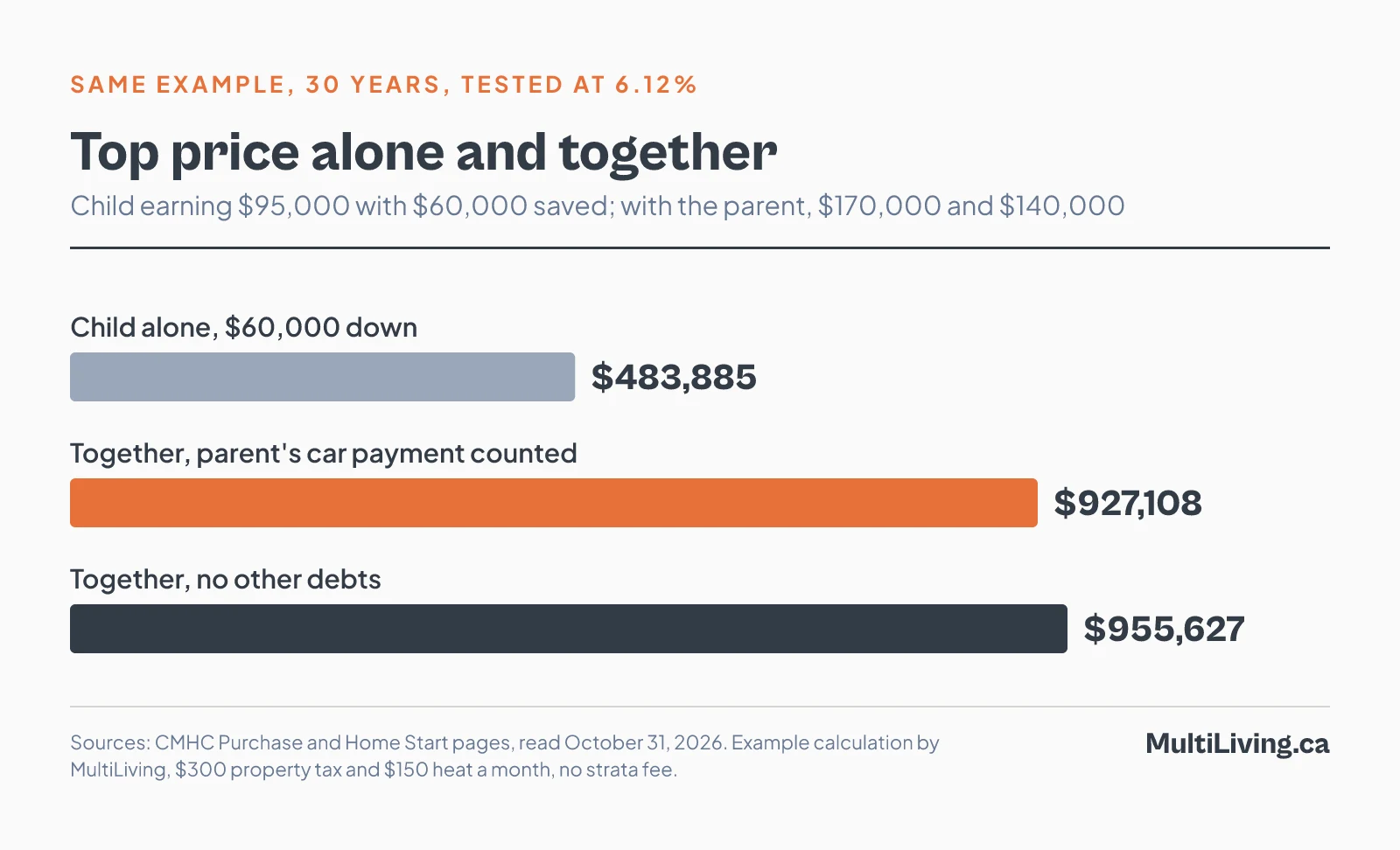
A parent and an adult child can apply for one mortgage through a mortgage broker licensed in British Columbia. Check the broker's licence with the BC Financial Services Authority (BCFSA), which licenses brokers. In our example, a child earning $95,000 and a parent earning $75,000 qualify for a new home up to $927,108 together, against $483,885 for the child alone.
How to check a broker
BC's Mortgage Services Act and its rules came into force on October 13, 2026.
- Anyone who arranges mortgages for pay needs a licence or an exemption (section 3).
- BCFSA must keep a public register of brokerages and brokers, showing each one's licence level (section 24).
The broker must tell you in writing:
- Before helping you, whether they act for you as a client (section 68).
- When they show you offers, what their brokerage will be paid, by whom, in dollars (section 72).
- Any interest they or a person linked to them has in the deal, at least 2 business days before you sign (section 74).
In our view, ask on day one whether the broker acts for both of you.
How lenders count two people
CMHC lets housing costs reach 39 percent of gross income: the mortgage payment, property tax, heat and half of any strata fee. All debts together can reach 44 percent. The payment is tested at your rate plus 2 percent, or 5.25 percent if higher.
- Sagen accepts a parent as a guarantor, or as a second borrower who does not live in the home, and counts that person's debts. Everyone on title (the record of who owns the home) must be on the mortgage.
- Canada Guaranty defines a guarantor as someone who promises to pay the mortgage but is not on title. The guarantor must be close family, and their debts count.
- A joint borrower is "equally responsible for repaying the unpaid balance," says the Financial Consumer Agency of Canada.
The insurer pages we read set no age limit, so ask each lender about a parent's years to retirement.
Rules that go person by person
CMHC Home Start allows 30 years to repay when at least one borrower is a first-time buyer, or the home is newly built.
- BC's first-time buyers' exemption covers only the first-time buyers' share, on homes up to $835,000, with a partial amount below $860,000.
- BC's newly built home exemption goes up to $1,100,000, cut by the share of buyers who do not qualify. Each buyer who claims must move in within 92 days, so a parent who stays in their own home cannot claim their share.
- For the first-time buyers' GST rebate, at least one buyer must be a first-time buyer who lives in the home, and only that person claims it, says CRA Guide RC4028.
- With a First Home Savings Account or the Home Buyers' Plan, each person uses their own account and passes their own test. In a CRA example, a mother's home has no effect on her child's withdrawal.
How you hold title sets these shares: see joint tenancy or tenants in common.
A worked example
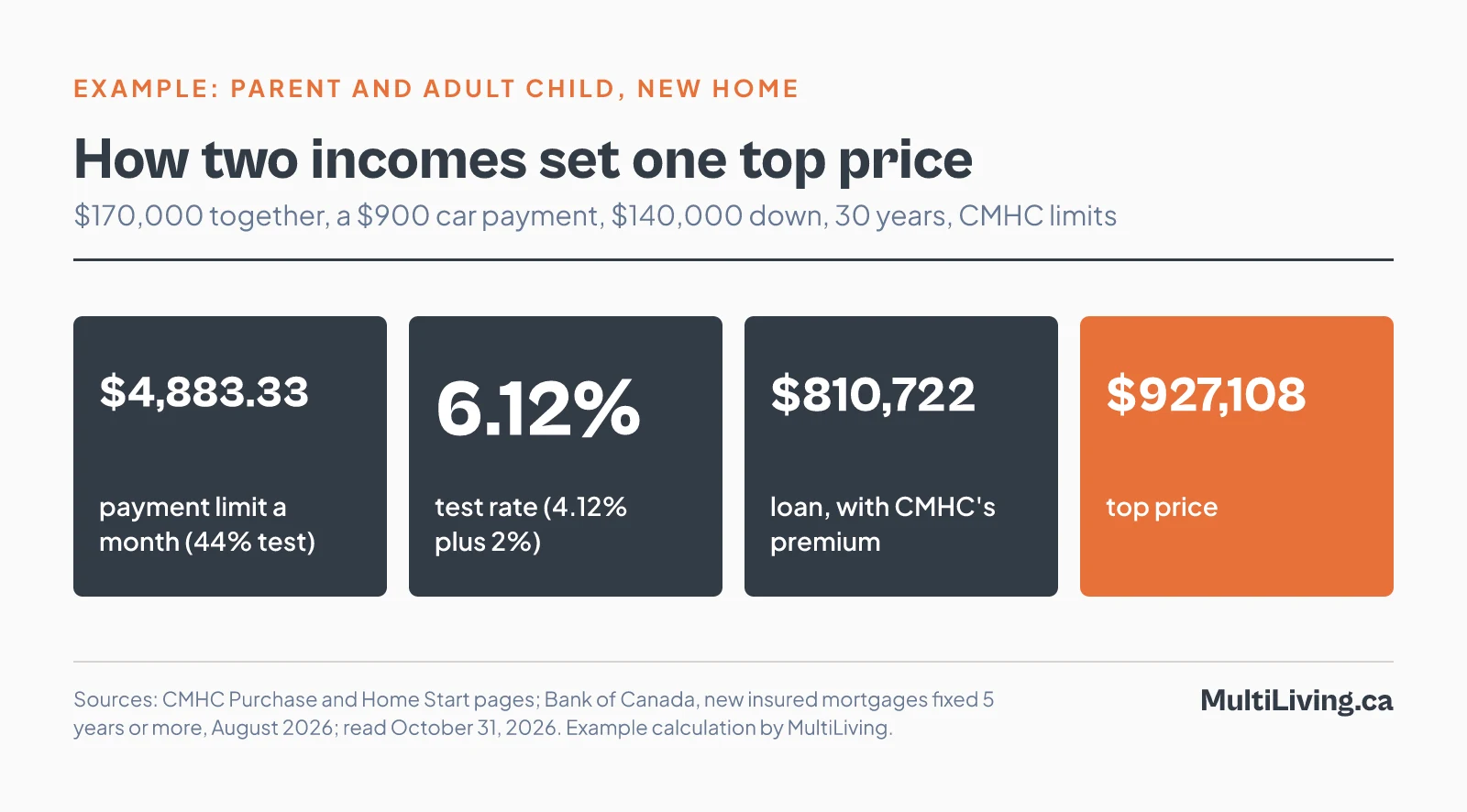
A child earns $95,000, has $60,000 saved and has never owned. A parent earns $75,000 and pays $900 a month on a car. They put $140,000 down on a new home. We assume the lender counts both incomes in full, $300 a month of property tax, $150 of heat and no strata fee. The rate is 4.12 percent, the Bank of Canada's August 2026 average for new insured mortgages fixed 5 years or more, so the test rate is 6.12 percent, as in our $200,000 income example.
- $170,000 a year is $14,166.67 a month. 39 percent is $5,525; 44 percent is $6,233.33.
- The 39 percent test leaves $5,075 after tax and heat. The 44 percent test also takes off the car payment, leaving $4,883.33. The lower one counts.
- At 6.12 percent over 30 years, that carries a loan of $810,722. Lenders state rates as compounded twice a year, and we work out the payment the same way.
- That includes CMHC's premium, 3.00 percent at 80.01 to 85 percent of the price.
- Add the $140,000: a top price of $927,108.
The payment at 4.12 percent would be $3,910.38 a month. With no car payment, the top price is $955,627. The child alone, with $60,000 down, reaches $483,885.
On October 28, 2026, 14 Active Vancouver and Burnaby half duplexes and townhouses with 2 or more bedrooms fit this budget, with half of each strata fee counted. 11 are in Vancouver, and 4 have 3 bedrooms. 9 show a strata fee of $0, so ask for the strata budget.
Questions buyers ask
Does the parent have to live in the home?
No. CMHC accepts a home lived in by the borrower, or by the borrower's parent or child rent free.
Can the parent give the money instead?
Yes. CMHC accepts a gift from a relative that you never repay.
Does a guarantor own part of the home?
No. Canada Guaranty describes a guarantor as someone who is not on title.
Next step
Talk to our team to test a listing against your numbers before you see a broker.
General information only. These figures are examples using rules and rates in force on October 31, 2026, and are not financial, mortgage, tax or legal advice. Speak to a licensed mortgage broker and a lawyer before you make an offer.
Sources
- Province of BC, Order in Council 350/2025, bringing the Mortgage Services Act into force, approved July 14, 2025, effective October 13, 2026, read October 31, 2026.
- BC Laws, Mortgage Services Act, sections 3 and 24, current to October 27, 2026, read October 31, 2026.
- Province of BC, Order in Council 352/2025, Mortgage Services Rules, sections 68, 72 and 74, effective October 13, 2026, read October 31, 2026.
- Province of BC, "Better safeguards, transparency for homebuyers", July 14, 2025, read October 31, 2026.
- CMHC, "Calculating GDS / TDS", published March 31, 2018, read October 31, 2026.
- CMHC, "Purchase" (homeowner mortgage loan insurance), no date shown, read October 31, 2026.
- CMHC, "CMHC Home Start", no date shown, read October 31, 2026.
- Sagen, Underwriting Policies and Standards, "Covenant Underwriting", no date shown, read October 31, 2026.
- Canada Guaranty, Underwriting Guidelines, sections 3.1.3 and 3.2.2, March 2026 edition, read October 31, 2026.
- Financial Consumer Agency of Canada, "Disclosure of information to joint borrowers", page dated October 15, 2025, read October 31, 2026.
- Bank of Canada, "Interest rates charged for new and existing lending by chartered banks", insured mortgages, fixed 5 years and over, funds advanced, August 2026, read October 31, 2026.
- Province of BC, first time home buyers' program, last updated June 20, 2025, read October 31, 2026.
- Province of BC, newly built home exemption, last updated January 6, 2026, read October 31, 2026.
- Province of BC, newly built home exemption amounts, last updated December 3, 2025, read October 31, 2026.
- Canada Revenue Agency, Guide RC4028, GST/HST New Housing Rebate, revision 10/2026, read October 31, 2026.
- Canada Revenue Agency, "Withdrawals and transfers out of your FHSAs", page dated February 10, 2026, read October 31, 2026.
- Canada Revenue Agency, "How to participate in the Home Buyers' Plan", page dated January 20, 2026, read October 31, 2026.
- MultiLiving count of Active MLS® listings in Vancouver and Burnaby filed as Half Duplex or Townhouse, using the price, bedrooms and strata fee of each record. Counted October 31, 2026, 2:05 AM PT, from listings last updated October 28, 2026, 10:33 PM PT. Qualifying prices and premium are our calculation, with mortgage interest counted monthly. Our copy of the MLS® listings holds homes built in 2025 or later.