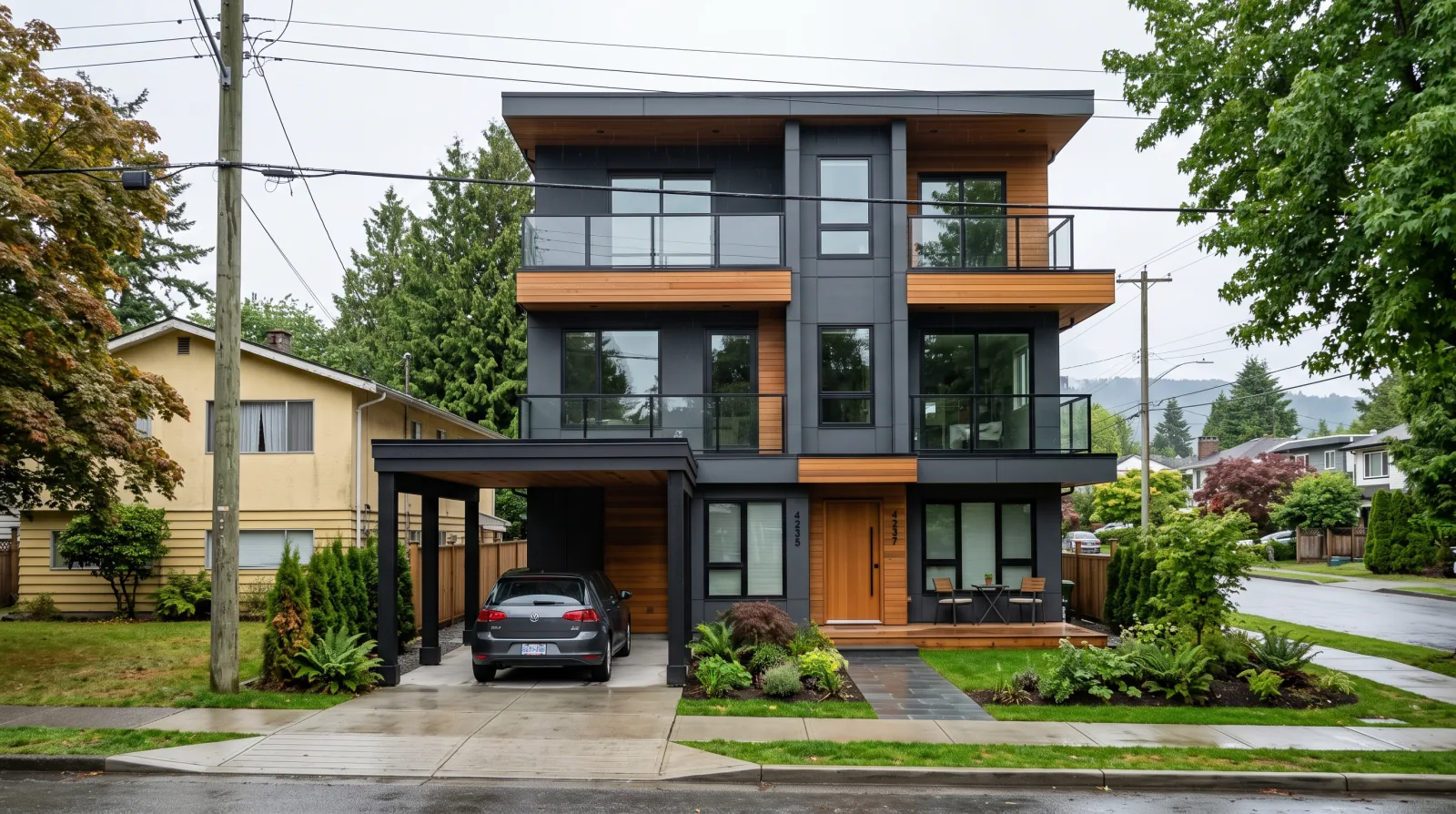
Multiplex Homes in Metro Vancouver: What We Learned
What the first wave of Metro Vancouver multiplex homes taught buyers: parking, front vs rear units, pricing against townhouses and duplexes, and Burnaby's monster multiplex question.
By Jersey Li, REALTOR®, REALTOR®, Metro Vancouver · July 27, 2026
Questions about this guide: Gary Paul, REALTOR®, Personal Real Estate Corporation, Grand Central Realty, 778-828-7476
Multiplex homes have gone from a talking point to a real choice on Metro Vancouver streets. After the province opened up more residential lots for duplexes, triplexes, and fourplexes in 2024, the first wave of these brand new homes is now finished and hitting the market. That means buyers can finally walk through them, compare them, and picture their own family inside. It also means we are learning what works and what does not, in real life, not on paper.
If you are shopping for a multiplex home right now, here is an honest read from Metro Vancouver REALTOR® Jersey Li on what the first buyers, and the teams building these homes, are figuring out. Some of it is reassuring. Some of it should make you slow down and look more carefully before you sign.
From “more housing” to “how does it actually live?”
When the rules first changed, the story was about supply. British Columbia's Bill 44 required cities to allow small multi-unit homes on lots that used to permit only a single house, and it took effect on June 30, 2024. That is the one-sentence version a buyer needs: this is why brand new duplexes, triplexes, and fourplexes are showing up on quiet inner streets in Vancouver and Burnaby, not just on busy main roads.
Now that people are actually living in the first homes, the conversation has moved on. Buyers and neighbours are asking practical questions that only come up once a home is built and lived in:
- How much parking comes with the home, and where does a second car go?
- Do the units share plumbing or utility systems, and what happens if something goes wrong?
- How private is each home from its neighbours, inside and out?
- Does the building's height and look fit the street?
- Who takes care of the shared parts over the years, and what does that cost?
None of these are dealbreakers on their own. But they are the questions that separate a home you will be happy in for ten years from one that quietly annoys you every day. The good news for you as a buyer is that you can now judge them for yourself, in person, instead of trusting a rendering.
Not every multiplex is built or priced the same
Here is something the first year taught everyone: these homes vary a lot. Two multiplexes on nearby streets can feel completely different in layout, finish, natural light, and how carefully the outdoor space was planned. The teams building them are still learning which choices buyers reward and which ones fall flat.
That matters to you because it means the price on the listing is not the whole story. A home that looked like a smart buy on a floor plan can feel cramped or awkward once it is finished, and another at a similar price can feel twice as livable. In our view, this is the single biggest reason to see multiplex homes in person and compare a few before deciding. The gap between an average unit and a well thought out one is wider here than it is with, say, a run of similar condos.
So treat every multiplex as its own case. Do not assume that because one fourplex down the block was excellent, the next one will be. And do not write off a whole neighbourhood because one early project missed the mark.
Buyers are making peace with one-car parking
One clear shift: buyers are getting more comfortable with one parking spot. Many multiplex homes come with a single carport or one designated space. A household with two vehicles increasingly plans to keep the second car on the street, especially when the home sits near a SkyTrain station, schools, shops, and the everyday places a family drives to anyway.
That is a real change from a few years ago, when a single space would have scared off a lot of buyers. If you can live with street parking for a second car, it opens up more homes and often better locations. If you cannot, that is fine too, just make it a filter early so you are not falling for homes that will never fit your driveway needs.
One caution: getting comfortable with parking does not mean buyers will accept anything. The same people who shrug at one carport still care deeply about layout, privacy, and price. Give up the second parking spot if you must, but do not let a seller talk you into giving up a livable floor plan or a fair price to go with it.
Which unit you pick matters as much as which building
Inside the same multiplex, not every home is equally appealing, and buyers are getting sharper at spotting the difference. A front unit usually has stronger street presence and that traditional “this is my house” feel, with a front door people can see from the sidewalk. A rear unit does not get that same sense of arrival, but it is far from the loser of the pair.
A well designed rear home can win on the things families actually use every day:
- A private backyard instead of a front yard on display to the street
- More separation and quiet, set back from traffic and passersby
- Extra outdoor space for kids, pets, or a garden
- Better privacy from the neighbouring units
- A calmer, more tucked-away feeling day to day
The rear unit often comes down to whether the design makes up for its position. When it does, it can be the quiet winner of the whole project. When it does not, the lack of light or a cramped path to the door will show. This is exactly the kind of thing you can only judge by standing in both homes. Walk the front unit and the rear unit back to back, and trust how each one feels, not just how it reads on the price list.
How multiplex homes get priced against townhouses and duplexes
Multiplex homes sit in an unusual spot in the market. When you shop for one, you are almost always also weighing a newer townhouse and a half-duplex at similar money. Buyers compare the price, the interior size, the outdoor space, the parking, the privacy, and the ongoing cost of ownership across all three.
A multiplex home can have a genuine edge over a townhouse: many do not carry the monthly strata fee that a townhouse complex does, so your fixed costs can be lower. But a multiplex may not give you the same privacy, land, or street presence as a traditional duplex. That is the squeeze. The price has to land between comparable townhouses and duplexes to make sense.
You can use that to your advantage. If a multiplex is priced almost as high as a nearby duplex, ask what you are giving up in privacy and resale recognition for the money. If it is priced close to a townhouse, do the math on strata fees over several years to see whether the savings are real. For context, Greater Vancouver REALTORS put the benchmark price of an attached home (the townhouse and multiplex category) at about $1,046,200 in June 2026, down 5.0% from a year earlier. A softer market like that gives careful buyers more room to compare and negotiate than a hot one would.
The “monster multiplex” question in Burnaby
In Burnaby, some of the first multiplex buildings came out noticeably taller and bulkier than the older houses around them. Locally, people started calling the biggest ones “monster multiplexes.” Their height and size can make a very different streetscape from the single-family homes next door, and not everyone loves it.
This is not just chatter. According to CBC News, public backlash over the scale of these homes led Burnaby council to scale the rules back. On October 14, 2025, council voted to lower the maximum height for future multiplex buildings from four storeys to three, with city staff estimating a roughly 33% cut in the floor area an average project could achieve. In plain terms, the very biggest designs that started this trend may not be built the same way going forward.
For a buyer, the honest takeaway is that the largest, tallest multiplex designs are the least tested part of this whole market. Some buyers will love the extra room inside and the modern feel. Others will worry about all the stairs, how the building sits next to its neighbours, or how easy it will be to sell later. As more of these homes change hands a second time, we will get a clearer picture of which designs hold their value. Until then, if you are looking at one of the biggest buildings on the block, go in with your eyes open and think hard about resale.
A product that is still finding its shape
Multiplex homes give Metro Vancouver buyers another option that sits between a condo, a townhouse, a duplex, and a detached house. That is genuinely useful, especially for families pooling resources to live near each other in a nicer neighbourhood than any of them could reach alone. But the product is young, and it is still changing.
The teams building them are learning which layouts buyers prefer. Cities are still adjusting their rules, as Burnaby just showed. And buyers are getting smarter about parking, shared systems, outdoor space, privacy, and resale. Our read is that the multiplex homes that age best will be the ones that get the basics right: an efficient, livable layout, parking that actually works for the household, real private outdoor space, and a price that honestly reflects where the home sits against the townhouses and duplexes nearby.
What this comes down to
- Judge every multiplex on its own. Quality and livability vary a lot from one project to the next, so compare a few in person before you commit.
- One parking spot is now normal. Decide early whether street parking for a second car works for you, and let that filter your search.
- Walk the front unit and the rear unit. A well designed rear home with a private yard can beat the front unit for daily life.
- Price it against townhouses and duplexes. Weigh the strata-fee savings against a townhouse and the privacy you give up versus a duplex.
- Be cautious with the biggest buildings. The tallest designs are the least tested for resale, and Burnaby has already pulled the rules back.
Frequently asked questions
What is a multiplex home?
A multiplex is a small multi-unit building, usually a duplex, triplex, or fourplex, where each home is sold separately. You buy one unit and live in it, much like a townhouse, rather than buying the whole building.
Why are there suddenly so many multiplex homes in Metro Vancouver?
British Columbia's Bill 44 required cities to allow these small multi-unit homes on lots that used to permit only a single house, and it took effect on June 30, 2024. That is why brand new duplexes and fourplexes now appear on quiet residential streets, not just main roads.
Is one parking spot enough for a multiplex home?
It depends on your household. Many multiplex homes come with a single carport or space, and buyers increasingly park a second car on the street, especially near transit and schools. If you own two cars and cannot rely on street parking, treat parking as an early filter in your search.
Should I buy a front unit or a rear unit?
Front units offer stronger street presence and a traditional house feel. Rear units trade that for a private yard, more quiet, and better separation. Neither is automatically better. Walk both back to back and choose the one that fits how your family actually lives.
Do multiplex homes have strata fees?
Many multiplex homes carry lower monthly costs than a townhouse complex because there is less shared property to maintain, and some have no monthly strata fee at all. Always confirm the exact arrangement for the specific home, since setups differ from one project to the next.
How does a multiplex compare to a townhouse?
A multiplex often has lower fixed monthly costs than a townhouse and can feel more like a house. A townhouse may offer more standardized quality and amenities. Compare interior size, outdoor space, parking, and several years of strata fees before deciding.
How does a multiplex compare to a duplex?
A duplex usually gives you more privacy, land, and street presence, and buyers tend to recognize it easily at resale. A multiplex can cost less and carry lower fees. If a multiplex is priced close to a nearby duplex, ask what you are giving up for the money.
What is a “monster multiplex”?
It is an informal name for the tallest, bulkiest multiplex buildings, mostly seen in Burnaby, that stand out against the older houses nearby. After public concern about their size, Burnaby council lowered the maximum height for future buildings from four storeys to three in October 2025.
Are large multiplex buildings a risky buy?
Not necessarily, but they are the least tested part of this market for resale. Some buyers value the extra interior space; others worry about stairs and how the building fits the street. If you are considering one of the biggest designs, think carefully about how easy it will be to sell later.
How much do multiplex homes cost in Metro Vancouver?
Prices vary by neighbourhood, size, and finish. As a reference point, Greater Vancouver REALTORS reported the benchmark price for attached homes (the townhouse and multiplex category) at about $1,046,200 in June 2026, down 5.0% year over year. Individual multiplex homes range above and below that.
Are multiplex prices going up or down right now?
As of mid-2026 the attached-home benchmark is softer than a year earlier, down about 5% according to Greater Vancouver REALTORS. A slower market gives careful buyers more time to compare homes and negotiate than a fast-rising one would.
What should I check before buying a multiplex?
Look at the real layout and light in person, the parking, the outdoor space, how private the home is from its neighbours, the shared systems and who maintains them, and the monthly costs. Then compare the price against nearby townhouses and duplexes.
Do shared plumbing or utilities cause problems?
Shared systems are common in multi-unit homes and usually work fine, but you should understand what is shared, who is responsible for repairs, and how costs are split before you buy. Ask for this in writing for the specific home you are considering.
Where in Metro Vancouver should I look for multiplex homes?
Vancouver's East Side and many Burnaby neighbourhoods have some of the most active multiplex building, and homes near SkyTrain and schools tend to hold appeal. The right area depends on your budget, commute, and family needs, so it helps to compare a few before deciding.
Ready to compare multiplex homes the smart way?
The best way to sort a great multiplex from an average one is to see a few side by side with someone who does this every day. Browse current multiplex homes for sale on our properties page, or get in touch and we will help you compare layouts, parking, outdoor space, and pricing across Vancouver and Burnaby so you buy with your eyes open.
This article was written for MultiLiving by guest contributor Jersey Li, REALTOR®, who works with buyers, sellers, and building teams across Metro Vancouver and focuses on the layout, pricing, and resale potential of multiplex homes.