Multiplex Common Areas & Lobbies in Vancouver (2026)
What the shared spaces in a Vancouver multiplex actually look like — entries, lobbies, mailbox banks, garbage rooms, courtyards — and how they shape daily life for buyers in 2026.
By MultiLiving Editorial · May 18, 2026
When buyers tour a brand new Vancouver multiplex for the first time, two questions almost always come up before they finish the front walk. Where is my front door? And what do I share with the neighbours?
These are not small questions. The way a multiplex handles its shared spaces — entries, hallways, mail, garbage, the bit of yard nobody is sure about — shapes the daily texture of living there. It is the difference between feeling like you have a real home with neighbours and feeling like you have a slightly upgraded condo in a mid-rise. This guide walks through what a Vancouver multiplex's common areas actually look like in 2026, what to expect on a tour, and what to ask before you sign anything.
First, what counts as a "multiplex" in Vancouver right now
Vancouver allows up to six strata-titled units, or up to eight rental units, on a single lot under its current low-density housing rules. Most of what you will see on the market is a duplex (two units), triplex (three), fourplex (four), or sixplex (six) on what used to be a single-family lot. The buildings sit roughly the height of a tall house — three storeys, occasionally with a basement level — and they are designed to feel like part of the street, not above it.
That scale is the single biggest reason multiplex common areas feel different from condo common areas. There is no concierge, no elevator, no lap pool. There is also no thirty-page list of amenity rules. Most things are smaller, simpler, and closer to a townhouse experience than a tower experience.
The front door question: ground-oriented vs shared lobby
The most important common-area decision in a multiplex is one most buyers do not realize is a decision: whether each unit has its own front door from outside, or whether some or all units share a small lobby.
On most Vancouver multiplex projects, units are ground-oriented. Your unit has its own door, on the street, side yard, lane, or a small interior courtyard. There is no shared corridor and no shared lobby. The City's low-density housing how-to guide specifies side-yard paths to ground-oriented entries must be at least 1.2 metres clear, which is why so many new sixplexes have a slim, well-lit walkway running along the side of the building. That walkway is often a piece of common property the strata maintains, but functionally it is just the route to your front door.
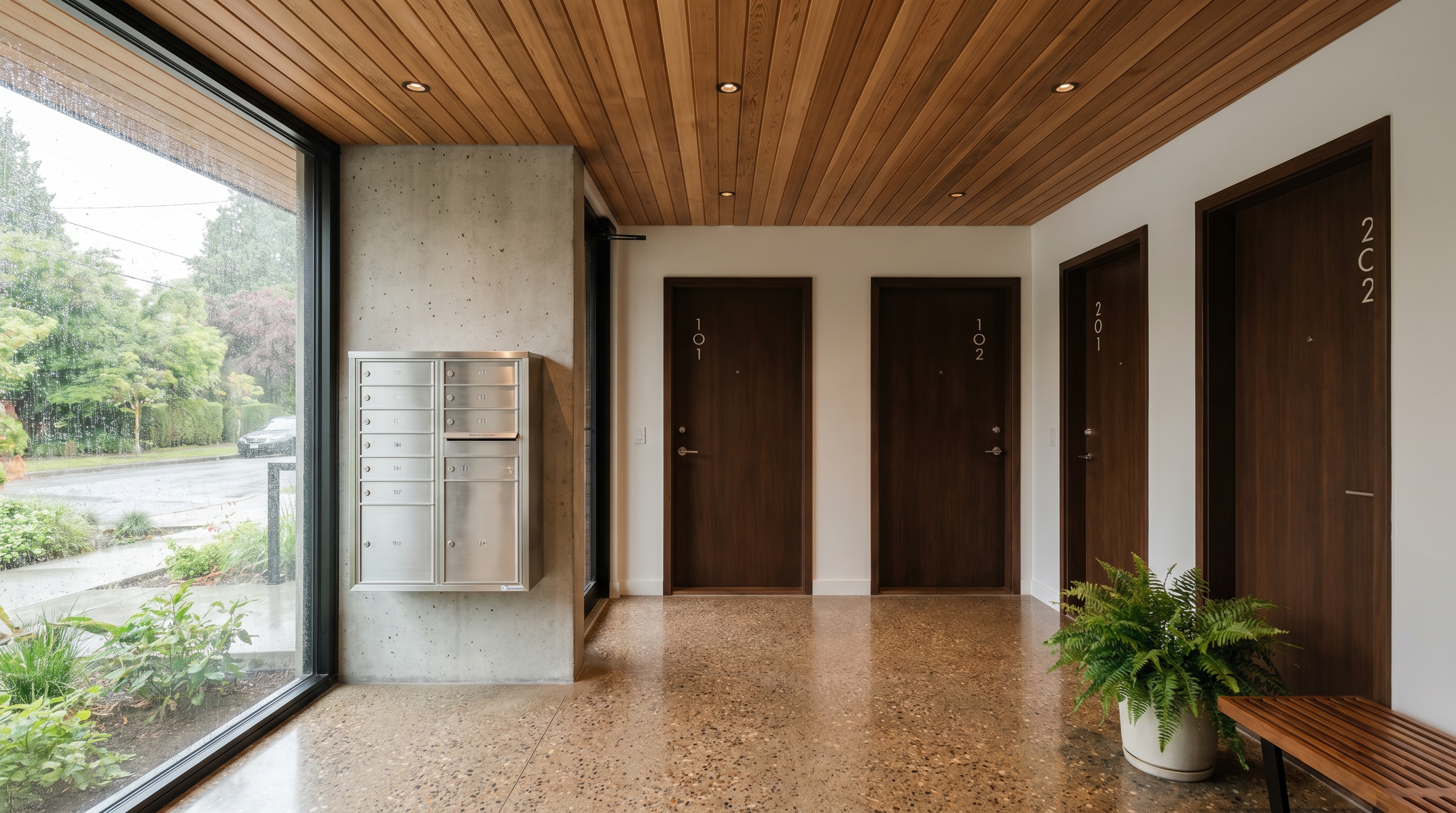
On larger sixplex and infill projects, designers sometimes group two or three upper units around a small shared vestibule — a single exterior door, a few mailboxes, doors to the individual units. It is not really a lobby in the condo sense. There is no seating, no concierge desk, no big chandelier. It is more like the small foyer of a low-rise apartment from the 1960s, only finished better. In our view, these are perfectly pleasant if the design is generous with daylight, and slightly grim if it is not. Always tour at the time of day you would actually use the space.
Mail, parcels, and the small infrastructure nobody talks about
Every multiplex needs a place for mail and parcels. Canada Post requires a centralized mailbox cluster for any new multi-unit residential building, and developers handle this in one of three ways: mounted on the side of the building near the main pedestrian access, recessed into a small alcove off the front yard, or tucked just inside a shared vestibule for upper units.
Parcels are messier. Some projects include a handful of larger parcel lockers in the same cluster. Others rely on couriers leaving packages at individual unit doors. If your unit has its own street-facing door but does not have a covered porch, ask where parcels are supposed to land on a rainy Vancouver Tuesday. Some buildings install a simple weatherproof shelf or cubby; others assume you will track packages and grab them quickly. This is a small thing that turns into a daily annoyance later if it is not designed well.
Garbage, recycling, and organics — yes, this matters
Vancouver has aggressive waste-sorting rules. Every multi-unit building is expected to have proper containers for garbage, mixed recycling, paper, glass, and food scraps. In a multiplex, that means somewhere on the lot — usually a small enclosure off the lane — a row of bins lives behind a screen.
On a tour, ask to see the garbage area. We have visited new projects where the bin enclosure is thoughtful — covered, lit, with a clear walking route from each unit. We have visited others where it is an afterthought tucked behind a hedge, the kind of place you do not want to walk to in January at nine at night. Strata bylaws will require you to use this area, so check it before you fall in love with the kitchen.
Outdoor common space: the yard, the courtyard, the patch you cannot quite figure out
Most Vancouver multiplexes have outdoor space split into three categories: private (a patio or rooftop deck assigned to a single unit), limited common property (a piece of yard the strata owns but only one unit can use), and common property (a piece of yard everybody can use, in theory).
On a duplex or triplex, the splits are usually simple — front yard for the front unit, back yard for the back unit, the strip down the side is a path. On a fourplex or sixplex, things get more interesting. There might be a small shared courtyard with a few benches and a planted bed. There might be a slim strip of lawn nobody uses. There might be a designated bike-and-stroller area near the rear lane.
Walk every piece of outdoor space and ask three things: whose is this, who pays to maintain it, and what are the rules around how it can be used? The Province's strata bylaws and rules guide confirms that strata corporations are responsible for maintaining common property, with the costs recovered through monthly strata fees. Limited common property is a hybrid — typically the user maintains routine upkeep, while structural and major work falls to the strata.
Parking and the bike room
Vancouver removed minimum parking requirements for most new residential projects, so multiplex parking varies wildly. Some projects include a parking stall per unit — usually surface or carport off the lane, occasionally a small underground garage. Some include one shared driveway and ask you to figure out a rotation. Some are zero-parking projects designed for the SkyTrain corridor, which often include a generous bike room instead.
If you have a car, confirm in writing — in the disclosure statement, not the brochure — that a stall comes with your unit, whether the stall is freehold or limited common property, and whether EV charging is pre-wired. If you do not have a car, the bike room is your common area: ask how big it is, whether it has charging outlets for e-bikes, and whether storage hooks are assigned by unit.
Lighting, signage, and the things you only notice at night
We always tell buyers to drive past a multiplex once during the day and once after dark. Vancouver winters are dark from late October through March, and the difference between a building with thoughtful exterior lighting and one without is the difference between feeling safe walking the dog at 8 pm and feeling like you should call somebody.
Look for: lighting at every entry door, lighting along the side-yard path, a unit-numbering scheme you can read from the sidewalk, and at least one motion-activated light near the garbage area. None of this is regulated in detail. Some developers nail it; some forget.
What the strata corporation actually does for you
The strata corporation is the legal entity all the unit owners belong to, and it is the body that maintains common property, enforces bylaws, and budgets for repairs. According to FirstService Residential's plain-English explainer, strata responsibilities include collecting fees, maintaining common areas, enforcing bylaws, and making decisions on behalf of the community.
In a multiplex, this often means owners do most of the work themselves. There is no full-time property manager. One owner mows the lawn, another organizes the annual fence repair, somebody volunteers as treasurer. It is a small co-op feel — closer to running a small business with five neighbours than living in a tower with 300 strangers. If that sounds appealing, multiplex life will suit you. If you want everything outsourced, ask whether the strata plans to hire a property manager and what that adds to the monthly fee.
What this comes down to
- Most Vancouver multiplexes are ground-oriented — own door, no shared lobby, very townhouse-like.
- When there is a shared vestibule, tour it at the time of day you would actually use it.
- Mail and parcel handling is small infrastructure that becomes a daily issue if it is poorly designed.
- Walk to the garbage area before you fall in love with the kitchen.
- Map every piece of outdoor space — private, limited common, common — and confirm responsibilities.
- Drive by once after dark to see what the lighting really looks like.
- In a multiplex, owners often do strata work themselves — that is a feature for many buyers, not a bug.
FAQ
Are multiplex common areas covered by strata insurance?
Yes. The strata corporation carries a master insurance policy that covers common property, the building envelope, and shared infrastructure. You carry your own policy for the inside of your unit and your contents. We cover the details in our multiplex insurance guide.
Can I personalize my front door or porch?
Sometimes. If the door faces common property, the strata bylaws will set rules about paint, mats, plants, and decor. Many multiplex bylaws are reasonable about this — a mat and a plant are usually fine — but check before you order a custom paint colour. Anything affecting the building exterior typically needs strata approval.
Do multiplexes have shared amenity rooms?
Almost never. The lot is too small. A few larger sixplexes include a tiny shared roof deck or a flexible co-working nook, but most projects do not have a separate amenity space. The trade-off is that you are not paying for amenities you would never use.
Who pays for the shared driveway?
If the driveway is common property, the strata pays for repairs and snow clearing out of monthly fees. If a portion is limited common property assigned to one unit, that owner is usually responsible for routine upkeep, with major repairs falling to the strata. The disclosure statement and strata plan will spell out which is which.
Where to go from here
If you are touring multiplex projects in Greater Vancouver and want a second opinion on the common-area design, talk to us. We have walked through dozens of new buildings and we are happy to point out the small things that distinguish a thoughtful project from a clumsy one. You can also browse current multiplex listings across Vancouver and Burnaby.
Related Resources
Multiplex Buying Guide
From discovery to closing
Financing Your Multiplex
Mortgages, programs & more
First-Time Buyer Guide
Down payments, CMHC, GST rebates
Multiplex for Sale in Vancouver
Browse all Vancouver listings
Where to Buy in Vancouver
Neighbourhood comparison guide
Vancouver Pre-Sales
Active & upcoming projects