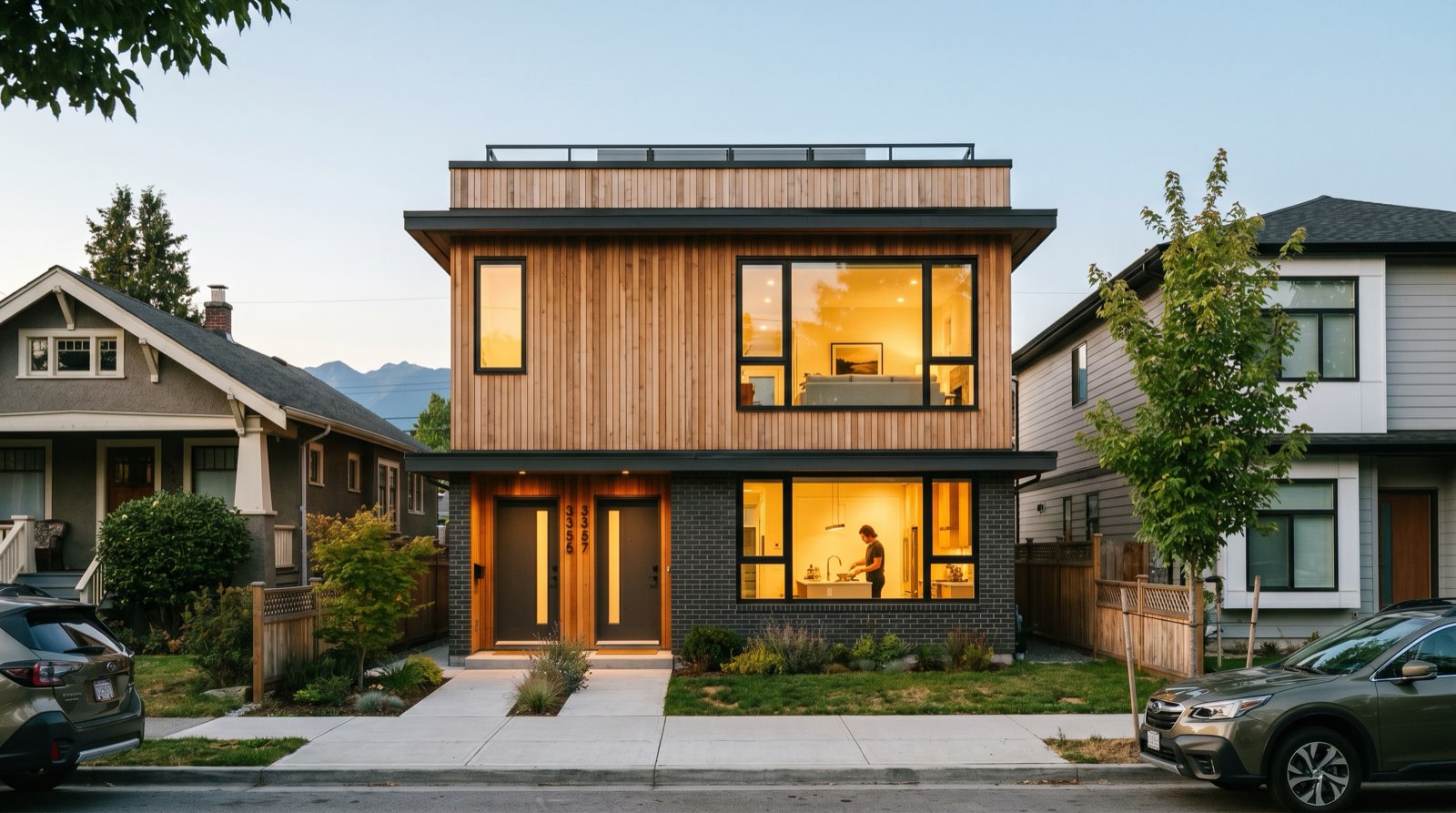
What Is a Lock-Off Suite? The Multiplex Feature Families Keep Asking About
What a lock-off suite is, how Greater Vancouver families use one, what to check on the floor plan, and the questions to ask the sales team before you buy.
By MultiLiving Editorial · August 24, 2026
Walk through a few new multiplex homes in Vancouver or Burnaby and you will hear the same phrase from more than one sales team: "this level works as a lock-off suite." The floor plan shows a small kitchen icon on the ground floor, a second entrance, and a note about a lockable door. Buyers nod along, and then, once they are back in the car, they ask each other what a lock-off suite actually is.
Fair question. The term comes from the hotel and resort world, and it has only recently become common in Greater Vancouver floor plans. This post explains what a lock-off suite is, how families really use one, what to look for on the plan, and the questions worth asking before you sign anything.
The short answer
A lock-off suite is a section of a home that can be closed off and lived in as its own small, self-contained space. It has its own entrance from outside, its own bathroom, usually a compact kitchen, and one connecting door that locks from both sides. Lock that door and you have two separate living spaces. Unlock it and the home works as one again.
That reversibility is the whole point. A basement suite in an older house is usually a permanent arrangement: a separate space, always. A lock-off suite is a switch you can flip as your family changes. Kids at home this decade, parents downstairs the next, a quiet office in between.
Lock-off suite, secondary suite, laneway home: which is which
The vocabulary around suites is messy, so it helps to anchor on the official version. The BC government's guide to secondary suites describes a secondary suite as a private, self-contained living space within the main home, with its own living area, kitchen, sleeping area, and washroom. The province is also clear that the main home and the suite form a single legal property. You cannot split them apart and sell them separately.
A lock-off suite fits inside that definition, with one twist: the connecting door. Where a classic basement suite is walled off for good, a lock-off suite stays attached to the rest of your home through a door you control. A laneway home or garden suite is different again. Those are separate small buildings in the yard, not part of the main home at all.
In a new multiplex, the lock-off suite is most often the ground floor or garden level of a three-storey unit. You might see it labelled "flex suite," "in-law suite," or "legal suite" on marketing materials. The label matters less than the layout. If it has its own entrance, its own bathroom, a place to cook, and a lockable door to the rest of the home, it is a lock-off suite in everything but name.
Why families keep asking about this
The demand is not a marketing invention. Statistics Canada counted more than 442,000 multigenerational households in the 2021 Census, home to 2.4 million people, and reported in its 2025 study Unpacking Canada's multigenerational households that their number grew 21.2% between 2011 and 2021, well ahead of the 12.4% growth in households overall. British Columbia also has one of the country's highest shares of children living with a grandparent.
New multiplex homes exist in volume now because BC changed its rules in 2023 to allow more homes on ordinary residential lots. That single change is why you can shop for a brand new fourplex unit on a quiet street in 2026, and it is also why so many of those units are designed with two generations in mind from day one.
Our view: the lock-off suite is the most useful floor plan idea to reach new Vancouver housing in the past decade. It answers the question most families are quietly asking, which is how to live close together without living on top of each other.
Four ways families actually use a lock-off suite
Parents one floor away, not one city away
This is the most common story we hear. Parents in their late 60s or 70s sell a detached house that got too big, and move into the ground-floor suite of their adult child's new multiplex unit. They keep their own front door, their own kettle, their own routine. Sunday dinner is a flight of stairs, not a drive across the region. When a grandchild is sick on a school day, help is already home.
The lockable door matters more here than people expect. Both generations get to choose when the home is one household and when it is two. That choice is what keeps the arrangement working after the first exciting month is over.
An adult child's first place
A 24-year-old saving for their own home cannot do it easily while paying Vancouver rent. A lock-off suite gives them a real, private starting point: their own entrance, their own bathroom, a kitchenette, and no need to introduce roommates to the family. Parents get their child nearby without sharing a bathroom schedule. Most families we talk to see this as a five-year arrangement, not a forever one, and the suite simply gets a new job afterwards.
A workspace with its own front door
If you run a practice, see clients, or just take a lot of video calls, a suite with a separate entrance is a different thing from a desk in the bedroom. Clients never walk through your kitchen. Work stays behind a locked door at night. For two-income households where one person works from home full time, this use alone can justify the layout.
Guests, and the quiet years in between
Visiting in-laws for three weeks in the summer. A cousin studying at UBC or SFU for a semester. A friend between homes. A suite absorbs all of it without anyone sharing a shower. And in the years when nobody needs it, the door stays unlocked and the space is simply more home: a gym, a teenager's floor, a den. Some owners do rent the space out for income, and there are real rules around that, from strata bylaws to city licensing. We cover the rental side separately; this post is about living in it.
Reading the floor plan: what to check
Floor plans make every space look better than it feels. A suite that looks self-contained on paper can feel like a hallway with a hotplate in person. Check these before you fall for the idea:
- The entrance. Is the suite's outside door a real second entrance at ground level, or a shared stairwell? Walk the path from street to suite door. Your parents will walk it in the rain, in January, with groceries.
- Where the locking door sits. A connecting door at the bottom of an internal stair is easy to live with. A door straight into your living room means every trip between spaces crosses the family zone.
- Kitchenette or kitchen. Look at what the plan actually shows: a sink and bar fridge, or a full fridge, stove, and counter space someone could cook dinner on daily. For a parent living there full time, the difference is everything.
- The bathroom. A full bathroom with a shower makes the suite genuinely independent. A powder room does not. For older parents, ask whether the shower has a low or no threshold.
- Laundry. Does the suite have its own washer and dryer, or will your mother-in-law carry laundry through your kitchen every Tuesday?
- Windows and light. Garden-level suites in new multiplexes are usually far brighter than old basement suites, but usually is not always. Check window sizes on the plan and stand in the space if you can.
- Heating and cooling controls. Ask whether the suite has its own thermostat. Two generations rarely agree on temperature.
- Sound between floors. You cannot read this off a plan. Visit the display home, send someone upstairs, and listen. Ask the sales team what sits between the suite ceiling and the floor above, and ask in plain words: will I hear footsteps?
- Storage. A person living in 450 square feet needs a closet and then some. Look for it on the plan, because you will not find it later.
Questions to ask the sales team
Sales teams for new multiplex projects answer these all day. Good ones will answer them straight; evasive answers are information too.
- Is the suite included in the advertised square footage, and how big is it on its own?
- Does it have its own heat controls, hot water, and electrical panel, or does everything run through the main home?
- Can the suite get its own mailing address or mailbox?
- What exactly is between the suite and the rest of the home for sound?
- Is the suite's kitchen wired and plumbed for a full stove, or limited to a cooktop?
- Do the strata bylaws for this building say anything about how the suite can be used?
- Is the suite counted as one of the bedrooms in the listing, or on top of them?
- Can the connecting door be removed or widened later if we want one open home?
- Which other units in the project have the same suite layout, and can we walk one that is further along?
One honest note on that first question. Two homes can both say "1,600 square feet" while one gives you 1,600 usable feet upstairs plus a suite, and the other counts the suite inside the number. Neither is wrong, but you should know which one you are comparing. This is exactly the kind of thing our team checks when buyers ask us to compare projects.
What a lock-off suite is not
It is not a separate legal home. As the BC government's secondary suite guide puts it, the main home and the suite are a single property. You cannot sell the suite on its own, and it does not make your one strata unit into two. If a listing implies otherwise, ask harder questions.
It is also not automatically a rental business. Renting out a suite in Greater Vancouver comes with rules that depend on the city, the strata, and how long the tenancy runs, and short-term rentals face their own provincial restrictions. None of that is a reason to avoid a lock-off suite. It is a reason to read the rules before you count on the income. If income is your main goal, start with the numbers and rules rather than the floor plan.
Does a lock-off suite cost more?
Usually, yes, all else equal. You are paying for a second bathroom, a second place to cook, extra plumbing, and a more complicated layout. No published data source tracks a "lock-off premium" for Greater Vancouver, so be suspicious of anyone quoting you a precise figure for one.
Whether it is worth paying for comes down to a blunt question: will anyone actually live or work in it during your first five years in the home? If the honest answer is yes, the suite is often the cheapest way ever invented to add a second household to your family's life. If the honest answer is "maybe someday," we would rather see you spend the same money on a better location or one more real bedroom. A feature you never use is just square footage with extra plumbing.
To see a suite like this in person, Quintet at 2240 E 40th Ave in East Vancouver has one on the lower floor of four of its five townhomes, each with its own entrance and a full bathroom. Use the checks above on its floor plans, and ask the same questions about the connecting door.
Questions buyers ask about lock-off suites
What is a lock-off suite in one sentence?
It is a self-contained section of a home, with its own entrance, bathroom, and usually a small kitchen, connected to the rest of the home by a door that locks from both sides, so the space can work separately or as part of one home.
Is a lock-off suite the same as a basement suite?
They are close cousins. Both are self-contained spaces inside the main home. The difference is the connecting door: a lock-off suite is designed to rejoin the main home whenever you want, while a traditional basement suite is set up as a permanently separate space.
Can I sell the lock-off suite separately from my home?
No. The BC government's secondary suite guide is explicit that the main home and the suite form one legal property. You buy them together, you sell them together. The suite adds use and value to your home; it is not a second title.
Does the suite count in the advertised square footage?
Sometimes, and this is worth pinning down on every home you compare. Ask the sales team whether the listed square footage includes the suite, and what the suite measures on its own. Two similar-sounding homes can differ by hundreds of usable feet.
Can my parents live in a lock-off suite full time?
Yes, and this is the most common use we see in new multiplex homes. Check the practical details first: a full bathroom with an accessible shower, a kitchen they can cook in daily, level entry or few stairs, and their own thermostat.
Does a lock-off suite always have its own kitchen?
No. Some have a full kitchen, many have a kitchenette with a sink, bar fridge, and cooktop, and a few include only the wiring and plumbing so a kitchen can be added later. The floor plan legend and the sales team can confirm which one you are looking at.
Will I hear the people living in the suite?
It depends on the home, so test it rather than trusting a brochure. Visit the display home with a family member, have them walk and talk in the suite while you stand above, and ask the sales team directly what separates the two spaces for sound.
Can I rent out a lock-off suite?
Often yes, but rules apply before the first tenant moves in: strata bylaws, city licensing, tenancy law, and tax reporting all come into play, and short-term rentals face provincial limits. Treat rental income as a separate research project, not an assumption.
Do all new multiplex homes include a lock-off suite?
No. Many new duplex, triplex, and fourplex units are straightforward single homes across two or three floors. Lock-off suites appear most often in larger units aimed at families. If you want one, say so early; it narrows the search quickly.
What should I check first on the floor plan?
The entrance and the bathroom. A real outside entrance at ground level and a full bathroom with a shower are what make the suite genuinely independent. A kitchenette can be upgraded later; a missing entrance usually cannot.
Is a lock-off suite a good home office?
For anyone who sees clients or spends the day on calls, it is one of the best. A separate entrance keeps work traffic out of your family space, and the locking door means the office closes at night. It also leaves the option of housing family later.
How do I find multiplex homes with lock-off suites?
Floor plans are the fastest filter: look for a second entrance, a bathroom, and a kitchen icon on the same level. Or skip the searching and tell us what you need; we track which Greater Vancouver multiplex projects include suites and can shortlist them for you.
What this comes down to
- A lock-off suite is a self-contained space inside your home with its own entrance and a lockable connecting door. It can join the home or stand apart, and you decide which, whenever you like.
- It is not a separate legal property. Per the BC government's definition, the suite and the main home are one real estate entity.
- Multigenerational living is the engine behind the trend. Statistics Canada counted over 442,000 such households in 2021, growing far faster than households overall.
- Judge the suite on five things: the entrance, the bathroom, the kitchen, sound, and storage. The plan shows the first three; your ears and eyes must check the rest.
- Expect to pay something for the feature, and only pay it if someone will genuinely use the space in your first five years.
- Renting the suite out is possible but rule-bound. Point your research there separately before counting on income.
If a lock-off suite is on your must-have list, you do not need to open fifty floor plan PDFs to find one. Browse the multiplex homes on MultiLiving and look for units with a garden level or flex suite, or tell our team what your family needs and we will shortlist the projects in Vancouver and Burnaby where the suite actually works the way you are picturing it.