Multiplex Homes for Multigenerational Living (2026)
A practical 2026 search guide for families buying a multiplex unit suited to multigenerational living — what to filter for, where to look in Greater Vancouver, and how to use the MHRTC and CMHC rules.
By MultiLiving Editorial · April 25, 2026
Questions about this guide: Gary Paul, REALTOR®, Personal Real Estate Corporation, Grand Central Realty, 778-828-7476
Two adult siblings, their parents, and three grandkids — same family, six adults' worth of decisions, one budget. Where do you actually live? A detached house in most of Greater Vancouver is still well north of $1.5 million. Two condos defeat the whole point. Renting indefinitely while parents age in place across town doesn't work either.
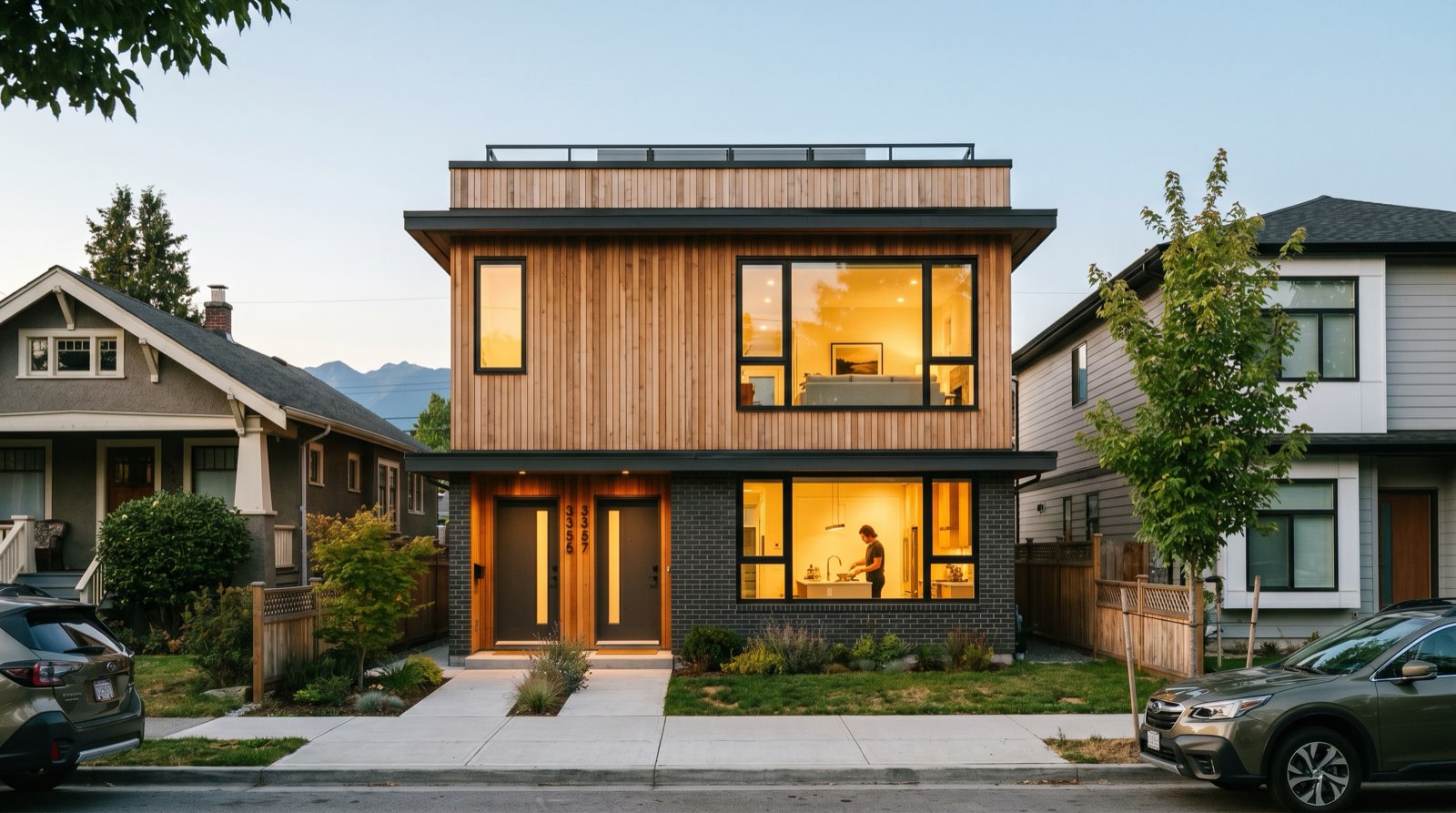
This is the conversation a lot of families across Greater Vancouver are having in 2026, and a brand new multiplex home is increasingly the answer. Sometimes one unit, sometimes two units next to each other, sometimes a unit with a smaller suite attached. The homes are new, the prices are reachable, and the design lets generations live close without living on top of each other.
The hard part isn't deciding to do it. The hard part is finding the right home. Multiplex listings are scattered, MLS feeds bury them under condos, and most of these new homes are too recent to have a price history. Here's how to actually search — what features matter for a multigen family, where to look, and what the money looks like.
Why families are searching for these homes in the first place
Multigenerational living isn't a fringe arrangement anymore. Statistics Canada counted 441,750 multigenerational households in Canada in 2021, up 8.6% from 2016 and 21.2% since 2001 — growing faster than overall household formation. About 2.4 million Canadians live in one, and over a third are children. British Columbia sits at 3.7% of households — second only to Ontario, and well above the national average of 2.9%.
Those numbers are from the last full census. Anecdotally, things have only accelerated since. Detached prices kept climbing, parents needed help with childcare or care of their own, and BC's recent housing rules opened up a new category of brand new homes that can hold a family across two or three generations under one address.
If you're reading this, you've probably already done the math on whether to keep paying two rents, sell two homes, or pool incomes for one bigger purchase. We'll skip relitigating that decision and get into the search itself.
The seven features that actually matter for multigen living
Most listings will tell you the unit count, the square footage, and the kitchen finishes. None of that tells you whether your in-laws can live in the unit downstairs without losing their minds — or yours. These are the things to filter on.
1. Separate front doors
Non-negotiable. Each household needs its own front door that doesn't pass through anyone else's living space. Some new homes have two doors side by side at the front and two more accessed from a back lane; others stack with stairs going up to the upper unit's private entrance. What you don't want is a shared hallway or vestibule everyone has to walk through. If grandma has to come through your kitchen to get home, the arrangement won't last.
2. A connected unit you can lock off
The closest thing to a magic bullet for multigen living is a smaller suite attached to a main unit by an internal door that can be locked or opened depending on need. When grandparents are visiting, the door's open and it feels like one big home. When everyone's independent, you lock it and it's two self-contained homes. A handful of newer Vancouver and Burnaby homes are designed this way — it's worth asking the team selling the home directly, because listings rarely flag it.
The next-best option is buying two adjacent units in the same building together. A few buyers are negotiating this — one unit for the parents, one for the adult kids' family, both purchases at the same time. Sales teams will sometimes discount the second unit to lock in two sales at once.
3. A genuinely accessible ground-floor home
If the older generation will live on the ground floor — and they probably should — verify the actual aging-in-place features, not just the marketing. Look for: a step-free entry from the sidewalk or driveway, doorways wide enough for a walker (about 32 inches), a curbless shower, lever handles, and a bedroom and bathroom on the same level so no internal stairs are needed for daily life. Some new homes have all of this baked in. Many don't, by default.
4. How quiet it is between neighbours
This is where new multiplex homes vary the most, and you cannot tell from a photo. Stand in the unit and ask the sales contact a simple question: how soundproof is it between this unit and the next one? A good answer talks about specific quiet-rated walls and floors. A vague answer is also information. If you're touring during a time when neighbours are home, listen — you should hear almost nothing through the walls. In a home where one unit holds toddlers and the other holds someone trying to sleep through chemo recovery, this matters enormously.
5. Kitchens that match how the family actually eats
Multiplex kitchens trend small. For multigen living, the upstairs (family) unit needs a kitchen that can host a real Sunday dinner — counter space, a real range, room for two people to cook side by side. The downstairs (parents') unit needs a kitchen they can use independently, but it can be a galley. The mistake to avoid is two equally tiny kitchens. Plan around how the family actually eats together.
6. Parking — more than you think
Two households means two cars at minimum, often more. Many new Vancouver multiplex homes come with one parking stall per unit, sometimes less near transit. Verify what's included with each unit on title, what's available to lease nearby, and whether there's any street parking. If the parents' unit comes without a stall and they still drive, you have a problem before you've moved in.
7. Outdoor space — yours, theirs, or shared
Multigen households need places to exist apart. A small private patio for the downstairs unit and a balcony or rooftop for the upstairs unit beats one big shared yard, in our experience. Shared yards become unspoken negotiations about whose kids' toys go where. Two smaller spaces, clearly assigned, cause less friction.
Where to actually look in Greater Vancouver
The REBGV townhouse benchmark sat at $1,047,100 in March 2026, down 5.7% year-over-year, but that benchmark blends old townhouses with brand new multiplex homes — it's a soft floor, not a real guide. Here's what families are actually finding by sub-market.
Vancouver East Side
The most active multiplex market in the city. Three-bedroom units in new fourplex homes typically run $950,000–$1,250,000 depending on neighbourhood and finishes. Hastings-Sunrise, Renfrew-Collingwood, Killarney, and Victoria-Fraserview are producing the highest volume of new multigen-suitable homes. Streets are family-friendly and the teams behind these homes understand the buyer.
Vancouver West Side
More expensive, lower volume, larger units. Newly built multiplex units in West Side neighbourhoods are closing around $1.15M for an 850 sq ft home and $1.55M for a 1,400 sq ft home, per recent CBRE-tracked sales. Worth it if proximity to UBC, specific schools, or aging parents already on the West Side is the priority. Otherwise, the East Side delivers more square foot per dollar.
Burnaby
Burnaby is the sleeper market for multigen multiplex right now. A wave of new four- and six-unit projects are coming online in Burnaby Heights, North Burnaby, and around Edmonds. Pricing tends to run 10–15% below comparable East Vancouver, with larger lots that allow for better-laid-out homes.
Surrey and the North Shore
Surrey has the highest concentration of multigenerational households in Metro Vancouver and the deepest pipeline of affordable new multiplex homes — entry pricing well below Vancouver, often with units big enough for the whole family on one floor. The trade-off is commute and amenity density. The North Shore is the opposite: limited supply, premium pricing, but unmatched if a parent needs to be near Lions Gate Hospital or you want kids in West Vancouver schools.
How to actually filter the search
MLS will let you filter by bedroom count and price. It will not let you filter for "separate front doors," "connected lock-off suite," or "step-free ground-floor entry." That's the gap MultiLiving was built to fill — every home is tagged with the features multiplex buyers actually need to compare, and the search is multiplex-only so condos and detached homes don't dilute the results.
If you're searching anywhere (us included), here's the filter logic that works for multigen:
- Home type: triplex, fourplex, or sixplex unit. Skip duplexes unless one half is meaningfully larger than the other.
- Bedrooms: 3 minimum in the main unit; ideally a separate 1- or 2-bed unit (lock-off, ground-floor suite, or adjacent unit) for the second household.
- Square footage: 1,200+ sq ft total across the household's space. Below that, multigen friction starts compounding fast.
- Entry: two separate front doors. Filter or ask before you tour.
- Year built: 2024 onward, in most cases. Older listings labelled "multiplex" tend to be carved-up older houses with awkward layouts.
- Parking: two stalls minimum, ideally one assigned per household.
Save a few candidates, then go deeper on each — who built it (and what their other homes are like), the floor plan, what's covered by warranty, and the strata bylaws around occupancy and rentals. The shortlist is where the real decision lives, not the long list.
Browse current homes filtered by these criteria on multiliving.ca/properties, or tell us what your family needs and we'll send a curated shortlist that matches.
How families actually pay for it
Two or three adults' incomes on one purchase is the entire point of going multigen. The financing tools that actually move the needle for multigen buyers are simple, and most of them stack on top of each other.
Multiple borrowers on one mortgage
Most lenders will put two or three borrowers on the same mortgage. A parent and an adult child, two adult siblings, even three generations on title together — combined incomes get pooled into a single qualifying number, which usually unlocks $100,000–$200,000 of additional purchase power versus one borrower alone. This is the single biggest unlock for most multigen families.
Stacked tax-advantaged accounts
Each adult on title can use their own personal accounts:
- FHSA (First Home Savings Account): Anyone who hasn't owned a principal residence in the last four calendar years can save up to $8,000/year, $40,000 lifetime, in an FHSA — tax-deductible going in, tax-free coming out for a first home. Two qualifying buyers on title means $80,000 of tax-advantaged down payment.
- Home Buyers' Plan: Each first-time buyer can withdraw up to $60,000 from their RRSP under the Home Buyers' Plan, repaid over 15 years, no tax hit on the withdrawal.
Gifted down payment
Standard playbook in multigen — parents gift the down payment, the working-age generation carries the mortgage. Lenders accept gift letters as long as the funds are clearly a gift, not a loan. Just be honest about which it is, because the documentation doesn't survive being misclassified.
BC's first-time buyer exemption
If at least one buyer on title qualifies as a genuine first-time buyer in BC and the home is under the program threshold, the property transfer tax can be partially or fully exempted. Worth checking with your lawyer before closing.
The co-ownership agreement no one wants to draft
Two or three adults' incomes on one mortgage means two or three adults on title. That's the whole point of pooled purchasing power, and it's also the thing that goes sideways when someone wants out, someone passes away, someone gets divorced, or one party wants to refinance and another doesn't. A simple co-ownership agreement drafted before you sign is cheap insurance against an expensive future argument. Most BC real estate lawyers have seen these now and can produce one in a couple of hours.
Red flags to watch for when you tour
By the time you're walking through a home, the listing has already presented the best version of itself. The job on a tour is to find the things it doesn't show.
- Doors that face each other across a narrow shared landing. Privacy fails immediately.
- "Separate entrances" that share a small enclosed vestibule. Better than nothing, but not actually separate.
- Internal stairs as the only way between floors. Fine for a single household, hostile for an aging parent in winter.
- Bedrooms directly under living rooms, with no obvious soundproofing detail. Ask how the floor is built between the units.
- No second way out of the lower home beyond the front door. Both a safety issue and a quality-of-life issue.
- Strata bylaws that ban occupancy by extended family, or restrict the home to the title-holder only. Read the bylaws before you offer, not after.
- A sales team that won't answer questions about quiet between units. If they don't know or won't say, that's information.
Why MultiLiving is the right place to do this search
We exist because multigen buyers were getting a raw deal on the major listing portals. MLS feeds optimize for volume across every property type — your fourplex search ends up sandwiched between condo towers and detached homes, with no way to filter for the things that actually matter to a multigenerational family.
MultiLiving is multiplex-only. That means:
- Every listing is a brand new multiplex home — no noise, no scrolling past 200 condos to find one fourplex.
- Detailed home data on each listing: who built it, year built, unit count, parking, accessibility features, and how quiet it is between neighbours where we know.
- Profiles of the teams behind each home so you can see who built what, what their other homes look like, and what buyers said after moving in.
- Pre-sale and pre-market access — many multigen-suitable homes sell before they hit MLS, especially the configurations that work for two households.
- Direct contact with our team, not a chatbot. We'll talk through your family's situation and shortlist what fits.
If you're at the stage of "we think a multiplex might work for us, but we don't know where to start," that's exactly the conversation we're built for. Get in touch, or browse current homes across Greater Vancouver. For broader context on multigen living in BC, our Ultimate Guide to Multi-Generational Living goes deeper.
What this comes down to
- Multigenerational households grew 21% in Canada from 2001 to 2021; BC is one of the most concentrated provinces.
- The features that decide whether a home works for multigen living aren't on most listings — separate front doors, a lock-off suite, step-free ground-floor entry, real soundproofing.
- East Vancouver and Burnaby are the highest-volume markets for new multigen-suitable homes; Surrey is the affordability play; the North Shore is the premium niche.
- The biggest financial unlock is putting multiple adults on one mortgage and stacking each adult's FHSA, HBP, and gifted down payment.
- MultiLiving's multiplex-only search is built specifically to surface the homes that work for multigenerational families — start there before you waste time on MLS.
Frequently asked questions
Can my parents and I co-own a home together?
Yes — joint title with two or three borrowers is common, and lenders will combine all qualifying incomes on a single mortgage application. The cleanest setup is a written co-ownership agreement covering what happens if one party wants to sell, dies, or can no longer afford their share. Any BC real estate lawyer can draft one for a few hundred dollars. Without it, future disputes get expensive fast.
What's the difference between a lock-off suite and a secondary suite for multigen living?
A secondary suite is a fully separate home (its own front door, kitchen, bathroom, and address) within a property. A lock-off is a smaller home connected to a main unit by an internal door that can be locked or opened. For multigen, secondary suites work better when the older generation values total independence; lock-offs work better when daily contact and informal childcare are the goal.
How many adults can be on the mortgage?
Most major lenders will put two or three borrowers on the same residential mortgage and pool all their qualifying incomes. Some will do four. Each borrower has to qualify on their own credit, but their incomes add together, which is why pooled-purchase scenarios unlock so much more buying power than going alone.
Are pre-sale homes a good fit for multigenerational families?
Often, yes. Buying pre-sale lets you negotiate floor plan tweaks (wider doorways, a lock-off door, step-free entry upgrades) before walls go up — changes that are far more expensive to do later. Trade-off: you wait 12–24 months and tie up your deposit. If your timeline allows it, pre-sale is the route to a home actually shaped for your family rather than one you're shoehorning into.
Related Resources
Multiplex for Sale in Vancouver
Browse all Vancouver listings
Where to Buy in Vancouver
Neighbourhood comparison guide
Vancouver Pre-Sales
Active & upcoming projects
Multiplex for Sale in Burnaby
Browse all Burnaby listings
Where to Buy in Burnaby
Neighbourhood comparison guide
Burnaby Pre-Sales
Active & upcoming projects