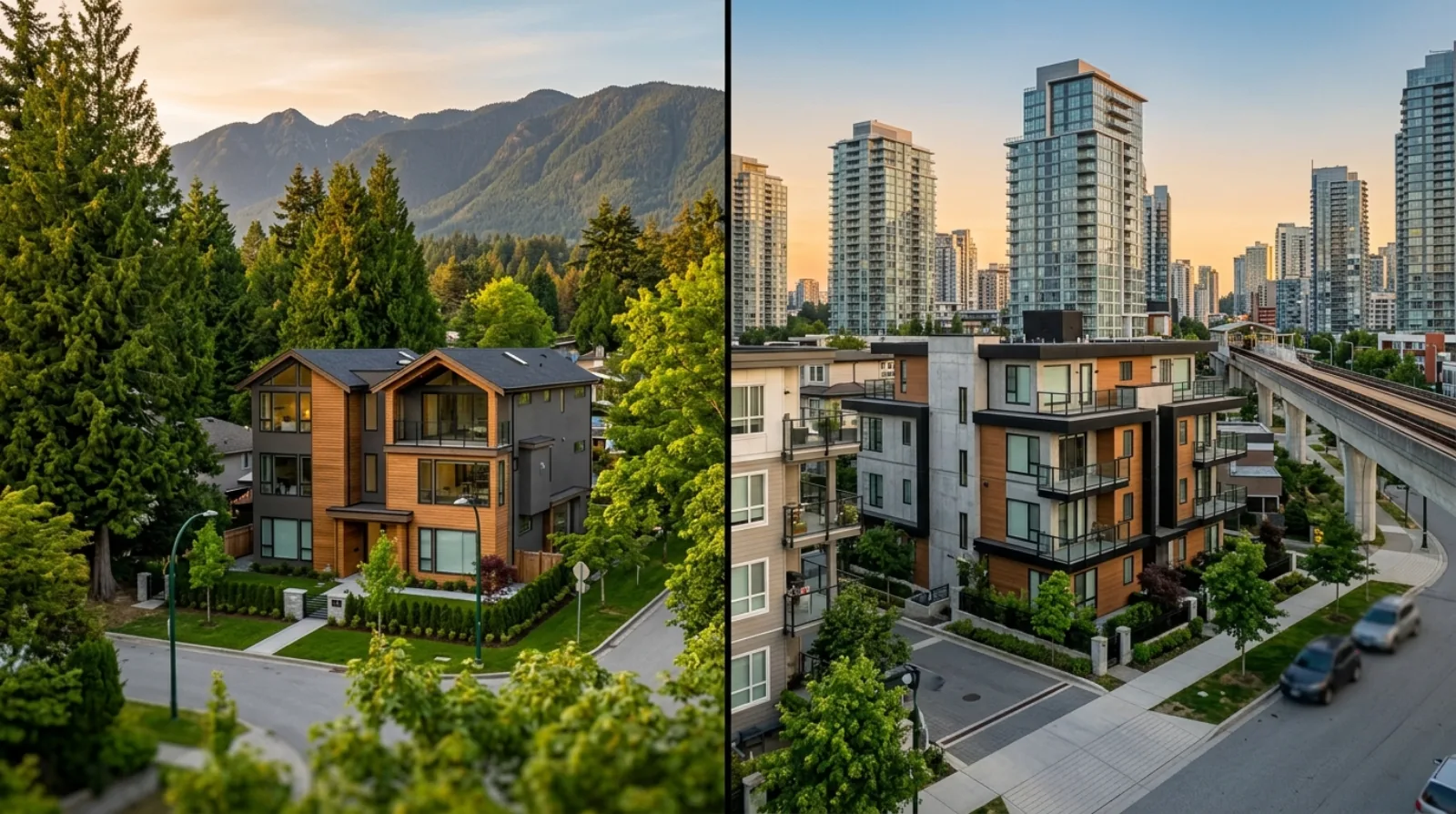
Coquitlam vs Burnaby: The Better Multiplex Buy?
Coquitlam vs Burnaby for a brand-new multiplex home: price, SkyTrain commute, schools, parks, and feel compared — with a clear 2026 verdict on who should pick which.
By MultiLiving Editorial · July 19, 2026
Questions about this guide: Gary Paul, REALTOR®, Personal Real Estate Corporation, Grand Central Realty, 778-828-7476
Two families sit at the same kitchen table, pooling money to buy one brand-new multiplex home so two generations can live close. They have narrowed it down to two places: Coquitlam or Burnaby. Both are on the SkyTrain. Both have brand-new duplexes, triplexes, and fourplexes coming to market. Both are cheaper than the West Side of Vancouver. So which one wins?
We'll say it plainly: this is a real trade-off, not a trick question. Coquitlam gives you more room and more trees for less money, but a longer ride downtown. Burnaby puts you closer to the action and closer to your job, but you pay for it in dollars and in density. This is an opinion piece, so we'll take a side at the end. But every number below is checked, and we'll show our work. If you want the deep-dive on each city on its own, we have a full Coquitlam multiplex buyer's guide and a Burnaby multiplex market guide. This piece is the head-to-head.
The short version, if you only read one paragraph
Pick Coquitlam if space, quiet, and greenery matter more to you than a short commute, and if you'd rather spend your extra money on square footage than on being 15 minutes closer to downtown. Pick Burnaby if a fast trip to work and a walk-everywhere lifestyle are worth paying more per square foot. That's the whole debate in two sentences. Everything below is why we think that, and where each of you might land differently.
Price and value: where does your money go further?
Start with the number that decides most of this. Townhouse-style and multiplex homes are tracked together in the regional benchmark, so it's the closest apples-to-apples we have. According to Greater Vancouver Realtors' June 2026 numbers, the townhouse benchmark across the whole region sat at about $1,046,200, roughly 5% lower than a year earlier.
Now the two cities. In Coquitlam, the townhouse benchmark was around $999,500 in June 2026, down about 5.7% year over year, per the June 2026 GVR statistics summary. In Burnaby, the same benchmark was closer to $1.14 million and had actually edged up slightly over the year, as reported in Burnaby's June 2026 townhouse market report.
So the gap is real: roughly $140,000 between a typical Coquitlam attached home and a typical Burnaby one. And the direction is telling. Coquitlam prices softened over the year while Burnaby held firm. In our view, that says something honest about demand — people are paying a premium to be in Burnaby, and they know it.
What does $140,000 buy in practice? Usually a bedroom, or a real yard, or the difference between a two-bedroom and a three-bedroom unit. For two families sharing a home, that extra room is not a luxury. It's the difference between everyone having their own space and everyone tripping over each other. Frame benchmark prices as an approximate guide, not a quote — the home you actually see may sit above or below these numbers depending on the street, the finish, and the size. But the pattern holds across the region.
- Coquitlam: more space per dollar. Your budget stretches to a bigger unit or an extra bedroom.
- Burnaby: you pay more, and you're paying for location, not for extra room.
- The gap (~$140k in mid-2026) is roughly one bedroom's worth of space.
Commute and SkyTrain: who gets downtown faster?
This is where Burnaby fights back, hard. If your job or your social life is anchored downtown, the difference is not small.
From Burnaby's Metrotown station, the Expo Line reaches Waterfront in downtown Vancouver in about 18 to 19 minutes, with trains every five minutes or so, according to TransLink's Expo Line schedule. Brentwood and the other Millennium Line hubs in north Burnaby run a bit longer once you factor a transfer, but you're still looking at a ride, not an expedition.
From Coquitlam City Centre, the trip downtown on the Millennium Line runs closer to 40 to 45 minutes. The Evergreen Extension opened on December 2, 2016 and connected Coquitlam to the rest of the network for the first time, running 10.9 kilometres from Lougheed Town Centre up to Lafarge Lake–Douglas, per TransLink and the extension's public record. It changed the city. But geography is geography — Coquitlam is simply farther out.
So call it roughly a 20-minute-each-way difference at rush hour, Burnaby's favour. Over a five-day work week that's more than three hours. Here's our honest opinion, though: a lot of families overweight this. If one of you works downtown five days a week, Burnaby's edge is worth real money. If you both work locally, or from home, or somewhere that isn't the downtown core, that 20 minutes matters far less than it feels like it should when you're standing on a platform imagining it.
Schools: which district is better for the kids?
If you're bringing children, this one carries weight, and here Coquitlam has a genuine advantage that surprises people.
Coquitlam sits inside School District 43, the third-largest district in British Columbia, with roughly 32,000 students across about 70 schools, according to SD43's own record. It runs one of the biggest French immersion programs in the province — around 5,900 students, spread across some twenty schools, per a local breakdown of SD43 immersion. If bilingual education is on your list, the sheer number of seats matters.
Burnaby's School District 41 is well regarded too, and its French immersion applications open on the usual annual cycle, per Burnaby Schools. It's a strong district. But Coquitlam's is bigger, and for immersion specifically, more seats usually means a better chance of getting into a program that fills up fast.
Our take: for a family whose whole reason for moving is the kids, Coquitlam edges this. Not because Burnaby schools are weak — they're not — but because a larger district with more immersion capacity gives you more room to land where you want. Check the specific catchment for any home you're serious about, because in both cities the school you get depends on the exact address, not the city name on the sign.
Parks and the outdoors: room to breathe
This is Coquitlam's home turf, and it isn't close.
Coquitlam has Mundy Park — 178 hectares of rare urban forest with about 16 kilometres of trails and two small lakes, per the City of Coquitlam. Como Lake gives you a flat one-kilometre loop that's perfect for a toddler on a balance bike or a grandparent on an evening walk. Town Centre Park and Lafarge Lake sit right next to each other with a spray park, a playground, and an easy lakeside path. The city's wider trail network runs well past 120 kilometres. If your idea of a good weekend is trees and quiet, Coquitlam delivers it at your doorstep.
Burnaby is far from a concrete box, to be fair. Central Park near Metrotown is 90 hectares of forest and playing fields right on the Vancouver border, per Tourism Burnaby. Deer Lake Park is genuinely lovely — herons, a paved lakeside path, art galleries and a village museum a short walk away. Robert Burnaby Park adds creeks and jogging trails in the south. Burnaby has real green space, and plenty of it.
But there's a difference between having good parks and being surrounded by forest. Coquitlam feels like it's built inside the trees. Burnaby feels like a city that made room for parks. Both are valid. If waking up to green is a core reason you're moving, that leans Coquitlam. If you're happy with a great park a SkyTrain stop away, Burnaby is more than enough.
Neighbourhood feel: urban energy vs green calm
Here's the part that isn't on any spreadsheet, and honestly might decide the whole thing for you.
Burnaby's multiplex hubs — Metrotown, Brentwood, Lougheed, Edmonds — feel like small downtowns. Glass towers, busy plazas, restaurants, and a mall you can walk to. Metropolis at Metrotown is the largest shopping centre in the province, about 1.7 million square feet and 400-plus stores, per its public profile. Living in a brand-new multiplex near one of these hubs means you can leave the car at home for most of your errands. It's dense, it's convenient, and for some people that energy is the whole appeal.
Coquitlam is calmer and greener. It has its own city centre — Coquitlam Centre mall is a big, established shopping destination at over 930,000 square feet, per its listing — but step a few blocks off the core and you're on quiet, leafy residential streets with mountains in view. It feels more like a town than a mini-city. For a family that wants their kids riding bikes on calm streets and Sunday dinners without traffic noise, that matters.
Neither feel is better. They're for different people. And this is the honest heart of the whole comparison: the price gap, the commute gap, the parks — they all line up behind this one question. Do you want to live in the middle of things, or a little apart from them?
Shopping, food, and daily life
Day-to-day convenience tilts toward Burnaby, and it's not subtle. Between Metrotown, Brentwood, and Lougheed, Burnaby stacks up more big retail, more restaurants, and more of the walk-out-your-door-and-it's-there kind of living. If you hate driving to get a coffee or a grocery run, Burnaby makes life easy.
Coquitlam has everything you actually need — Coquitlam Centre, grocery stores, restaurants, the works — but it's spread out more, and you'll drive more often. That's not a knock. Plenty of families prefer a parking spot and a quiet street to a crowded plaza. But if walkable convenience is high on your list, be honest with yourself: Burnaby wins that one.
Who should pick which
Time to take a side. Here's how we'd steer a family, based on what they actually value.
Pick Coquitlam if…
- Space is your top priority and you want the most bedrooms and yard your budget can buy.
- You have young kids and want big parks, forest trails, and a large school district with lots of immersion seats.
- You work locally, from home, or somewhere that isn't the downtown core.
- You want a quieter, greener, more town-like feel over urban energy.
- The roughly $140k saving matters, and you'd rather put it toward square footage.
Pick Burnaby if…
- A fast trip downtown is a real part of your week and 18–19 minutes on the Expo Line changes your life.
- You want to walk to shopping, food, and transit and drive as little as possible.
- You like the energy of a busy, built-up hub like Metrotown or Brentwood.
- You'd trade some space and some money to be closer to everything.
- Holding value matters to you — Burnaby's prices held up better over the past year.
Our verdict
If you put a gun to our head: for the two-generation family pooling money to buy one brand-new multiplex home, we lean Coquitlam. Here's the reasoning. The whole point of this kind of purchase is space — room for parents on one floor and kids on another, room to actually live together without living on top of each other. Coquitlam gives you more of that for less, plus the parks and the school district that make family life easier. The commute is the price you pay, and for a family that isn't glued to downtown five days a week, it's a price worth paying.
But we'd flip that in a heartbeat for a different family. If one or both of you commutes downtown daily, or you want a genuinely walkable, car-light life, Burnaby earns its premium and then some. It's not a worse choice. It's a different life. The mistake would be picking Burnaby's higher price for the space, or picking Coquitlam's lower price and then discovering you resent the commute every single morning. Know which of those two people you are before you sign anything.
What this comes down to
- Coquitlam is cheaper — about $140k less on a typical attached home in mid-2026 — and gives you more space and more trees.
- Burnaby gets you downtown far faster (~18–19 min from Metrotown vs ~40–45 min from Coquitlam) and offers a walkable, built-up lifestyle.
- Coquitlam edges the school question thanks to a large district with lots of French immersion capacity.
- Coquitlam wins on parks and forest; Burnaby wins on shopping and daily convenience.
- It really comes down to one thing: do you want to live in the middle of things, or a little apart from them?
Frequently asked questions
Is Coquitlam cheaper than Burnaby?
Yes. In June 2026 the typical attached home benchmark was about $999,500 in Coquitlam versus roughly $1.14 million in Burnaby, per Greater Vancouver Realtors data — a gap of about $140,000. Coquitlam prices also softened over the year while Burnaby's held firm.
Which has the faster downtown commute?
Burnaby, clearly. From Metrotown, the Expo Line reaches downtown Vancouver in about 18–19 minutes. From Coquitlam City Centre, the Millennium Line trip runs closer to 40–45 minutes. Over a work week, that difference adds up to more than three hours.
Which is better for families with young kids?
We lean Coquitlam. It has large parks like Mundy Park with 16 km of trails, quieter residential streets, and School District 43 — the third-largest in BC — with one of the province's biggest French immersion programs. Burnaby is family-friendly too, just denser and busier.
Where do you get more space for the money?
Coquitlam. That roughly $140,000 price gap usually buys you an extra bedroom or a real yard. For two families sharing one multiplex home, that added room often matters more than being 20 minutes closer to downtown.
Which city has better schools?
Both are strong. Coquitlam's School District 43 is the third-largest in BC with about 32,000 students and heavy French immersion capacity. Burnaby's District 41 is well regarded as well. For immersion specifically, Coquitlam's larger program gives you more seats and better odds.
Which is better for the outdoors?
Coquitlam. Mundy Park, Como Lake, and Town Centre Park put forest and lakes at your doorstep, with a trail network over 120 km. Burnaby has excellent parks too — Central Park and Deer Lake — but it feels like a city with parks, while Coquitlam feels built inside the trees.
Which is more walkable?
Burnaby, by a wide margin near its hubs. Around Metrotown, Brentwood, and Lougheed you can walk to shopping, food, and SkyTrain and rarely touch a car. Coquitlam has everything you need, but it's more spread out, so you'll drive more often.
Does Burnaby hold its value better?
Over the past year, yes. Burnaby's townhouse benchmark edged up slightly year over year in June 2026 while Coquitlam's fell about 5.7%. That suggests steady demand for Burnaby's location. Past movement is not a guarantee, but it's a real signal.
Is the SkyTrain good in both cities?
Yes, both sit on the network. Burnaby is served by the Expo and Millennium lines with hubs at Metrotown, Brentwood, and Lougheed. Coquitlam joined via the Evergreen Extension, which opened December 2, 2016, connecting the city to the rest of the SkyTrain system.
Which is better if I work from home?
Coquitlam becomes much more attractive. The commute penalty is the main thing Burnaby holds over it, so if you don't commute downtown daily, that gap mostly disappears — and you keep Coquitlam's extra space, lower price, and greener surroundings.
Are brand-new multiplex homes available in both cities?
Yes. Both Coquitlam and Burnaby have brand-new duplexes, triplexes, and fourplexes coming to market for buyers. The mix and pace vary by neighbourhood. You can browse current and upcoming options on our properties page and we'll flag what fits your budget and family size.
Which city is better for a two-generation family buying together?
We lean Coquitlam for this specific case. The whole point of pooling money is space — a floor for each generation. Coquitlam delivers more room for less, plus family-friendly parks and schools. Burnaby wins if a daily downtown commute is central to your life.
Should I choose Burnaby just because it's closer to downtown?
Only if you actually use that proximity. If one of you commutes downtown daily, Burnaby's 20-minute edge is worth real money. If you both work locally or remotely, many families overweight the commute and would be happier with Coquitlam's space and savings.
How do I decide between the two?
Answer one question honestly: do you want to live in the middle of things, or a little apart from them? Then match it to your commute and budget. If you'd like help weighing it for your family and seeing real homes in both cities, reach out to us — that's exactly what we do.
Still torn between Coquitlam and Burnaby? That's normal — this is a genuine trade-off, and the right answer depends on your family's daily life, not a chart. Tell us how you work, where the kids go to school, and what your budget is, and we'll show you real brand-new multiplex homes in both cities so you can compare them side by side. Get in touch with our team or browse current multiplex homes to start.