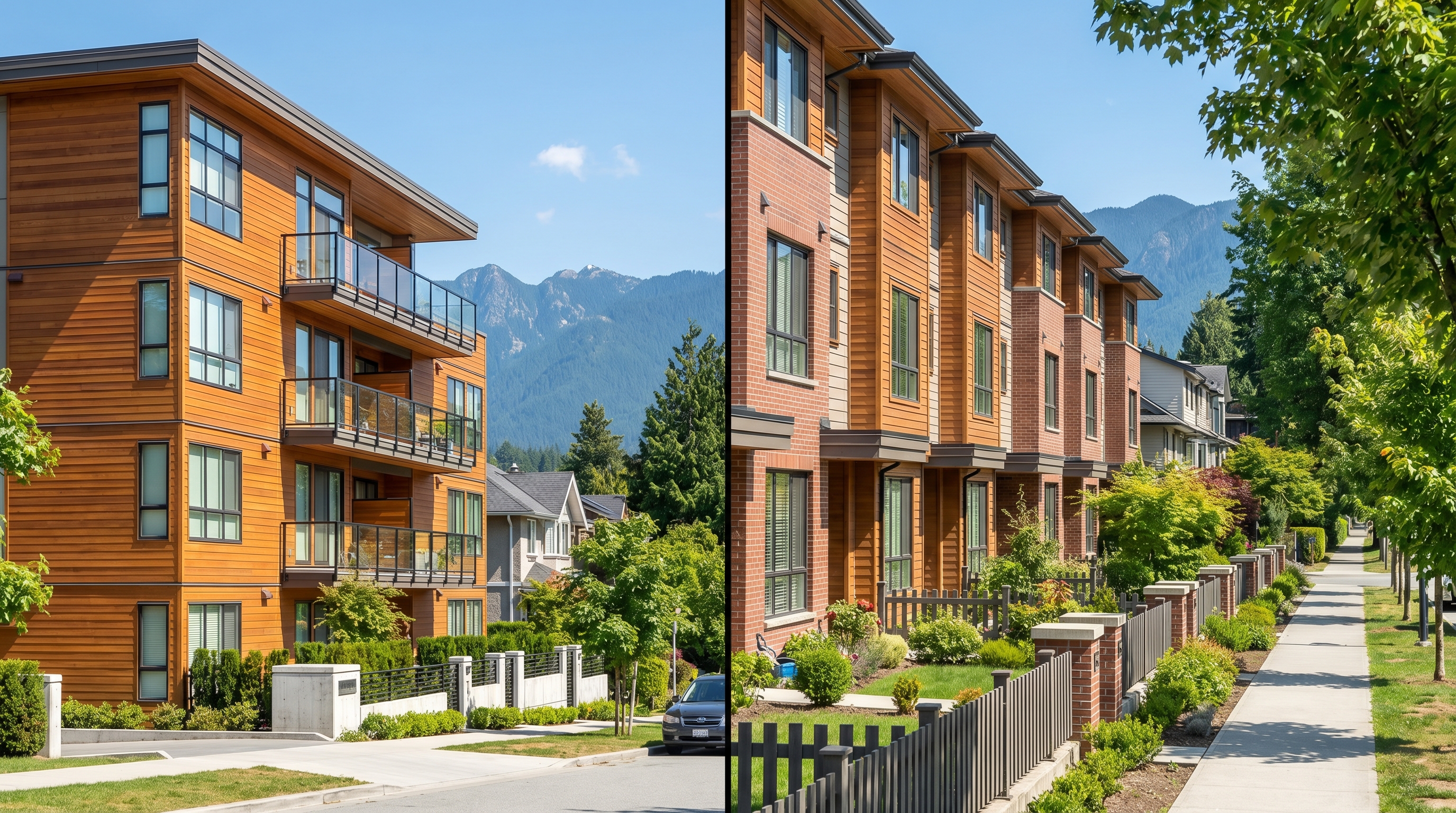
Multiplex vs Townhouse: Which Is the Better Buy?
Price, space, strata fees, resale value — a side-by-side comparison of multiplex units and townhouses for Vancouver buyers in 2026.
By MultiLiving Editorial · April 14, 2026
Questions about this guide: Gary Paul, REALTOR®, Personal Real Estate Corporation, Grand Central Realty, 778-828-7476
If you are shopping for ground-oriented housing in Metro Vancouver right now, two property types keep landing on your shortlist: the multiplex unit and the townhouse. On paper they look similar. Both give you multiple floors, a front door at street level, and more space than a condo. But the similarities end there.
Price gaps, ownership structures, strata fees, and long-term equity tell very different stories depending on which type you choose. This guide breaks down every factor that matters in 2026 so you can make a decision based on real numbers, not marketing brochures.
Price Comparison: What You Actually Pay in 2026
The Greater Vancouver Realtors (GVR) March 2026 benchmark for attached homes sits at $1,047,100, down 5.7% year-over-year. That benchmark blends townhouses and row homes across the entire region, so it is not a perfect proxy for either property type. But it is the closest official figure we have.
New-construction multiplex units tell a different pricing story. Completed fourplex and triplex units on Vancouver’s East Side have sold between $1,050 and $1,250 per square foot in early 2026, while West Side projects have closed at $1,250 to $1,414 per square foot. A 1,100-square-foot unit in a new fourplex on the East Side lands around $1,150,000 to $1,375,000 depending on finishes and orientation, according to proforma data published by VanPlex.
Resale townhouses, by contrast, cluster around $900 to $1,100 per square foot for newer builds and drop to $700–$850 per square foot for older stock. A 1,300-square-foot resale townhouse in Burnaby typically lists between $950,000 and $1,200,000.
The bottom line: multiplex units carry a new-construction premium, but they also come with modern building codes, energy efficiency, and zero deferred maintenance. Resale townhouses are cheaper upfront but may need $50,000+ in near-term upgrades if the building is 15–20 years old.
Space and Layout Differences
A typical multiplex unit in Vancouver ranges from 850 to 1,400 square feet. Ground-floor units in a fourplex are usually two-bedroom, two-bath at 850–1,100 square feet. Upper units get more space — 1,200 to 1,400 square feet with three bedrooms is common, often spread across two levels with an internal staircase.
Townhouses in Metro Vancouver average around 1,200 to 1,500 square feet, according to Statistics Canada data showing a median above-grade area of 1,330 square feet for row houses in BC. Newer townhouse developments push closer to 1,600 square feet with three bedrooms and 2.5 bathrooms on three levels.
Here is where things get interesting. Townhouses almost always stack vertically across three narrow floors. That means stairs — lots of them. A family with a stroller or an older adult with mobility concerns will feel those stairs every single day.
Multiplex units, especially ground-floor ones, can offer single-level living with direct garden access. That is a genuine advantage for accessibility and aging in place. Upper multiplex units do have stairs, but typically just one flight between two levels rather than the two flights typical of a townhouse.
Outdoor space differs too. Townhouse buyers usually get a small front yard and a fenced rear patio. Multiplex ground-floor units get comparable outdoor space. Upper units get balconies or rooftop decks, which can be generous (100–200 square feet is common) but feel different from a ground-level yard.
Strata Fees: The Monthly Cost Nobody Ignores
Strata fees are the second mortgage that never gets paid off. They matter enormously when comparing these two property types.
Townhouse Strata Fees
Townhouse complexes generally charge $0.20 to $0.45 per square foot per month. For a 1,300-square-foot townhouse, that works out to roughly $260 to $585 per month. Older complexes with aging roofs, elevators in common areas, or swimming pools can push well above $600. Insurance costs have driven many townhouse stratas to special levy territory in the past three years.
Multiplex Strata Fees
New multiplex buildings have a structural advantage here: fewer units sharing fewer common elements. A four-unit strata has no elevator, no lobby, no gym, and no concierge. Monthly fees for new multiplex units typically run $150 to $350 per month, depending on the building’s insurance costs and whether the strata funds landscaping and snow removal.
That is a meaningful difference. Over 10 years, a $200/month gap in strata fees adds up to $24,000 — money that could go toward your mortgage principal instead.
Our take: New multiplex strata fees are genuinely lower, but watch the trajectory. As these buildings age and need roof replacements or envelope repairs, fees will climb. The advantage is real today but will narrow over 15–20 years.
Ownership Structure: Fee Simple vs. Strata Title
This is one of the most misunderstood differences between the two property types.
Most multiplex units in Vancouver are sold as strata title under the BC Strata Property Act. You own your unit and a proportional share of common property (roof, foundation, landscaping, shared walls). The strata corporation manages insurance, maintenance reserves, and bylaw enforcement.
Townhouses come in two flavours: strata title and fee simple (freehold). Fee simple townhouses are less common in Vancouver but more common in newer master-planned communities in Burnaby and the Tri-Cities. With fee simple ownership, you own the land under your unit outright. You pay a homeowners association (HOA) fee — typically $100 to $350 per month — that covers shared roads, visitor parking, and common landscaping, but your roof, walls, and building insurance are entirely your responsibility.
Fee simple townhouses command a price premium of roughly 5–10% over comparable strata townhouses because buyers value the autonomy. You can renovate without strata approval, paint your front door whatever colour you want, and you are not tied to a building insurance policy set by committee vote.
Multiplexes are virtually all strata title. Fee simple multiplex ownership is rare because the provincial legislation that enabled multiplexes (Bill 44) anticipated strata subdivision as the standard pathway. If ownership autonomy is your top priority, a fee simple townhouse is the better fit.
Maintenance Responsibilities
Who fixes the roof when it leaks? The answer depends on your ownership structure.
Strata townhouse and multiplex owners share responsibility for common elements through their strata corporation. The strata’s contingency reserve fund (CRF) covers planned maintenance like roof replacement, exterior painting, and plumbing stack repairs. BC law requires stratas to commission a depreciation report every three years and fund at minimum the report’s recommended contributions.
Fee simple townhouse owners handle everything themselves. Your roof, your budget. That is liberating if you are handy and disciplined about saving. It is terrifying if you are not.
New multiplex buildings have one clear advantage: everything is new. The roof, the plumbing, the HVAC systems — all under warranty for 2–5 years depending on the component, with the building envelope covered by BC’s mandatory 10-year new home warranty. A resale townhouse built in 2006 has none of those protections.
Resale Value and Appreciation Trends
Townhouses have a long track record in Metro Vancouver. The GVR benchmark for attached homes has appreciated roughly 65–75% over the past decade, outperforming condos but trailing detached houses. The March 2026 benchmark of $1,047,100 is down 5.7% from a year ago, reflecting the broader rate-sensitive correction, but remains well above 2019 levels.
Multiplex units are too new to have a meaningful resale track record. The first wave of Bill 44 multiplex completions hit the market in late 2024 and early 2025. We simply do not have five or ten years of price data to chart a trend line.
What we do know: the 46 multiplex land sales that closed in 2025 represented $114 million in total land value, averaging about $2.5 million per transaction. That signals strong developer confidence in the product type. But developer confidence and buyer resale performance are not the same thing.
Our take: Townhouses are the safer bet for predictable appreciation. Multiplex units carry more uncertainty but also more upside potential. If you believe Vancouver will continue densifying along transit corridors — and all evidence says it will — then owning a ground-oriented unit in a walkable neighbourhood should hold value regardless of whether it is a townhouse or a multiplex.
Lifestyle Differences: Who Suits Each Type
Multiplex Units Work Best For
- Couples and small families who want new construction without paying detached-home prices
- Downsizers who want single-level living on the ground floor with garden access
- Multigenerational families who buy multiple units in the same building
- Buyers who prioritize energy efficiency and modern building performance (Step Code compliance)
- People who dislike large strata councils and complex bylaws
Townhouses Work Best For
- Growing families who need three bedrooms and a small yard
- Buyers who want a proven resale track record and conventional mortgage appraisals
- People who value the fee simple ownership option
- Pet owners who want a fenced yard (though strata bylaws still apply in many complexes)
- Buyers looking in suburban locations like South Burnaby or Coquitlam where townhouse supply is deeper
Parking and Storage Comparison
Parking can make or break a deal in Vancouver, where a single underground stall adds $50,000–$80,000 to a project’s hard costs.
Townhouse complexes typically provide one to two parking stalls per unit — either in an attached single-car garage or in a shared underground parkade. Storage lockers are usually included. Visitor parking varies: older complexes are generous, newer ones less so.
Multiplex units are a mixed bag. Vancouver’s zoning allows multiplexes to be built with zero to one parking stall per unit, depending on proximity to transit. A fourplex near a SkyTrain station might offer no dedicated parking at all, relying on street parking and bike storage instead. Projects farther from transit typically include one stall per unit in a surface pad or tandem driveway configuration.
If you own two cars, a townhouse is almost certainly the better option. If you are a one-car or no-car household near transit, the multiplex’s lower parking allocation will not bother you — and you are not paying for stalls you do not need.
Pet Rules and Strata Bylaws
BC’s Strata Property Act was amended in 2023 to prohibit blanket pet bans in strata buildings. Both townhouse and multiplex stratas must now allow at least one cat or one dog per unit. However, stratas can still impose reasonable restrictions: weight limits (25–30 kg is common), breed restrictions, and requirements for pets to be leashed in common areas.
Townhouse complexes with fenced yards are generally more pet-friendly in practice. Your dog has outdoor space without you needing to walk to a park every time. Multiplex ground-floor units with garden patios offer similar benefits. Upper-floor multiplex units are more like condos for pet purposes — functional, but you will be taking the stairs for every bathroom break.
If you have large dogs or multiple pets, check the specific strata bylaws before making an offer on either property type. The legal minimum (one pet allowed) and the practical reality of living with a Great Dane in a 900-square-foot upper unit are very different things.
Our Take: When to Pick Which
We have spent the past two years tracking Vancouver’s multiplex market closely. Here is our honest assessment.
Choose a multiplex unit if: you want new construction, lower strata fees, modern energy performance, and you are buying near transit where parking is not essential. Multiplex units are particularly strong for downsizers seeking ground-floor single-level layouts and for multigenerational families buying multiple units in one building. The pricing premium over resale townhouses is real, but you are getting a brand-new home with warranties and no deferred maintenance.
Choose a townhouse if: you need a proven resale track record, want fee simple ownership as an option, require two parking stalls, or are buying in a suburban location where townhouse supply is strong. Families with kids will generally find townhouse layouts more practical — three full floors give you separation between living space, bedrooms, and a rec room or home office.
The honest truth is that neither property type is universally better. The right choice depends on your household size, commute pattern, parking needs, and tolerance for being an early adopter. Multiplex units are the newer, less-tested product. Townhouses are the known quantity. Both are solid paths to ground-oriented homeownership in a city where detached houses are out of reach for most buyers.
Are Multiplex Units Cheaper Than Townhouses in Vancouver?
Not necessarily. New multiplex units sell for $1,050–$1,414 per square foot in Vancouver, which is comparable to or higher than new townhouses. However, resale townhouses built 10–20 years ago are typically 15–25% cheaper per square foot than new multiplex units. The price gap narrows when you factor in the deferred maintenance costs of older buildings.
Do Multiplex Units Hold Their Value?
It is too early to say definitively. The first wave of completed multiplex units only entered the resale market in late 2024. Developer confidence is strong — 46 multiplex land sales closed in 2025 totalling $114 million — but individual unit resale data is limited. Townhouses have a much longer appreciation track record in Metro Vancouver.
Which Has Lower Strata Fees: Multiplex or Townhouse?
New multiplex units typically have lower strata fees — around $150 to $350 per month compared to $260 to $585 per month for townhouses. Multiplex buildings have fewer common amenities and fewer units sharing costs. However, fees will rise as these buildings age and need major repairs.
Can I Get Fee Simple Ownership in a Multiplex?
Fee simple multiplex units are rare in Vancouver. Nearly all multiplex projects use strata title ownership under the BC Strata Property Act. If fee simple ownership is important to you, townhouses in newer master-planned communities are more likely to offer that option, particularly in Burnaby and the Tri-Cities.
Key Takeaways
- The GVR March 2026 attached-home benchmark is $1,047,100, down 5.7% year-over-year.
- New multiplex units sell for $1,050–$1,414/sqft; resale townhouses sell for $700–$1,100/sqft.
- Multiplex strata fees run $150–$350/month vs. $260–$585/month for townhouses.
- Townhouses offer fee simple ownership options; multiplex units are nearly all strata title.
- Multiplex ground-floor units offer single-level living — a real advantage for accessibility.
- Townhouses have a 10+ year resale track record; multiplex units do not yet.
- Parking allocation favours townhouses (1–2 stalls) over multiplexes (0–1 stalls).
- Neither type is universally better — your household needs and location preferences should drive the decision.
Related Resources
Multiplex vs Condo
Side-by-side comparison for buyers
Multiplex vs Condo vs Townhouse
Three-way comparison
Multiplex for Sale in Vancouver
Browse all Vancouver listings
Where to Buy in Vancouver
Neighbourhood comparison guide
Vancouver Pre-Sales
Active & upcoming projects
Browse All Listings
Multiplex homes across BC