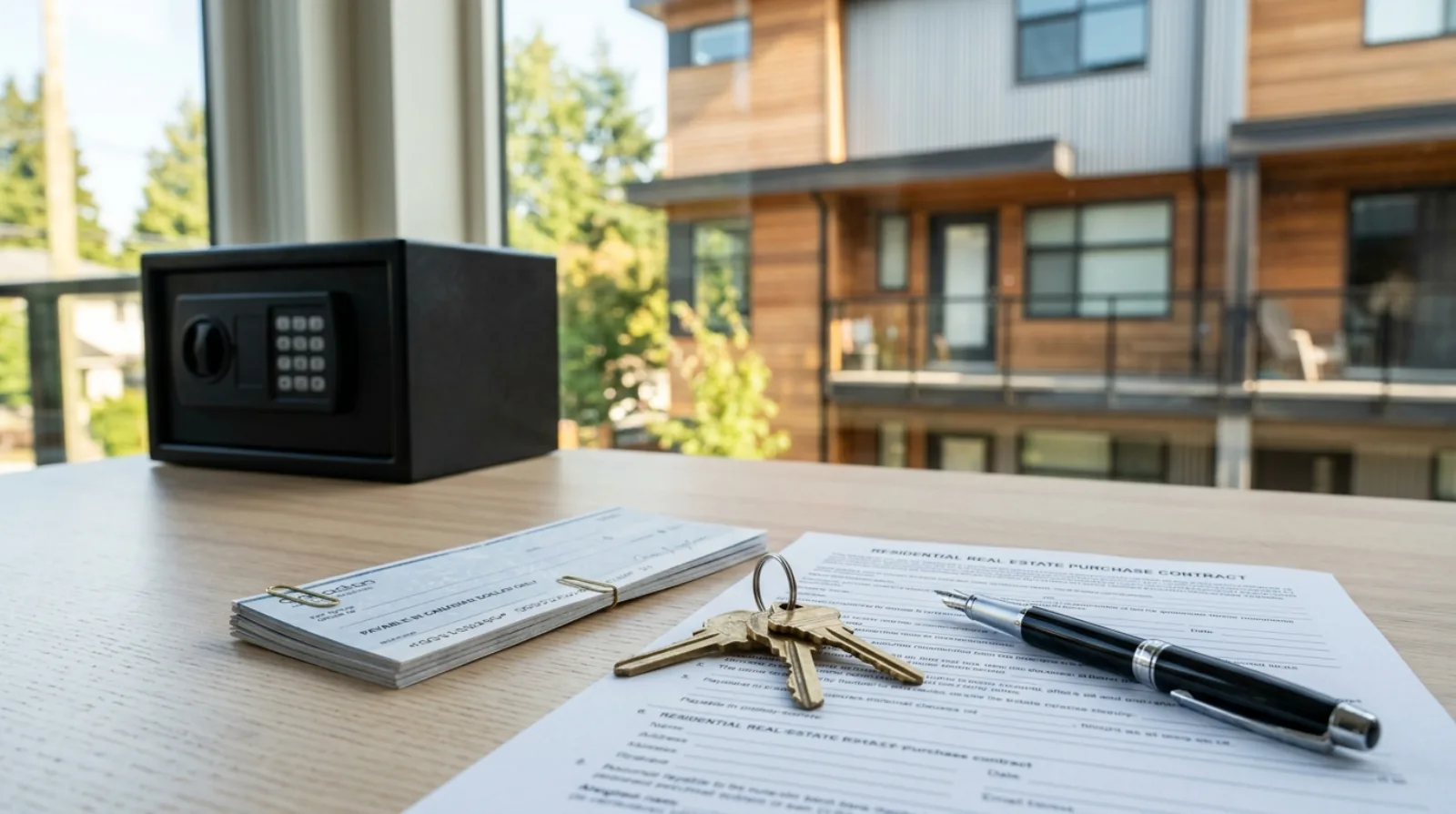
How Your Pre-Sale Multiplex Deposit Is Protected
How BC law protects your pre-sale multiplex deposit: held in trust under REDMA, the 7-day cancellation refund, and what happens if the project is cancelled.
By MultiLiving Editorial · July 18, 2026
Questions about this guide: Gary Paul, REALTOR®, Personal Real Estate Corporation, Grand Central Realty, 778-828-7476
Handing over a big cheque for a home that is not built yet feels strange the first time you do it. You are trusting a company you may have only met a few weeks ago with tens of thousands of dollars, and the keys are still a year or two away. That worry is normal. The good news is that in British Columbia, the money you put down on a brand-new pre-sale multiplex home is not just sitting in the developer's bank account waiting to be spent. It is protected by law.
One note before we start. This is general information written for buyers, not legal advice. The exact terms of your deal live in your contract and your disclosure statement, and every project is a little different. Before you sign anything, read those documents and confirm the details with your own lawyer or notary.
Deposit vs down payment: two different things
People use these words as if they mean the same thing. They don't, and mixing them up leads to real confusion about how much cash you need and when.
Your deposit is the money you pay early to hold your unit and show the developer you are serious. On a pre-sale, it usually gets paid in stages over the months while the home is being built. It sits in a trust account the whole time. When your home is finished and you close, the deposit counts toward your purchase — it is not an extra cost on top.
Your down payment is the total amount of your own money that goes into the purchase, as opposed to the money your mortgage lender puts up. Your deposit is part of your down payment. So if you plan to put 20% down and you have already paid a 10% deposit in stages, you bring the remaining 10% at closing, and the bank finances the other 80%.
How pre-sale deposits are usually structured
On a resale home, you write one deposit cheque and that is that. Pre-sale works differently. Because the home takes time to build, developers usually collect the deposit in a few smaller payments spread across the construction period. This is called a staged or instalment deposit.
A common schedule looks something like this, though every project sets its own terms:
- A small amount — sometimes as little as $1,000 — when you sign the contract.
- A larger payment, often 5% of the price, once your 7-day cancellation window closes.
- One or two more payments, each usually around 5%, at set dates as construction moves along.
Across the whole schedule, total pre-sale deposits in British Columbia commonly land somewhere between 15% and 25% of the purchase price, paid in instalments at pre-set stages, according to MLA Canada, a firm that markets new-home projects across the province. The exact split and total depend on the developer and the project, so read your own contract for the real numbers.
In our view, the staged structure is one of the quiet advantages of buying pre-sale. You are not writing one enormous cheque on day one — you put down a smaller amount to lock in your unit and today's price, then top it up over time.
Your deposit must be held in trust — the developer can't just spend it
This is the part that should put your mind at ease. In British Columbia, developers cannot take your pre-sale deposit and pour it straight into building costs or their own operating account. The law says the money has to be set aside and held for you.
The rule comes from the Real Estate Development Marketing Act — usually shortened to REDMA — which is the provincial law that governs how brand-new homes are marketed and sold before they are finished. Section 18 of that Act says a developer who receives a deposit must promptly place it with a brokerage, a lawyer, a notary public, or another approved person, who then holds the money as a trustee in a trust account at a savings institution in British Columbia.
A trust account is a separate, protected account kept apart from the developer's own money. The person holding it — the trustee — holds it for both you and the developer at the same time, not as anyone's agent. That is confirmed by guidance from the former Real Estate Council of BC, whose oversight role has since moved to the BC Financial Services Authority (BCFSA), the provincial regulator.
Who is allowed to hold your deposit?
Under REDMA section 18, only a short list of people can act as the trustee for your deposit:
- A licensed real estate brokerage in British Columbia
- A BC lawyer
- A BC notary public
- Another person specifically approved to hold these funds
The trust account itself has to be at a savings institution — a bank, credit union, or trust company — located in British Columbia. This matters because it keeps your money inside a regulated system that the BCFSA oversees. When you make your deposit payment, ask who the trustee is and get written confirmation that they received your money. More on that below.
When does the developer actually get your money?
The deposit does not stay locked up forever. At some point it is released to the developer and applied to your purchase. The question is when, and REDMA sets clear rules for that.
The trustee releases your deposit to the developer once the developer certifies in writing that all of the following are true:
- Your 7-day right to cancel has ended (we cover that next).
- The strata plan or other required plan has been filed at the land title office, if that step applies.
- The approvals needed to legally live in the home have been obtained.
In plain terms, the developer generally cannot pull your deposit out of trust until your home is real enough to live in and your cancellation window has closed. Those conditions come straight from section 18 of the Real Estate Development Marketing Act.
The one exception: deposit protection insurance
There is a second path. Under REDMA section 19, a developer who wants to use deposit money earlier can buy a deposit protection contract — a form of insurance on your deposit. If the developer arranges approved deposit insurance and gives the trustee proof of it, the trustee may release the deposit to the developer for the developer's own use before the home is finished.
If that happens, your money is not sitting in trust anymore, but it is not unprotected either. The insurance is there so that your deposit can be paid back to you if the deal falls apart. If your disclosure statement mentions deposit insurance, it is worth asking your lawyer or notary to explain how that specific policy protects you.
What happens to your deposit if you use the 7-day cancellation right
British Columbia gives pre-sale buyers a cooling-off period, and it is one of the strongest protections in the whole process. Under REDMA section 21, you have 7 days to cancel a pre-sale purchase — for any reason at all. You do not need to explain yourself. You do not need the developer's permission.
The clock starts on the later of two dates: the day you and the developer both sign the agreement, or the day the developer receives your written confirmation that you got and read the disclosure statement. To cancel, you serve written notice on the developer inside those 7 days.
Now the important part for your money. When you rescind inside the 7 days, section 21 says the developer must immediately tell whoever is holding your deposit, and that trustee must promptly return your deposit to you. You get your money back. This is confirmed both in the Act itself and in plain-language explanations from BC real estate lawyers such as Meridian Law Group.
So the honest answer to "can I get out early?" is yes, cleanly, within that first week. After the 7 days pass, the rules change — walking away then usually means you risk losing your deposit, which is exactly why the cooling-off period exists. Use those 7 days to actually read your documents and, if anything feels off, talk to a lawyer before the window closes.
What happens to your deposit if the project is cancelled
This is the worry that keeps some buyers up at night. You put money down, months go by, and then the whole project gets shelved. What happens to your deposit?
Because your deposit was held in trust the entire time — separate from the developer's own money — it does not disappear when a project is cancelled. If the development does not go ahead, buyers who paid a deposit get their money back. That is the core reason REDMA forces deposits into trust in the first place: so the funds are still there to be returned even if the developer's plans fall through. Several BC real estate law firms describe this exact outcome, and it is echoed in general guides such as this REDMA buyer overview.
A fair, honest caveat: a cancelled project is still a headache. Getting your deposit back can take time, and you have lost the months you spent waiting. But the actual dollars you put down are the part the law works hardest to keep safe.
Practical steps that protect you
The law does a lot of the heavy lifting here, but a careful buyer still does a few things to make sure everything is clean. Here is what we would tell a friend buying their first pre-sale.
- Pay the way your contract tells you to. Pre-sale deposits usually have to be paid by a specific method — often a bank draft, certified cheque, or wire transfer to the trustee, not cash. Follow the instructions exactly so your payment lands in the right trust account.
- Get your trust receipt. After you pay, ask for written confirmation that the trustee — the lawyer, notary, or brokerage — received your deposit. Keep it. That paper is your proof the money is where it should be.
- Actually read the disclosure statement. This is the long document the developer must give you. It covers the project, the timeline, and the deposit terms. Reading it is also what starts and ends your 7-day cancellation clock, so it is not optional homework.
- Confirm who the trustee is before you pay. You want to know the money is going to a BC brokerage, lawyer, or notary holding it in trust — not into the developer's regular account.
- Use the 7 days. Treat the cooling-off period as real. If a question comes up, get an answer — or get out — before the window shuts.
- Bring in your own lawyer or notary. For a purchase this size, having someone review the contract and disclosure statement on your side is money well spent.
One more thing people ask about: whether the deposit earns interest, and who keeps it, is set by your contract, not a single fixed rule. On most pre-sale deals the amounts are small and the terms are spelled out. If it matters to you, ask before you sign.
What this comes down to
- Your pre-sale deposit and your down payment are not the same thing. The deposit is paid early, held in trust, and counts toward your purchase; the down payment is the full amount of your own cash in the deal.
- Pre-sale deposits are usually paid in stages, often totalling somewhere around 15% to 25% of the price over the build period.
- By law (REDMA section 18), your deposit must be held in trust by a BC brokerage, lawyer, or notary — not spent by the developer.
- The developer only gets your money once your cancellation window closes and the home is approved to live in, unless deposit insurance is in place.
- You have a 7-day right to cancel for any reason, and if you do, your full deposit comes back to you.
- If the project is cancelled, your deposit is returned because it was protected in trust the whole time.
Frequently asked questions
Is my deposit safe if the project is cancelled?
Yes. Because REDMA requires your deposit to sit in a trust account separate from the developer's own money, it is still there to be returned to you if the project does not go ahead. Getting it back can take time, but the money itself is protected.
Where is my deposit held?
It is held in a trust account at a bank, credit union, or trust company in British Columbia. The account is controlled by a trustee — a licensed BC brokerage, lawyer, or notary public — not by the developer, under REDMA section 18.
Do I get my deposit back within the 7 days?
Yes. If you cancel in writing within your 7-day rescission window under REDMA section 21, the developer must tell the deposit holder and that trustee must promptly return your full deposit. You do not need a reason to cancel in those first 7 days.
How much deposit do I need for a pre-sale multiplex?
It varies by project, but total pre-sale deposits in BC commonly run about 15% to 25% of the price, paid in stages over the build. Some schedules start with as little as $1,000 at signing, then step up after the cancellation period. Check your own contract for the real numbers.
Can the developer spend my deposit before my home is built?
Generally no. The deposit stays in trust until your cancellation window closes and the home is approved for occupancy. The one exception is if the developer buys approved deposit protection insurance under REDMA section 19, which can let the money be released earlier while still keeping it insured for you.
What is the difference between a deposit and a down payment?
Your deposit is the money paid early and held in trust to secure your unit. Your down payment is the total amount of your own cash in the purchase. The deposit is the first part of your down payment — not an extra cost on top of it.
Who holds my deposit in trust?
Under REDMA, only a BC real estate brokerage, a BC lawyer, a BC notary public, or another approved person can hold it, and the trust account must be at a savings institution located in British Columbia. Ask who your trustee is before you pay.
When is my deposit released to the developer?
The trustee releases it once the developer certifies in writing that your 7-day cancellation right has ended, the required plan is filed at the land title office if needed, and the approvals to legally occupy the home are in place. These conditions are set out in REDMA section 18.
How should I pay my deposit?
Follow the exact method in your contract. Pre-sale deposits are usually paid by bank draft, certified cheque, or wire transfer to the trustee, not by cash. Paying the required way makes sure your money lands in the correct trust account.
What is a trust receipt and why do I need one?
A trust receipt is written confirmation from the trustee that they received your deposit. Keep it. It is your proof that your money is being held in trust where it should be, which is useful if any question ever comes up about your payment.
What is deposit protection insurance?
It is a contract, allowed under REDMA section 19, that lets a developer use deposit money earlier than usual while insuring it. If a developer arranges approved deposit insurance and shows the trustee proof, the deposit can be released to the developer, with the insurance there to repay you if the deal falls apart.
Does my deposit count toward the purchase price?
Yes. The deposit is not an extra fee. When your home is finished and you close, the deposit you already paid is applied against the total price, and you bring the rest of your down payment at closing while your mortgage covers the balance.
Can I lose my deposit after the 7 days pass?
You can. The clean, no-questions cancellation right only lasts 7 days. After that, backing out of the deal usually puts your deposit at risk, which is exactly why you should use the cooling-off period to read everything and confirm you want to go ahead.
Does the disclosure statement affect my deposit?
Indirectly, yes. The disclosure statement spells out the deposit terms and the project details, and the date you confirm reading it helps set your 7-day cancellation clock. If a developer fails to give you a disclosure statement you are entitled to, you may gain the right to cancel.
Should I have a lawyer review my pre-sale deposit terms?
For a purchase this size, yes. A BC lawyer or notary can read your contract and disclosure statement, confirm your deposit is going into trust, and flag anything unusual before you sign. It is a small cost next to the amount you are putting down.
Buying a brand-new multiplex home is a big step, and the deposit is often the first moment it feels real. The rules in British Columbia are built to keep that money safe while you wait for your keys — but the paperwork still deserves a careful read, and every project has its own terms. If you are looking at a pre-sale multiplex in Greater Vancouver and want a clear, honest walk-through of how a specific deal is structured, get in touch with our team or browse the homes we have available. We are here to help you buy with confidence.
This article is general information for buyers, not legal advice. Confirm the details against your own contract and disclosure statement, and speak with a lawyer or notary before you sign.