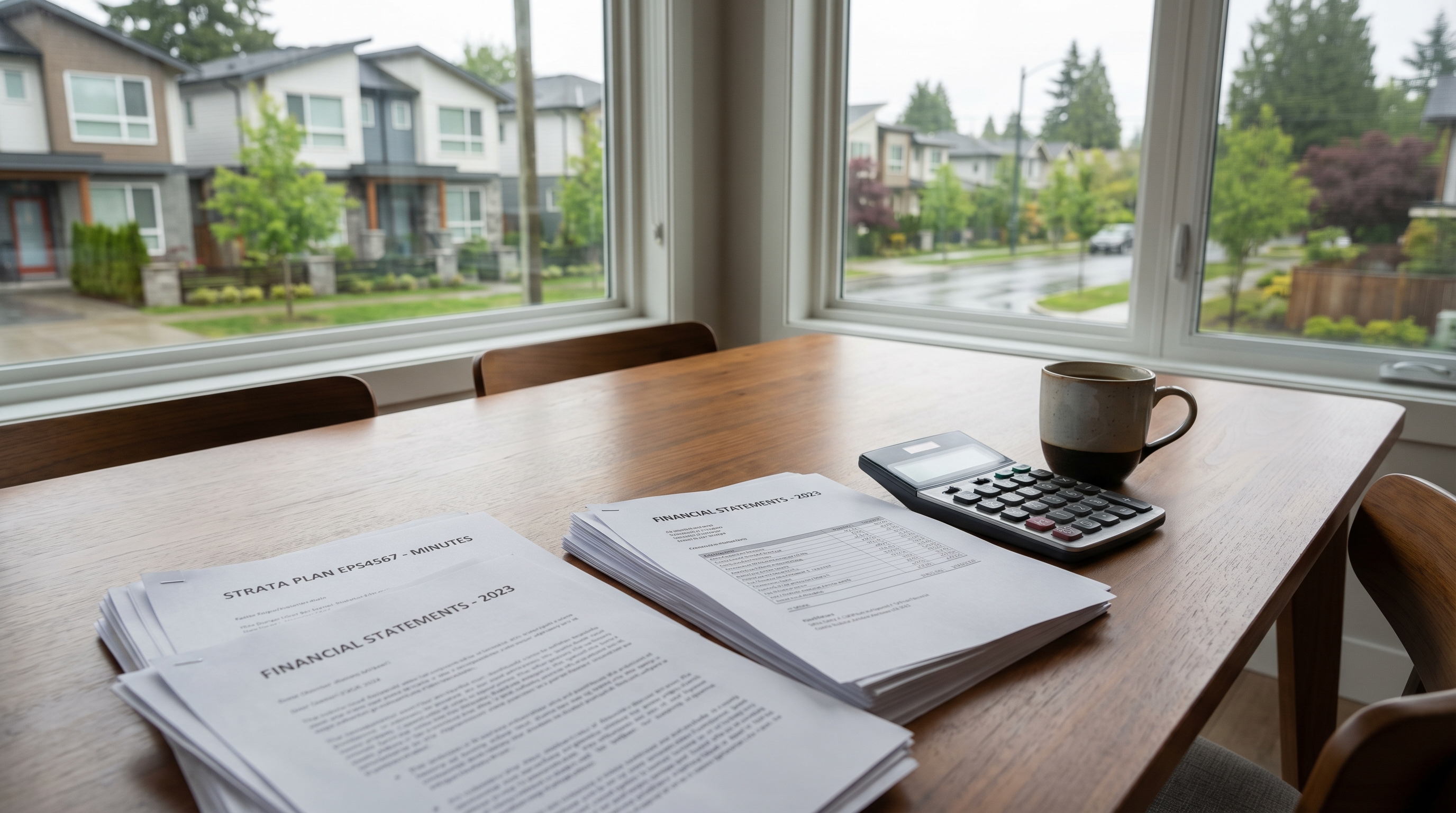
Your First Strata Meeting in a Brand-New Multiplex: What to Expect
BC law makes the owner developer call the first strata AGM. What happens at that meeting in a 4-6 unit multiplex, and why every owner should be in the room.
By MultiLiving Editorial · September 2, 2026
Questions about this guide: Gary Paul, REALTOR®, Personal Real Estate Corporation, Grand Central Realty, 778-828-7476
A few months after you move into your brand new multiplex home, a letter or email arrives: notice of the strata corporation's first annual general meeting. If you have never owned a strata home before, this document reads like it was written for someone else. It was not. It was written for you, it is about your money and your home, and the meeting it announces is the moment you and your neighbours officially take over running your own small building.
Here is the good news: in a four or six unit multiplex, this meeting is usually short, friendly, and held in someone's living room or a coffee shop. This guide explains why the meeting exists, when the law says it must happen, what actually gets decided in the room, and why showing up matters more in a small strata than almost anywhere else.
Why this meeting exists at all
When you bought your unit, you also became a member of a strata corporation, the legal body that owns and manages the shared parts of your building: the roof, the exterior, the shared yard, the insurance. Until the first annual general meeting, that corporation is run by the owner developer, which is the legal term for the company that created and sold the project.
BC's Strata Property Act does not let that arrangement continue for long. Section 16 of the Act requires the owner developer to call the first annual general meeting and hand control to the owners. The Province's guidance on new strata developments walks through the whole sequence, and it is genuinely worth reading before your meeting. The short version: the first AGM is the formal handover, after which the owners, meaning you and your neighbours, make the decisions.
When the meeting must happen
The Act sets a precise clock. The owner developer must hold the first AGM within six weeks of the earlier of two dates:
- the date when half the strata lots plus one have been transferred to buyers, or
- the date nine months after the first strata lot was transferred.
In a small multiplex, that first trigger arrives quickly. In a fourplex, half plus one is just three sold units. In a sixplex it is four. If the project sells well, your first AGM can land within a few months of the first families moving in, so do not be surprised if the notice shows up while you still have boxes in the hallway.
A few more timing rules from the Province's guidance: notice of the meeting must go out two weeks before the date, and there are real penalties for an owner developer who delays, starting at $1,000 for a delay of up to 30 days and another $1,000 for each further week. If the owner developer never calls the meeting, the Act lets the owners call it themselves. In practice, in our experience, small multiplex projects rarely have this problem; a handover meeting for five owners is easy to organize and most sellers want it done.
What actually happens in the room
The agenda at a first AGM is fairly standard, and none of it is complicated in a small building. Expect four main pieces of business.
Electing the strata council. That means you.
The strata council is the small group of owners who handle day-to-day decisions between general meetings. In a big tower, getting elected can take campaigning. In your building, it takes a show of hands among neighbours. Under BC's standard bylaws the council has between three and seven members, and the Province's strata council guidance notes that in stratas with fewer than four lots, every owner sits on council automatically. In a four to six unit multiplex, the realistic outcome is that most or all of the owners around the table end up on council. We think that is a feature, not a burden: the people making decisions about the building are the people who live in it.
Approving the first annual budget
Before anyone bought, the owner developer had to prepare a twelve-month interim budget, and your monthly strata fees so far have been based on it. At the first AGM, the owners review and vote on the strata's first real budget. Bring the interim budget and the fee estimates from your disclosure statement and compare line by line. Fees can change here, up or down, because the budget is now built on actual quotes for insurance and maintenance instead of pre-sale estimates. If you want the deeper background on what those fees cover, we wrote a separate piece on multiplex strata fees, but the first AGM is where your building's own numbers get set.
Insurance
BC law requires a strata corporation to insure the common property to full replacement value, as the Province's strata insurance guidance explains. During the handover there is a bridge: the owner developer's coverage must stay in place for at least four weeks after the first AGM, and the new council's first serious job is making sure the strata's own policy is active before that bridge ends. Ask directly at the meeting: who is arranging our policy, and when does it start? It is the least glamorous item on the agenda and the one you least want to discover was missed.
The document handover
At or around the first AGM, the owner developer must hand over the strata corporation's records: the official plans, any contracts the strata is party to, warranty documents and manuals for the shared parts of the building, and the corporation's records. Within a week of the meeting, money, keys, and garage remotes follow, and updated financial statements arrive within eight weeks. Take the handover seriously. Five years from now, when someone needs the warranty terms for the roof, this box of documents is where the answer lives.
Why showing up matters in a small strata
In a 200-unit tower, one absent owner changes nothing. In a fourplex, one absent owner is a quarter of the building. Decisions at your first AGM set your monthly fees, choose who manages the money, and establish how your little community talks to each other. Miss it, and the three other households decide all of that for you, with your money.
There is also a softer reason. This meeting is usually the first time all the owners sit in one room. These are the people you will share walls, a yard, and repair bills with for years. An hour spent being reasonable and friendly at the first AGM pays off every single month afterward. Our honest opinion: skipping the first AGM of your own four-unit building is like skipping your own housewarming. Technically allowed, and a little absurd.
How to prepare (30 minutes, tops)
- Read the notice package the day it arrives. It must include the proposed budget and financial statement, so you have time to think before you vote.
- Dig out your disclosure statement and compare its fee estimates with the proposed budget. Differences are normal; unexplained differences deserve a question.
- Write down your questions in advance. Insurance start date, who holds the bank account, snow and gutter arrangements, and where the warranty documents will be kept are all reasonable questions.
- Decide how you feel about being on council before you arrive, because in a small building someone will ask you.
- If you truly cannot attend, assign a proxy. The notice package explains how, and in a small strata your vote is too large a share to waste.
What this comes down to
- The first AGM is where owners take over the strata corporation from the owner developer. Section 16 of the Strata Property Act makes the meeting mandatory.
- Timing: within six weeks of half the units plus one selling, or nine months after the first sale, whichever comes first. In a fourplex that means three sold units start the clock.
- Notice arrives at least two weeks ahead and must include the budget and financial statement.
- The meeting elects a council (probably including you), approves the first real budget, sorts out insurance, and receives the document handover.
- The owner developer's insurance lasts at least four weeks past the meeting. The new council's first job is having the strata's own full replacement value policy ready.
- In a four to six unit building, one household's absence is a big share of the vote. Go to the meeting.
Frequently asked questions
What is the first annual general meeting of a strata?
It is the legally required meeting where the owner developer hands control of the strata corporation to the owners. Owners elect a strata council, vote on the first annual budget, and receive the building's documents. Section 16 of BC's Strata Property Act requires it.
When does the first AGM have to happen?
Within six weeks of the earlier of two dates: when half the strata lots plus one have been transferred to buyers, or nine months after the first lot transferred. In small multiplexes the 50% trigger usually arrives first, so the meeting tends to happen early.
Who calls the meeting and organizes it?
The owner developer must call it, send notice two weeks ahead, and include the budget and financial statement with the notice. If it fails to do so, the Province's guidance sets penalties starting at $1,000, and the Act lets owners call the meeting themselves.
Do I have to attend?
Legally, no. Practically, yes. In a four unit building your household is a quarter of the ownership, and the meeting sets your fees, your council, and your insurance. If you truly cannot make it, send a proxy so your vote still counts.
What is a strata council, and will I end up on it?
The council is the group of owners who make day-to-day decisions between general meetings. Under the standard bylaws it has three to seven members, and in stratas with fewer than four lots all owners are automatically on it. In a small multiplex, expect to serve.
Can strata fees change at the first AGM?
Yes. Your fees until now came from the owner developer's twelve-month interim budget. The first AGM approves a budget built on real costs, and fees can move in either direction. Compare the proposed budget against your disclosure statement estimates and ask about differences.
What documents should the owners receive?
The official plans, contracts the strata corporation is party to, warranty documents and manuals for shared parts of the building, and the corporation's records. Money, keys, and garage remotes follow within a week of the meeting, and updated financial statements within eight weeks.
Who looks after the building's insurance at handover?
The owner developer's coverage must continue for at least four weeks after the first AGM. After that, the strata corporation needs its own policy insuring common property to full replacement value, which BC law requires. Confirm the start date of the new policy at the meeting.
We are only four units. Do these rules really apply to us?
Yes. The Strata Property Act applies to a fourplex the same way it applies to a tower. Small stratas often run informally, which is fine, but the first AGM, the budget vote, and the insurance requirement are not optional at any size.
What happens if nobody wants to be on council?
Someone has to be. A strata corporation cannot function without a council, and in a small building the workload is light: a few decisions a year, a budget, an insurance renewal. Splitting duties among all owners usually works better than pushing everything onto one volunteer.
Should we hire a strata management company?
It is a choice the owners can make, at this meeting or later. Many small multiplexes self-manage to keep fees down; others pay a manager for bookkeeping and insurance handling. Our view: try self-managing first in a small building, and hire help if the paperwork starts causing friction.
What questions should I ask at the first AGM?
When does our own insurance policy start? Who holds the bank account and the contingency fund? Where will the warranty documents be kept? How were the budget numbers arrived at? And how do we want to make decisions between meetings: group chat, email, or scheduled coffees?
Buying first, meeting later
If you are still at the shopping stage, remember that every brand new multiplex home comes with this small, manageable dose of self-government included. It is one of the quiet advantages of the format: a building small enough that your voice always counts. Browse the current multiplex homes for sale and pre-sale on our properties page, and if you have questions about how a specific building will run day to day, contact us. We are glad to walk you through it before you commit.