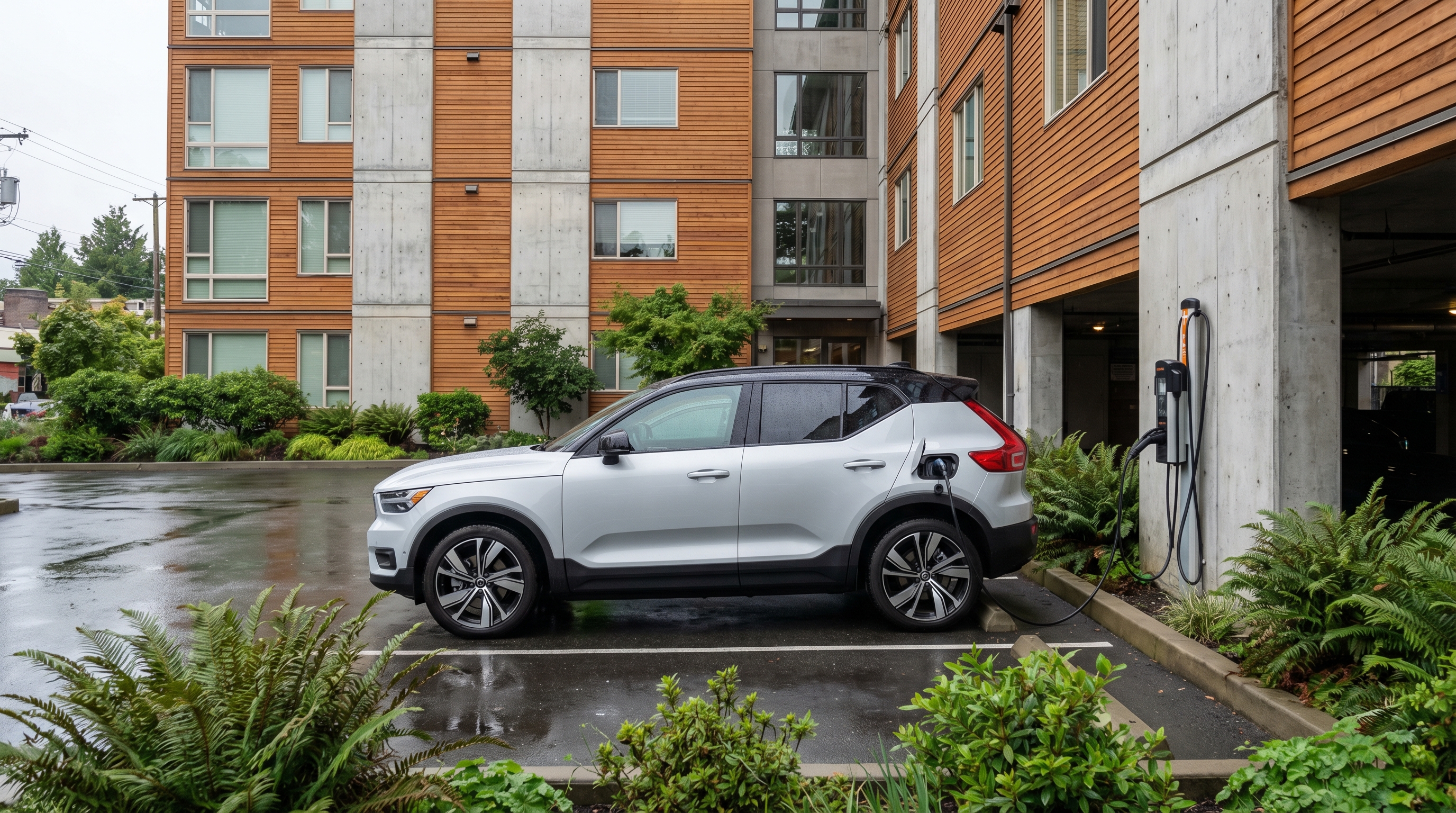
EV Charging & Heat Pumps in Vancouver Multiplexes
The Dec 2026 EPR deadline, EV charging rights, heat pump standards, and rebates — what multiplex buyers in Vancouver need to know about green features.
By MultiLiving Editorial · April 17, 2026
Questions about this guide: Gary Paul, REALTOR®, Personal Real Estate Corporation, Grand Central Realty, 778-828-7476
If you're shopping for a multiplex in Metro Vancouver right now, the brochures probably mention "EV-ready parking" and "high-efficiency heat pumps" somewhere between the granite countertops and the mountain views. But what do those terms actually mean for your wallet, your comfort, and your resale value five years from now? More than you might think.
BC has been quietly rolling out a series of regulations that are reshaping what new multiplexes look like from the inside out. The biggest one most buyers haven't heard about: every strata with five or more lots in Metro Vancouver must complete an Electrical Planning Report by December 31, 2026. That deadline is eight months away.
Here's what all of this means if you're buying.
The December 2026 EPR Deadline: Why It Matters to Buyers
An Electrical Planning Report (EPR) is an assessment of a strata building's electrical system — its current capacity, peak demand, spare capacity, and what it would take to support future loads like EV chargers and heat pumps. According to the Province of BC, every strata corporation with five or more lots in the Metro Vancouver Regional District, Fraser Valley Regional District, or Capital Regional District must have one completed by December 31, 2026. Stratas in the rest of BC have until December 31, 2028.
New strata corporations get five years from the date their strata plan is deposited. So if you're buying into a brand-new multiplex that was registered in 2024, the EPR deadline would be 2029.
Why should you care? Because the EPR tells you whether the building can actually handle the electrical upgrades you'll eventually want — or need. A building that's already near its electrical capacity limit is going to face expensive panel and service upgrades before anyone can add chargers or swap out gas furnaces. Those costs get shared across all owners through special levies or increased strata fees.
Our take: if you're buying into an existing strata, ask whether the EPR has been completed. If it hasn't, that's not necessarily a deal-breaker, but it is a yellow flag. You're buying into a building that hasn't yet faced the question of how much its electrical infrastructure needs to grow — and the answer might be expensive.
As of October 2025, the qualified professionals who can prepare an EPR include Professional Engineers registered with APEGBC, Applied Science Technologists registered with ASTTBC, and — for smaller Part 9 buildings — journeyperson electricians.
BC's EV Charging Rights in Strata: The 2023 Rule Change
Before 2023, getting an EV charger installed in a strata building could be a nightmare. You needed a three-quarter (75%) vote from the strata council for almost anything that touched common property or the contingency reserve fund. In a building with even a handful of holdout owners, that threshold was often impossible to clear.
Bill 22, the Strata Property Amendment Act, changed this. The BC government announced in December 2023 that stratas now only need a simple majority vote (50%+1) to approve EV charging infrastructure on common property and to spend contingency reserve funds on EV-related work. The three-quarter threshold still applies to special levies — so if the strata needs to raise extra money specifically for EV infrastructure, that higher bar remains.
The legislation also introduced a "right to charge" concept. Strata corporations are required to approve an owner's request to install EV charging at their own expense, as long as reasonable criteria are met. This matters because it means no strata can simply refuse all EV requests by policy.
For multiplex buyers, this is good news. A fourplex with four parking stalls and a strata structure no longer has one veto-wielding neighbour blocking your charger installation. The voting math got much simpler.
What New Multiplexes Include for EV Charging
If you're buying a new-build multiplex in Vancouver, the EV charging situation is better than you might expect. The City of Vancouver's building code (Bylaw 10908) requires that a minimum of 100% of parking stalls in new residential buildings be "EV-ready" — meaning pre-wired with conduit and electrical capacity for Level 2 charging. Most developers are meeting this by installing a 240V, 20A outlet at each stall or running conduit with a dedicated circuit.
The Vancouver Multiplex Electrical Process Guide encourages developers to use charging management technology — sometimes called load sharing or smart panel systems — to deliver Level 2 charging to every stall without oversizing the building's electrical service. This is a practical approach: rather than pulling 200 amps for four individual chargers, the system shares a smaller total allocation across all stalls, throttling output based on demand.
What to look for when touring a new multiplex:
- Is your parking stall pre-wired for 240V? (If not, the cost to run new wiring could be $2,000-$5,000.)
- Is there a dedicated circuit breaker, or is the building using a load management system?
- What is the charging capacity per stall? (A 20A/240V circuit delivers about 4.8 kW — enough for roughly 30 km of range per hour.)
- Does the strata have rules about charger brands or networked vs. non-networked units?
Heat Pumps in New Multiplexes: BC Step Code and What You're Getting
Here's a reality that not every buyer's agent is explaining clearly: gas heating is basically dead in new BC multiplex construction. Not because it's banned outright, but because the math no longer works.
Since January 2026, all new Part 3 buildings (including larger multiplexes) must meet Step 3 of the BC Energy Step Code. Step 3 sets strict airtightness requirements — no more than 3.0 air changes per hour at 50 Pascals — and when combined with the Zero Carbon Step Code (in effect since March 2025), gas-fired heating systems can't realistically hit the targets. As VanPlex notes, air-source heat pumps are now the default mechanical system for new BC multiplex construction.
What does this mean in practice? If you're buying a new multiplex unit, you're almost certainly getting a heat pump. The question is what kind.
Common Heat Pump Types in New Multiplexes
- Ductless mini-split (single zone): $8,000-$10,000 installed per unit. Efficient for open-plan layouts. The wall-mounted head unit is visible.
- Ductless mini-split (multi-zone): $12,000-$15,000 per unit. Multiple indoor heads serve different rooms from one outdoor compressor.
- Central ducted air-source heat pump: $10,000-$14,000 per unit. Hidden in the ductwork, no wall units. Preferred by buyers who don't want visible equipment.
- Shared central system: $8,000-$12,000 per unit. One large system serves the whole building, with individual controls per suite.
The operating cost difference is where heat pumps really pay off. VanPlex estimates annual heating costs of $800-$1,200 per unit with an air-source heat pump, compared to $1,800-$2,400 per unit for a gas furnace plus air conditioning. That's a 40-60% reduction in annual operating costs. Over a 25-year ownership period, cumulative savings can reach $90,000-$180,000 per unit.
Frankly, the operating cost savings alone make the higher upfront cost a non-issue for most buyers. You'll recoup the difference within five to seven years through lower utility bills, and that's before factoring in BC's rising natural gas prices.
How Green Features Affect Resale Value
This is the part where most buyers' eyes glaze over — until they see the numbers.
Research from the University of Maryland's Center for Global Sustainability found that homes with heat pumps sell for 4.3% to 7.1% more than comparable properties without them. In Metro Vancouver, where the benchmark price for a multiplex unit can range from $700,000 to $1.2 million depending on the neighbourhood, that premium translates to $30,000-$85,000 in additional resale value.
Homes with EnerGuide ratings above 80 — which most new multiplex builds in BC will achieve thanks to Step Code requirements — sell for a measurable premium in Metro Vancouver, typically 3-7% above comparable homes with poor energy ratings.
EV charging is harder to quantify as a standalone value-add, but it's rapidly becoming a baseline expectation. With BC aiming for 100% of new vehicle sales to be zero-emission by 2035, a multiplex without EV charging capability is going to feel dated within a few years. Think of it like a home without internet hookup in 2010 — technically livable, but you'd notice the gap.
BC Hydro Rebates for Strata EV Charging
BC Hydro runs a dedicated EV charger rebate program for multi-unit residential buildings. The numbers are worth knowing, because even if you're buying new, your strata may access these funds for shared infrastructure.
Here's what's available for existing stratas with five or more units (built before August 31, 2022):
- EV Ready Plan: up to $3,000 (covers 75% of plan costs)
- EV Ready Infrastructure: up to $600 per parking stall, maximum $120,000 per project (covers 50% of costs)
- EV Chargers: up to $2,000 per charger, maximum $14,000 per complex
- Total maximum funding: $137,000 per complex through the comprehensive EV Ready program
There's also free support: stratas planning EV charger installations can get up to five free hours with a BC Hydro EV advisor.
One important deadline to note: beginning July 15, 2026, stratas will need to have completed an Opportunity Assessment, EPR, or EV Ready Plan before they can even apply for the standalone EV charger rebate. If your strata hasn't started this process, the clock is ticking on two deadlines, not just one.
CleanBC Heat Pump Incentives
The provincial CleanBC program offers separate rebates for heat pump installations, and the amounts were expanded significantly in 2025. These are available to individual unit owners, not just strata corporations acting collectively.
Current CleanBC Better Homes rebate amounts:
- Air-source heat pump (ducted or ductless): $3,000-$4,000 per unit
- Ground-source (geothermal) heat pump: $4,000-$6,000 per unit
- Heat pump water heater: $1,000-$2,000 per unit
- Combined CleanBC + BC Hydro incentives: $4,000-$8,000 per unit
For lower-income households (under $87,350 annual income for a family of four), the Province has increased heat pump rebates to $16,000 per unit — and some families may qualify for up to $24,000 when electrical service upgrades or northern BC top-ups are included. The Province announced $50 million in each of the 2025-26 and 2026-27 fiscal years to fund up to 8,300 new heat pump rebates annually, according to a March 2025 provincial announcement.
For condo and apartment owners specifically, the Better Homes Energy Savings Program offers up to $5,000 for high-performance electric heat pumps installed in individual suites. This is separate from the whole-building rebates — meaning both the strata and individual owners can claim.
What to Ask the Developer Before Buying: Green Feature Checklist
Marketing materials love phrases like "energy-efficient design" and "sustainable features" without getting specific. Here's what to actually ask:
EV Charging
- Is every parking stall wired for Level 2 (240V) charging?
- What amperage is each circuit? (20A is minimum; 40A is better for faster charging.)
- Is a charger included, or just the outlet and wiring?
- Does the building use a load management / energy management system? If so, which one?
- How is electricity metered for EV charging — individual meters, or shared common area?
Heating and Cooling
- What type of heat pump is installed? (Ductless mini-split, central ducted, shared system?)
- What is the heat pump's COP (Coefficient of Performance)? (3.0+ is good; 4.0+ is excellent.)
- Is there a heat pump water heater, or is hot water provided by a traditional tank?
- Is there any gas service to the building at all? (Fully electric = lower operating costs, no gas utility bill.)
Building Envelope and Energy Performance
- What BC Energy Step Code level was the building designed to? (Step 3 is the current minimum; Step 4 or 5 is significantly better.)
- What was the blower door test result? (Lower ACH@50Pa = tighter building = lower energy bills.)
- Does the building have an EnerGuide or ENERGY STAR rating?
- What R-value insulation is in the walls and roof?
Solar Readiness in New Multiplex Builds
BC's Solar Hot Water Ready Regulation has been in effect since 2013 for single-family homes — builders must install conduit from the mechanical room to the attic to allow for future solar hot water installation. The cost is minimal, typically $200-$500 during construction versus thousands to retrofit later.
For multiplexes, solar readiness is less standardized. The regulation doesn't explicitly require it for all multi-unit buildings, and the shared-roof dynamic of a fourplex makes solar more complicated than on a single-family home. Who owns the panels? How is generated electricity allocated? These are strata governance questions that haven't been fully sorted out in BC.
That said, some forward-thinking developers are building multiplex roofs that are structurally rated for solar PV panels and pre-running conduit to the electrical room. BC Hydro also offers rebates for solar panels and battery storage through its residential programs. If solar is on your radar, ask the developer whether the roof is solar-ready — it's a small detail that could save you $5,000-$10,000 in retrofit costs down the road.
The Cost of Retrofitting vs. Buying Green-Ready
This is where the math gets stark. Here's a rough comparison using estimates from VanPlex and BC Hydro program data:
EV Charging Retrofit: Running new 240V wiring to a parking stall in an existing building costs $2,000-$5,000 per stall, depending on how far the panel is from the parking area. If the panel needs upgrading — common in buildings over 15 years old — add $15,000-$25,000 for the building's electrical service upgrade, shared across owners.
Heat Pump Retrofit: Replacing a gas furnace with a heat pump in an existing unit runs $8,000-$15,000 after rebates. If the building's electrical service needs upgrading to handle the added load, that's another shared cost.
New Build (Green-Ready): The incremental cost of building green is much lower than retrofitting. Developers report that the premium for building to Step 3 with heat pumps and EV-ready parking adds $5,000-$15,000 per unit compared to a hypothetical gas-heated, non-EV-ready building. But that comparison is increasingly academic — you can't actually build the non-green version anymore under current codes.
Developers going all-electric also save $5,000-$10,000 per building by eliminating gas service connection fees, and another $3,000-$8,000 by not running gas piping through the building. Those savings partially offset the heat pump costs.
The bottom line: buying a new multiplex with green features baked in is almost always cheaper than buying an older unit and retrofitting. And the gap is only going to widen as retrofit costs increase and energy codes get stricter.
Key Takeaways
- Every Metro Vancouver strata with 5+ lots must complete an Electrical Planning Report by December 31, 2026. Ask whether it's done before you buy.
- BC's 2023 Strata Property Amendment Act lowered EV charging approval from 75% to majority vote. You now have a legal right to install a charger at your own expense.
- Heat pumps are the default in new BC multiplex construction due to Step Code 3 and Zero Carbon requirements. Operating costs run 40-60% less than gas heating.
- BC Hydro offers up to $137,000 per complex for EV Ready infrastructure, plus up to $2,000 per charger.
- CleanBC heat pump rebates range from $3,000-$6,000 for standard households, and up to $16,000-$24,000 for income-qualified families.
- Homes with heat pumps sell for 4.3-7.1% more than comparable properties. Green features are a resale advantage, not just a feel-good upgrade.
- Buying new with green features built in is significantly cheaper than retrofitting an older unit. The gap keeps widening.
Do I need an EV charger if I don't own an electric vehicle?
Not today, but probably within five years. BC's Zero Emission Vehicle Act targets 100% of new car sales being electric by 2035. Even if you don't drive an EV now, your next car likely will be. Buying into a building with EV-ready parking protects your resale value and avoids costly retrofit wiring later.
Are heat pumps reliable in Vancouver's climate?
Yes. Metro Vancouver's mild winters are ideal for air-source heat pumps, which operate efficiently down to about -15°C. Vancouver rarely drops below -5°C. Cold-climate models rated to -25°C or lower are also available for buyers in colder parts of BC, though they cost roughly 15-20% more.
Can I stack BC Hydro and CleanBC rebates?
In many cases, yes. BC Hydro and CleanBC programs are designed to complement each other. A strata can claim EV infrastructure rebates from BC Hydro while individual owners claim CleanBC heat pump rebates for their suites. Combined incentives can reach $4,000-$8,000 per unit. Check the specific program terms, as some caps apply when multiple rebates are layered.
What happens if my strata misses the December 2026 EPR deadline?
The Province hasn't specified penalties for non-compliance. However, missing the deadline means your strata won't have the data it needs to plan EV and heat pump infrastructure — and after July 2026, stratas without a completed EPR or equivalent plan can't apply for BC Hydro's standalone EV charger rebate. The real cost of missing the deadline is lost rebate eligibility and delayed infrastructure planning.
Looking for a multiplex with green features already built in? Browse Vancouver multiplex listings on MultiLiving or get in touch with our team to find properties that match your sustainability priorities.