Managed Strata vs Non-Conforming Strata: What It Means for a Quintet Owner
What a managed strata and a non-conforming strata are in BC, checked against Quintet's disclosure statement, its budget and the provincial strata rules.
By MultiLiving Editorial · October 1, 2026
Ask about Quintet and the sales team gives you a one-page sheet titled "Managed vs 'Non-Conforming' Strata Homeownership." It sets two columns side by side: seven green ticks on the left, eight red crosses on the right. The left column describes how Quintet will be run. The right column describes a type of strata that Vancouver buyers hear about from agents, and from friends who bought a half-duplex.
We read that sheet next to Quintet's disclosure statement, dated May 7, 2025, and the BC government's own strata pages. The aim was to find out which lines are accurate as written. The managed setup it describes suits five households sharing one lot. One line on the sheet says something the law contradicts, and one promise on it depends on a contract we have not seen. Both are explained below, with the Quintet budget numbers.
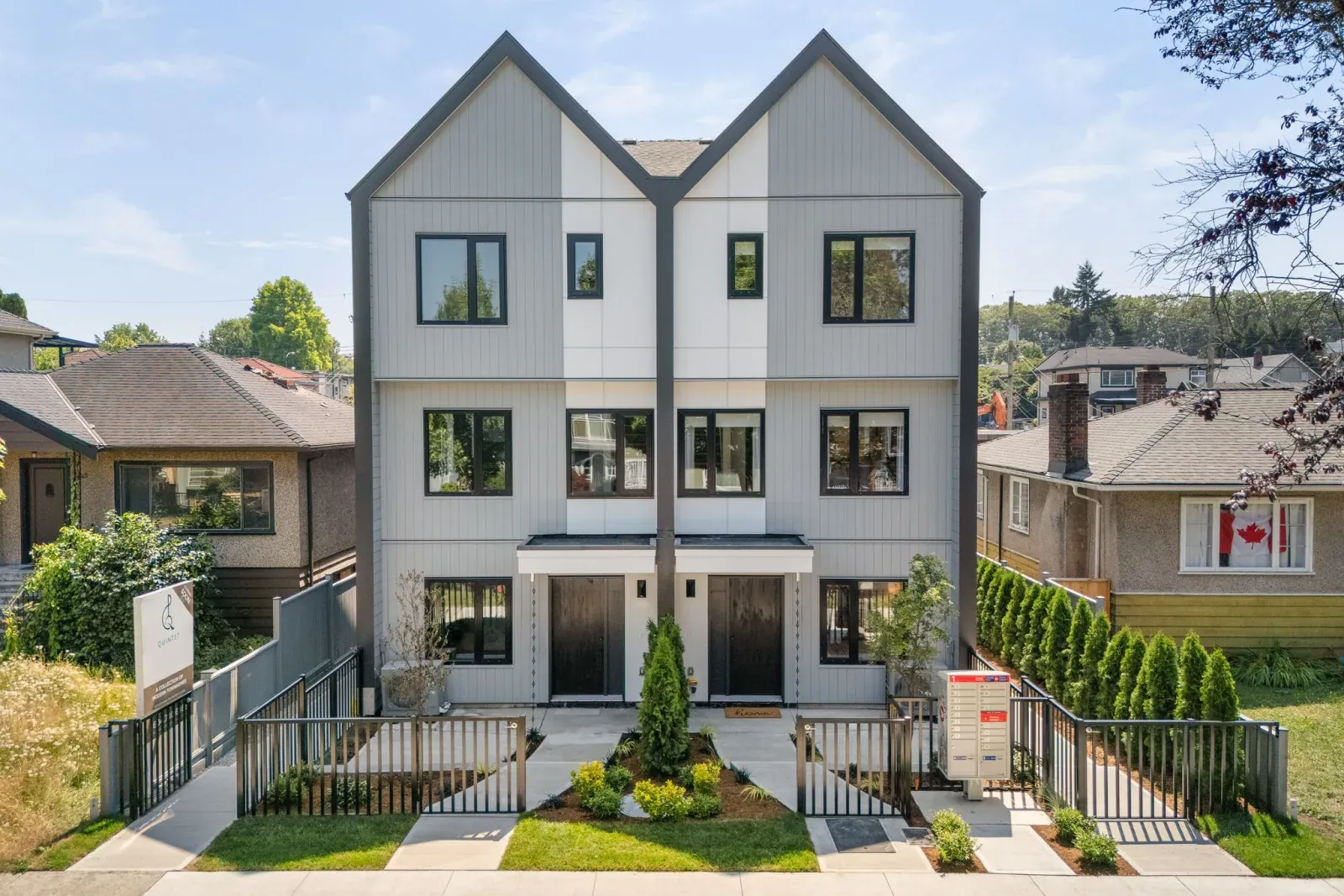
Quintet from E 40th Avenue. The walkway, the landscaping and the outside of the buildings are what the five owners share.
What strata means at Quintet
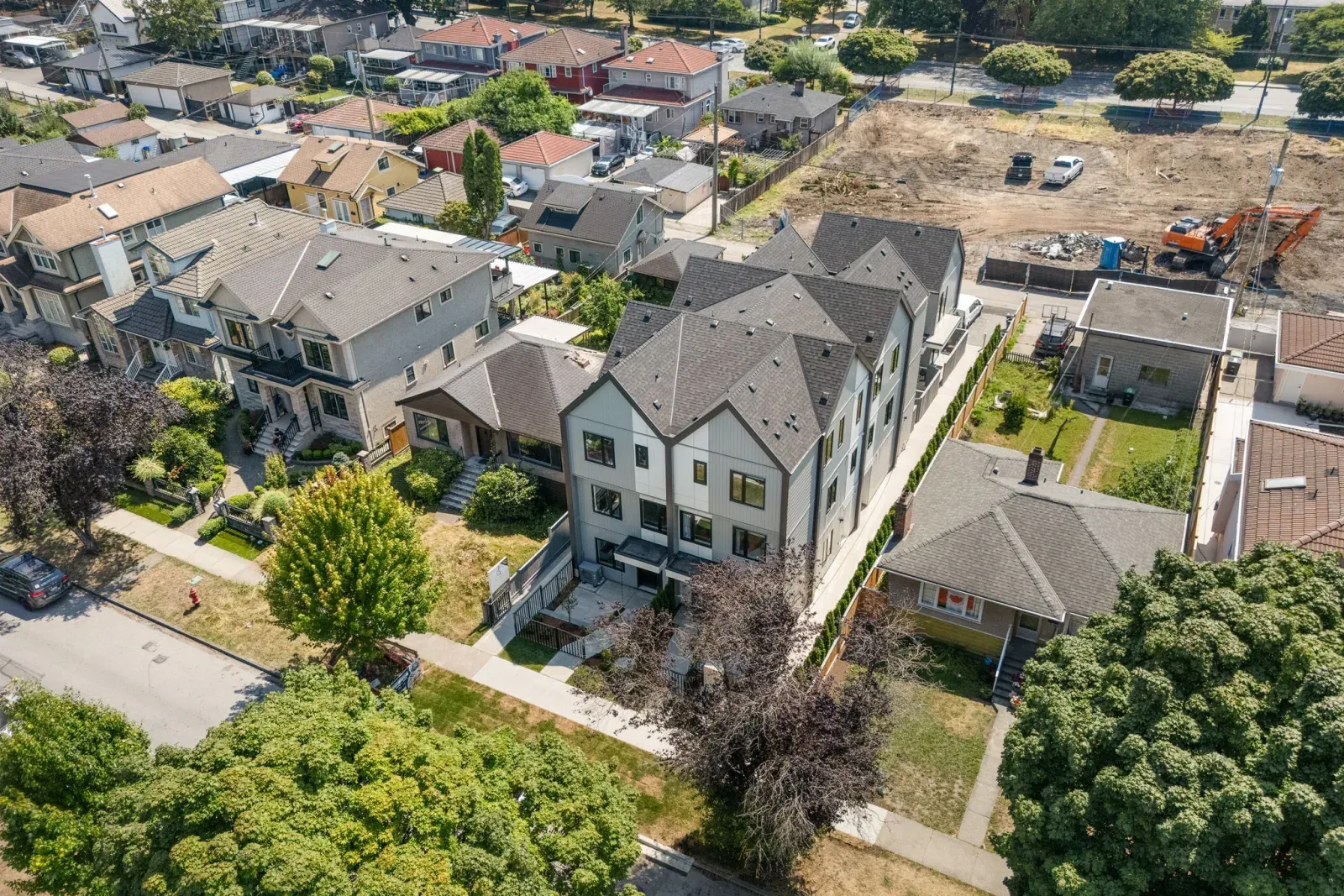
Each Quintet home is owned outright by its buyer. The walkway, the landscaping and the outside of the buildings are shared, and the five owners share them through a strata corporation. The corporation is the five owners acting together. It has a council the owners elect, a budget the owners vote on each year, and a monthly fee every owner pays.
Everything below about Quintet comes from the developer's documents: the sheet, the disclosure statement, the pricing sheet and the feature sheet. Everything below about BC law comes from the provincial government's strata pages and the Strata Property Act, linked where we use them.
What people mean by "non-conforming strata"
Agents use the phrase for small strata developments, most often a duplex with two owners, where the owners skip the formal duties. A Vancouver mortgage broker's article describes them as stratas that do not hold meetings, keep bylaws or collect monthly fees. The owners settle shared bills between themselves as they come up.
The label has no standing in law. Quintet's own sheet says so in its disclaimer: the term "is commonly used in the marketplace but is not a legal ownership structure recognized under the Strata Property Act." The Act covers a two-home strata the same way it covers a 200-home tower. The BC government says all strata corporations, "regardless of type or size," must carry property and liability insurance, and its reserve fund page says "Every strata corporation and section must have contingency reserve funds." The Act itself requires every strata corporation to hold an annual general meeting (section 40) and to keep an operating fund and a reserve fund (section 92). The operating fund pays the yearly running costs. The reserve fund is money set aside for costs that come less often than once a year, such as replacing a roof.
So a small strata that skips its meetings is still a strata corporation. It owes the same duties and has stopped carrying them out. That is the useful way to read the label. It signals owners who have stopped meeting their legal duties.
Two separate questions sit inside one column
The sheet treats "managed" and "non-conforming" as opposites. They answer two different questions. The first: does the strata follow the Strata Property Act? The second: does someone outside the five owners do the paperwork?
The BC government says a strata corporation "may contract with a strata property management company," which makes hiring a manager a choice. Its licensing page adds that strata lot owners in a self-managed strata do not have to be licensed. A self-managed strata that holds its meetings, approves a budget, funds its reserve and insures the building follows the Act. Put the two questions together and you get three cases:
- Managed and following the Act. This is the setup Quintet describes.
- Self-managed and following the Act. Legal, and it works when the owners are organized and willing to do the work themselves.
- Informal. The owners skip the meetings, the budget, the reserve fund or the insurance.
The sheet compares the first case with the third. The second case is where a buyer of a small strata most needs to look, because it can work well or turn into the third.
The sheet, line by line
Here is how each claim checks out, taking the left column first.
- "Clear governance structure and decision-making process." Accurate. The disclosure statement says Quintet's bylaws will be the Schedule of Standard Bylaws in the Strata Property Act, and owners vote at an annual meeting. Any strata that follows the Act can say the same, managed or not.
- Professional management of the budget, bylaws, voting, meetings, financial reports and banking. Accurate as a description of the service. It is also a cost, and the next section puts a number on it.
- "Mandatory reserve fund for future expenses." Accurate. The BC government requires every strata to have one, with a minimum yearly contribution of 10 percent of the operating fund since November 1, 2023. Quintet's interim budget sets aside $2,780 a year, which is 10.0 percent of its $27,800 operating budget.
- "More predictable monthly ownership costs." Partly accurate. The budget in the disclosure statement covers the first 12 months and is an estimate. The statement says the owners set the real budget at the first annual meeting, and it warns that insurance prices are uncertain and could change the budget. Predictable here means owners vote each year on a budget they can read. The amounts can still move.
- "Landscaping and common areas are collectively and cohesively maintained." Accurate. The pricing sheet lists landscaping in the monthly fee, and the budget has a $2,000 line for it.
Now the right column, the "non-conforming" side.
- "No mandatory reserve fund for future expenses." This line contradicts the BC government page above. The law requires the fund in every strata, a two-home strata included. What an informal strata can lack is anyone making sure the money is set aside.
- Unexpected costs from major repairs. A fair concern for an informal strata with no savings. A managed strata can also ask owners for extra money when a repair costs more than the reserve fund holds. The fund lowers that chance and cannot remove it.
- "Insurance and claims coordination require greater owner involvement." Every strata must hold property insurance and liability insurance, and the BC government sets the minimum liability cover at $2 million. In a strata run informally, the question to ask is whether that policy exists. Quintet's interim budget carries $8,000 a year for insurance.
- "Potential for disagreements that may delay repairs or decision-making." True of any shared building. A written budget and a yearly vote give owners a place to settle a disagreement. A manager handles the paperwork that follows the vote.
What the managed strata costs at Quintet
The disclosure statement attaches an interim budget dated April 22, 2025, for the 2026 year. Operating expenses come to $27,800, plus a $2,780 contribution to the reserve fund, for $30,580 a year across the five homes, or $2,548.33 a month. The fee for each home is its share of that total: $576.26 a month for Units 1 and 2, $520.76 for Units 3 and 4, and $354.29 for Unit 5. The reserve fund portion of those fees runs from $32.21 to $52.39 a month.
Three lines in the budget decide most of the fee:
- Management: $6,600 a year, or $550 a month for the building. That is 23.7 percent of the operating budget. Averaged over five homes it is $110.00 a month per home. If it is shared the way the total fee is shared, the range is $76.47 for Unit 5, $112.40 for Units 3 and 4, and $124.37 for Units 1 and 2. That range is our arithmetic. The budget does not split the management line by home.
- Insurance: $8,000 a year, 28.8 percent of the operating budget. Management and insurance together are 52.5 percent.
- Water and sewer: $4,000 a year. Garbage and recycling pickup is $3,000, landscaping $2,000, and building repairs, the fire and sprinkler system and electricity are $1,000 each.
The rest of the budget is small: $500 for accounting and legal, $500 for the internet connection on the EV chargers, and $200 in bank charges.
For $110.00 a month per home on average, nobody among the five owners has to keep the books, send the meeting notices, renew the insurance or phone the landscaper. In our view that is fair value for five households with jobs, children and, in four of the homes, a lower-floor suite to look after. Buyers comparing Quintet with a duplex that collects no monthly fee should remember that the insurance, the repairs and the water in that duplex cost money too. The difference is who organizes them and how the owners split the bill. Our post on duplexes with and without strata goes through that choice.
One promise to get in writing
The sheet, the feature sheet and the brochure all say Quintet is managed. The feature sheet names Fort Park Property Management as the manager. The disclosure statement, which is the legal document, words it differently. In section 3.11 the developer says it intends to cause the strata corporation to sign an agreement with a professional management company that has no link to the developer. The same section adds that the developer reserves the right, in its sole discretion, not to do so, and that the strata would then be self-managed.
The developer has not said it will use that right, the budget includes a $6,600 management line, and the pricing sheet says the fee covers management. A buyer who is paying for management deserves to see the contract. We have not seen a signed agreement with Fort Park, and the feature sheet's description of the company is the developer's own. Ask for the agreement before you sign, and have your lawyer read it.
BC requires strata managers to be licensed. The BC government says its licensing rule covers all strata managers, and that a strata management company must be a licensed brokerage. Ask the company for its licence number and confirm it with BCFSA, the provincial regulator that issues the licences.
What happens at the first owners' meeting
Every strata holds an annual general meeting no later than two months after the end of its financial year, unless the owners waive it, according to the BC government's meeting guide. The owners approve the next year's budget by majority vote, and the council sends the proposed budget with the meeting notice at least two weeks ahead. At Quintet that first meeting replaces the developer's estimate with a budget the owners chose. We describe what to expect in your first strata meeting in a new multiplex.
Which setup suits which household
Five households on one lot is the case for a manager. Five households have five different schedules, and a manager gives them one set of books, one insurance renewal and one person to call.
A self-managed strata can suit two owners who know each other well and keep records. Before buying into one, ask for the minutes of the last two years, the current budget, the insurance summary, the reserve fund balance and any depreciation report. A depreciation report is a professional estimate of the repairs a building will need and what they will cost, and we cover it in our post on depreciation reports. A seller who cannot produce these papers is selling into an informal strata.
Lenders read these papers too. The broker article linked earlier reports that Canada's mortgage default insurers declined small stratas that did not follow the Act. The article is undated and we found no current statement from CMHC, Sagen or Canada Guaranty, so treat it as a reason to ask your mortgage broker, not as a current rule.
Questions to ask before you sign at Quintet
- Is the management agreement signed? With which company, for what monthly fee, for how long, and what does it cover?
- What is the manager's BC licence number?
- What was the developer's opening contribution to the reserve fund? The disclosure statement says the developer intends to contribute 10 percent of the estimated operating expenses, which on the interim budget is $2,780.
- Has the building insurance been placed, and at what yearly premium compared with the $8,000 in the budget?
- Will any bylaws beyond the standard set be filed? Ask in particular about renting out a lower-floor suite, because that is a bylaw question.
- When is the first annual meeting, and who sits on the council until then?
What this comes down to
- "Non-conforming strata" is marketplace slang. Every strata in BC answers to the Strata Property Act, whatever its size.
- Managed and self-managed are both legal. The real contrast is between a strata that follows the Act and one that does not.
- Quintet's interim budget is $30,580 a year, with $6,600 for management and $2,780 for the reserve fund, which is 10.0 percent of operating costs.
- The sheet's line "No mandatory reserve fund" contradicts BC government guidance. The reserve fund is required in every strata.
- The disclosure statement says the developer intends to hire a management company and reserves the right not to. Ask to see the signed agreement.
The figures in this post are the developer's interim budget estimates, dated April 22, 2025. They will change when the owners approve the first real budget. This is general information, not legal or financial advice. Have a BC real estate lawyer review the disclosure statement and the management agreement before you sign.
Questions buyers ask about managed and non-conforming strata
What is a non-conforming strata in BC?
It is slang for a small strata, usually a duplex, whose owners skip the duties the Strata Property Act sets: annual meetings, a budget, a reserve fund and insurance. The Act has no such category. The owners remain a strata corporation with every legal duty, and they have stopped carrying the duties out.
Is a non-conforming strata legal?
Owning a home in one is legal. Skipping the duties is a breach of the Act, because every strata corporation must hold annual meetings, keep an operating fund and a reserve fund, and carry insurance. Quintet's own sheet says the term is not a legal ownership structure under the Act.
What is a managed strata?
It is a strata whose owners hire a licensed strata management company to handle the budget, the meeting notices, the financial records and the contractors. The owners still vote and still own the decisions. The BC government says a strata corporation may contract with a management company, so hiring one is a choice.
Does a strata have to hire a management company?
No. A strata may run itself, and the BC government says owners in a self-managed strata do not need a licence. A self-managed strata still has to follow the Act: hold its meetings, approve a budget, fund its reserve and keep its insurance in place.
Is Quintet a managed strata?
The sales sheet, the feature sheet and the brochure say yes, and the feature sheet names Fort Park Property Management. The disclosure statement says the developer intends to appoint an unrelated management company and reserves the right not to. We have not seen the signed agreement, so ask for it before you sign.
How much does management cost at Quintet?
The interim budget has a management line of $6,600 a year, which is $550 a month for the building and $110.00 a month per home on average. That is 23.7 percent of the operating budget. The budget does not split the line by home.
What does the Quintet monthly strata fee cover?
The pricing sheet says it includes management, water, sewer, garbage and recycling removal, and landscaping. The budget also pays for building insurance, repairs, the fire and sprinkler system, electricity, accounting and a reserve fund contribution. Fees run from $354.29 to $576.26 a month, depending on the home.
Does Quintet have a reserve fund?
Yes. The interim budget includes a $2,780 yearly contribution, which is 10.0 percent of operating expenses, and the disclosure statement says the developer intends to make its opening contribution at 10 percent as well. Ask for the opening balance in writing before you sign.
Must every BC strata have a reserve fund?
Yes. The BC government says every strata corporation and section must have contingency reserve funds, and since November 1, 2023 each must contribute at least 10 percent of its annual operating fund. Size does not matter, so a two-home strata must have one too.
Can the Quintet strata fee go up?
Yes. The budget in the disclosure statement covers the first 12 months only. The owners approve the real budget at the first annual meeting and every year after that. The statement warns that insurance costs are uncertain and could change the interim figures.
Can I get a mortgage on a non-conforming strata?
Possibly, but ask a mortgage broker before you make an offer. An older broker article reported that the national mortgage default insurers declined such properties, which would mean a down payment of at least 20 percent. We found no current insurer statement, so confirm it before you rely on it.
Should I avoid a self-managed strata?
Not automatically. A self-managed strata that holds its meetings, keeps its minutes and funds its reserve follows the Act. Ask for two years of minutes, the budget, the insurance summary and the reserve fund balance. A seller who cannot supply them is selling into an informal strata.
What documents should I ask for at Quintet?
The disclosure statement, the interim budget and fee schedule, the bylaws, and the signed management agreement. Our guide to reading a multiplex strata disclosure covers what to look for in each. Your lawyer should review all of them before you sign.
Next step
If Quintet is on your list, book a show home visit and ask us for the disclosure statement and the budget. We will go through the strata pages with you. You can also start with the full Quintet page, which has every floor plan and the costs table, or read our walk-through of the homes. To compare other options, browse all multiplex homes for sale.