Strata or Not: What 'Fee Simple' Means When You Buy a Duplex in BC
New BC duplexes sell as two strata lots or as non-strata homes with a shared wall agreement. Fees, insurance, decisions, and what your lawyer should check.
By MultiLiving Editorial · August 23, 2026
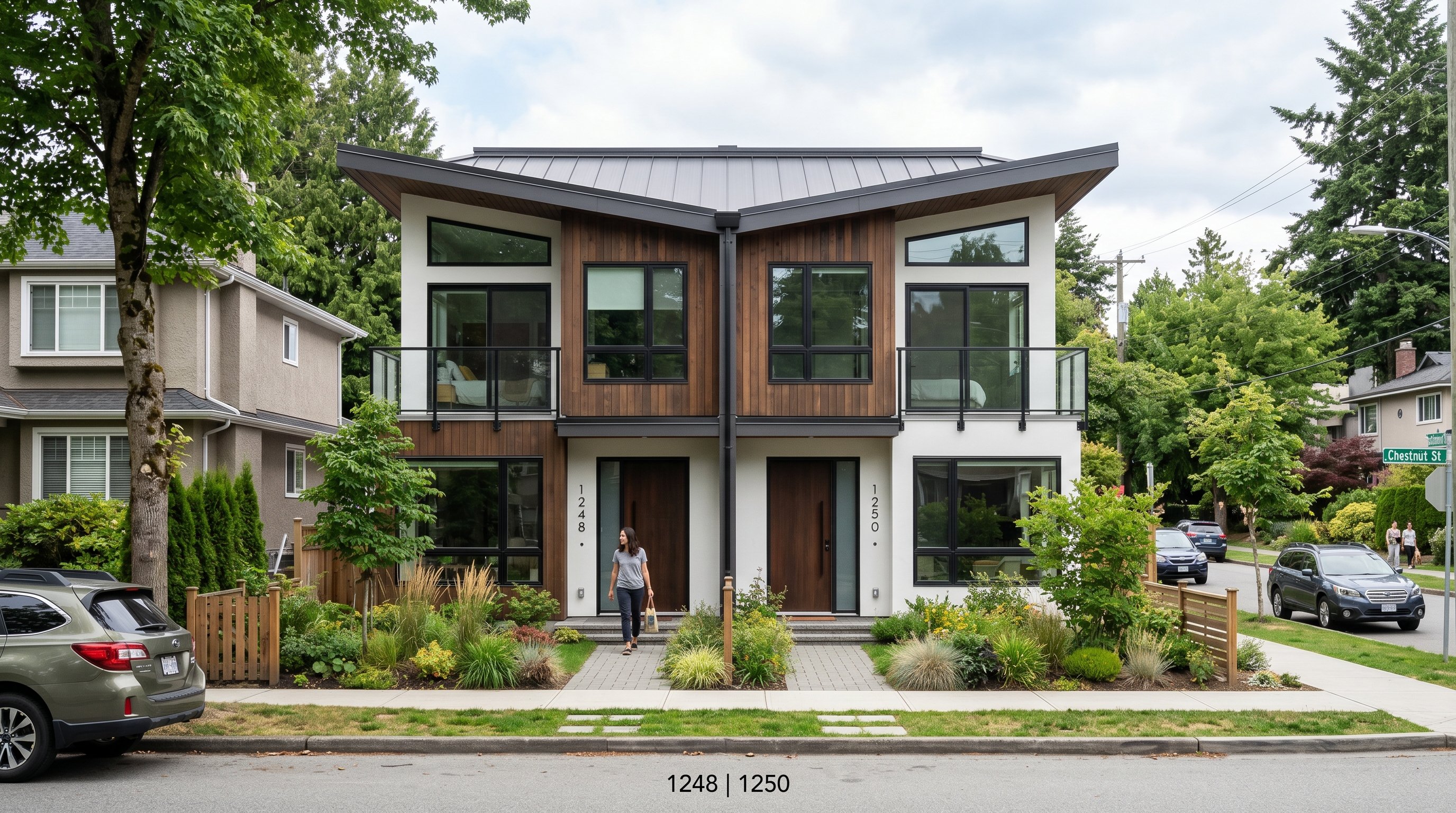
Two brand new half duplexes can look identical from the sidewalk: same size, same finishes, same price range. Then you open the paperwork and discover they are two completely different kinds of ownership. One is a strata lot. The other is what listings call 'fee simple, non-strata'. Most buyers meet these terms for the first time in the middle of an offer, which is the worst moment to learn them.
This post explains both structures in plain English: what you actually own, who pays for what, who insures what, and how decisions about the building get made. It is about ownership structure only. If you are weighing a half duplex against a full duplex, or trying to understand unit sizes, we have covered those separately.
The two ways a new duplex can be owned
Option one: two strata lots
Most new duplexes in BC are sold this way. The building and land are divided into two strata lots plus shared elements, and the two owners automatically form a strata corporation, the same legal structure a 200-unit tower uses, just with two members. BC's Strata Property Act governs how you insure the building, hold meetings, and make decisions together.
Do not let the word strata scare you. A two-lot strata is usually self-managed, has no property manager, and often collects no monthly fee at all, with the two owners simply splitting shared costs as they come. But the legal obligations of a strata corporation still exist, and they matter, as we will get to.
Option two: non-strata, on separate lots
Some new duplexes are sold with each half sitting on its own separate legal lot. There is no strata corporation, no shared elements, and no bylaws. You own your land and your home outright, and the only thing legally connecting you to your neighbour is the wall between you.
That wall is handled by a shared wall agreement: a contract, registered on the titles of both lots under the Land Title Act, that says who owns which half of the wall, gives each side the right of support from the other, and sets out how repairs to the wall get decided and paid for. Your lawyer will read it before you buy, and so should you.
About the phrase 'fee simple'
One clarification worth thirty seconds. 'Fee simple' is the legal term for the fullest form of property ownership in BC. Here is the twist: a strata lot is also owned in fee simple. You genuinely own a strata half duplex; you are not leasing it from anyone. When listings say 'fee simple' they almost always mean 'non-strata', and everyone in the industry understands the shorthand. Just know that the real distinction is strata versus non-strata, not owning versus not owning.
Fees: the smallest difference, despite the headlines
Buyers often chase 'no strata fees' as if the fee were the whole story. In a two-lot strata it mostly is not. There is no building manager to pay and no gym to maintain, so many two-unit stratas charge nothing monthly and split the insurance bill once a year. Others set a small monthly amount to build a repair fund, which is honestly the more disciplined habit.
A non-strata duplex has no fees by definition. You pay for your own roof half, your own insurance, your own everything, on your own schedule. The money leaves your account either way; the difference is whether a structure forces you to plan for it. Our observation after watching both: the no-fee arrangement feels cheaper and occasionally is, but the strata structure protects you from a neighbour who never saves for the day the building needs work.
Insurance: the biggest difference, and the one people miss
This is the section to read twice.
In a strata duplex, the strata corporation, meaning you and your neighbour together, must insure the whole building for full replacement value. That is not optional and not size-dependent: the Province of BC's strata insurance guidance is explicit that every strata corporation, including strata-titled duplexes, must carry property and liability insurance. Each owner then adds a personal policy for belongings and improvements inside their unit. The building policy premium is a shared cost, and keeping the coverage current is a shared legal duty.
In a non-strata duplex, each owner insures their own half under an ordinary home policy. Simpler in one way, riskier in another: nothing forces your neighbour to stay properly insured, and your homes share a wall and, often, a roof line. A good shared wall agreement addresses insurance and rebuilding after damage. A thin one leaves you exposed to your neighbour's choices at the worst possible moment. This is exactly the clause to ask your lawyer to read aloud and explain.
Decisions: what needs a conversation, and what does not
In a two-lot strata, decisions about shared elements are made together under the bylaws, and many need both owners to agree. With two voters there is no majority, so a disagreement is a deadlock. BC's Civil Resolution Tribunal handles strata disputes, but the honest protection is simpler: you are entering a long-term partnership with whoever owns the other half, so the bylaws and your relationship both matter. Read the bylaws before you offer; in a new duplex they are usually the standard ones from the Act, sometimes with builder additions.
In a non-strata duplex, your half is your business: your paint, your garden, your timeline. Only the shared wall, and whatever else the agreement covers, needs coordination. People who deeply value doing things their own way tend to be happier on this side of the line.
One more strata note that works in your favour. Small stratas are exempt from the depreciation report requirement: the Province's depreciation report rules apply to strata corporations with five or more lots, so a two-lot duplex strata does not need to commission one. Less paperwork, though the future costs the report would have flagged still arrive on schedule, so plan for them anyway.
What your lawyer should check, whichever type you buy
- Strata duplex: the strata plan (exactly what is shared and what is yours), the bylaws, the insurance policy and its current appraisal, and any budget or fund the two owners keep.
- Non-strata duplex: the shared wall agreement word by word: support rights, access for repairs, cost sharing, insurance obligations, and what happens if one side is damaged or destroyed.
- Both: confirm what the title actually says rather than what the listing says. The words 'no strata fees' in marketing are not a substitute for the documents.
- Both, if buying pre-sale: the disclosure statement sets out which structure the finished duplex will use. Ask your lawyer to point to the page.
So which is better?
Our honest answer: neither, categorically. We have seen both work beautifully and both go wrong, and in every bad case the problem was the documents or the neighbour, not the structure. That said, here is how we would lean for different buyers.
- If you want maximum independence and are comfortable managing your own repair savings, the non-strata duplex with a thorough shared wall agreement is hard to beat.
- If you like the idea that building insurance and shared costs are legally required rather than dependent on goodwill, the two-lot strata gives you that floor.
- If the two halves are being bought within one family, the strata structure's obligations can actually prevent future arguments, because the rules exist before any disagreement does.
- Whatever you choose, the quality of the paperwork beats the type of the paperwork. A well-drafted shared wall agreement beats sloppy bylaws, and clean bylaws beat a vague agreement.
What this comes down to
- Most new BC duplexes are two strata lots; some are non-strata homes on separate legal lots connected by a shared wall agreement registered on title.
- 'Fee simple' in listings means non-strata, though strata lots are legally fee simple ownership too.
- Two-lot stratas are usually self-managed with little or no monthly fee, but the strata corporation must insure the whole building for full replacement value, per the Province of BC.
- Non-strata owners each insure their own half; the shared wall agreement is the only thing coordinating the two homes, so its wording matters enormously.
- Two-lot stratas are exempt from BC's depreciation report requirement, which applies at five or more lots.
- Decisions in a two-owner strata need agreement, and a disagreement is a deadlock; non-strata owners only coordinate on the wall.
- Have a lawyer read the actual documents before you offer. Both structures are safe when the paperwork is good.
Frequently asked questions
What does fee simple mean when buying a duplex?
Fee simple is BC's fullest form of property ownership. In duplex listings the phrase is shorthand for non-strata: each half sits on its own legal lot with no strata corporation. Technically a strata lot is also owned in fee simple, so the real distinction is strata versus non-strata.
Do I really own my home if it is a strata lot?
Yes, outright. You hold title to your strata lot and a shared interest in the building's common elements, governed by the Strata Property Act. A strata half duplex is not a lease or a partial claim; it is full ownership plus a rulebook for the shared parts.
Do all new duplexes have strata fees?
No. Many two-lot stratas are self-managed and collect no monthly fee, splitting shared costs like building insurance as they arise. Some set a small monthly contribution toward future repairs. Non-strata duplexes have no fees at all. Either way, the underlying costs of owning a building continue to exist.
Who insures a strata duplex?
The strata corporation, meaning both owners together, must insure the full building for replacement value, per the Province of BC's strata insurance rules. This applies even to a two-lot duplex strata. Each owner also carries a personal policy for belongings and improvements inside their own unit.
Who insures a non-strata duplex?
Each owner insures their own half with an ordinary home policy. No law forces your neighbour to keep proper coverage, which is why a good shared wall agreement addresses insurance and rebuilding. Ask your insurance broker and lawyer to review both your policy and that agreement together.
What is a shared wall agreement?
A contract registered on the titles of both lots under the Land Title Act. It defines ownership of the wall between the homes, guarantees each side structural support, grants access for repairs, and sets out how wall costs are shared. It is the constitution of a non-strata duplex.
Can my neighbour block decisions in a two-unit strata?
On shared matters, effectively yes: with two voters, decisions that need agreement stall when you disagree. BC's Civil Resolution Tribunal can resolve strata disputes, but prevention beats resolution. Read the bylaws before buying and, where possible, meet the other owner. You are choosing a long-term partner.
Does a two-unit strata need a depreciation report?
No. BC's requirement applies to strata corporations with five or more lots, per the Province's depreciation report rules, so duplex stratas are exempt. The exemption saves paperwork, not money: roofs and shared systems age on the same schedule either way, so plan your own repair savings.
Is financing different for strata versus non-strata duplexes?
The mortgage itself works the same way for both, and insured down payment rules do not distinguish between them. Lenders will ask for different documents: strata bylaws and insurance confirmation on one side, the shared wall agreement on the other. Tell your broker which structure you are buying early.
Can strata bylaws restrict rentals or pets in a duplex?
Rental restrictions are gone: the Province removed strata rental-restriction bylaws across BC in November 2022. Pet restrictions can still exist if the bylaws include them, though a new two-lot strata usually starts with the standard bylaws. Age restrictions are limited to 55-plus communities. Read the bylaws regardless.
Which has better resale value, strata or non-strata?
In our experience the market prices the home, the street, and the finish quality far more than the ownership structure. Some buyers pay a little extra for 'no strata', others prefer the strata's mandatory insurance. Clean, well-drafted documents help resale more than either label does.
What should I ask my lawyer before buying either type?
For a strata duplex: walk me through the strata plan, bylaws, and the building insurance. For a non-strata duplex: walk me through the shared wall agreement, especially support, access, insurance, and rebuilding. For a pre-sale: show me where the disclosure statement defines the structure. Then ask what worried them.
Both structures put a brand new home with no upstairs neighbours within reach; the right one depends on how you want to share a building. Browse the new duplexes and multiplex homes on the market now, and when one catches your eye, talk to our team. We will tell you which structure it uses, what that means for your costs, and which questions to hand your lawyer.