Buying Your First Home in a New Multiplex (2026)
A first-time buyer's guide to buying a brand-new multiplex home in Greater Vancouver: how it differs from a condo or townhouse, and the four BC money programs you can stack.

By Michael Goering, REALTOR®, FRIVE (RE/MAX Magnolia) · July 25, 2026
Questions about this guide: Gary Paul, REALTOR®, Personal Real Estate Corporation, Grand Central Realty, 778-828-7476
I spend most of my working days with people buying their very first home. They come in thinking they have two choices: a condo or a townhouse. That was true for a long time. It is not true anymore. Across Greater Vancouver there is now a third option that many first-time buyers have never seriously looked at, and in a lot of cases it is the best one for the money: a home in a brand-new multiplex.
I am a guest writer here. I run a small team called FRIVE that works only with first-time and move-up buyers, so I am not going to sell you anything on this page. What I want to do is walk you through how a first home in a new multiplex actually works, how it is different from the condo or townhouse you were picturing, and which money programs you can line up so the down payment is smaller than you think. This is general information, not tax or mortgage advice. Before you sign anything, confirm your own numbers with a mortgage advisor or an accountant.
Why a brand-new multiplex is a real first home now
A quick bit of background, and then I will not mention rules again. A couple of years ago British Columbia changed what can be built on ordinary residential lots, so that a single lot that used to hold one house can now hold a few separate homes. That is the whole reason you are suddenly seeing brand-new duplexes, triplexes, and fourplexes going up on quiet streets in East Vancouver, Burnaby, and beyond. For a first-time buyer, that shift did something useful: it created a wave of brand-new homes at a lower price than a detached house on the same block.
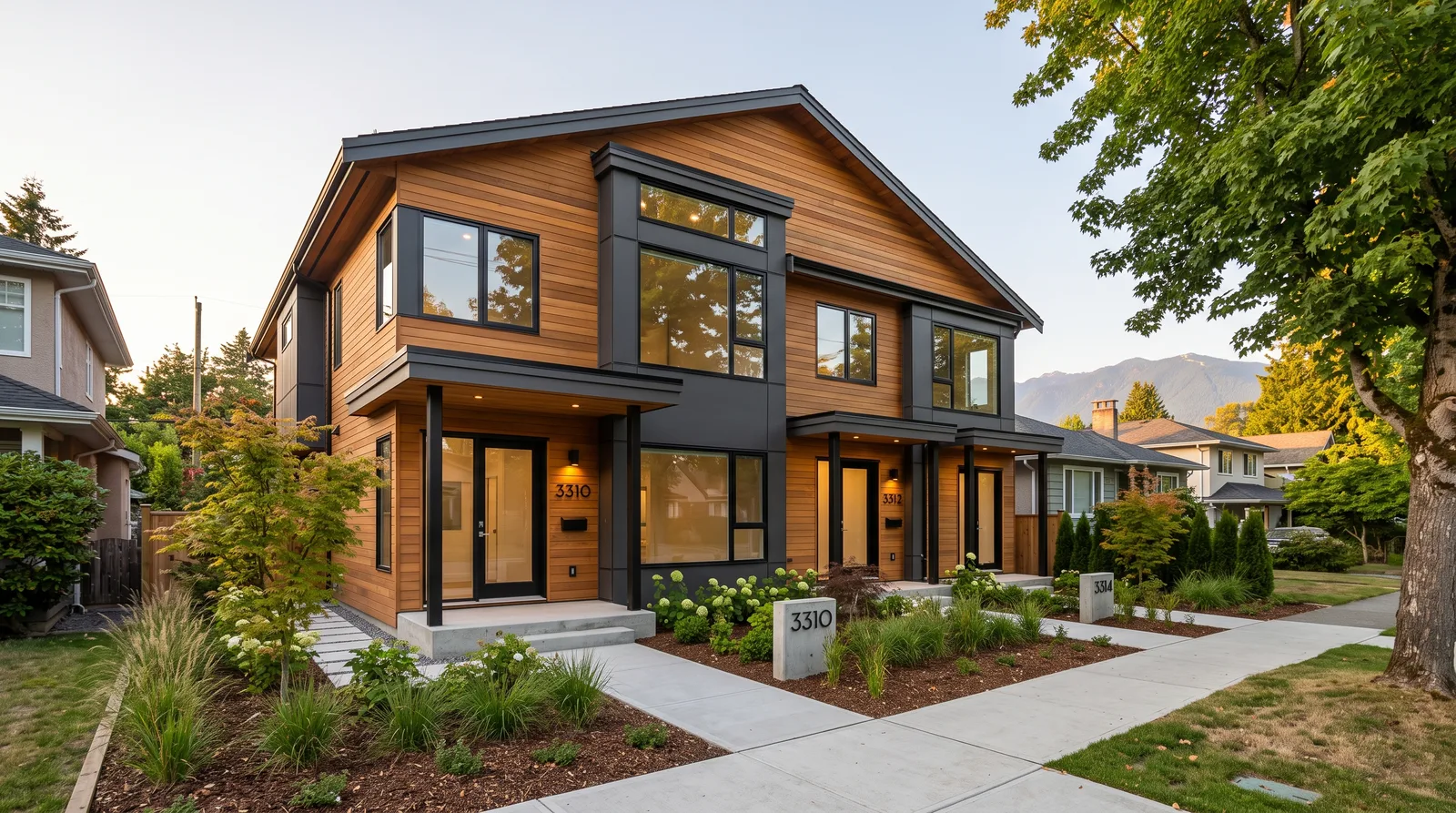
Here is the plain version of what a multiplex is. It is a small building split into a few separate homes. Each home is owned on its own title, the same way a condo is, so you buy one unit, not the whole building. You get your own front door, your own space, and in most cases a patch of outdoor area. You share the lot and the outside of the building with two or three other owners, and that is about it.
In my view, that middle ground is exactly what a lot of first-time buyers are looking for and did not know they could afford. You get much of the feel of a house, without the price of a house.
How a multiplex home is different from a condo or a townhouse
You are almost certainly comparing a multiplex unit against the two homes you already know. So let me put them side by side in plain terms.
Against a condo. A condo usually means a shared lobby, a hallway, an elevator, and dozens or hundreds of neighbours sharing the same systems. A multiplex home has none of that. You walk in from the street through your own door. There are two or three other homes in the building, not two hundred. Because there is so little shared equipment, the monthly strata fee on a small multiplex is often lower than on a condo of the same size. The trade-off is that you may look after a few more things yourself, like your own bit of yard.
Against a townhouse. These two feel the most alike, and that is fair. Both are attached homes with a bit of ground. The difference is scale and age. A townhouse complex might be a long row of twenty homes; a multiplex is two to four homes in what looks like a single house. Multiplex homes are also almost always brand new right now, while many townhouses in the same price range are twenty or thirty years old. And a multiplex sometimes offers a single-level home, which is rare in a townhouse and a real gift if stairs are a concern.
One thing stays the same across all three: you are buying into a strata. Even a three-home multiplex has a strata with a monthly fee, a set of rules, and a shared savings fund for future repairs. A small strata means a small group sharing those costs, which cuts both ways, and I will come back to it.
If you want the fuller comparison, we have written it up separately for a multiplex versus a townhouse and for a multiplex versus a condo.
What to look at when you tour a new multiplex, or read the plans
Many new multiplex homes are sold pre-sale, which means you are buying before the home is finished. Instead of walking through rooms, you are often reading a floor plan and a list of finishes. That sounds intimidating the first time. It is a learnable skill, and it is worth learning, because it is how you picture your real life in the space.
Here is what I tell my own first-time buyers to focus on:
- Which home in the building. A ground-floor home gives you easy entry and usually the outdoor space. An upper home often gives you more light and a view. Front or back, corner or middle, all change how quiet and how bright the home feels.
- Light and layout. Look at which way the main windows face and where the sun lands in the afternoon. Learn to read the plan so a drawing turns into a real room in your head. We wrote a plain guide to reading a multiplex floor plan.
- Quiet between neighbours. You share a wall or a floor with the home next door. Ask, in plain words, how the homes are kept quiet from each other. A good answer here is worth a lot on a Sunday morning.
- Parking and storage. Find out what comes with your home and what costs extra. In a small building these are not always assigned the way you expect.
- Outdoor space. A patio, a balcony, or a small yard is one of the real advantages of a multiplex over a condo. Confirm what is yours alone and what is shared.
- Who built it. Look up the team behind the building and what else they have finished. A brand-new home in BC also comes with a warranty, which I cover below.
The money side: the BC programs a first-time buyer can stack
This is the part I get most excited about, because it is where first-time buyers leave the most money on the table. There are four separate programs, and a first-timer buying a brand-new multiplex home can often use all of them at once. Every number below comes straight from the government source, and I have linked each one.
Your down payment can start at 5%
You do not need 20% down to buy a single multiplex home. With an insured mortgage you can start with as little as 5% down. According to CMHC's homeowner mortgage insurance rules, the minimum is 5% on the first $500,000 of the price, plus 10% on any amount between $500,000 and $1,499,999. Homes priced at $1.5 million or more cannot use this insurance and need 20% down. So on an $850,000 home the minimum down payment works out to $60,000. We break the math down further in our guide to buying a multiplex with 5% down.
Save that down payment faster with an FHSA and your RRSP
Two savings tools were built for this exact moment. The First Home Savings Account, or FHSA, lets you put in $8,000 a year up to a $40,000 lifetime limit, and the withdrawal for your first home comes out tax-free and never has to be paid back, per the Canada Revenue Agency. On top of that, the RRSP Home Buyers' Plan lets you borrow up to $60,000 from your own RRSP for the same purchase. Used together, one person can pull together as much as $100,000. And here is the part first-timers miss: if you are buying with a partner or a family member, each of you gets your own accounts, so a couple can reach the down payment roughly twice as fast. Our full FHSA walk-through has the details.
The property transfer tax break on a brand-new home
British Columbia charges a tax when a home changes hands, but brand-new homes get a break that resale homes do not. Under the province's newly built home exemption, a qualifying brand-new home priced up to $1,100,000 pays no property transfer tax at all, with a partial break running up to $1,150,000. You do have to move in within 92 days and live there for the first year. Separately, the first-time home buyers' program gives a full break up to $500,000 and a partial one up to $835,000 on any qualifying home. For a brand-new multiplex above that, the newly built exemption is usually the one that saves you the most. We keep a running explainer on both transfer tax exemptions.
The new GST rebate for first-time buyers, worth up to $50,000
This one is new this year and it is a big deal for anyone buying brand new. Bill C-4 received Royal Assent on March 12, 2026 and created a First-Time Home Buyers' GST Rebate. Per the Canada Revenue Agency, it refunds 100% of the federal GST on a brand-new home priced up to $1 million, worth up to $50,000, then phases out and reaches zero at $1.5 million. It applies to purchase agreements signed between March 20, 2025 and December 31, 2030. To count as a first-time buyer, you and your spouse or partner cannot have lived in a home you owned in the current year or the four years before. Because a multiplex home is brand new, it is exactly the kind of purchase this rebate was written for. We cover how to claim it in our GST on a new multiplex guide.
Stack those four together and the picture changes fast. A smaller down payment, tax-free savings from two accounts, no property transfer tax, and up to $50,000 of GST back. For context on what your money buys, the benchmark price for an attached home across Greater Vancouver sat at $1,046,200 in June 2026, down about 5% from a year earlier, according to Greater Vancouver REALTORS. A calmer market is not a bad time to be a first-time buyer.
Questions to ask before you sign
When my buyers get close, I hand them a short list of questions. Here is the version for a brand-new multiplex:
- What is the monthly strata fee, and what does it cover?
- How much is in the shared repair fund, and is there a plan for it? A small building means a small group sharing any future cost.
- What are the strata rules on pets, rentals, and use of the outdoor space?
- Is my parking and storage assigned to me and included in the price?
- What is the expected move-in date, and what happens if it slips?
- What deposit is required, and how is it protected while I wait?
Two protections are worth knowing before you sign a pre-sale contract. First, BC's Real Estate Development Marketing Act gives pre-sale buyers seven days to change their mind after signing, for any reason, with the deposit returned in full. We explain the seven-day right to cancel in detail. Second, every brand-new home in BC comes with the 2-5-10 warranty: roughly two years of coverage on labour and materials, five years on water getting into the building, and ten years on the structure itself. That safety net is one of the real advantages of buying brand new over buying an older home.
What this comes down to
- A home in a brand-new multiplex is now a genuine third option for first-time buyers, sitting between a condo and a townhouse.
- You get your own front door, more space than a condo, and usually a lower strata fee, because very little is shared.
- You can often start with 5% down on a single unit, not 20%.
- A first-time buyer can stack four money programs: the 5% insured mortgage, tax-free FHSA and RRSP savings, no property transfer tax on a qualifying brand-new home, and up to $50,000 back through the new GST rebate.
- Learn to read a floor plan, ask about the strata and the quiet between homes, and lean on the seven-day cancel window and the 2-5-10 warranty.
If you want a real person to walk through the options with you, that is what the MultiLiving team is here for. You can browse the multiplex homes for sale or get in touch and start with a simple conversation about what you are looking for and what you can spend. Buying your first home is a big step. It is a lot less scary when someone has walked the path with you before.
Frequently asked questions
What is a multiplex, exactly?
A multiplex is a small building split into a few separate homes, usually two to four. Each home is owned on its own title, like a condo. You buy one unit to live in, with your own front door, not the whole building.
Is a multiplex unit a good first home for a single buyer?
It can be a strong fit. A single buyer gets more space and privacy than a condo, often for a similar price, plus a smaller strata fee. If a full two-storey home feels like too much, look for a single-level multiplex unit, which some buildings offer.
How much down payment do I need for a new multiplex unit?
With an insured mortgage you can start at 5% down on the first $500,000 of the price, plus 10% on any amount above that, up to a $1.5 million limit. On an $850,000 home that is about $60,000. Above $1.5 million you need 20%.
Can I use my FHSA and my RRSP together for the down payment?
Yes. You can withdraw up to $40,000 tax-free from an FHSA and borrow up to $60,000 from your RRSP under the Home Buyers' Plan for the same first home, for as much as $100,000. If you buy with a partner, each of you has your own accounts.
Do I pay GST on a brand-new multiplex home?
Brand-new homes carry federal GST, but a first-time buyer can now claim the new First-Time Home Buyers' GST Rebate. It refunds all of the federal GST on a home priced up to $1 million, worth up to $50,000, and phases out by $1.5 million.
Do first-time buyers get a property transfer tax break on a new multiplex?
Yes. A qualifying brand-new home priced up to $1,100,000 pays no property transfer tax under BC's newly built home exemption, with a partial break to $1,150,000. You must move in within 92 days and live there for the first year.
What is the difference between a multiplex unit and a townhouse?
They feel similar, since both are attached homes with some ground. The main differences are scale and age: a multiplex is two to four homes in what looks like a single house, and is almost always brand new, while many townhouses in the same price range are older.
Are strata fees lower in a small multiplex?
Often, yes. A small multiplex shares very little equipment, so there is less to maintain and the monthly fee tends to be lower than a comparable condo. The flip side is a smaller group sharing any future repair, so ask about the shared repair fund.
What is the 2-5-10 warranty?
It is BC's warranty on brand-new homes: about two years on labour and materials, five years on water getting into the building, and ten years on the structure. It transfers to you automatically as the owner and is a key reason to buy new over old.
Can I change my mind after signing a pre-sale contract?
Yes. BC law gives pre-sale buyers seven days to cancel after signing, for any reason, with the full deposit returned. It is a real safety net that lets you sign, then take a week to review the documents and sleep on the decision.
Is it better to buy pre-sale or a finished multiplex unit?
Both work. Pre-sale means buying from plans before the home is built, which gives you more time to save and first pick of units. A finished home lets you walk through the real space. The right choice depends on your timeline and how much certainty you want.
How many bedrooms do new multiplex units usually have?
Most brand-new multiplex homes come as two or three bedrooms, which suits first-time buyers, couples, and small families. Some larger fourplex and triplex units offer three bedrooms plus a flex room, giving you a home office or a nursery without paying detached-house prices.
Can two families buy into the same multiplex together?
Yes, in two ways. Two family members can each buy a separate home in the same small building to live close by, or they can co-buy a single unit together and share it. Both are common with multigenerational families, and each path has its own money and legal setup.
Where can I find new multiplex homes for sale in Greater Vancouver?
MultiLiving is a marketplace built only for multiplex homes across Greater Vancouver. You can browse current homes for sale on the properties page or contact the team to talk through what fits your budget and where you want to live.