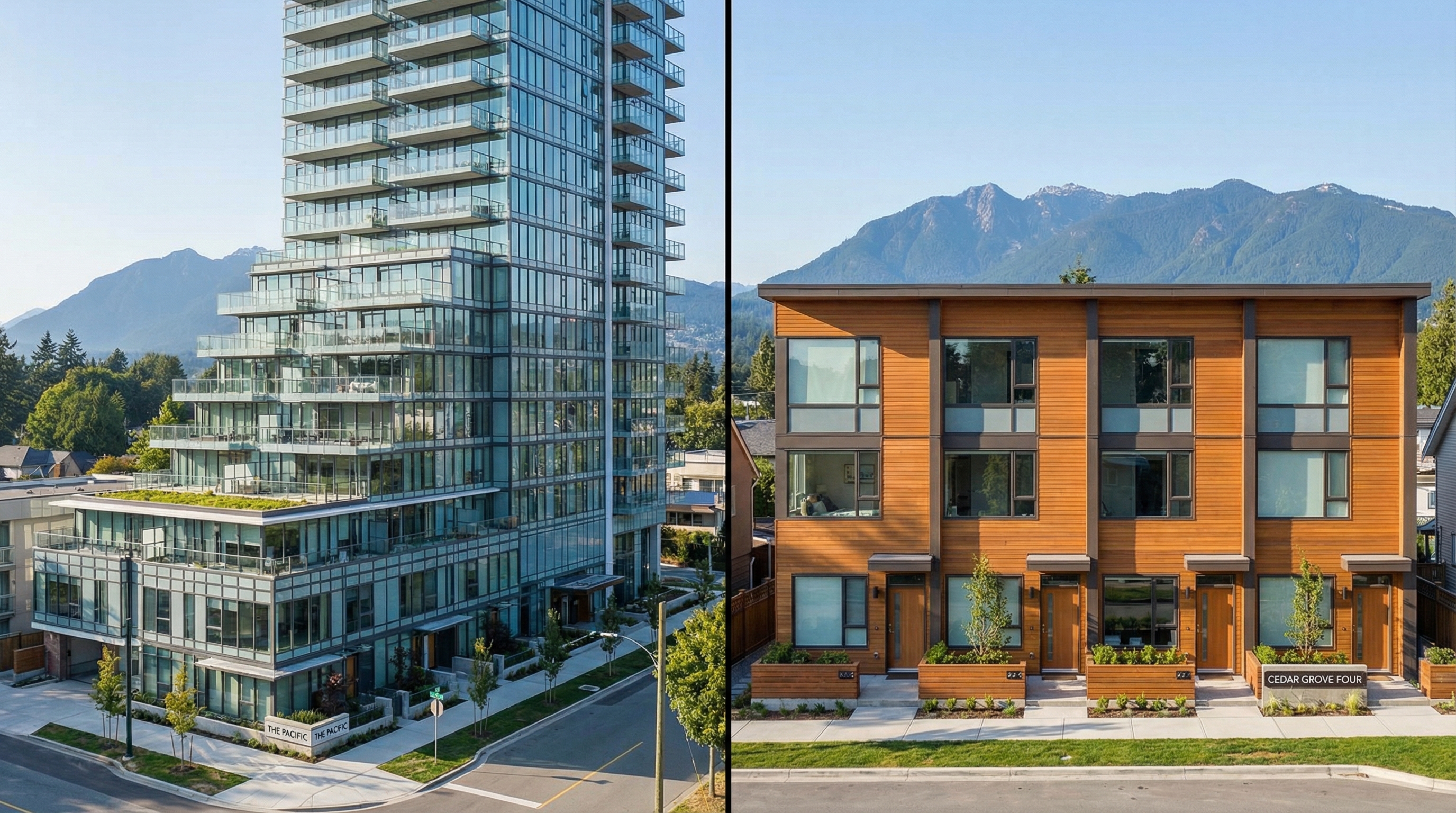
Multiplex vs. Condo: Which Is the Better Buy in Vancouver?
Comparing multiplex units to condos across price, space, strata fees, privacy, and resale — data-backed analysis to help Vancouver buyers decide which housing type fits their needs.
By MultiLiving Editorial · March 30, 2026
Questions about this guide: Gary Paul, REALTOR®, Personal Real Estate Corporation, Grand Central Realty, 778-828-7476
The Short Answer (Then the Long One)
Multiplexes offer better value per square foot for most buyers who prioritize space, privacy, and potential rental income. Condos offer better resale liquidity, lower entry price, and more predictable costs. Neither is universally "better" — but for buyers who can afford the higher entry price, a multiplex unit is the stronger long-term play in Vancouver's current market.
Now let's unpack that with actual numbers.
Price: What Your Dollar Actually Buys
According to WOWA.ca Vancouver housing data, the average condo in Vancouver sold for approximately $704,600 in early 2026. For that price, you're getting about 650-750 square feet in most neighbourhoods — a one-bedroom or a small two-bedroom. That works out to roughly $940-$1,080 per square foot.
A unit in a new fourplex — and we're talking about finished strata units, not buying the whole building — runs $850,000 to $1,200,000 on Vancouver's east side for 1,000-1,400 square feet. That's $710-$860 per square foot. On the west side, expect $1,100,000-$1,600,000 for slightly larger units, pushing per-square-foot pricing to $780-$1,000.
So even at a higher absolute price, the multiplex unit delivers more space per dollar. A buyer spending $1M on a condo gets maybe 900 square feet in a newer building. The same $1M in an east side fourplex gets 1,200+ square feet — 33% more living space. That's the difference between a cramped two-bedroom and a comfortable three-bedroom with storage.
Monthly Costs: Strata Fees Tell the Real Story
Condo strata fees in Vancouver average $0.55-$0.75 per square foot per month. For a 700-sqft condo, that's $385-$525 monthly. For an older building (1990s or earlier), fees often exceed $0.80/sqft — meaning $560+ per month for the same size unit. These fees cover building insurance, common area maintenance, elevator service, concierge (in some buildings), and contributions to the contingency reserve fund.
Multiplex strata fees are a different animal. A four-unit building has dramatically lower operating costs than a 200-unit tower. There's no elevator, no concierge, no pool, no gym. Shared costs are limited to building insurance, exterior maintenance, and the contingency reserve. Monthly fees for new multiplex strata units typically run $150-$300 per month — roughly half what you'd pay in a condo tower.
But there's a catch. Multiplex strata corporations are small — four owners sharing maintenance responsibility means each owner carries a larger proportional burden when something expensive breaks. A new roof on a condo tower gets split 200 ways. A new roof on a fourplex gets split four ways. Your monthly fees may be lower, but your special assessment risk is more concentrated.
The smart move: scrutinize the contingency reserve fund. A well-run multiplex strata should be building reserves quickly, because the per-unit exposure to major repairs is significant.
Space and Layout: No Contest
This is where multiplexes dominate, and it's not close.
A typical new condo in Vancouver offers 650-800 square feet with one parking stall (maybe), a small balcony, and shared storage in the basement. The layouts are constrained by the building's structural grid — load-bearing columns dictate where your walls can go, and the developer optimizes for unit count, not spaciousness.
A multiplex unit is designed differently. You're one of four households, not one of two hundred. Units often span two levels (ground floor plus upper, or upper plus rooftop). Ceiling heights are generous — 9 or 10 feet versus the condo standard of 8 feet. Many units have private outdoor space: a ground-level yard, a second-floor deck, or a rooftop terrace.
Storage is another advantage. Multiplex units typically include in-unit laundry, a dedicated storage room, and sometimes a garage or carport. Compare that to the condo experience of hauling laundry to a shared facility two floors down and storing your camping gear in a 4×6 wire cage in the parkade.
For families — and this is the big market that multiplexes are designed to serve — the difference is transformational. Two parents and a kid in a 700-sqft condo is doable but stressful. The same family in a 1,300-sqft multiplex unit with a yard has room to breathe.
Privacy and Noise: The Honest Comparison
Condos and multiplexes both involve shared walls. But the nature of the sharing is different.
In a condo tower, you might share walls with two neighbours, a floor with one below, and a ceiling with one above. That's potentially four shared surfaces. In a multiplex, a corner or end unit might share only one wall with an adjacent unit. Even a middle unit in a fourplex shares at most two walls.
BC Building Code requires minimum STC (Sound Transmission Class) 50 ratings for walls between dwelling units. At STC 50, normal speech is inaudible and loud sounds are faintly perceptible. Most new multiplex builders are targeting STC 55+, because the small number of units makes noise complaints more personal — it's your neighbour, not some anonymous person on the 14th floor.
The National Research Council of Canada recommends STC 55 as the threshold for "good" sound isolation and STC 60+ for "excellent." When evaluating a multiplex purchase, ask for the wall assembly specifications and the target STC rating. If the builder can't tell you, that's a red flag.
One area where condos have an advantage: concrete floors. Concrete-frame condo towers have inherently better floor-to-floor sound isolation than wood-frame multiplexes. Impact noise (footsteps, dropped objects) travels more easily through wood framing. Good multiplex builders address this with resilient channels, acoustic mats under flooring, and careful joist detailing — but concrete is still superior for impact noise isolation.
Rental Income: The Multiplex Advantage
This is the multiplex's killer feature for owner-occupiers, and condos can't match it.
If you buy a fourplex and live in one unit, the other three units can generate rental income. In East Vancouver, a 1,200-sqft three-bedroom multiplex unit rents for $2,800-$3,400 per month. Three units at $3,000/month is $9,000 in gross monthly rental income — which covers most or all of your mortgage payment on the entire building.
With a condo, your rental income options are limited to renting the entire unit (which means you're not living there) or renting a bedroom (which means you're a roommate). Neither is comparable to the structured, separate-unit rental income that a multiplex provides.
CMHC's owner-occupied multiplex financing rules make this even more attractive: up to 50% of projected rental income from your non-owner units counts toward your mortgage qualification. A family earning $150,000/year with $9,000/month in projected rental income (50% counted = $4,500/month = $54,000/year) effectively qualifies as if they earn $204,000. That's a massive boost in purchasing power.
Resale: The Condo's Edge
Here's where condos have the clear advantage, and it's worth being honest about.
Condos in Vancouver have decades of resale data. Buyers know what a 700-sqft condo in Yaletown is worth because there are hundreds of comparable sales. Appraisers have deep data sets. Lenders are comfortable with the product type. MLS listings are abundant.
Multiplex strata units are new. The product type barely existed in Vancouver before 2024. There are very few resale comparables. Appraisers are still figuring out how to value them. Lenders are cautious. If you need to sell in two or three years, you may find limited comparable sales data to support your asking price, which can make the appraisal process challenging for your buyer's lender.
This will change over time — as more multiplex units sell and resell, the data set grows. But right now, buying a multiplex unit requires comfort with a thinner resale market. If you're buying for 5+ years, this matters less. If you might need to sell quickly, it's a real consideration.
Lifestyle: Which Suits You?
Beyond the numbers, these are fundamentally different ways of living.
Condo living offers amenities. Many newer towers include a gym, rooftop deck, party room, bike storage, and concierge. You pay for these through strata fees, but you have them. The tradeoff is density — you're sharing these amenities with 100-300+ other households, and the building's rules (pets, rentals, noise) are set by a council that may not share your priorities.
Multiplex living is quieter and more independent. You likely know all three of your neighbours. Building decisions are made by four people, not a council of twelve representing hundreds. You probably have outdoor space — a yard, deck, or terrace — that's yours alone, not shared. But you don't have a gym or a concierge, and when the roof needs replacing, your share is 25%, not 0.5%.
For young singles and couples who want walkability, amenities, and low maintenance, condos still make sense. For families, downsizers from detached homes, and anyone who values space and autonomy, multiplexes are the better fit.
The Verdict: Position-Based, Not Universal
If you're buying strictly as a financial asset with resale in 2-3 years, buy a condo. The liquidity is better and the market is more predictable.
If you're buying a home to live in for 5+ years, want significantly more space per dollar, value privacy and autonomy, and especially if you want to offset your housing costs with rental income from other units — buy a multiplex unit. The value proposition is stronger by almost every measure except resale certainty.
The market will eventually catch up. As more multiplex resales happen and the data set grows, the resale liquidity gap will narrow. Early multiplex buyers are taking on some market risk in exchange for better space, better costs, and income potential that condos simply can't match.
Key Takeaways
- Multiplex units deliver 30-40% more space per dollar than condos — $710-860/sqft vs $940-1,080/sqft
- Monthly strata fees in multiplexes run $150-300, roughly half of comparable condo fees, but special assessment risk is more concentrated
- Rental income from other units in an owner-occupied fourplex can cover most or all of the mortgage — condos can't compete
- Condos have decades of resale data; multiplex strata units have almost none, creating short-term liquidity risk
- For 5+ year homeowners who want space and income potential, multiplexes are the stronger buy in Vancouver's 2026 market
Frequently Asked Questions
Is a multiplex unit more expensive than a condo?
The total price is higher ($850K-$1.2M vs $704K average), but the price per square foot is actually lower. You get 30-40% more space per dollar in a multiplex, making it better value for buyers who need room.
Do multiplex units hold their value like condos?
It's too early to say definitively. Multiplex strata units are a new product type in Vancouver with limited resale history. Condos have decades of comparable data. Over time, multiplex resale markets will develop, but buyers today should plan for a 5+ year hold.
Can I rent out a condo and a multiplex unit equally?
No. An owner-occupied multiplex lets you rent three separate units while living in one — generating $7,000-$10,000/month in gross rental income. A condo offers no comparable income structure unless you rent the entire unit and live elsewhere.
Which has lower ongoing costs — a condo or a multiplex?
Multiplex strata fees are typically 40-50% lower than condo fees due to simpler building systems and fewer shared amenities. However, your proportional share of major repairs is higher in a four-unit building than in a 200-unit tower.
Related Resources
Multiplex vs Condo
Side-by-side comparison for buyers
Multiplex vs Condo vs Townhouse
Three-way comparison
Multiplex for Sale in Vancouver
Browse all Vancouver listings
Where to Buy in Vancouver
Neighbourhood comparison guide
Vancouver Pre-Sales
Active & upcoming projects
Browse All Listings
Multiplex homes across BC