Multiplex vs Half-Duplex: Which One Fits Your Life?
Half-duplexes have been Vancouver's workhorse starter home for decades. Now Bill 44 multiplexes are arriving on the same streets. A half-duplex benchmarks at $1.04M in Metro Vancouver. New multiplex units start around $710K. Price is only part of the story. Strata governance, neighbour dynamics, and long-term flexibility all look different too.
Key Topics
Price Gap Is Real
REBGV's closest published benchmark is the townhouse category, which sat at $1.04M as of January 2026. REBGV does not publish a half-duplex-specific figure. New multiplex units start around $710K for smaller configurations. That $300K+ gap buys a lot of flexibility.
Different Buildings Entirely
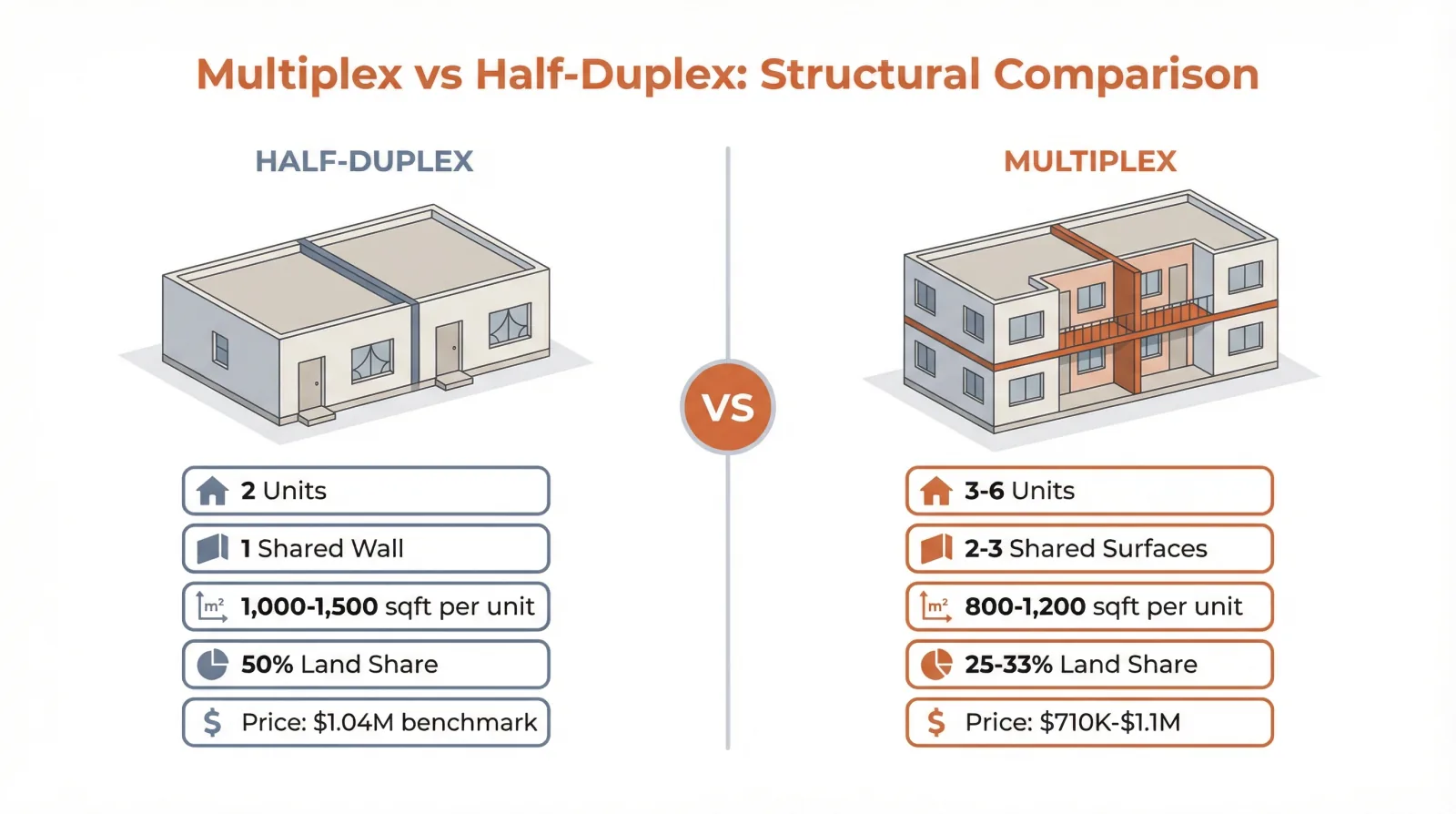
A half-duplex is one of two units sharing a wall or floor. A multiplex is 3-6 units on a single lot, so there are more neighbours and more shared systems, along with more rental income potential and lower per-unit costs.
Strata With 2 vs 4 Owners
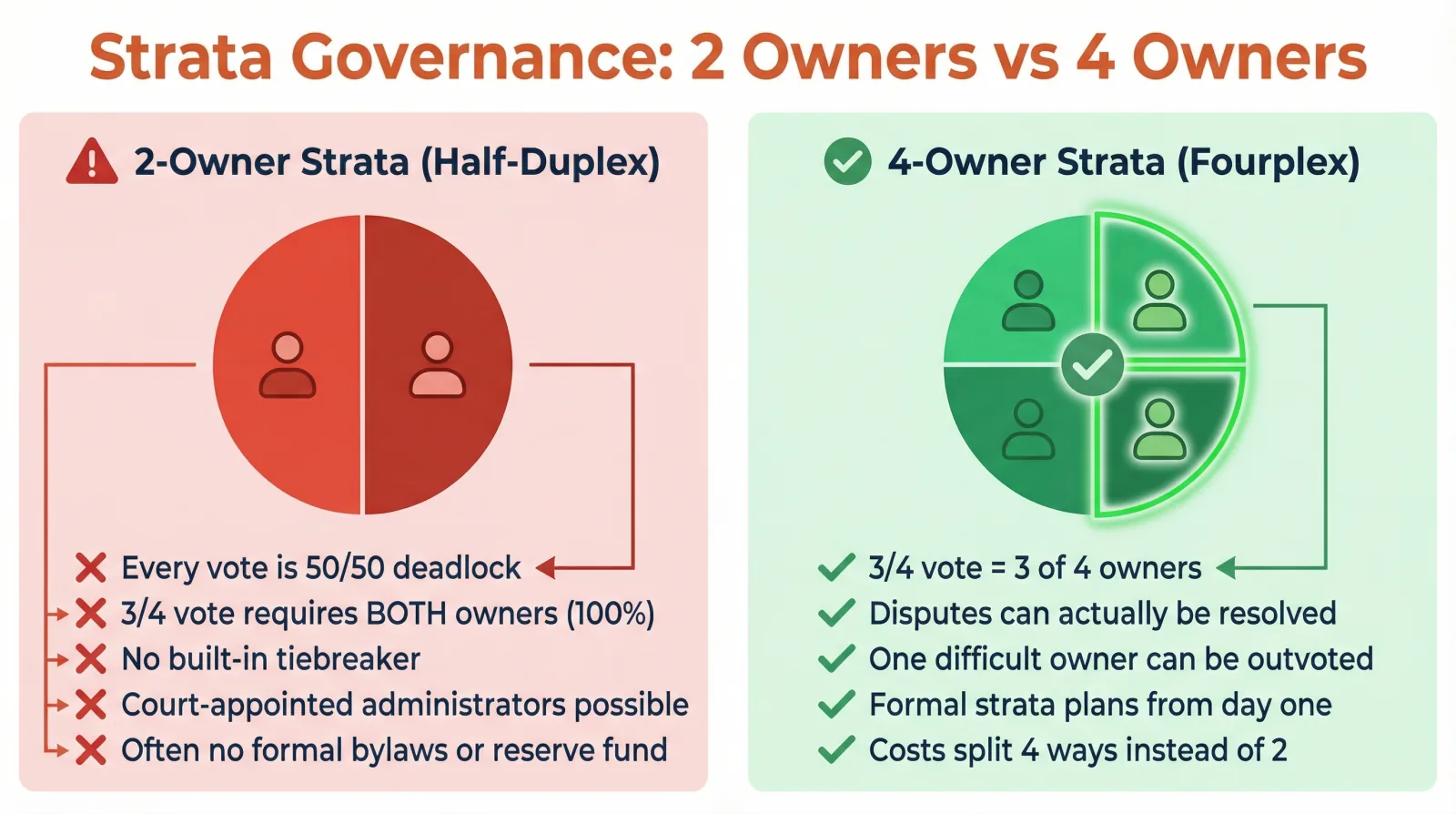
Two-owner stratas sound simple until there's a disagreement. Every vote is 50/50. BC courts have appointed administrators for deadlocked duplexes. Four owners at least allow 3/4 majority votes to break ties.
Rental Income Math
Half-duplex owners can rent their other half for $2,000-$3,000/month. Fourplex owners can rent three units for $5,000-$7,000/month combined. The mortgage offset difference is massive.
Insurance & Maintenance
Half-duplexes split costs two ways. Fourplexes split four ways. Roof replacement, exterior painting, plumbing: every shared expense drops per unit as the building gets bigger.
Build Quality Varies
Half-duplexes have 40+ years of track record in Vancouver. New multiplexes are untested at scale. Early builds show good quality, and there is no 20-year maintenance history yet to reference.
Two Very Different Animals
People use “duplex” and “multiplex” interchangeably. They shouldn't. Here's what each actually means in BC real estate.
Half-Duplex
One of two units sharing a wall (side-by-side) or a floor (stacked). Sits on a single lot with one strata plan. In Vancouver, these are classified as RT-zoned “Two Family Dwellings.”
- •Typically 1,000–1,500 sqft per unit
- •Separate entrance, own kitchen/bath/utilities
- •You own ~50% of the lot's land value
- •Common in Vancouver since the 1970s
Multiplex
A building with 3 to 6 units on a single lot: triplexes, fourplexes, and six-plexes. Enabled by Bill 44 (June 2024) and Vancouver's own Multiplex Policy. New construction, new building codes, new product type.
- •Typically 800–1,200 sqft per unit
- •Separate entrances, own everything
- •You own ~25–33% of the lot's land value
- •First completed projects hit market late 2025
Sources: WeLoveEastVan.com, City of Vancouver RT Zoning, BC Gov Bill 44 Small-Scale Multi-Unit Housing legislation.
The Full Comparison
Twelve factors that actually matter when choosing between these two housing types in Metro Vancouver.
| Factor | Half-Duplex | Multiplex (3-6 Units) |
|---|---|---|
| Entry Price | $1.04M benchmark (Jan 2026) | $710K to $1.1M for new units |
| Typical Unit Size | 1,000 to 1,500 sqft | 800 to 1,200 sqft |
| Land Share | About 50% of lot value | About 25% to 33% of lot value |
| Strata Owners | 2 owners, unanimous votes required | 3 to 6 owners, 3/4 majority possible |
| Deadlock Risk | High, because 50/50 splits cannot be resolved internally | Low, because odd-number or 3/4 votes break ties |
| Strata Fees | $200 to $400/month (split 2 ways) | $150 to $350/month (split 3 to 4 ways) |
| Rental Income | 1 unit: $2,000 to $3,000/month | 1 to 3 units: $2,000 to $7,000/month |
| Shared Walls | 1 wall (side-by-side) or 1 floor (stacked) | 2 to 3 shared surfaces typical |
| Outdoor Space | Private yard, often generous | Smaller private patio or yard |
| Resale Track Record | 40+ years of sales data in Vancouver | First resales expected 2026 to 2027 |
| CMHC Insurable | Yes, up to $1.5M | Yes, up to $1.5M |
| Building Age | 1970s to 2020s stock available | All new construction (2024+) |
Sources: REBGV MLS® HPI January 2026 (townhouse benchmark, the closest published comparable to a half-duplex). WOWA.ca market data. CMHC Rental Market Report 2025. BC Strata Property Act voting requirements.
The Strata Problem Nobody Talks About
BC has roughly 5,000 small-strata buildings. Most work fine. When a two-owner strata breaks down, there is no easy fix.
2-Owner Strata (Half-Duplex)
- Every vote is 50/50, with no built-in tiebreaker
- 3/4 vote requires both owners to agree (2 of 2 = 100%)
- CBC reported duplex owners going to CRT three times over maintenance
- BC Supreme Court has appointed administrators for deadlocked duplexes
- Many operate informally, with no meetings, no bylaws, no reserve fund
4-Owner Strata (Fourplex)
- 3/4 vote = 3 of 4 owners, so disputes can be resolved
- One difficult owner can be outvoted on maintenance, budgets, bylaws
- New builds come with proper strata plans, bylaws, and reserve funds from day one
- Shared costs split four ways, lowering the per-unit burden
- BC Strata Property Act is actually designed for 3+ owner corporations
Sources: CBC News “Small strata, big trouble” (Feb 2021). BC Strata Property Act s.174 (administrator appointment). BCLI case summary: BC Supreme Court, Surrey duplex deadlock. BC Gov types of strata voting.
What You Actually Pay Each Month
Rough monthly costs for an owner-occupier in each scenario, assuming 5% down on the first $500K and current rates. These are estimates, and your numbers will vary.
Half-Duplex at $1.04M
Owner-occupied, renting other half
Fourplex Unit at $850K
Owner-occupied, renting 1 adjacent unit
Estimates only. Mortgage assumes CMHC-insured, 5% down on first $500K, 10% on balance, 4.5% rate, 25yr amortization. Rental income based on CMHC 2025 Vancouver 2BR averages. Property tax estimated from City of Vancouver 2025 rates. Your actual costs will differ.
Which One Is Right for You?
Choose a Half-Duplex If…
- You want maximum space, with 1,200+ sqft as your minimum
- You prefer dealing with just one neighbour
- You value a proven resale track record
- You can handle the $1M+ entry price
- You want a bigger yard and more outdoor space
Choose a Multiplex If…
- You want the lowest entry price for ground-oriented living
- Rental income to offset your mortgage is a priority
- You prefer strata governance that actually works (3/4 votes)
- New construction with modern building codes matters to you
- You're comfortable being an early adopter in a new market
Consider Either If…
- You want a separate entrance and ground-level living
- You're a family that needs more room than a condo offers
- You're downsizing from a detached home
- Multi-generational living is the goal
- You want to own land, not just airspace
The bottom line
Both half-duplexes and multiplexes are strong paths into Vancouver homeownership. REBGV's closest published comparable, the townhouse benchmark, dropped about 5% year-over-year by early 2026, which means buyers have real negotiating power on both options. Half-duplexes at $1.04M offer a proven format that realtors, lenders, and appraisers all understand. Multiplex units starting around $710K offer a lower entry point, better rental income potential, and more functional strata governance with 3–4 owners instead of two.
The first Bill 44 projects hit the market in late 2025, and the early results are promising. Multiplexes are filling a gap that half-duplexes never could, giving buyers a ground-oriented home with suite income at a price that works. Half-duplexes remain excellent for buyers who want simplicity and a single-neighbour dynamic. The strata governance is straightforward, the format is time-tested, and goodwill between two owners goes a long way.
The deciding factor comes down to your lifestyle and financial goals. A half-duplex is a great fit if you want simplicity and a proven track record. A multiplex is the better play if you want lower monthly costs, rental income, and more upside from a newer build. Either way, you're buying into a housing type that Vancouver needs more of.
Not sure which one fits your situation? Talk to our team. We will walk you through the numbers side by side and help you find the right home on the right street. If you've already narrowed it down to two specific listings, use our side-by-side listing comparison tool to compare exact prices, floor plans, and neighbourhood scores. For more comparison guides and buying advice, explore our Playbook.
Data: REBGV MLS® HPI Jan 2026. WOWA.ca Metro Vancouver market update. CBC News small-strata reporting. CMHC Rental Market Report 2025. VanPlex multiplex market analysis 2026.
Be first to see new projects coming soon
Get the free Buyer Guide and early access to new multiplex projects in Greater Vancouver, before they're publicly listed.
Key Takeaways
- Half-duplexes benchmark at $1.04M in Metro Vancouver, about $300K more than entry multiplex units.
- Two-owner strata governance creates 50/50 deadlock risk on every decision.
- Fourplex owners can generate $5,000-$7,000/month in rental income from three units.
- Multiplex strata fees run lower per unit because costs split 3-4 ways instead of two.
- BC courts have appointed administrators for deadlocked duplex stratas.
- Half-duplexes offer proven resale markets; multiplex resale data is still emerging.
Frequently Asked Questions
What is the difference between a half-duplex and a multiplex?
A half-duplex is one of two units in a building sharing a wall or floor on a single lot. A multiplex contains 3-6 units on one lot. In Vancouver, half-duplexes are classified as RT-zoned 'Two Family Dwellings' while multiplexes fall under the newer Bill 44 and Vancouver Multiplex Policy.
The physical difference is straightforward: two units versus three or more. But the legal and financial differences run deeper. A half-duplex strata has exactly two owners, meaning every decision requires unanimous agreement or you're deadlocked. A fourplex strata with four owners can pass resolutions with a 3/4 majority vote under the BC Strata Property Act, which makes governance far more practical. Half-duplexes have been common in Vancouver since the 1970s under RT zoning. Multiplexes are newer, enabled by Bill 44 (June 2024) and Vancouver's own Multiplex Policy. The construction type also differs. Half-duplexes are typically side-by-side or front-back on traditional lots, while multiplexes stack units more creatively across 2-3 storeys to fit 3-6 homes on the same footprint.
Are half-duplexes cheaper than multiplexes in Vancouver?
Yes, half-duplexes generally cost more. REBGV does not publish a half-duplex-specific benchmark; its closest comparable category, townhouse, sat at $1.04M as of January 2026. New multiplex units in East Vancouver start around $710K-$850K for two-bedroom configurations, making them the more affordable entry point.
The price difference comes down to what you're actually buying. A half-duplex typically gives you 1,000-1,500 sqft of one of two units on a lot, with a proportional share of the land value. You own roughly half the lot. A multiplex unit might give you 800-1,200 sqft of one of four units, with a quarter share of the land. Less land per unit means a lower purchase price. In Vancouver East, half-duplexes benchmark around $1.037M while multiplex units range from $710K-$1.1M depending on size and configuration. Vancouver West half-duplexes run closer to $1.4M. The gap narrows for larger multiplex units with premium finishes, but at the entry level, multiplexes win on price by $200K-$300K. Factor in that multiplex buyers also get rental income potential from adjacent units, and the effective cost difference widens further.
What are the strata problems with owning a duplex in BC?
The biggest problem is governance deadlock. With only two owners, every strata vote is 50/50. CBC reported that some BC duplexes have been to the Civil Resolution Tribunal three times over maintenance disputes. BC courts have even appointed administrators for deadlocked duplex stratas.
BC has an estimated 5,000+ duplex, triplex, and fourplex strata buildings, and most function fine day to day. But when things go wrong in a two-unit strata, they go wrong fast. You can never outvote your neighbour. If you disagree on whether to replace the roof, repaint the exterior, or change the insurance policy, there's no majority to break the tie. Many duplex stratas operate informally, skipping annual meetings and ignoring the Strata Property Act requirements. That works until one owner wants to sell and the buyer's lawyer discovers there are no meeting minutes, no contingency reserve fund, and no formal maintenance schedule. The BC Supreme Court case in Surrey is instructive: two duplex owners became so deadlocked that the court appointed an external administrator to run the strata corporation. That's an extreme outcome, but it happens because the two-owner structure has no built-in tiebreaker. With four owners in a multiplex, a 3/4 vote (three of four) can resolve most disputes without court intervention.
Is it better to buy a fourplex unit or a half-duplex in Vancouver?
It depends on your priorities. A fourplex unit costs less ($710K-$1.1M vs $1.04M benchmark), generates more rental income, and has better strata governance. A half-duplex offers more space per unit, a proven resale market, and only one shared wall instead of multiple neighbours.
For first-time buyers optimizing on price and rental income, a fourplex unit is hard to beat. You enter the market for less money, and three rental units next door can generate $5,000-$7,000/month to offset your mortgage. Strata governance with four owners is also more practical, because you can pass resolutions with a 3/4 majority instead of needing unanimous agreement. For buyers who want maximum space and minimal neighbour interaction, the half-duplex wins. You share one wall with one neighbour, not three walls with three neighbours. Half-duplexes also have decades of resale data in Vancouver, so you know what you're getting in terms of appreciation patterns. Multiplex resale is still new. The first Bill 44 units only hit the market in late 2025. If you're risk-averse and can afford the premium, a half-duplex is the safer bet. If you're optimizing for value and income, the fourplex math is stronger.
How much are strata fees for a half-duplex vs a multiplex?
Half-duplex strata fees in Vancouver typically run $200-$400 per month, splitting all shared costs between two owners. Multiplex strata fees for new fourplexes are estimated at $150-$350 per month, since shared costs like insurance, roof maintenance, and landscaping split across 3-4 units.
The per-unit math favours multiplexes. A $12,000 annual insurance policy costs each half-duplex owner $6,000/year ($500/month). The same policy on a fourplex costs each owner $3,000/year ($250/month). This pattern repeats across every shared expense: roof replacement, exterior painting, gutter cleaning, landscaping, and common area maintenance. However, multiplexes have more shared systems, such as shared mechanical rooms, more complex plumbing runs, and shared parking areas that need maintenance. The net effect is still lower per-unit costs for multiplexes, but the gap isn't as dramatic as simply dividing by four. Also worth noting: many older half-duplex stratas in Vancouver operate without formal strata fees, instead splitting costs informally as they arise. This can mean lower monthly outlay but zero contingency reserve, which is a real risk when a $30,000 roof replacement lands with no savings to draw from.
Do half-duplexes hold their value better than multiplexes in Vancouver?
Half-duplexes have a 40+ year track record in Vancouver with consistent appreciation data. REBGV's closest published comparable, the townhouse benchmark, is down about 5% year-over-year as of early 2026. Multiplex resale data is too new to draw conclusions, because the first Bill 44 units only reached the market in late 2025.
Half-duplexes have been a staple of Vancouver's RT-zoned neighbourhoods since the 1970s. Buyers and lenders understand them, appraisers have decades of comparable sales data, and the resale market is well-established. REBGV publishes no half-duplex-specific benchmark; its closest comparable category, townhouse, has tracked alongside broader market trends: up during booms, softer during corrections like the current 5% year-over-year decline. Multiplexes are genuinely new to the market. Bill 44 passed in June 2024 and the first completed projects started selling in late 2025. There simply isn't enough resale transaction data to know whether multiplex units hold value as well as half-duplexes over a full market cycle. The underlying land value supports the thesis that they should, because a quarter share of a Vancouver lot is still a quarter share of a Vancouver lot. But until we see how appraisers, lenders, and resale buyers treat these units through a downturn, calling multiplexes a proven store of value would be premature. If you're holding for 10+ years, the risk is probably low. If you might sell in 2-3 years, the half-duplex has more predictable liquidity.
More from The Playbook
Why Multiplex
The case for ground-oriented living
ExploreBuying Guide
From discovery to closing
ExploreFinancing
Mortgages, programs & more
ExploreMarket Reports
Data, trends & analysis
ExploreLiving
What ownership looks like
ExploreMulti-Gen
Families buying together
ExploreWhere to Buy (Van)
Vancouver neighbourhood data
ExploreWhere to Buy (Burnaby)
Burnaby neighbourhood data
ExploreStrata Guide
Bylaws, governance & ownership
ExploreTalk to a Multiplex Expert
Whether you're buying, building, or exploring your options, our team can help you navigate the process with confidence.
Ready to find your multiplex?
Browse duplexes, triplexes, and fourplexes across Greater Vancouver and BC.