Vancouver Multiplex Amenities & Storage (2026)
A buyer's plain-English guide to the amenities, storage lockers, and bike rooms in new Vancouver multiplex homes — what actually adds value, what's just marketing.
By MultiLiving Editorial · May 27, 2026
Questions about this guide: Gary Paul, REALTOR®, Personal Real Estate Corporation, Grand Central Realty, 778-828-7476
Walk into the showroom for almost any new Vancouver fourplex and the sales materials will list the same handful of selling points: secure bike room, in-suite laundry, a storage locker per unit, EV-ready parking. They sound like the same thing across every project. They're not.
Some of these features change how your daily life works. Some are line items that puff up the price sheet. After touring dozens of new multiplex projects across the city this spring, here's our blunt take on what's worth paying for, what's filler, and what to ask before you sign anything.
The short version
- A real, secure bike room with proper hooks and lighting is worth paying for. A token corner labelled "bike storage" is not.
- A private storage locker that fits the gear of one full household — usually 35 to 60 cubic feet — is the single most under-priced amenity in Vancouver multiplex life.
- Shared rooftop decks and small landscaped courtyards earn their keep. Pools, gyms, and concierge desks belong in towers, not fourplexes.
- Every amenity shows up on your monthly strata bill. The smaller the building, the more each square foot of common space costs you.
Why amenities matter more in a multiplex than in a tower
In a 200-unit concrete tower, the gym, lounge, and co-working room are split 200 ways. The cost per unit is small. In a four- or six-unit Vancouver multiplex, every shared space is paid for by a handful of households. A poorly chosen amenity in a fourplex isn't just unused space — it's a real line on your monthly fee.
Average strata fees in Vancouver run roughly $0.45 to $0.55 per square foot per month for low-rise wood-frame buildings, with concrete and amenity-heavy buildings closer to $0.55 to $0.70 per square foot, according to StrataCalc's 2026 review of typical Vancouver strata fees. On a 1,200 sq ft fourplex unit that's roughly $540 to $840 a month before any extras. Anything you add to the building's amenity list nudges that number up.
In our view: in a small building, less is more. You want amenities that quietly improve daily life and don't need a contract cleaner, a lifeguard, or a $4,000 annual hot-tub service to keep them running.
Bike rooms: the one amenity worth real scrutiny
Vancouver is the most bike-friendly major city in Canada, and the new Broadway, Arbutus, and Mount Pleasant cycling networks have changed how people get to work. A good bike room is not a frill — for many buyers it replaces a second car. So this is the one amenity where you should look hard at what's actually being delivered.
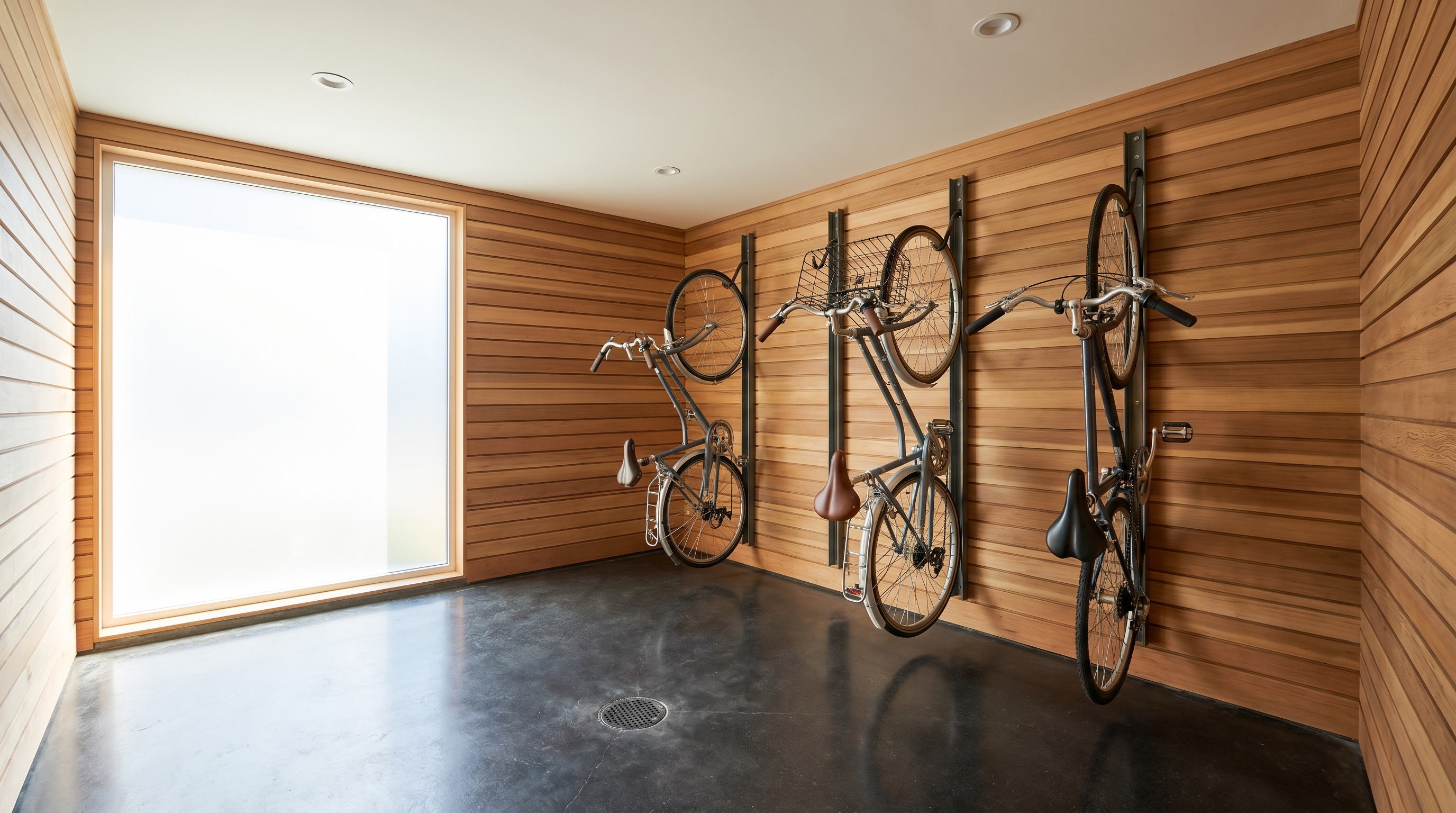
What a real bike room looks like
The City of Vancouver's bicycle parking standards require that secure bike rooms have solid opaque walls, motion-activated security lighting in a tamper-proof housing, full visibility from the entry door, and a reinforced steel entry door at least 75 cm wide with high-security locks, per the City's February 2026 Parking By-law. Vancouver also requires that at least 10% of Class A spaces be lockable bike lockers, not just rack spots.
In practice, a well-designed multiplex bike room has:
- One Class A space per unit at minimum, plus visitor spots near the front entry.
- Vertical wall hooks (saves floor space) and at least one ground-level rack for a cargo bike or e-bike with a child seat.
- A 120-volt outlet on every wall — increasingly important as e-bikes outnumber acoustic bikes among buyers under 50.
- A floor drain so wet rain gear and muddy tires don't pool into the unit hallways.
- A small workbench with a basic stand, pump, and a few hex keys — about $300 of fixtures that make a $1.5 million home feel considered.
Red flags in the floor plan
If the bike room is labelled on the plans but is under 24 sq m and shoved into a corner of an underground parkade with no light and no outlet, you don't really have a bike room. You have a place to leave a bike for a week before it disappears. Walk through it before you sign. If the developer can't show you the actual room, that's a no.
Storage lockers: the silent dealbreaker
Multiplex units in Vancouver are smaller than the detached homes most buyers are coming from. A typical three-bedroom unit runs 1,100 to 1,400 sq ft. That works fine — until you try to put away the camping gear, the Christmas tree, the kids' winter tires, the suitcases, and that one ugly chair you can't bring yourself to throw out.
A proper private storage locker — usually a steel-mesh enclosure 4 ft by 6 ft by 7 ft tall, around 35 cubic feet of usable volume, but ideally 60 — is the most consistently under-priced amenity in Vancouver multiplex housing. Buyers walk past the diagram on the plan and don't think about it. Two years in, they wish they'd asked. Some questions to push on:
- Is the locker assigned to your unit on title, or is it a licensed exclusive-use area? On title is better — it travels with the unit if you sell.
- Where is it physically located? A locker on the same floor as your unit is worth more than one in a basement two flights down.
- Is it climate-controlled or a damp crawl space? Vancouver's coastal humidity ruins anything left in unconditioned storage for a winter.
- How big is it actually? Ask for the square footage in writing. Some "storage lockers" advertised in marketing are 12 to 18 cubic feet — barely a closet.
In our view, a single 35-cubic-foot locker per unit should be table stakes for any multiplex over $1.2 million. If a project doesn't include one, that's a soft signal that the developer optimized the floor plan to maximize sellable area at your expense.
In-suite storage: the cheaper fix
Some new multiplex projects skip the central storage locker room entirely and instead build deep in-suite closets, mudroom benches with cubbies, or a dedicated under-stair pantry. We like this trade. A well-designed in-suite storage strategy — a deep entry closet, two-foot-deep pantry shelving, full-height bedroom closets with built-in organization — can replace a locker for most families and lives inside your unit, where you actually use it.
What you do not want is a project where the developer has skipped both. If the unit's only closets are the bedroom and the front entry, and there is no shared locker, the household will end up renting a $200-a-month off-site locker by year three. That is a real ongoing cost the showroom won't tell you about.
Outdoor space: where small buildings actually shine
This is where Vancouver multiplex housing pulls ahead of condos. A four- or six-unit building can give every household something a tower physically cannot: a private deck or patio, plus a small shared courtyard or rooftop. Outdoor space is the amenity buyers consistently say they use the most after move-in, and it's the cheapest one to maintain.
What we look for:
- A private deck or patio of at least 80 sq ft per unit. Smaller than that and it's a balcony that fits one chair.
- A gas line on at least one outdoor space per unit. Otherwise you're cooking on a propane tank and storing it… where, exactly?
- A shared courtyard or rooftop with a hose bib, a bench or two, and a small landscaped bed. That's it. You don't need an outdoor kitchen on a fourplex roof.
- Privacy planting between adjacent decks — a row of bamboo screens or a slat trellis goes a long way to making a deck feel like yours.
Parking and EV charging: the rules just got friendlier
Vancouver requires every new residential parking space to be EV-ready, meaning the conduit, panel capacity, and rough-in are already there for a Level 2 charger. You provide the actual charger when you move in. That's the standard. What varies project to project is who pays for the install and who pays for the electricity.
Ask three questions before signing:
- Is the charger included or extra? Some developers include a $1,500 hardwired Level 2 charger; others quote $2,500 to $3,500 as an upgrade.
- How is the electricity metered? The cleanest setup is a sub-meter that bills your charger usage to your own BC Hydro account. Avoid arrangements where charger electricity is bundled into strata fees — it's a slow source of resentment between neighbours.
- What's the building's panel capacity? Some early Bill 44-era multiplexes were sized for one charger per unit, which is fine until your second car arrives.
What we'd skip in a small multiplex
Anything that requires a service contract to keep running. A small building's strata cannot absorb the operating costs of resort-style amenities. The math just doesn't work.
- Hot tubs and pools — uninsurable, expensive, and Vancouver's weather makes them seasonal at best. We have not seen one in a fourplex that earned its keep.
- Shared gyms with a treadmill and a single weight rack — they sit unused after the first six months, then become a dust trap that everyone pays to keep clean.
- Concierge or part-time front-desk staff — never financially viable below ~30 units.
- Guest suites — rare in multiplex; if offered, ask exactly how the booking and cleaning is handled and who collects the fee.
How to read the strata budget for amenity costs
Once a building has been operating for a year or two, the strata's annual budget tells you exactly what each amenity costs. When you're buying pre-sale, the developer's disclosure statement includes a projected first-year budget. It's a forecast — usually optimistic — but you can read between the lines:
- Look for line items called "common area utilities," "landscaping contract," "window cleaning," "elevator maintenance," and "amenity supplies." Add them up. That's your amenity tax.
- If the projected budget shows zero contingency or under 10% to the contingency reserve fund (CRF), the strata fee will rise sharply in years two and three to catch up.
- Compare against the StrataCalc benchmark for similar buildings. If the projection is much lower, ask your lawyer to flag it — under-projected fees are the most common pre-sale buyer regret we hear about.
What this comes down to
In a multiplex, the amenities you'll actually use every week are the boring ones: a real bike room, a storage locker that fits a household's gear, a deck big enough for a table, EV-ready parking, decent in-suite closets. Everything else is decoration that you pay for monthly.
Walk through every shared space before you sign. Ask for the projected strata budget in writing. Then look at your own life — how many bikes, how much gear, how often you'd actually use a rooftop terrace — and weigh the building accordingly. The right multiplex isn't the one with the longest amenity list. It's the one whose amenity list matches how you live.
FAQ
How big should a storage locker be in a Vancouver multiplex?
Aim for at least 35 cubic feet of usable, climate-controlled, lockable storage assigned on title. 60 cubic feet is generous. Anything under about 25 cubic feet is closet-sized and won't hold a typical Vancouver household's seasonal gear.
Are bike rooms required in new Vancouver multiplexes?
Yes. The City of Vancouver's parking by-law sets minimum Class A bicycle parking ratios for residential developments, and at least 10% of those spaces must be lockable bike lockers. The room must have solid opaque walls, security lighting, and a reinforced steel entry door.
Will I really use a shared rooftop deck?
In a small building, yes — most owners use shared outdoor space for BBQs, summer evenings, and overflow gatherings. The catch is whether the rooftop is genuinely accessible (an elevator stop or top-floor stair landing) or a token feature you'd never bother climbing to. Visit the rooftop before signing.
Do amenities really raise strata fees that much?
In a four- to six-unit building, every amenity is paid for by a handful of households, so each one matters. A pool, gym, or hot tub can add $100 to $250 per unit per month once contracts and reserves are factored in. In a tower, the same amenity might cost $20 to $40 per unit.
Next step
Want help comparing the actual amenity packages, storage, and bike room layouts of multiplex buildings on the market right now? Browse what's available on our properties page, or reach out to the MultiLiving team — we'll walk you through which buildings are over- and under-delivering on the things that matter once you've moved in.