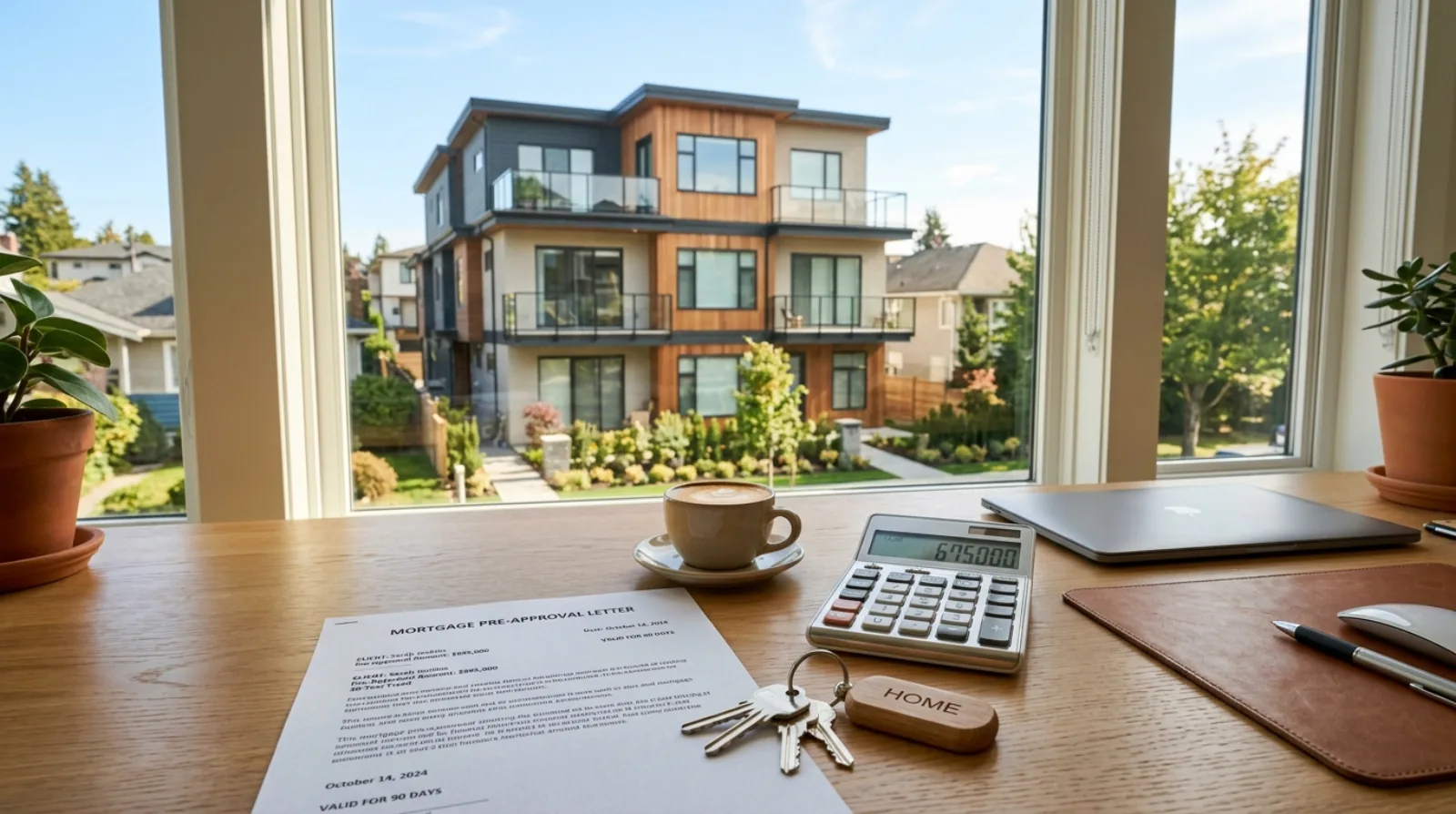
Fixed or Variable? Choosing a Mortgage for Your New Multiplex Home
Fixed or variable for your new multiplex home? Where rates sit in August 2026, what each costs monthly, the penalty gap, and our honest take for BC buyers.
By MultiLiving Editorial · August 18, 2026
At some point in every purchase, the paperwork slows down and your lender asks one question: fixed or variable? For a lot of families buying their first brand new multiplex home, this is the moment the process suddenly feels real. You are not comparing floor plans anymore. You are deciding how your single biggest monthly bill will behave for the next three to five years.
This guide walks through the choice in plain English, with current numbers, for one specific buyer: a household buying a single strata unit in a new duplex, triplex, or fourplex in Greater Vancouver. Not a whole building, not an income property. One home, one mortgage.
One thing we will not do here is explain rate holds or the qualification rules in depth. We have covered rate holds for pre-sale buyers separately, and qualification is its own topic. This post is about the fixed-versus-variable decision itself.
Where rates stand in August 2026
Start with the backdrop. The Bank of Canada held its policy rate at 2.25% on July 15, 2026, its sixth straight decision without a change. The next scheduled announcement is September 2, 2026. That policy rate is not your mortgage rate, but variable mortgages move when it moves, so it matters.
Banks price variable mortgages off their prime rate, which sits at 4.45% across the major lenders as of August 14, 2026, according to Ratehub's prime rate tracker. A variable mortgage is quoted as a discount from prime, something like "prime minus 1.10".
Here is where the two options actually sit right now:
- 5-year fixed (insured): the best advertised rate is 4.04% as of August 14, 2026, per Ratehub's rate comparison.
- 5-year variable (insured): the best advertised rate is 3.35% as of the same date, also per Ratehub. That works out to prime minus 1.10.
- 3-year fixed: around 3.89% as of August 13, 2026, according to nesto's rate tables, a little below the 5-year fixed.
Two cautions about those numbers. First, they are the best advertised rates for insured mortgages, meaning a down payment under 20%. Your own quote depends on your file, and it may be higher. Second, rates change weekly. Treat these as a snapshot of mid-August 2026, not a promise.
The unusual part of this moment is the direction of the gap. Variable is sitting about 0.7 percentage points below fixed. For most of 2023 and 2024 it was the other way around. That gap is the whole reason this decision feels hard right now: the cheaper option is also the one that can move against you.
What fixed and variable actually mean
Fixed: the rate cannot move
A fixed mortgage locks your rate for the length of the term, usually three or five years. Your payment is identical every month until renewal. If rates jump, you are protected. If rates fall, you keep paying the higher rate until the term ends, unless you pay a penalty to get out early. Fixed buys you certainty, and you pay for that certainty up front through a higher rate.
Variable: the rate follows prime
A variable mortgage moves with your lender's prime rate. When the Bank of Canada changes its policy rate, prime follows within days, and your mortgage rate changes with it. Your discount from prime stays the same for the whole term; only prime moves.
Variable comes in two versions, and the difference matters more than most people realize:
- Adjustable payment: your monthly payment goes up or down when prime changes. You feel every rate move right away, but your payoff schedule stays on track.
- Fixed payment: your monthly payment stays the same, but the split changes. When rates rise, more of each payment goes to interest and less to paying down the loan. If rates rise far enough, you hit what lenders call the trigger rate, where your payment no longer covers the interest and the lender steps in to raise it.
Ask which version you are being offered. Buyers sometimes discover the difference only when rates move, which is the worst possible time to learn it.
The gap in dollars: a worked example
Percentages are abstract. Dollars are not. Take a family buying a new multiplex unit with an $800,000 mortgage on a 25-year amortization. Using the August 14, 2026 rates above, standard Canadian semi-annual compounding, and counting principal and interest only:
- Fixed at 4.04%: about $4,226 per month.
- Variable at 3.35%: about $3,931 per month.
- Difference: about $295 per month, or roughly $3,540 per year.
We calculated those figures ourselves from the quoted rates; your lender's numbers may differ slightly depending on payment frequency and rounding. On a smaller mortgage, scale it down: at these rates the fixed option costs about $528 per month for every $100,000 borrowed, and the variable option about $491.
Now the uncomfortable part. That $295 gap only holds while the Bank of Canada stays put. Each quarter-point increase in the policy rate adds roughly $105 per month to the variable payment on this mortgage. Two increases and most of the gap is gone. Two cuts and the gap grows to almost $500 a month. We are not going to predict which happens, and you should be suspicious of anyone who does with confidence.
The part most buyers skip: penalties
Almost everyone compares rates. Almost no one compares exit costs, and in our experience the exit cost is where the real money hides.
Life changes inside a five-year term more often than people expect. A job moves cities. A second child arrives. Parents decide to sell their house and join you, which changes what home you need. Breaking a mortgage early triggers a penalty, and the two mortgage types calculate it very differently.
- Variable: the penalty is typically three months of interest. On an $800,000 balance at 3.35%, that is about $6,700. Painful, but survivable.
- Fixed: the penalty is typically the greater of three months of interest or something called the interest rate differential (IRD), which compensates the lender for the rate difference over the rest of your term. When rates have fallen since you signed, the IRD can run to tens of thousands of dollars, several times the three-month figure. The big banks tend to calculate it in the way that produces the larger number.
One legal footnote: under the federal Interest Act, once a mortgage with a term longer than five years passes the five-year mark, the penalty is capped at three months of interest. That helps with ten-year terms, not with the standard five.
Our view: if there is a realistic chance you sell or refinance within the term, the penalty difference deserves as much weight as the rate difference. A fixed rate that saves you nothing and costs $25,000 to escape is not the safe option it appears to be.
Buying pre-sale changes the timing
If you are buying your multiplex unit pre-sale, there is a wrinkle that catches people off guard: you sign the purchase contract now, but the mortgage that actually funds the purchase is finalized close to completion, which might be one to three years away.
That has three practical consequences:
- The fixed-versus-variable choice you are weighing today is not binding. You will make the real decision near completion, at whatever rates exist then.
- Today's 0.7-point gap between fixed and variable may be wider, narrower, or reversed by the time your home is ready. Do not build your family budget on the assumption that the current variable rate will still be there.
- The honest way to budget for a pre-sale is to test your numbers at today's fixed rate, not at the best-case variable rate. If the payment only works at 3.35%, you are relying on the Bank of Canada to cooperate for the next two years, and it has no obligation to.
Rate holds can protect part of this risk for a stretch of the wait, and we have written about how those work for pre-sale buyers in a separate post. The short version: ask your lender how long they will hold a rate for a home that completes well into the future, because the answer varies a lot.
Our honest take
We promised an opinion, so here it is, in three parts.
If the variable payment is the only one that fits your budget, take fixed anyway, or buy a less expensive unit. That sounds backwards, but a budget that only works at the lowest rate on the board is not a budget. It is a bet. The stress your family absorbs every time a Bank of Canada announcement approaches is not worth $295 a month.
If you have real room in your budget, variable at prime minus 1.10 is genuinely attractive right now. You start about 0.7 points ahead, you keep the cheap three-month-interest exit, and if you turn out to be wrong you can usually convert to a fixed rate with the same lender mid-term. You will not get today's fixed rate when you convert, which is the cost of waiting, but the door is open.
And if you cannot sleep with a moving payment but the 5-year fixed feels expensive, look at the 3-year fixed around 3.89%. It costs less than the 5-year fixed, keeps your payment certain, and brings your renewal forward so you can reassess sooner. For buyers who expect their life to change within five years, we think the shorter fixed term is the most underrated option on the menu.
Questions worth asking your lender
Rate quotes all look alike. These questions surface the differences that matter:
- Is this variable mortgage the adjustable-payment kind or the fixed-payment kind, and what is my trigger rate if it is the latter?
- Exactly how do you calculate the penalty on your fixed mortgage: posted rate or discounted rate?
- If I start variable, can I convert to fixed later without a penalty, and which fixed rate would I get?
- How much extra can I prepay each year without penalty?
- If I sell this home and buy another, can I take this mortgage with me?
- For a pre-sale: how long before completion do you finalize my rate and terms?
Where this leaves you
- The Bank of Canada has held its policy rate at 2.25% since October 2025, with the next decision on September 2, 2026.
- As of August 14, 2026, insured 5-year money costs about 4.04% fixed and 3.35% variable (Ratehub). Variable is about 0.7 points cheaper, which is not the usual order.
- On an $800,000 mortgage over 25 years, that gap is worth about $295 a month, and each quarter-point rate change moves the variable payment by roughly $105.
- Penalties are the hidden difference: about three months of interest to break a variable, potentially far more to break a fixed.
- Pre-sale buyers choose fixed or variable near completion, not today, so budget at today's fixed rate to stay safe.
- Rule of thumb: if variable is the only payment you can afford, you should be in fixed, or in a smaller home.
Frequently asked questions
What is the difference between a fixed and a variable mortgage?
A fixed mortgage keeps the same rate and payment for the whole term, usually three or five years. A variable mortgage moves with your lender's prime rate, so your cost rises and falls with Bank of Canada decisions. Fixed buys certainty at a higher starting rate; variable starts cheaper but can change.
Which is cheaper right now, fixed or variable?
Variable, by a clear margin. As of August 14, 2026, Ratehub lists the best insured 5-year fixed at 4.04% and the best insured 5-year variable at 3.35%. That 0.7-point gap holds only while the Bank of Canada keeps its policy rate at 2.25%, so treat it as a snapshot.
Does the Bank of Canada set my mortgage rate?
Not directly. Its policy rate, 2.25% as of the July 15, 2026 announcement, drives the prime rate that variable mortgages follow. Fixed rates are priced mainly from government bond yields, which move on market expectations. That is why fixed rates can rise or fall even when the Bank does nothing.
What happens to my variable mortgage when the Bank of Canada moves?
Prime follows the policy rate within days, and your rate changes by the same amount. On an $800,000 mortgage over 25 years, each quarter-point move changes the true cost by roughly $105 a month. Whether your monthly payment changes right away depends on which type of variable mortgage you hold.
What is a trigger rate?
It applies only to variable mortgages with fixed payments. If rates rise enough, your unchanged payment stops covering the interest owed. That crossing point is the trigger rate, and your lender will then raise your payment or ask for a lump sum. Ask for your trigger rate in writing before you sign.
What does it cost to break a fixed mortgage early?
Typically the greater of three months of interest or the interest rate differential, which measures the rate gap between your contract and current rates over the remaining term. When rates have fallen, the differential can reach tens of thousands of dollars. Ask your lender to show the exact formula before signing.
What does it cost to break a variable mortgage early?
Usually three months of interest, full stop. On an $800,000 balance at 3.35%, that is about $6,700. This simpler, smaller penalty is one of the strongest arguments for variable if there is any real chance you will sell or refinance before your term ends.
Can I switch from variable to fixed partway through my term?
Usually yes, with the same lender and normally without a penalty. The catch is that you convert into the fixed rates available on that day, not the rates from when you signed. If rates have already climbed, the protection costs more, so conversion is a safety valve rather than a free redo.
I am buying my multiplex unit pre-sale. When do I choose fixed or variable?
Close to completion, when the mortgage actually funds, which may be one to three years after you sign the purchase contract. Today's rates will have changed by then. Budget using today's fixed rate as your test, and ask lenders how long they can hold a rate for a future completion.
Is a 3-year fixed a reasonable middle option?
We think so. At around 3.89% as of August 13, 2026 per nesto, it sits below the 5-year fixed, keeps your payment certain, and lets you reassess in three years instead of five. For families who expect changes, a new job, a growing household, it shortens the commitment.
Does choosing fixed or variable change how much I can borrow?
Sometimes. Lenders test your finances at a rate higher than your contract rate, so a lower variable contract rate can be tested at a lower qualifying rate too. The details of that test are a topic of their own; the honest summary is that the effect exists but rarely decides the purchase.
Do these rates apply if I am buying a whole multiplex building?
No. Everything here assumes you are buying one strata unit in a new duplex, triplex, or fourplex, which uses standard residential mortgage rules. Buying an entire three- or four-unit building follows different insured rules and down payment tiers, and deserves its own conversation with a broker.
The right answer to fixed or variable depends on the home and the numbers attached to it, and that part we can help with directly. Browse the new multiplex homes on the market now to see real prices to run against real rates, or talk to our team and we will walk through your shortlist, your timeline, and which questions to put to your lender. No scripts, just the homework done properly.