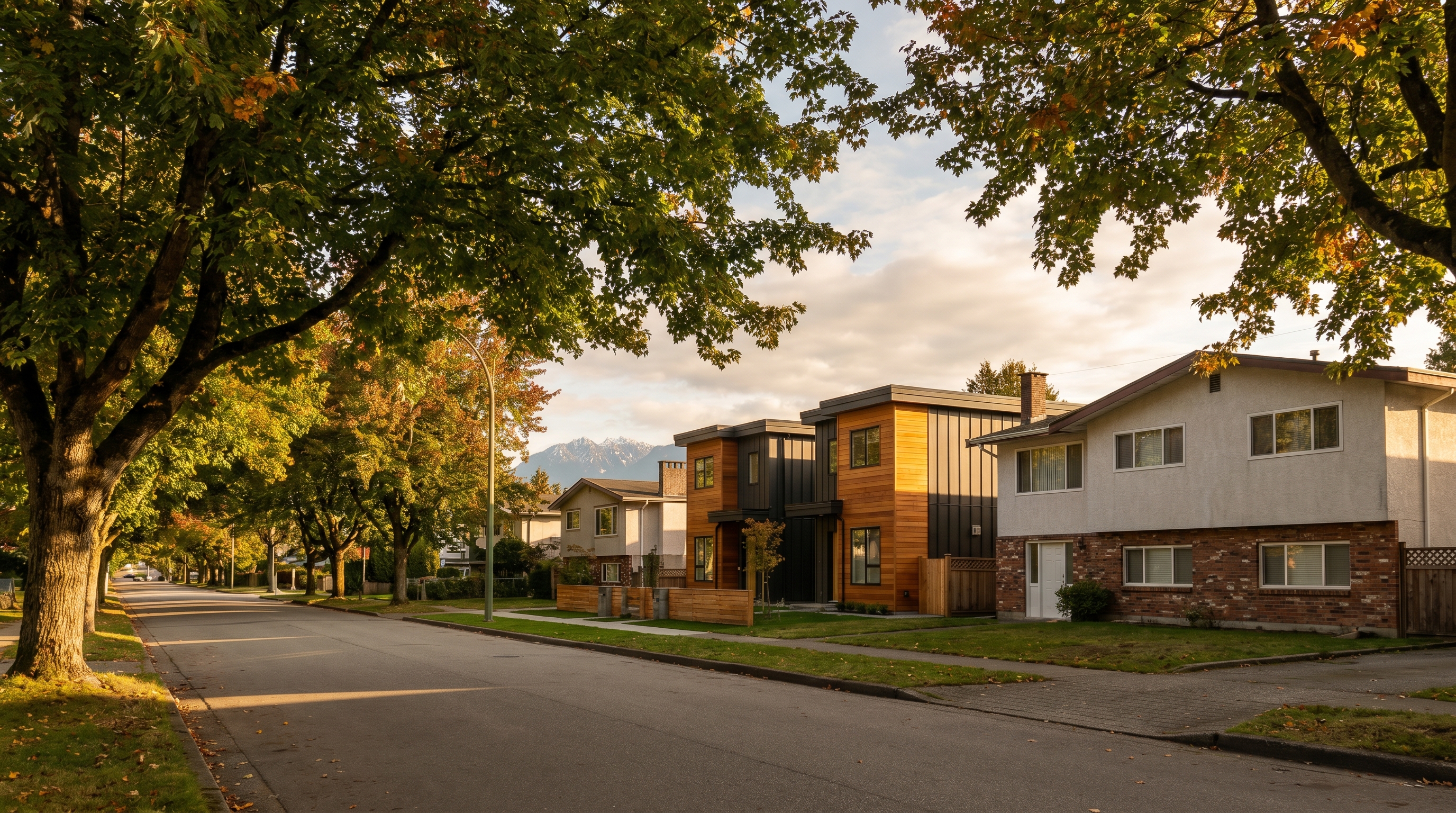
West Side or East Side: What Your Multiplex Budget Really Buys in Vancouver
GVR's July 2026 index puts $312,000 between east and west Vancouver townhouses. What that gap really buys multiplex shoppers, and where we think the value is.
By MultiLiving Editorial · September 9, 2026
Questions about this guide: Gary Paul, REALTOR®, Personal Real Estate Corporation, Grand Central Realty, 778-828-7476
Every Vancouver buyer eventually has the east-or-west conversation. For decades it was mostly abstract, because the two sides sold different things: character houses and towers west, older houses and low-rises east. Multiplex homes changed that. For the first time, nearly identical brand new homes, three to six on a lot, are selling on quiet streets on both sides of Ontario Street at the same time. Which means the question finally has numbers attached, and an honest answer. This piece is an opinion column with a spreadsheet: what the gap costs, what it buys, and where we would put our own money in late 2026.
The numbers first, from the board that publishes them
Greater Vancouver REALTORS publishes MLS® Home Price Index benchmarks separately for Vancouver East and Vancouver West. From the GVR July 2026 statistics package:
- Townhouse: Vancouver East $1,009,100, Vancouver West $1,321,100. Gap: $312,000, or about 31 per cent more to cross Ontario Street heading west.
- Apartment: Vancouver East $628,600, Vancouver West $768,700. Gap: $140,100, about 22 per cent.
- Over the year to July 2026: east townhouses fell 8.7 per cent and west townhouses 6.5 per cent; apartments fell 7.5 per cent east and 6.4 per cent west. Both sides are cheaper than a year ago, the east slightly more so.
Now the sentence this site repeats on purpose: there is no multiplex benchmark. GVR's index covers detached, townhouse, and apartment only, and no board anywhere publishes an official multiplex price for Vancouver. The townhouse benchmark is the closest published cousin, because a three-bedroom multiplex unit and a townhouse live very similarly. So when we talk about the east-west gap for multiplex shoppers, the honest method is to use the townhouse and apartment gaps as the measuring sticks and check them against real asking prices, which is what we do below. Anyone quoting an official multiplex benchmark is quoting something that does not exist.
One more piece of context from the same GVR release: July sales across the region were 2,061, down 9.8 per cent from a year earlier and well below the ten-year seasonal average, with a sales-to-active-listings ratio of 13 per cent. Translation for buyers: on both sides of the city, sellers are competing for you, not the reverse.
What the extra $300,000 buys on the West Side
Be fair to the west first. That premium is not irrational; it has been paid, consistently, for a century, and it buys real things.
- Position. Kits Beach, the endowment lands, Pacific Spirit Park, and the shortest runs to UBC are all west of Ontario Street, and no amount of east-side coffee changes the geography.
- School reputation. West-side catchments and the private school cluster carry decades of reputation, deserved or not, and buyers pay for it. More on this below, because we think it is the most over-weighted factor in the whole debate.
- Depth of demand. When you sell a west-side home, the buyer pool includes everyone who wants the west side plus everyone indifferent. That depth is a genuine, if unquantifiable, comfort.
- The subway. From fall 2027 the Broadway Subway puts stations at Oak-VGH, South Granville, and Arbutus, as Daily Hive Urbanized has reported, giving the central west side rapid transit it never had.
Notice what is not on the list: the homes themselves. A brand new multiplex home is built to the same code, carries the same warranty, and often comes from the same teams on either side. The premium buys the dirt and the postal code, not the countertops.
What keeping the $300,000 buys on the East Side
- The extra bedroom. The bluntest way to say it: the townhouse-benchmark gap is roughly the price difference between a two-bedroom and a three-bedroom unit in many projects. Same money, one more generation housed. For the multigenerational families this site serves, that is frequently the entire decision.
- A smaller mortgage. $312,000 less of purchase price is, at the roughly 4 per cent insured rates available in 2026, about $1,650 a month less in payment on a 25-year schedule, or the difference between one income straining and two incomes breathing.
- Newer stock in more places. Multiplex projects are spread across Fraser, Victoria, Renfrew, and the streets off Kingsway, so east-side shoppers usually choose among several projects at once and negotiate accordingly.
- Streets with life in them. Commercial Drive, Fraser, and Main south of 30th are, in our view, the best everyday high streets in the city right now. This is taste, stated as such. But taste is what you live in.
- Transit that already exists. The Expo and Millennium lines have served the east side for decades. The west is getting its first taste in 2027; the east never lost it.
Schools, handled honestly
This is where west-side agents lean hardest, so let us be precise about what is fact and what is not. It is a fact that west-side schools carry stronger reputations and that some families pay six figures for a catchment. It is not a fact that a given child does better west of Ontario Street; no published measure demonstrates anything so simple, and east-side schools include some of the city's strongest programs and communities. Our opinion, having watched many families make this trade: if the school premium is stretching your budget to its limit, the child is better served by the calmer household than the catchment. Visit the actual school either way; reputations run years behind reality in both directions.
The ten-year record, for what it is
GVR's index also shows where each side has been. Over the ten years to July 2026, the east-side townhouse index rose about 32 per cent while the west-side rose about 22 per cent; over the past three years both fell, east down 9.4 per cent and west down 8.9 per cent. We include that as history, not prophecy: it says east-side homes have held their value at least as well as west-side ones over that stretch, and it says nothing reliable about the next ten years. Anyone who tells you otherwise is selling something.
Our verdict
For most multiplex buyers, and especially for families buying bedrooms rather than addresses, the East Side is the better purchase in 2026. The product is the same, the gap is enormous, and the things the gap buys are mostly reputational rather than lived. A three-bedroom east-side unit at roughly the price of a west-side two-bedroom is not a subtle argument.
We would buy west in three specific cases. First, if your daily life is anchored there: a VGH shift, a UBC lab, kids already in a west-side school. Paying the premium to delete a daily crossing of the city is rational. Second, if you are a downsizer whose community, doctor, and friends are all within ten blocks of your current west-side house; do not exile yourself to save money you have. Third, if you find a project near a future Broadway Subway station at a price that has not noticed the station yet; those exist in 2026 and will not in 2028. Outside those cases, cross Ontario Street with your chequebook closed and your eyes open.
And the mistake to avoid, whichever way you lean: do not compare an east-side multiplex to a west-side multiplex and stop there. Compare each against what else the same money buys on its own side. On the west, $1.3 million faces old townhouses and large condos; the new multiplex usually wins that fight. On the east, $1 million faces a broad field of new projects, so push harder on price and inclusions there. The east-west gap gets the headlines, but the within-side comparison is where buyers actually save money.
What this comes down to
- GVR's July 2026 benchmarks: townhouses $1,009,100 east versus $1,321,100 west (a $312,000 gap); apartments $628,600 east versus $768,700 west ($140,100).
- No multiplex benchmark exists on either side; the townhouse figure is the closest published reference.
- Both sides are cheaper than last July, and July's sales-to-listings ratio of 13 per cent means buyers hold the advantage everywhere in the city.
- The west premium buys geography, reputation, and (from fall 2027) the Broadway Subway. It does not buy a better-made home.
- The east discount buys the extra bedroom, about $1,650 a month less in mortgage payment at 2026 rates, and more projects to negotiate among.
- Our call: East for value, West for specific lives already rooted there, and near-station west-side projects as the interesting exception.
Questions buyers ask about the east-west choice
How big is the price gap between East and West Vancouver right now?
As of GVR's July 2026 index: $312,000 on the townhouse benchmark ($1,009,100 east, $1,321,100 west) and $140,100 on apartments ($628,600 east, $768,700 west). The gap moves monthly, so re-check the current package when you shop.
Is there an official multiplex price for either side?
No. Greater Vancouver REALTORS publishes benchmarks for detached, townhouse, and apartment homes only; no multiplex category exists. Use the townhouse benchmark as the nearest published reference for family-sized multiplex units and compare actual project asking prices on both sides.
Where is the line between East and West Vancouver?
Ontario Street. Addresses west of it carry 'West' street numbering and the west-side label; east of it is East Vancouver. The border blocks themselves are a quietly interesting shopping zone, priced closer to east while sitting minutes from west-side amenities.
Why is the West Side so much more expensive?
A century of reputation, the beaches and parks, school catchment demand, UBC proximity, and a deep buyer pool. The homes themselves are not better made; a new multiplex meets the same code and warranty on either side. You are paying for land and address, which is a legitimate but examinable choice.
Are West Side schools actually better?
Their reputations are stronger; whether a particular child does better there is not something any published measure proves. Strong schools exist on both sides. Visit the actual catchment school before letting it move your budget by six figures; that is our standing advice.
Which side has fallen more in price?
The east, slightly, over the year to July 2026: townhouses down 8.7 per cent east versus 6.5 per cent west, apartments down 7.5 versus 6.4. In practice that widens the buyer's advantage on the east side, where more competing projects already made negotiation easier.
Does the Broadway Subway change the answer?
It is the strongest new argument for the central west side. From fall 2027, stations at Oak-VGH, South Granville, and Arbutus give Fairview and Kitsilano's edge rapid transit. Projects near those stations priced without a station premium are, in our view, the west side's best value this year.
Is an East Side multiplex lower quality than a West Side one?
No. Both are built to the same BC Building Code and carry the same new-home warranty, and several teams deliver projects on both sides. Judge each project on its own drawings, finishes, and sales answers, not its postal code.
What does the $312,000 gap mean in monthly terms?
At the roughly 4 per cent insured mortgage rates available in 2026, about $1,650 a month of payment on a 25-year schedule, recomputed from the benchmark gap itself. That is the recurring monthly price of the west-side label on an otherwise equivalent home.
Where do East Side multiplex projects cluster?
Along and off the north-south streets: Fraser, Main south of King Edward, Victoria, Renfrew, and the avenues near Kingsway. Having several active projects within a short drive is itself a negotiating tool; sales teams know you have alternatives.
Should I wait for prices to fall further?
Nobody can time it, including us. What is knowable: both sides are down from last year, sellers are negotiating, and selection is wide. If a home fits your budget with room to spare, buying into a soft market beats guessing at its bottom.
Where are these figures from, exactly?
The Greater Vancouver REALTORS MLS® Home Price Index, July 2026 statistics package, which reports Vancouver East and Vancouver West separately for detached, townhouse, and apartment homes. Benchmarks update monthly; treat every figure here as a July 2026 snapshot.
Put the gap to work
Whichever side of Ontario Street you lean toward, the useful next step is the same: look at real projects with real prices side by side. Browse current multiplex homes across both sides on our properties page, or talk to our team and tell us your budget and bedroom count. We will show you what it buys east, what it buys west, and give you the same straight opinion we gave here.