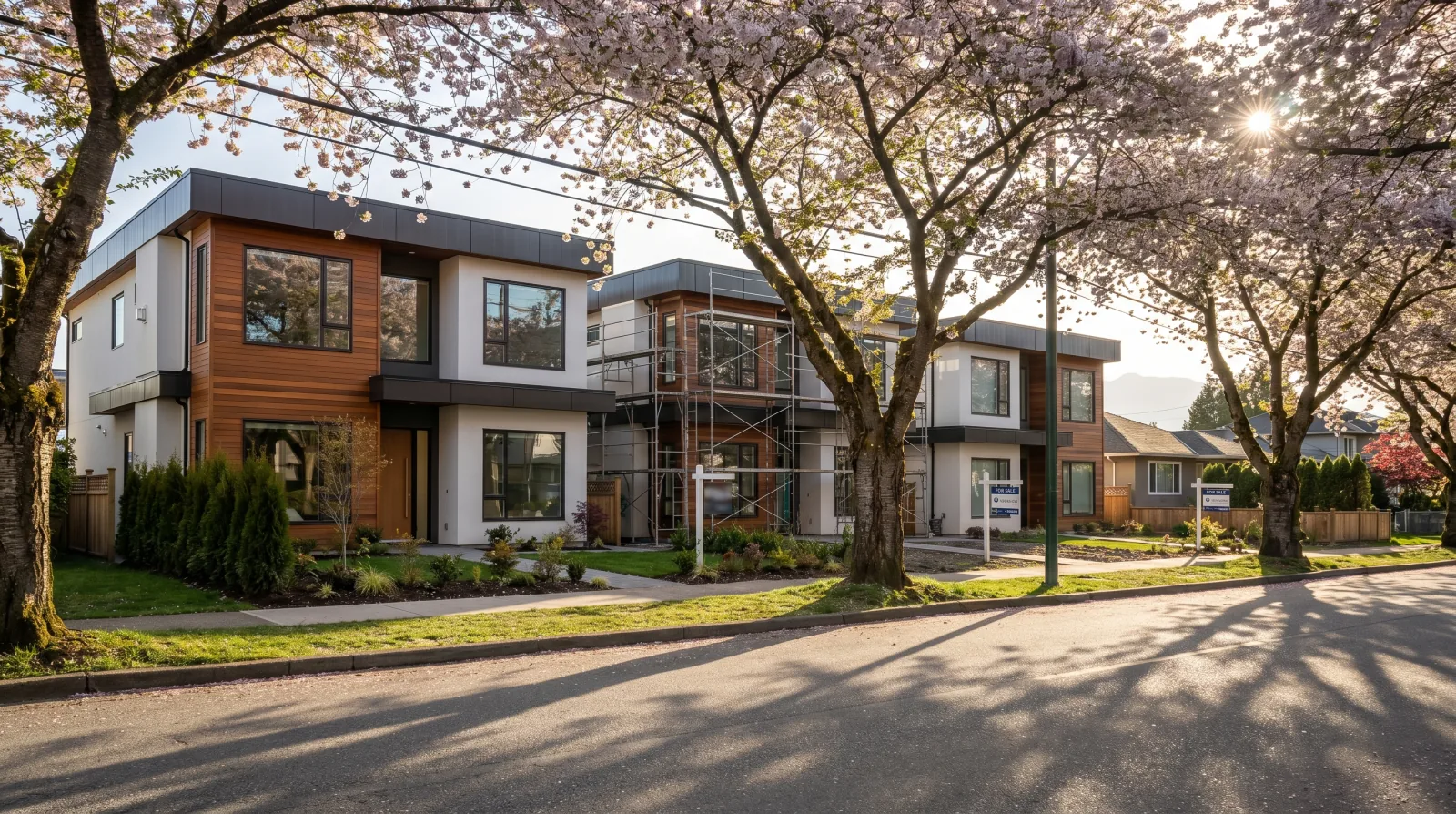
What the New Multiplex Wave Means for Prices
600 multiplex project applications filed in Vancouver, with less than half completed yet. What ~2,500 brand new homes mean for prices, timing, and whether to buy now or wait — backed by REBGV April 2026 data.
By MultiLiving Editorial · May 8, 2026
A buyer asked me last week whether she should pull the trigger on a townhouse in Mount Pleasant or wait six months. Six months because, in her words, “all the new multiplex stuff is supposed to be coming, right? Won’t prices drop?”
It’s the right question. The answer is more boring than she hoped, and in some ways more useful.
There is a wave of brand new multiplex homes arriving in Vancouver. It’s just slower, narrower, and more uneven than the headlines suggest — and the price story is already happening in the data, not in 2027.
The wave is real, but it’s not a flood
Here are the numbers, in plain English.
By spring 2026, Vancouver’s planning office had received roughly 600 multiplex project applications since the rules changed in 2024. That’s projects to build duplexes, triplexes, fourplexes, and sixplexes on lots that used to allow only one house. Around 2,500 brand new homes, if everything that’s been filed eventually gets built. Less than half have actually been completed yet — most are still working through their build phase.
That gap — between filed and finished — is the real story. Filing with the city is fast. Building each home takes 18 to 24 months once the work actually starts. The math means most of the remaining homes won’t be a buyer’s option until somewhere between late 2027 and 2029.
This isn’t bad news. It just means the “wait for the wave” thesis has a long runway.
What the timing actually looks like for someone shopping today
For 2026: a trickle. Maybe 30 to 60 brand new multiplex homes finish across all of Vancouver, mostly the projects filed in the first half of 2024 that finally cleared their build phase. You’ll see them on listings sites under “Half Duplex,” “Triplex,” and “Townhouse” — most filed individually unit-by-unit, which is why MLS still feels chaotic for this category.
For 2027: noticeably more. If projects move through the typical 18-month timeline from breaking ground to keys-in-hand, we should see 200–400 homes complete and list during the year, concentrated in the second half.
For 2028 onwards: the real volume. This is when the buyer who locks in a pre-sale today actually moves in, and when first-resale of 2026 completions starts hitting the market.
So the buyer in Mount Pleasant who waits six months is waiting for a market where 30–60 new homes have arrived in a metro area that did 433 attached-home sales in April 2026 alone, per REBGV’s monthly report. That’s not enough to move prices visibly.
Why prices probably don’t crash
Three reasons, all measurable.
The numbers are small relative to demand. REBGV counted 433 attached-home sales in a single month across Greater Vancouver in April 2026. The full ~2,500-unit Vancouver pipeline, even if all of it got built tomorrow, equals about six months of attached sales volume. Buyer demand for ground-oriented homes hasn’t gone anywhere; it’s been pent up for a decade.
The rate environment isn’t pushing prices down either. The Bank of Canada held its overnight rate at 2.25% on April 29, 2026, and most forecasters now expect it to sit there through 2026. Variable mortgage rates are essentially flat. Fixed rates have crept up a touch with bond yields. Translation: nobody’s getting cheaper money, which means no surge of leveraged buyers either way. The supply pressure on prices isn’t being amplified by a demand crash.
The new homes price themselves into the existing market. A new triplex unit on the West Side closed in January 2026 at $1,150,000 for 850 square feet, and another at $1,550,000 for 1,400 square feet, per VanPlex’s closing data. Those numbers sit comfortably between condo pricing and detached pricing — they don’t undercut townhouses that already exist; they slot in alongside them.
What’s actually happening to prices is more nuanced.
Detached softens, attached holds — and that’s the supply story
This is the part most people miss.
REBGV’s April 2026 benchmark for a Greater Vancouver detached house is $1,840,700, down 8.3% year over year. The same month’s benchmark for an attached home — townhouses, duplexes, and the multiplex units we cover — is $1,043,400, down only 5.1%.
The attached segment is sitting at a 15% sales-to-active-listings ratio, which REBGV considers balanced. Detached is at 11.3%, below the 12% line where prices typically face downward pressure.
In our view, that’s not a coincidence. It’s a substitution effect, and it’s already in motion.
A family that would have stretched to $2M for an old detached house is increasingly choosing a brand new $1.4M four-bedroom triplex unit instead. Same neighbourhood, same school catchment, often a better-finished home with a smaller yard but a bigger kitchen and three storeys of light. The detached side loses a buyer; the attached side keeps theirs and adds new entrants who couldn’t have afforded detached at all.
So the wave isn’t going to crash multiplex prices. It’s already gradually compressing the gap between detached and attached. If you’re watching for “the moment when prices drop,” you’re watching the wrong segment. The price effect is happening on the detached side, where buyers are leaving for new ground-oriented options.
Where the new homes are actually showing up
The pipeline isn’t evenly spread. VanPlex’s neighbourhood mapping of the active applications shows the activity clustered hard:
- East Vancouver corridors — Cedar Cottage, Renfrew, Hastings-Sunrise, Killarney. Lots of two- and three-storey duplex/triplex projects, prices typically $1.1M–$1.6M.
- Marpole and Sunset — wide, deep lots that suit fourplexes and sixplexes. Often the best value in the city for new ground-oriented homes.
- Mount Pleasant and Main Street — premium pricing, smaller projects, fast absorption.
- West Side pockets — Kitsilano, Dunbar, Kerrisdale. Lower volume but higher price point. New triplex units here are $1.5M–$2.5M and selling.
If you’re in West Vancouver or much of the British Properties, the pipeline is essentially zero. If you’re house-shopping along Cambie or south of 41st, the next two years will produce real options.
Who’s actually buying these homes
Not investors. The economics for a single-unit multiplex purchase aren’t compelling for a buy-and-rent investor — strata fees, modest rents relative to purchase price, and the same restrictions any new strata building has.
The actual buyers we see fall into three groups.
Multigenerational families. Two adult siblings buying separate units in the same fourplex. A retired couple selling a $2.2M Vancouver Special and using the proceeds to buy two units — one for them, one for an adult child. The whole “live close but not together” pattern. This is the largest single buyer pool we work with, and it’s not going away.
Downsizers from detached homes. A 60-something couple with a paid-off house in Kitsilano sells, buys a new West Side triplex unit for $1.6M, banks the rest, stays in the neighbourhood. Schools matter less; quality of finish, single-floor primary suite, and a small private yard matter more.
Young professionals priced out of detached. Two-income couples in their 30s and 40s who would have bought a detached house ten years ago and now physically cannot. They’re picking new triplex units at $1.2M–$1.5M, often with a basement suite they rent to offset their mortgage.
None of these buyer types is going to disappear because more homes arrive. If anything, more inventory makes them more aggressive — finally, options.
Should you buy now or wait?
Here’s the honest answer, and it’s not the one most agents will give.
If you find a home you actually like in 2026, buy it. The supply wave isn’t going to deliver a 2028 fire sale. The Bank of Canada isn’t priming a rate cut to push prices down. The new inventory is small relative to demand, priced into the existing market, and concentrated in neighbourhoods where waiting just means watching listings cycle.
If you’re a pre-sale buyer comfortable with an 18–30 month timeline, 2026 is genuinely a good year to lock in. Deposit structures are still 15–20%. Rescission rights and assignment rules give you protection. You’re picking up a brand new home at today’s contract price for a 2027 or 2028 move-in. If prices drift down 3–5% during that window, you’ll feel it on paper but it won’t change your housing reality.
If you’re hoping a flood of new homes will hand you a bargain, you’re going to wait a long time and buy something more expensive than today’s listing.
The one scenario where waiting genuinely helps: you’re flexible on neighbourhood and don’t need to move for two-plus years. In that case, the 2027–2028 inventory will be richer, especially in Marpole, Sunset, and East Van, and you’ll have actual choice instead of taking what’s there.
What this comes down to
- 600 multiplex project applications filed in Vancouver, with less than half completed yet. The “wave” is a slow build, not a flood.
- Most of the ~2,500 brand new homes won’t reach the market until 2027–2029.
- New homes are pricing themselves into the existing market — not undercutting it.
- Detached benchmark is down 8.3% year over year per REBGV April 2026; attached only 5.1%. That gap is the supply story already in motion.
- Buyers we work with are multigenerational families, downsizers, and young professionals priced out of detached. None of them are price-sensitive enough to wait two years for marginally better inventory.
- Pre-sale 2026 → move-in 2027–28 is the most useful timing strategy if you have flexibility.
If you’re shopping right now, looking at what’s already on the market makes more sense than holding off. Get in touch and we’ll walk through where the better-fit homes are landing in your specific neighbourhood.
FAQ
Will Vancouver multiplex prices drop in 2026?
Probably not in any meaningful way. The pipeline is large in absolute terms but small relative to monthly attached-home sales. REBGV’s April 2026 attached benchmark of $1,043,400 is down 5.1% year over year — that’s the gradual softening you’re already seeing, not a future event.
How many new multiplex homes will hit the Vancouver market in 2026?
Realistically, several dozen more brand new homes will complete and list across the rest of 2026. Vancouver’s pipeline now sits at roughly 600 multiplex project applications and around 2,500 units — less than half have completed so far, with the bulk of remaining completions landing in 2027–2029.
Is it cheaper to buy a pre-sale multiplex unit now or a finished one in 2027?
There’s no clean answer, but the math usually favours pre-sale for committed buyers. You lock today’s contract price, pay deposits over 18–30 months instead of a full mortgage, and avoid the 2027 buying cohort if more inventory creates more competition. The risk is a major life change before completion. We cover the full pre-sale framework in our pre-sale buyer’s guide.
What happens to detached house prices when the multiplex wave lands?
The detached segment is already where the supply story is showing up. REBGV’s detached benchmark is down 8.3% year over year as of April 2026, with a sales-to-active-listings ratio at 11.3% — below the 12% line that signals downward price pressure. As more buyers move from “stretching for old detached” to “buying brand new attached,” that gap continues to compress.
Which Vancouver neighbourhoods will see the most new multiplex homes?
The pipeline is heavily concentrated. East Vancouver corridors (Cedar Cottage, Renfrew, Hastings-Sunrise, Killarney), Marpole, and Sunset are taking the bulk of the roughly 600 active applications. Mount Pleasant, Main Street, and Kitsilano have steady but smaller activity. West Vancouver, the British Properties, and Point Grey are essentially zero. If you want choice, focus south of 41st Avenue and east of Main Street.
Is buying a brand new multiplex unit a better deal than a comparable condo?
For most buyers who actually need the space, yes. A 1,200 sq ft triplex unit in East Van around $1.3M typically delivers ground access, three full bedrooms, and a private outdoor area for the same money as a 2-bed condo plus locker plus parking downtown. Strata fees are usually lower because there’s no elevator, pool, or amenities pool to maintain. If you’re a one-person household who values walking distance to a SkyTrain station, the condo math still wins.
How do current mortgage rates affect whether to buy now or wait?
Not as much as buyers expect. The Bank of Canada is sitting at 2.25% and most forecasters expect it to stay there through 2026. Variable rates are flat. Fixed rates are mostly tracking bond yields, not central-bank moves. There’s no rate cut coming that would meaningfully change your monthly payment if you bought today versus six months from now.
Why are so many of these new homes filed as “Half Duplex” on MLS?
Most three- and four-unit projects get strata-titled into individual Half Duplex listings on the MLS even when they’re really part of a triplex or fourplex. It’s a quirk of how the BC listing system handles attached new construction — the strata creates a separate civic address per unit, and each gets filed individually. Don’t filter your search to only “Triplex” or “Fourplex” or you’ll miss most of the actual inventory.
Can I rent out a brand new multiplex unit?
Most new multiplex stratas allow long-term rentals — provincial law (since late 2022) generally prevents stratas from blocking rental tenancies. Short-term rentals like Airbnb are a different story: Vancouver’s short-term rental rules apply citywide regardless of strata bylaws, and most multiplex bylaws layer on additional restrictions. If rental income matters to your purchase math, read the bylaws before you write an offer.
What deposit do I need for a pre-sale multiplex unit?
Most pre-sale multiplex projects ask for 15–20% over two or three deposit milestones — typically 5% at signing, 5% at a development milestone 90–180 days later, and 5–10% closer to occupancy. Compare that to a finished home, which needs a full down payment plus closing costs at completion. The pre-sale structure spreads the cash requirement over 18–30 months instead of all at once.
How does a brand new multiplex unit compare to an older townhouse?
Two things matter most: build year and strata size. A brand new triplex unit in 2026 is typically built to current energy and acoustic standards, has a 2-5-10 home warranty, and sits in a strata of 3–6 owners (vs 30+ in an older townhouse complex). The trade-offs: smaller yards, less mature landscaping, and you’re sometimes the first owner figuring out the strata governance. Most multigenerational and downsizer buyers we work with prefer new for the warranty and the smaller strata.
Will this supply wave help first-time buyers in Vancouver?
Modestly, yes — but indirectly. New multiplex units don’t price themselves below the existing attached market, but they expand the supply of move-in-ready ground-oriented homes, which historically were almost impossible to find under $1.3M. A first-time buyer with $260K saved (20% down on $1.3M, or well past the $105K insured minimum on a $1.3M unit) suddenly has dozens of new options to choose from instead of competing for one or two stale listings. That’s a real lift, even if the headline price doesn’t move.