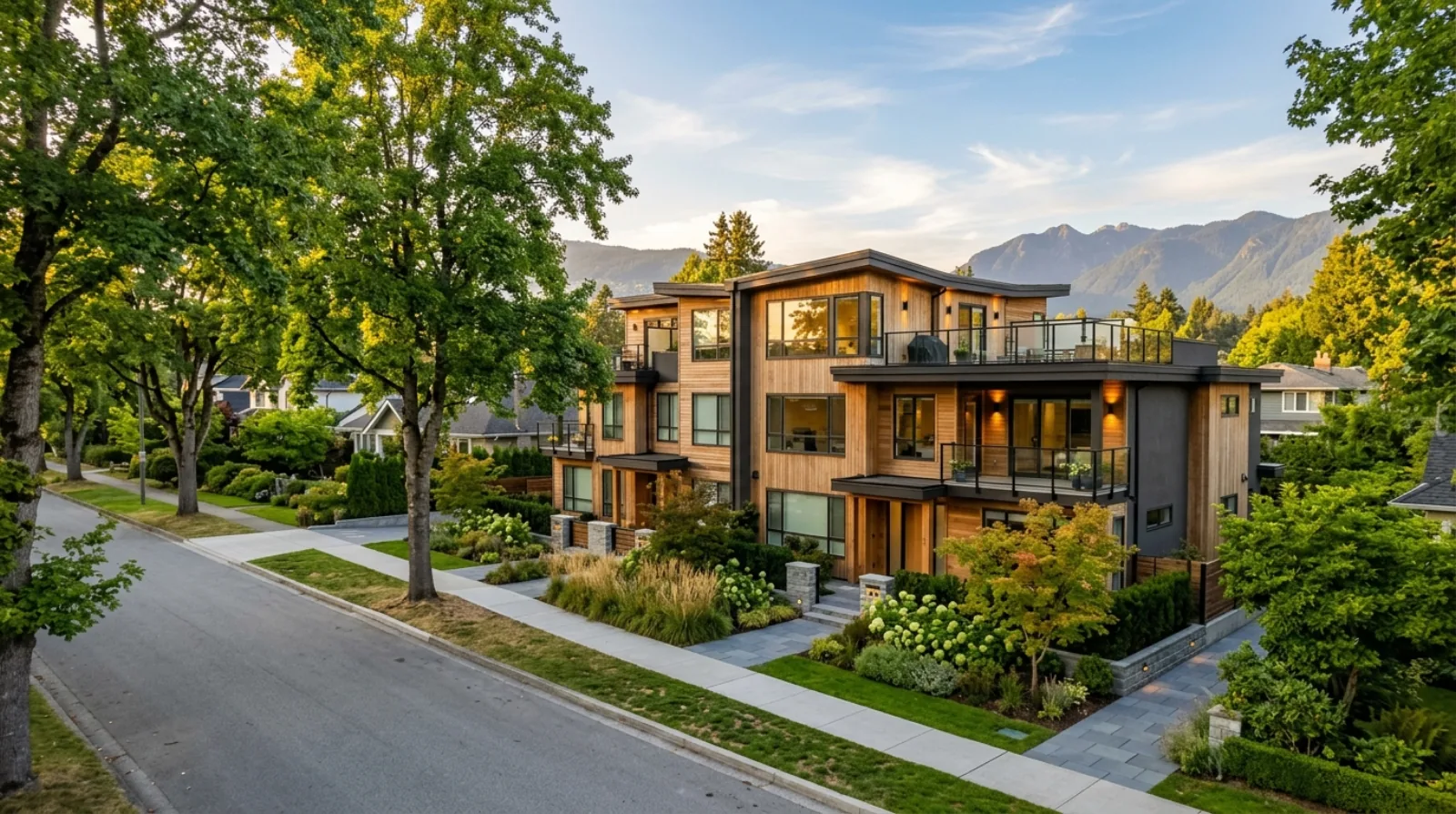
Relocating to Metro Vancouver: Buying a Multiplex From Another Province
Moving to Metro Vancouver from elsewhere in Canada? How to buy a multiplex remotely: video tours, BC taxes that surprise, pre-sale timing, and one scouting weekend.
By MultiLiving Editorial · September 10, 2026
Questions about this guide: Gary Paul, REALTOR®, Personal Real Estate Corporation, Grand Central Realty, 778-828-7476
Every month, households in Toronto, Calgary, Ottawa, and Winnipeg accept a job in Metro Vancouver and face the same puzzle: how do you buy a home in a city you cannot visit on a Saturday? You already know how to buy a house; you have probably done it before. What you do not know is BC. The taxes are different, the contracts have different exit rules, and the market runs on numbers published by boards you have never read. This guide is for Canadians relocating from another province: how to shop remotely without costly mistakes, why pre-sale buying happens to fit a relocation almost perfectly, the BC costs that catch out-of-province buyers, and how to run one scouting weekend so well that you only need one.
A note on scope: this is for buyers moving within Canada. If you are new to Canada entirely, credit history and banking work differently, and we have covered that situation separately.
Why pre-sale buying fits a relocation
Buying pre-sale means signing for a brand new home before it is finished and completing when it is ready, often a year or more later. For a local buyer, the wait is the price of a new home. For a relocating buyer, the wait is the feature. If your move is eight to eighteen months out, a pre-sale completion date can land close to your arrival, which means no gamble on buying a resale home that sits empty, and no paying rent in two cities. You choose the home from plans and a display suite, complete around the time the moving truck arrives, and walk into a place nobody has lived in.
There is also a legal safety net that matters more when you sign from 3,000 kilometres away. Under BC's Real Estate Development Marketing Act, a pre-sale buyer has a seven-day rescission period: seven days after signing (or after acknowledging the project's disclosure statement, whichever comes later) in which you can cancel in writing and get your deposit back. Resale purchases in BC carry a shorter three-business-day rescission right. Practically, that means a relocating buyer can sign after a video tour, then spend a week having a BC lawyer read everything, and still walk away cleanly if something is wrong. Use that week every single time; it exists for exactly this situation.
One caution to balance the sales pitch: completion dates move. New buildings finish late more often than early, and your contract will give the seller ranges and extension rights. Ask for the outside completion date in writing and plan your housing around that date, not the optimistic one. We have watched relocations go smoothly on this one habit alone.
Calibrating your budget to BC numbers
Skip the city-versus-city comparison articles and go straight to what the local boards actually publish. Greater Vancouver REALTORS' July 2026 MLS® Home Price Index puts the benchmark townhouse in Metro Vancouver at $1,030,400 and the benchmark apartment at $688,000, both down six to seven and a half per cent from a year earlier, per the GVR July 2026 statistics package. South and east of Vancouver, in Fraser Valley Real Estate Board territory (Surrey, Langley, North Delta, White Rock), the July 2026 FVREB package shows a townhome benchmark of $757,300 and apartments at $469,500. Two orientation notes for newcomers to these boards: first, Metro Vancouver is split between those two boards, so check which one covers a neighbourhood before comparing numbers. Second, neither board publishes a benchmark for multiplex homes; the category is too new. Use the townhouse figure as the nearest published reference for family-sized multiplex units and compare actual project pricing from there.
For Calgary buyers, the honest message is to budget from the BC numbers above, not from what your Calgary equity feels like it should buy; the jump is large and it is better met on paper than at a sales centre. For Toronto buyers, the gap is usually smaller than feared, and a falling BC market in 2026 means you arrive with negotiating room. Both surprises land in opposite directions.
Researching neighbourhoods from another time zone
- Shortlist areas by your real anchors: the new job's address, the airport if you travel, family if you have any here, and schools if you have kids. Three areas maximum; more than that and the scouting weekend collapses.
- Walk streets virtually. Street-level map imagery answers more than listing photos: how wide the street is, what the neighbouring lots hold, where the bus stops are.
- Test the commute at the right hour. Transit apps let you set a Tuesday 8 am departure from any address; run it for every project you consider. Distance in Metro Vancouver misleads; bridges and tunnels decide everything.
- Read neighbourhood guides written for buyers, including ours, and note what each area trades away. Every Metro Vancouver neighbourhood trades something: space, transit, quiet, or price.
- Join the boring local sources: the municipality's newsletter, the community centre schedule. A week of skimming tells you more about daily life than any ranking.
Video tours that actually protect you
A recorded walkthrough is marketing. What you want is a live video call, with either your BC agent or the sales team walking the actual site and display suite while you direct them. On a live call you can say 'stop, go back, open that door, hold the phone out the window so I can hear the street'. Ask for these specifically:
- The display suite, walked slowly, with the camera held at your eye height, not sweeping cinematically.
- The actual location of your unit in the building: which floor, which direction the main windows face, what they will face in five years.
- The walk from the nearest transit stop to the front door, unedited, so you see and hear the route.
- The street at two different times, ideally a weekday rush hour and a quiet evening.
- A clear statement, on the call, of what in the display suite is standard and what is an upgrade. Display suites are built to make you forget the difference; every experienced buyer knows this and asks anyway.
Then get everything that matters in writing: floor plan with dimensions, the included-features list, strata fee estimate, deposit schedule, and completion date range. If a sales team resists putting numbers in writing for a remote buyer, treat that as your answer about the project.
The BC costs that surprise out-of-province buyers
Start with the big one. BC charges a property transfer tax when you buy: per the Province of BC, 1 per cent on the first $200,000 of the price, 2 per cent from there up to $2 million, and 3 per cent above that. On a $900,000 home that is $16,000, due at completion, on top of everything else. Buyers from Alberta, where no equivalent tax exists, feel this hardest; Ontario buyers know the concept but should not assume the brackets match.
Now the good news, and it favours exactly what this site covers: BC's newly built home exemption wipes out the transfer tax entirely on a brand new home valued up to $1,100,000 when you will live in it as your principal residence, with a partial break up to $1,150,000. You do not need to be a first-time buyer. A relocating family buying a $900,000 brand new multiplex unit pays zero transfer tax where a resale buyer at the same price pays $16,000. That difference alone can cover the moving truck, twice.
- GST: brand new homes carry 5 per cent federal GST on top of the price. Always ask whether a quoted pre-sale price includes it; contracts differ, and the answer changes your budget by tens of thousands.
- Strata fees: most multiplex homes share a lot, so a monthly fee applies. In small buildings it is usually modest, but lenders count it in qualifying, so get the estimate early.
- Deposits: BC pre-sale deposits are commonly paid in stages over months. Ask for the schedule in writing and line it up against the sale timing of your current home.
- Property taxes and insurance run differently than you are used to; neither is shocking, but ask your BC lawyer for a completion cost sheet so nothing arrives as a surprise.
Your remote team, in hiring order
Three professionals do the heavy work, and all three must be BC-licensed, because real estate licensing, law, and mortgage brokering are provincial. Your Ontario or Alberta contacts can refer you; they cannot act for you here.
- A BC REALTOR® who works multiplex and pre-sale. Hired first, because a good one supplies the other two names and runs your video tours. Interview two or three by video call; a buyer's agent generally costs you nothing directly, and how they handle the interview tells you how they will handle the search.
- A BC real estate lawyer or notary. Non-negotiable for a remote buyer: this is who reads the pre-sale contract and disclosure statement inside your seven-day window and who handles completion. Hire them before you sign anything, not after.
- A mortgage broker licensed in BC. Your home bank's pre-approval is a useful start and rate hold, but a BC broker knows which lenders are comfortable with relocation files: new-job offer letters, income that starts next month, equity still locked in a house two provinces away. Those files are routine here; brokers place them weekly.
The one scouting weekend, planned properly
Book it two to three weeks ahead, after the video tours have cut your list to a handful of projects across at most three areas. Then run it like this:
- Friday: land, collect the rental car, and drive your shortlisted areas in the evening. You learn a neighbourhood's honest personality after dinner: noise, light, who is on the street.
- Saturday: three or four booked project visits, spaced with time to walk each neighbourhood for half an hour. Do the transit run to the new job from your favourite project, at street level, with your own feet.
- Sunday morning: return to the favourite unannounced. Buy coffee nearby, sit in the park, talk to a stranger with a dog. Then meet your agent for an hour to talk numbers before flying out.
- What not to do: cram seven areas in, tour on Friday night adrenaline, or let a sales office schedule your whole Saturday. You are auditing a life, not collecting brochures.
Buyers who do this in the order described, research, video tours, then one focused trip, routinely sign with confidence a week after flying home, inside a rescission window their lawyer is actively using. Buyers who fly out first 'to get a feel' usually need three trips. The order is the method.
What this comes down to
- Pre-sale buying fits relocation: the completion date can land near your move, and BC law gives every pre-sale buyer a seven-day cancellation window after signing.
- Anchor your budget to BC's own numbers: GVR's July 2026 townhouse benchmark is $1,030,400 and FVREB's is $757,300; no multiplex benchmark exists anywhere.
- BC's property transfer tax runs 1 to 3 per cent by bracket, but the newly built home exemption takes it to zero on new homes up to $1.1 million you live in. Brand new beats resale on this alone.
- Always confirm whether a pre-sale price includes the 5 per cent GST.
- Hire BC-licensed people: agent first, lawyer before signing, broker who handles relocation files.
- Live video tours with your own directions beat recorded walkthroughs; one well-planned scouting weekend beats three vague ones.
Questions relocating buyers ask
Can I really buy a BC home without visiting first?
Legally yes, and pre-sale buyers do it regularly. The safer pattern is video tours plus one scouting trip before signing, but if timing forces a purely remote purchase, the seven-day pre-sale rescission window and a BC lawyer reviewing the contract are your protection. Use both fully.
What is BC's property transfer tax?
A tax paid when you buy: 1 per cent of the first $200,000, 2 per cent up to $2 million, and 3 per cent above that, per the Province of BC. It is due at completion through your lawyer. Alberta has no equivalent; Ontario's version uses different brackets.
Do brand new homes really avoid the transfer tax?
Yes, up to a point. The newly built home exemption eliminates the tax on a new home valued to $1,100,000 that you occupy as your principal residence, with partial relief to $1,150,000. You need not be a first-time buyer. Most new multiplex units fit under the threshold.
Is there GST on a new multiplex home?
Yes, 5 per cent federal GST applies to brand new homes. Some quoted pre-sale prices include it and some do not, so ask directly and get the answer in writing. Your lawyer can also confirm whether a partial GST rebate applies at your price point.
Can I cancel a pre-sale contract signed from out of province?
Within seven days, yes. BC's Real Estate Development Marketing Act gives pre-sale buyers a seven-day rescission period from signing or from acknowledging the disclosure statement, whichever is later. Cancel in writing and the deposit comes back. Have your BC lawyer work inside that window.
Can my Toronto or Calgary agent handle the purchase?
No; real estate licensing is provincial, so you need a BC-licensed REALTOR®. Your current agent can refer you to one, and referral relationships are common. The same applies to your lawyer and mortgage broker: BC-licensed professionals must do the BC work.
Will my bank's pre-approval from home work in BC?
As a starting point and a rate hold, yes; the big banks lend nationally. But relocation files, with a new-job offer letter and income that starts after the move, are placed most smoothly by a BC-licensed mortgage broker who knows which lenders handle them routinely.
How do Vancouver prices compare with what I am leaving?
Anchor on published BC figures rather than comparison articles: GVR's July 2026 benchmarks are $1,030,400 for townhouses and $688,000 for apartments, with Fraser Valley at $757,300 and $469,500. Compare those against your own board's published benchmarks and let the arithmetic, not the headlines, set your expectations.
When should I take the scouting trip?
After video tours have cut your list to a few projects in at most three areas, and before you sign. Two or three weeks of lead time books the visits properly. One disciplined weekend at that stage replaces the two or three exploratory trips most relocators otherwise take.
What if the completion date slips past my move date?
Plan for it, because new homes finish late more often than early. Ask for the contract's outside completion date, arrange flexible interim housing (a furnished monthly rental), and keep your goods in storage terms you can extend. If the dates land close, the overlap is usually weeks, not months.
Should I just rent in Vancouver for a year first?
It is a legitimate path and we will not pretend otherwise: you learn the city before committing. The trade-offs are two moves, a year of rent, and shopping in whatever market exists next year. Buying pre-sale splits the difference: you commit now, at today's soft prices, and arrive to a new home.
How does selling my current home fit the timeline?
Staged pre-sale deposits help: you typically need a portion early and the balance at completion, which is when your sale proceeds arrive. Map the deposit schedule against your selling plan with your broker before signing, and ask your lender about bridging if the dates cross.
Start from where you are
You do not need to be in BC to start; you need a shortlist and a team. Browse the current multiplex homes and pre-sale projects on our properties page from wherever you are reading this, then contact our team and tell us your move date, your budget, and the job's postal code. We will send back a shortlist matched to your timeline, run the first video tour, and help you plan the one scouting weekend that decides it.