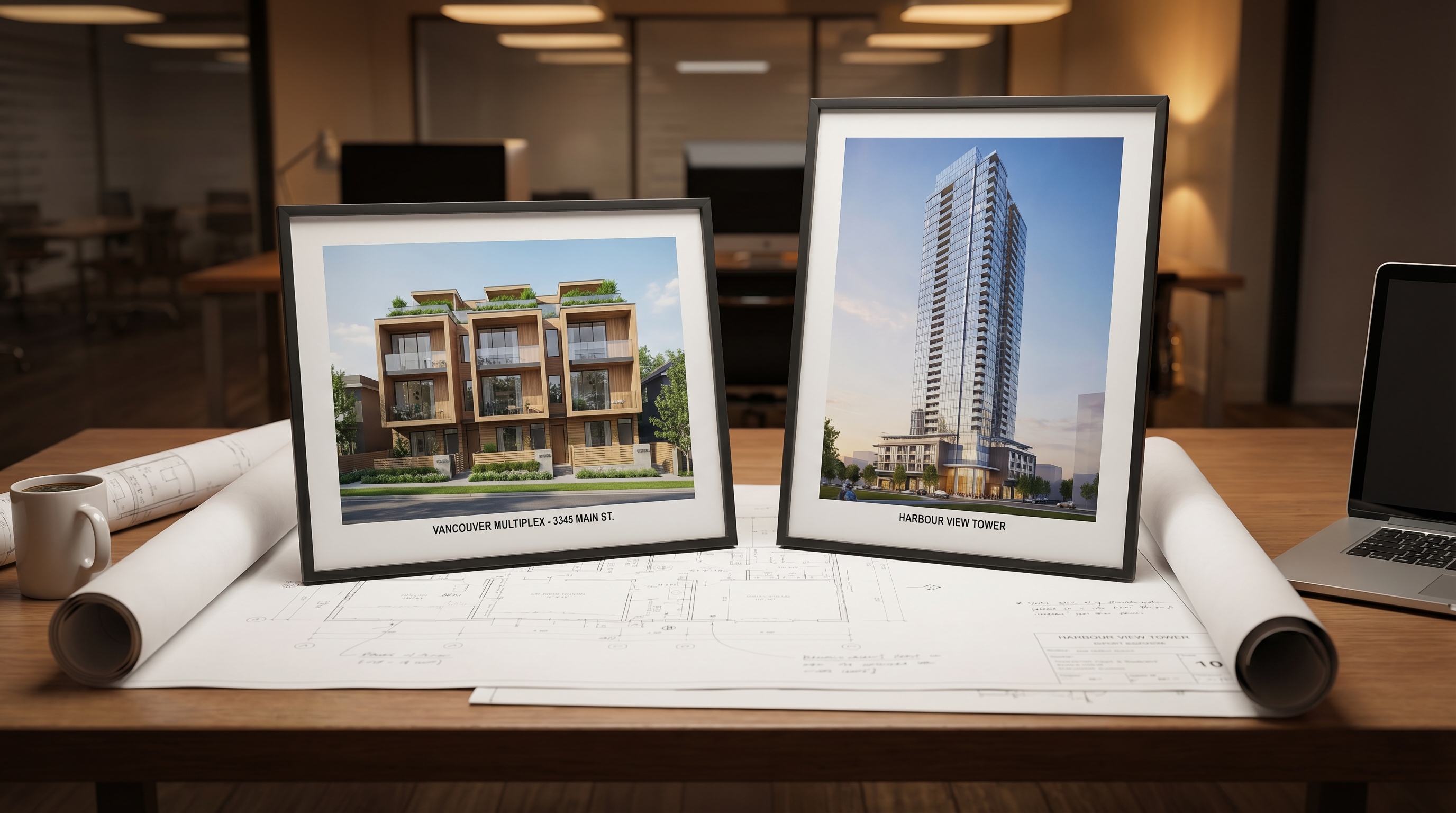
Pre-Sale Multiplex vs Pre-Sale Condo in Vancouver
Deposits, timelines, risks, and developer profiles — how buying a pre-sale multiplex differs from a pre-sale condo in Vancouver.
By MultiLiving Editorial · April 24, 2026
Questions about this guide: Gary Paul, REALTOR®, Personal Real Estate Corporation, Grand Central Realty, 778-828-7476
You're comparing two pre-sale options in Vancouver. One is a unit in a 35-storey glass tower near Cambie and Broadway. The other is a three-bedroom in a fourplex being built by a small firm in East Vancouver. Both are "pre-sale." Both require deposits. Both involve waiting for construction to finish before you move in.
But the similarities end there. The deposit schedule, the developer profile, the timeline, the contract, the financing risk, and the strata situation will look fundamentally different between these two purchases. If you treat a multiplex pre-sale like a condo tower pre-sale, you'll misread the deal in ways that could cost you — or cause you to walk away from a better option.
This is a side-by-side breakdown of how pre-sale purchasing actually differs between multiplexes and condos in Vancouver in 2026, based on current BCFSA regulations, market conditions, and what we're seeing in real transactions.
The Pre-Sale Process: A Quick Refresher
"Pre-sale" means buying a home before it's built. You sign a contract of purchase and sale, pay deposits over time, and complete the purchase when construction finishes. In British Columbia, all pre-sale developments — condos, townhomes, multiplexes — fall under the Real Estate Development Marketing Act (REDMA), regulated by the BC Financial Services Authority (BCFSA).
The developer must file a disclosure statement before marketing any units. You get a 7-day rescission period after signing, during which you can back out for any reason with no penalty. Your deposits are held in a trust account managed by the developer's lawyer — the developer cannot access them until the project completes.
Those rules apply equally to a 400-unit condo tower and a 4-unit multiplex. Where things diverge is in how those rules play out in practice.
Deposit Structure: Staged Payments Look Different
Condo pre-sales in Vancouver typically follow a well-established staged deposit structure. According to Bridgewell Real Estate Group, the standard pattern for a condo tower looks like this:
- On signing: $1,000 to $5,000 reservation deposit
- After the 7-day rescission period: 5% to 10% of purchase price
- At 6 months: another 5%
- At 12–18 months: another 5% to 10%
- Total before completion: 15% to 20%, paid over 12 to 18 months
On a $750,000 one-bedroom condo, that means $112,500 to $150,000 in deposits sitting in trust while the tower goes up — often for two to four years before you see the keys.
Multiplex pre-sales work differently. Because the projects are smaller and the builders are often financing construction through private lending rather than presale revenue, the deposit structures are less standardized. What we typically see:
- On signing: $5,000 to $10,000
- After rescission: 10% of purchase price
- At a construction milestone (e.g., framing complete): another 5% to 10%
- Total before completion: 10% to 20%, often with fewer stages
The total percentage can be similar. But with multiplexes, the timeline is compressed — your money sits in trust for 12 to 18 months rather than three to four years. That's a real financial difference. Less time with your capital locked up means lower opportunity cost and less exposure to interest rate shifts.
Our view: the compressed deposit timeline is one of the underrated advantages of multiplex pre-sales. Your money is at work sooner rather than sitting in a trust account for three years earning nothing.
Developer Profiles: Local Builders vs. Corporate Developers
The typical condo tower in Vancouver is built by a large, well-capitalized developer — Concord Pacific, Wesgroup, Bosa Properties, Polygon, Onni. These companies have track records spanning decades, multiple projects under construction simultaneously, and dedicated sales centres with polished marketing materials.
Multiplex developers look nothing like that. The builder behind a fourplex in Renfrew-Collingwood is more likely to be:
- A small construction firm with two to five employees
- A homeowner who demolished their existing house and is building a multiplex on the same lot
- A partnership between a landowner and a builder
- A family operation doing their first or second multiplex project
This isn't inherently better or worse. Small builders can deliver excellent quality — they often have more personal accountability and a reputation tied to every unit they produce. But you won't find a 40-year corporate track record or a dedicated warranty department.
What to ask a small multiplex developer that you'd never need to ask Bosa:
- How many multiplexes have you completed?
- Can I visit a finished project and talk to the owners?
- Who is your general contractor, and are they licensed with BC Housing?
- What warranty coverage will the units carry?
Timeline to Completion: 14 Months vs. 3+ Years
This is where the gap is widest.
A condo tower pre-sale in Vancouver typically involves a completion timeline of 3 to 5 years from contract signing. Towers take 2 to 3 years to construct after permits are issued, and many projects sell pre-sale units 6 to 12 months before breaking ground. Delays are common. The pandemic era taught Vancouver buyers that "estimated completion Q4 2024" can easily become "actual completion Q3 2026."
A multiplex? Construction typically takes 10 to 14 months once permits are in hand. Vancouver's permit processing for multiplexes averaged 6.2 months in Q4 2025, according to VanPlex's market data. So from planning to keys, you're looking at roughly 16 to 24 months total — and much of that permit period happens before you even sign a contract.
In practice, many multiplex pre-sales don't launch until construction is already underway or nearly complete. Unlike towers, a 4-unit building doesn't need presale revenue to secure construction financing. The builder can start with private financing and sell units once the framing is up and buyers can actually see what they're getting.
This is a meaningful advantage for risk-averse buyers. When you can walk through a partially built multiplex and see the actual unit before committing deposits, the uncertainty drops considerably.
What You're Actually Buying: Ground-Level vs. High-Rise Living
A pre-sale condo puts you in a highrise or midrise tower — concrete construction, shared corridors, elevators, amenity rooms, and potentially hundreds of neighbours. You get a defined square footage, a parking stall (maybe), a storage locker, and access to shared facilities.
A pre-sale multiplex unit is a different animal entirely:
- Ground-oriented: most units have their own entrance at grade or one level up
- Private outdoor space: a yard, patio, or rooftop deck — not a shared amenity terrace
- Fewer shared walls: 2 to 4 units total, versus 200+ in a tower
- Multi-level living: many multiplex units span two or three floors, giving a townhouse feel
- Parking: often a dedicated garage or surface spot, not a shared underground parkade
- Smaller strata: 2 to 6 owners making decisions together, versus a council representing hundreds
The trade-off: you won't get a gym, a concierge, a party room, or a rooftop pool. If those amenities matter to your lifestyle, a condo tower is the better fit. If you want something that feels closer to a house — with your own door, your own outdoor space, and a quiet strata council — a multiplex is the play.
Customization Options: More Flexibility with Small Multiplex Builders
Buy a pre-sale condo from a large developer and your customization options are typically limited to choosing between two or three colour schemes — "light," "dark," or "warm." The finishes are selected in bulk, the layouts are fixed, and the timelines are too tight for individual requests.
Multiplex builders, especially on projects with 4 to 6 units, operate differently. Because they're building at a smaller scale, they can often accommodate:
- Changes to flooring, countertop, and cabinet selections
- Minor layout modifications (moving a closet wall, adding a built-in)
- Fixture and appliance upgrades
- Electrical changes (adding outlets, relocating light fixtures)
- Smart home wiring or EV charging pre-wiring
This flexibility has limits. Structural changes are off the table once permits are issued. And the builder will charge for upgrades — sometimes at a premium. But the fact that the conversation is even possible puts multiplexes in a different category from tower condos, where "customization" means choosing between quartz and marble for the same slab.
Contract Differences: What to Watch For
Both condo and multiplex pre-sale contracts in BC must comply with REDMA. But the contracts themselves can feel quite different.
Condo tower contracts
- Typically 40 to 80 pages of legal documentation
- Heavily standardized — large developers use templates refined over dozens of projects
- Include detailed schedules for completion dates, deposit milestones, deficiency holdbacks, and interim occupancy terms
- Often contain assignment restriction clauses and marketing co-ops
Multiplex contracts
- Often shorter — 20 to 40 pages
- May be less standardized, especially if it's the builder's first or second project
- Completion date provisions may be less detailed
- May or may not address deficiency holdback procedures in the same depth
What to verify in any pre-sale contract, regardless of property type:
- Exact deposit amounts and due dates
- Completion date and what happens if the developer misses it
- Your rights if the developer makes material changes to the project
- Deficiency holdback terms — how long you have to identify problems after completion
- Assignment clause — whether you can sell your contract before completion
- GST treatment and whether the listed price is inclusive
Hire a real estate lawyer who has reviewed pre-sale contracts before. This is not a place to save $500.
Developer Disclosure Statements: Same Rules, Different Scale
Under REDMA, every developer — whether building 4 units or 400 — must file a disclosure statement with the BCFSA before marketing begins. The BCFSA's disclosure requirements mandate that the statement include all "material facts" that could reasonably affect price, value, or use of the development.
As of April 1, 2025, developers must also attach the new "Summary of Pre-Sale Risks and Buyer Rights" form to the front of every disclosure statement. Buyers must initial the form to confirm they understand their key rights.
The disclosure filing fee reflects project scale. For a multiplex with up to 9 units, the fee is $900. For a tower with 100+ units, it's $5,400. Small difference in the big picture, but it shows how BCFSA scales its oversight.
What actually matters to you as a buyer: read the disclosure statement. All of it. In a condo tower, the disclosure statement can run 200+ pages. For a multiplex, it's typically shorter — 30 to 60 pages — which means you have less excuse for not reading every word. Pay particular attention to:
- The developer's track record and financial standing
- Construction timelines and completion estimates
- Any existing encumbrances, liens, or easements on the property
- The proposed strata plan and common property allocations
- Any conditions that could lead to project cancellation
BCFSA Deposit Protection: How Your Money Is Safeguarded
This is where BC's regulatory framework works in buyers' favour regardless of project size.
Under REDMA, all pre-sale deposits must be held in a trust account controlled by the developer's lawyer or the listing brokerage. The developer cannot touch these funds during construction. If the project collapses, the money in the trust account is not part of the developer's bankruptcy estate — it goes back to you.
The BCFSA's deposit guidelines further state that deposits should not be used for construction or marketing unless the developer has obtained authorized deposit insurance. Some larger developers obtain this insurance, which lets them access deposits during construction — but the insurance then protects buyers if the developer defaults.
For multiplex buyers, the trust account protection is particularly relevant. Small builders don't typically carry deposit insurance (it's expensive relative to the small deposit amounts involved), so your deposits will almost certainly sit untouched in a trust account from day one until completion. That's actually the safest possible arrangement.
One additional note: BCFSA launched an early marketing pilot program in 2025 for developments with 100+ units, extending the pre-sale marketing period from 12 to 18 months. This only applies to large projects — multiplexes are unaffected.
Risk Comparison: Small Builder Risk vs. Large Developer Risk
Every pre-sale purchase carries risk. The question is what kind.
Large developer risk (condo towers)
- Project cancellation: if presales don't hit the threshold the lender requires (often 60–70% sold), the project may never break ground. Your deposits come back, but you've lost years of time and possibly purchased at a higher price elsewhere.
- Extended delays: supply chain issues, labour shortages, and permitting holdups can push completion by 12 to 24 months. You can't control this and often can't exit the contract.
- Market shift on completion: if the market drops during a 3-to-5-year build, you may complete on a unit worth less than you contracted for. Your lender might appraise it below contract price, forcing you to come up with the difference in cash.
- Depersonalized experience: you're one buyer among hundreds. Communication is filtered through sales teams and project managers.
Small builder risk (multiplexes)
- Builder inexperience: a first-time multiplex developer may underestimate costs, timelines, or the complexity of strata registration
- Financial fragility: small builders have thinner margins and less access to capital. A construction cost overrun that a large developer absorbs could sink a small builder.
- Warranty execution: while BC Housing's 2-5-10 warranty applies to all new residential construction, the builder's capacity to address warranty claims varies with their financial stability
- Fewer legal resources: the contract may not be as polished or as thoroughly tested as a large developer's standardized agreements
Our honest take: neither category is inherently safer. Large developer risk centres on market cycles and delays. Small builder risk centres on execution and financial capacity. Your job is to do the due diligence that matches each risk profile.
Resale Before Completion: Assignment Clauses
An "assignment" is when you sell your pre-sale contract to another buyer before the project completes. It's been common in Vancouver's condo market for years, though it's become less attractive recently.
Two things to know about assignments in 2026:
- The developer must approve the assignment. Both condo and multiplex contracts typically require the developer's written consent. Large developers often charge an assignment fee (1% to 2% of the purchase price or a flat fee of $5,000 to $10,000). Some prohibit assignments entirely.
- BC's home flipping tax applies. Since January 1, 2025, the BC home flipping tax taxes income from selling pre-sale contracts held for less than 730 days. Assignments that happen quickly — the classic "flip" — now face a tax rate of up to 20% on the profit.
For multiplex pre-sales, assignment is less common because the timelines are shorter and the number of units is small. With only 3 to 6 units available, there's no liquid secondary market the way there is for a 300-unit condo tower. If your circumstances change and you need to exit a multiplex pre-sale contract, you'll likely have fewer potential assignees and less negotiating flexibility.
Financing at Completion: Getting a Mortgage When It's Time to Close
Here is where many pre-sale buyers — condo and multiplex alike — get caught off guard.
When you sign a pre-sale contract, your mortgage broker gives you a pre-approval. But a pre-approval is not a commitment. You can't lock in a mortgage rate until roughly 90 to 120 days before completion. For a condo tower with a 3-to-5-year build, your pre-approval from 2023 means nothing when the building completes in 2027.
During the gap between signing and completion, any of these can change:
- Interest rates (which have been volatile since 2022)
- Your employment or income
- Lending rules and qualification criteria
- The appraised value of the unit at completion
According to Rain City Properties' 2026 analysis, if you can't qualify for a mortgage when the building completes, you risk losing your entire deposit. The developer will sell the unit to someone else and keep your deposits as liquidated damages.
Multiplexes have a structural advantage here. Because the completion timeline is 12 to 18 months rather than 3+ years, the gap between your pre-approval and your actual mortgage closing is much narrower. You're far less likely to face a dramatic interest rate change, and your financial situation is less likely to have shifted. The appraisal risk is also lower, since the property hasn't been sitting in a market cycle for half a decade.
That said, multiplexes can face their own financing wrinkle: some lenders are less familiar with strata multiplexes and may apply stricter lending criteria or lower loan-to-value ratios than they would for a condo tower. Ask your mortgage broker early whether they've financed multiplex strata units before, and whether your intended lender has any restrictions on the property type.
Our Take: Which Is Better for Different Buyer Profiles
There's no universal answer. The right choice depends on who you are and what you need from the property.
A pre-sale condo tower may be better if you:
- Want to buy in a specific urban location where only towers are being built (downtown, Brentwood, Marine Gateway)
- Value on-site amenities — gym, concierge, rooftop terrace
- Are comfortable with a 3-to-5-year wait and have stable long-term finances
- Prefer the security of a large, well-capitalized developer with a decades-long track record
- Plan to rent the unit out (towers often have better rental demand in central locations)
A pre-sale multiplex may be better if you:
- Want outdoor space, a private entrance, and a house-like feel
- Prefer a shorter timeline — 12 to 18 months to keys rather than 3+ years
- Want more control over finishes and minor layout decisions during construction
- Are buying with a family and need multi-level living with more square footage
- Prefer a small strata with 2 to 6 owners rather than a complex with hundreds of units
- Want lower financing risk due to the shorter gap between contract signing and completion
We think the multiplex pre-sale model is underrated for 2026. The shorter timelines, ground-oriented layouts, and increasing supply from Vancouver's multiplex zoning push make this a category more buyers should be considering — especially families and anyone burned by long tower delays in the past.
Can I Back Out of a Pre-Sale Contract in BC?
Yes — during the 7-day rescission period, you can cancel for any reason with no penalty and get your deposit back in full. After day 7, the contract is binding. Backing out after rescission typically means forfeiting your deposits, though material changes by the developer can trigger additional exit rights under REDMA.
Are Multiplex Pre-Sales Covered by BC Housing's New Home Warranty?
Yes. All new residential construction in BC, including multiplexes, must be enrolled in a 2-5-10 home warranty through a licensed warranty provider. The warranty covers 2 years for materials and labour, 5 years for the building envelope, and 10 years for structural defects. This applies regardless of whether the builder is a one-person operation or a national firm.
How Much GST Do I Pay on a Pre-Sale Purchase?
Pre-sale purchases are subject to 5% federal GST. The GST new housing rebate returns 36% of the GST paid on homes priced under $350,000, phasing out completely at $450,000. Most Vancouver pre-sales exceed $450,000, so the full 5% GST applies. On a $750,000 unit, that's $37,500. Some developers include GST in the listed price; others don't. Confirm this before signing anything.
What Happens If the Developer Goes Bankrupt Before Completion?
Your deposits are held in a trust account separate from the developer's operating funds. In a bankruptcy, the trust account is not part of the developer's estate, and your deposits are returned to you. However, you lose the contract — you won't get the unit, and you'll need to start your home search over at current market prices. This risk exists for both tower and multiplex projects.
Key Takeaways
- Deposits are similar in total (15–20%) but structured differently. Condo towers stage deposits over 12–18 months with a 3–5 year completion wait. Multiplexes compress the full cycle into 12–18 months from contract to keys.
- Developer profiles are worlds apart. Large corporate developers build towers; small local builders do multiplexes. Neither is inherently safer — the risks are just different.
- Timelines favour multiplex buyers. A 14-month build vs. a 3+ year build means less financing risk, less opportunity cost on deposits, and less exposure to market shifts.
- Customization is a real advantage with small builders. Multiplex buyers can often influence finishes, layouts, and features in ways that tower buyers cannot.
- BCFSA protections apply equally to both. Trust account rules, the 7-day rescission period, and disclosure statement requirements protect every pre-sale buyer in BC, regardless of project size.
- Financing risk scales with timeline. The longer the gap between signing and completion, the more exposure you have to interest rate changes, income shifts, and appraisal surprises.
- Assignment is harder with multiplexes. The small unit count means no liquid secondary market. Plus, BC's home flipping tax now applies to quick assignments.
- Read every page of the disclosure statement. For a multiplex, it's 30–60 pages. For a tower, 200+. Either way, your lawyer should review it before you sign.
Pre-sale buying in Vancouver is not one experience — it's two very different transactions that happen to share a regulatory framework. Knowing which one you're walking into, and what to watch for in each case, is the difference between an informed purchase and a costly surprise.