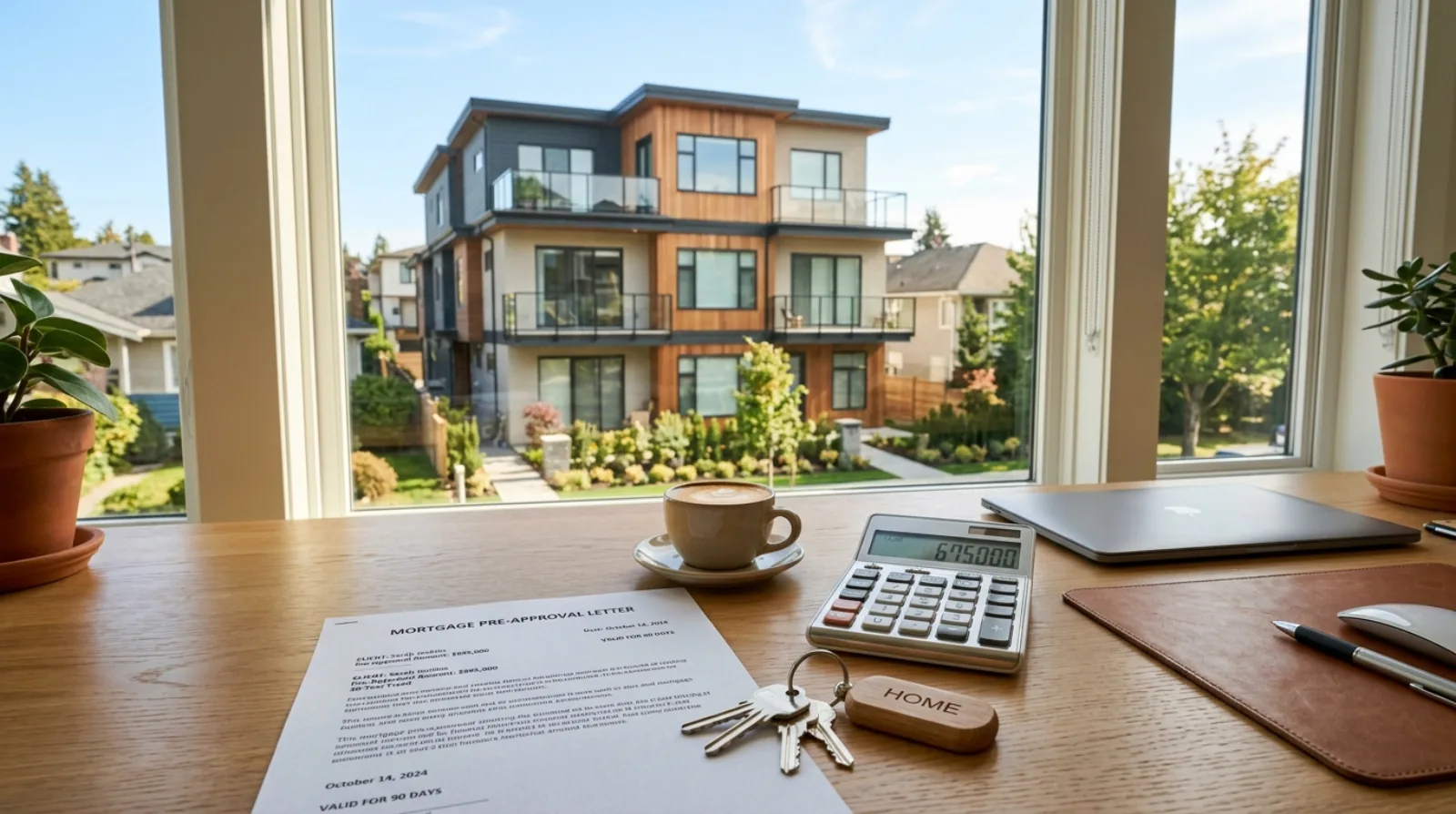
Mortgages for a Pre-Sale Multiplex in BC (2026)
How financing a brand-new pre-sale multiplex works: deposits vs mortgage, rate holds, pre-approval vs final approval, and the stress test at completion.
By MultiLiving Editorial · July 21, 2026
Questions about this guide: Gary Paul, REALTOR®, Personal Real Estate Corporation, Grand Central Realty, 778-828-7476
You found the pre-sale multiplex home you want. You put down a deposit and signed. But the keys are still one, maybe two years away. So here is the question that keeps buyers up at night: how do you get a mortgage for a home that is not built yet, when nobody knows what interest rates will be on the day you move in?
It is a fair worry, and it works differently from buying a resale home. With a resale home, you get your mortgage and move in within a couple of months. With a pre-sale, you commit today but borrow later. The gap between those two moments is where most of the confusion lives. This guide walks through it in plain language, so you know what to do now and what to expect near the finish line.
One thing up front: this is general information, not financial advice. Rules and rates change, and everyone's finances are different. Before you sign anything, talk to a licensed mortgage broker or your lender.
A deposit now, a mortgage later
The first thing to get straight is that a deposit and a mortgage are two separate things. When you buy a brand-new multiplex unit pre-sale, you pay a deposit out of your own money soon after you sign. In British Columbia that deposit is usually staged, often around 15% to 20% of the price spread across a few payments over the months after you sign, held in trust by the seller's lawyer or notary.
Your mortgage is a different animal. You do not borrow the money the day you sign. The mortgage only funds at completion — the day the home is finished, the sale closes, and you get the keys. That could be a year or two after you signed. So on signing day you are not really shopping for a mortgage yet. You are proving you can pay the deposit and showing that a lender is likely to fund the rest when the time comes.
This is the single biggest way pre-sale financing differs from buying resale. With resale, you shop the mortgage, lock a rate, and close within about 30 to 90 days. With a pre-sale, the deposit is the near-term money question and the mortgage is the far-term one.
Why you usually can't lock a rate two years out
Here is the part buyers find frustrating, and it helps to hear it plainly: you generally cannot lock a mortgage rate today for a home that completes in two years. Lenders do not offer that.
Think about it from the lender's side. A rate is a promise about the future price of money. No lender wants to promise you a rate for two years when they have no idea what money will cost them by then. So instead of a two-year lock, lenders offer something shorter called a rate hold, tied to when your home actually completes.
The interest-rate world can move a lot in two years. As a reference point, the Bank of Canada held its policy rate at 2.25% on June 10, 2026, one of several holds through the year. That policy rate is not your mortgage rate, but it is one of the forces that pushes fixed and variable rates up and down over time. Rates change — always check the current numbers with a broker rather than trusting a figure you read months ago.
What a rate hold is, and how long it lasts
A rate hold is a lender's short-term promise: if rates go up before your hold expires, you keep the held rate; if rates drop, you usually get the lower one. It protects you from bad surprises for a set window, and no longer.
For a normal resale purchase, rate holds commonly run about 90 to 120 days. That is plenty when you close in a couple of months. For a pre-sale that completes in a year or two, a standard 120-day hold does not stretch anywhere near far enough. This is why you cannot simply lock today and coast to completion.
Some lenders do offer longer pre-sale rate holds for brand-new homes, sometimes stretching farther out than a standard hold. The exact length and terms vary by lender and change over time, so this is exactly the kind of thing a mortgage broker earns their keep on. The practical takeaway: you will most likely secure your real rate through a hold that kicks in as your completion date comes into view, usually a few months before you get the keys — not on the day you first sign.
Pre-approval now vs final approval near the end
There are two approvals in a pre-sale, and mixing them up causes a lot of needless stress.
Pre-approval happens early. A lender or broker looks at your income, your down payment, your debts, and your credit, and gives you a good-faith read on how much you can likely borrow. A pre-approval is useful for three reasons: it tells you your realistic budget before you fall in love with a unit, it flags any problems while you still have time to fix them, and it gives you confidence to sign. But a pre-approval is not a guarantee. It is a lender saying “based on what we see today, you look good.”
Final approval happens near completion, usually a few months before the keys. This is the real decision. The lender re-checks your income, your job, your credit, and your debts, orders any needed paperwork, and confirms the loan against the finished home. Only after final approval does the mortgage fund. The gap between the two approvals is why your job here is not “get approved once and relax” — it is “get pre-approved, then stay approvable.”
The stress test: you have to qualify at a higher rate
Canada has a rule meant to protect you from borrowing more than you could handle if rates rise. It is called the mortgage stress test. You do not qualify at the rate you will actually pay — you qualify at a higher, made-up “qualifying rate,” to prove you would still cope if rates climbed.
The rule, set by Canada's banking regulator (OSFI), is that you must qualify at the greater of your mortgage contract rate plus 2%, or a floor of 5.25%. OSFI describes the 2% as a safety margin and the 5.25% as a floor that accounts for risks in the wider economy. Whichever number is higher is the one your lender uses to test you.
A quick example. If your actual contract rate came in around 4.5%, your qualifying rate would be 4.5% plus 2%, which is 6.5%. That is higher than the 5.25% floor, so 6.5% is the rate you have to prove you can carry. Your real monthly payment would be based on 4.5%, but the lender checks your budget as if it were 6.5%. This is standard for a single strata unit bought as your principal residence — the ordinary residential mortgage rules apply.
Why the stress test bites again at completion
Here is the pre-sale twist most buyers miss. You do not pass the stress test once at signing and get a free pass to completion. Because your mortgage funds near the end, the lender runs the numbers on your finances and the contract rate that exists then — one or two years from now — not the ones from signing day.
So two things can move between signing and keys, and both matter. Rates can rise, which pushes your qualifying rate up. And your own finances can change. If you switched to a lower-paying job, took on a car loan, ran up credit card debt, or your credit score slipped, you might qualify for less than you did at pre-approval — even for the very same home you already put deposits on.
That is the risk to respect. It is not common for well-prepared buyers to fall short, but it happens, and it is avoidable. Keep your finances boring and steady between signing and completion, and the second stress test is a formality rather than a scare.
What if rates rise before you move in?
This is the honest heart of pre-sale financing: nobody controls where rates go. If rates are higher at completion than when you signed, your monthly payment is higher, and you have to qualify at a higher number too. There is no way to pretend that risk away.
What you can do is manage it:
- Secure a rate hold as your completion window comes into view, so you lock a real rate a few months out rather than gambling on completion-day pricing.
- Budget with a cushion. When you plan, picture a payment based on a rate higher than today's, so a rise does not break your budget.
- Keep your borrowing power strong. The less other debt you carry, the more room you have to absorb a higher qualifying rate.
- Stay in touch with your broker through the wait, not just at the start and the end. If rates or rules shift, you want to hear about it early.
It cuts both ways, by the way. Rates can also fall before completion, and a good rate hold lets you drop to the lower rate. You are not only protecting against a rise — you keep some upside too.
A simple plan from signing to keys
You do not need to become a mortgage expert. You need a short list of sensible habits over the waiting period.
- Talk to a broker or lender early — before you sign, ideally. Get a pre-approval so you know your real budget and catch any problems while you have time.
- Keep your deposit money ready and clean. Lenders like to see where your down payment comes from, so avoid moving large sums around in strange ways right before completion.
- Do not make big financial moves during the wait. No new car loan, no big credit purchases, no co-signing a friend's loan, no quitting a steady job for something shaky right before your home completes.
- Protect your credit. Pay every bill on time, keep card balances low, and do not open a pile of new credit accounts.
- Line up your rate hold as completion nears. Your broker will tell you when the window opens for your finish date.
- Get final approval a few months before the keys, with fresh income and job paperwork ready so nothing stalls at the finish line.
Do those things and the mortgage side of a pre-sale becomes calm and predictable, even though the wait is long.
What this comes down to
- A deposit and a mortgage are separate. You pay the deposit soon after signing; the mortgage funds at completion, a year or two later.
- You usually cannot lock a rate two years out. Lenders offer a rate hold instead — often about 90 to 120 days for resale, with some longer holds for brand-new homes.
- There are two approvals: a pre-approval early (a good-faith read, not a guarantee) and a final approval near completion (the real decision).
- You must pass the stress test — qualifying at the greater of your contract rate plus 2% or 5.25%, per OSFI — and it applies again near completion, on the numbers that exist then.
- Rates can rise or fall before you move in. Budget with a cushion, keep your finances steady, and line up a rate hold as completion nears.
- This is general information, not financial advice. Talk to a licensed mortgage professional about your own situation.
Frequently asked questions
Can I lock my mortgage rate for a pre-sale completing in 2 years?
Generally no. Lenders do not promise a rate that far ahead. Instead you get a shorter rate hold that starts as your completion date comes into view — usually a few months before the keys. That is when you secure your real rate, not on signing day.
What's a rate hold?
A rate hold is a lender's short-term promise on your rate. If rates rise before it expires, you keep the held rate; if rates fall, you usually get the lower one. It protects you for a set window, commonly about 90 to 120 days for a resale purchase.
Do I need a mortgage when I sign the pre-sale?
No. At signing you pay a deposit from your own money, not borrowed funds. The mortgage only funds later, at completion, when the home is finished. It is smart to be pre-approved before you sign, but you do not take out the loan then.
What's the difference between a deposit and a mortgage?
The deposit is your own cash, often around 15% to 20% of the price in BC, paid in stages after you sign and held in trust. The mortgage is the loan that pays the rest, and it funds at completion. Two separate things, at two separate times.
What if rates rise before completion?
Then your payment and your qualifying rate are higher. You cannot remove that risk, but you can manage it: secure a rate hold as completion nears, budget as if rates were higher than today, and keep other debt low so you have room to absorb a rise.
Will I have to pass the stress test again?
Yes, effectively. Because your mortgage funds near completion, the lender re-checks your finances and the contract rate at that time, not the ones from signing. Keep your income, job, and credit steady in between and this second check is usually a formality.
How does the mortgage stress test work?
You must qualify at the greater of your contract rate plus 2% or a floor of 5.25%, per OSFI, Canada's banking regulator. Your actual payment uses your real rate, but the lender tests your budget at the higher qualifying rate to make sure you could still cope if rates rose.
What's the difference between pre-approval and final approval?
Pre-approval is an early, good-faith estimate of how much you can borrow based on today's finances — useful, but not a guarantee. Final approval happens near completion, when the lender re-checks everything and confirms the loan. Only after final approval does the mortgage actually fund.
How long does a pre-approval last?
A standard pre-approval and its rate hold often run about 90 to 120 days, which is far shorter than a pre-sale timeline. So an early pre-approval will usually expire before your home is ready, and you will refresh it and secure a new rate hold closer to completion.
How big a deposit do I need for a pre-sale multiplex in BC?
Pre-sale deposits in British Columbia are commonly around 15% to 20% of the purchase price, paid in stages over the months after you sign and held in trust. The exact schedule is set in your contract, so read that section carefully before you commit.
Can my finances change between signing and getting the keys?
Yes, and that is the risk to manage. A new car loan, more credit card debt, a lower-paying job, or a slipped credit score can shrink what you qualify for at completion — even for the home you already put deposits on. Keep your finances steady in between.
Should I choose a fixed or variable rate for a pre-sale?
That depends on your comfort with change and where rates sit when you lock, so it is a conversation for your broker near completion, not a decision to force at signing. A fixed rate gives a steady payment; a variable rate moves with the market. Neither is right for everyone.
When should I talk to a mortgage broker about a pre-sale?
Before you sign, ideally. An early conversation tells you your real budget, flags any problems while you still have time to fix them, and helps you understand the deposit and rate-hold timeline. Then stay in touch through the wait so nothing surprises you near completion.
Is buying a single multiplex unit different from buying the whole building?
Yes. This guide is about buying one strata unit as your home, which uses ordinary residential mortgage rules. Buying an entire multiplex building is a different process with different rules and lending, and it is not what most family buyers are doing.
What happens if I can't get approved at completion?
It is uncommon for well-prepared buyers, but it is why staying approvable matters. If your finances slipped, you could face a shortfall or, worst case, trouble closing. The fix is prevention: keep income and credit steady, avoid new debt, and stay in touch with your broker throughout the wait.
Talk to us before you sign
Financing a pre-sale multiplex home is not hard once you see the shape of it: pay the deposit now, keep your finances steady, secure a rate hold as completion nears, and clear final approval before the keys. The wait is long, but the plan is simple.
We help families find and compare brand-new multiplex homes across Greater Vancouver, and we can point you to the right questions to ask a mortgage professional for your situation. Get in touch with our team or browse pre-sale multiplex homes to see what fits your family and your budget.