Multi-Generational Multiplex Living
In Metro Vancouver, 4.7% of households are multigenerational — nearly double the national average. In Surrey, it's 9.6%. For these families, multiplexes aren't a trend. They're the only arrangement that makes financial and emotional sense.
Key Topics
Separate Doors, Shared Lot
Each generation gets their own front entrance, kitchen, and living space. You're close enough to share a meal but far enough to avoid sharing a bathroom. That's the whole point.
Pool Your Buying Power
TD's Generational Mortgage lets up to 4 family members across 2 generations co-borrow. Combined incomes mean qualifying for a larger property — and splitting the payments makes each share manageable.
Childcare Built Into the Building
Grandparents one floor down. No daycare waitlist, no $2,000/month fees, no 45-minute commute to pickup. This is how most of the world raises kids. Vancouver is catching up.
$7,500 Back at Tax Time
The federal Multigenerational Home Renovation Tax Credit (MHRTC) covers 15% of up to $50,000 in renovation costs to create a secondary unit for a family member 65+ or with a disability. It's refundable — you get it even if you owe no tax. Note: this applies if you're adding a suite to an existing home, not buying a multiplex that already has separate units.
Aging in Place, For Real
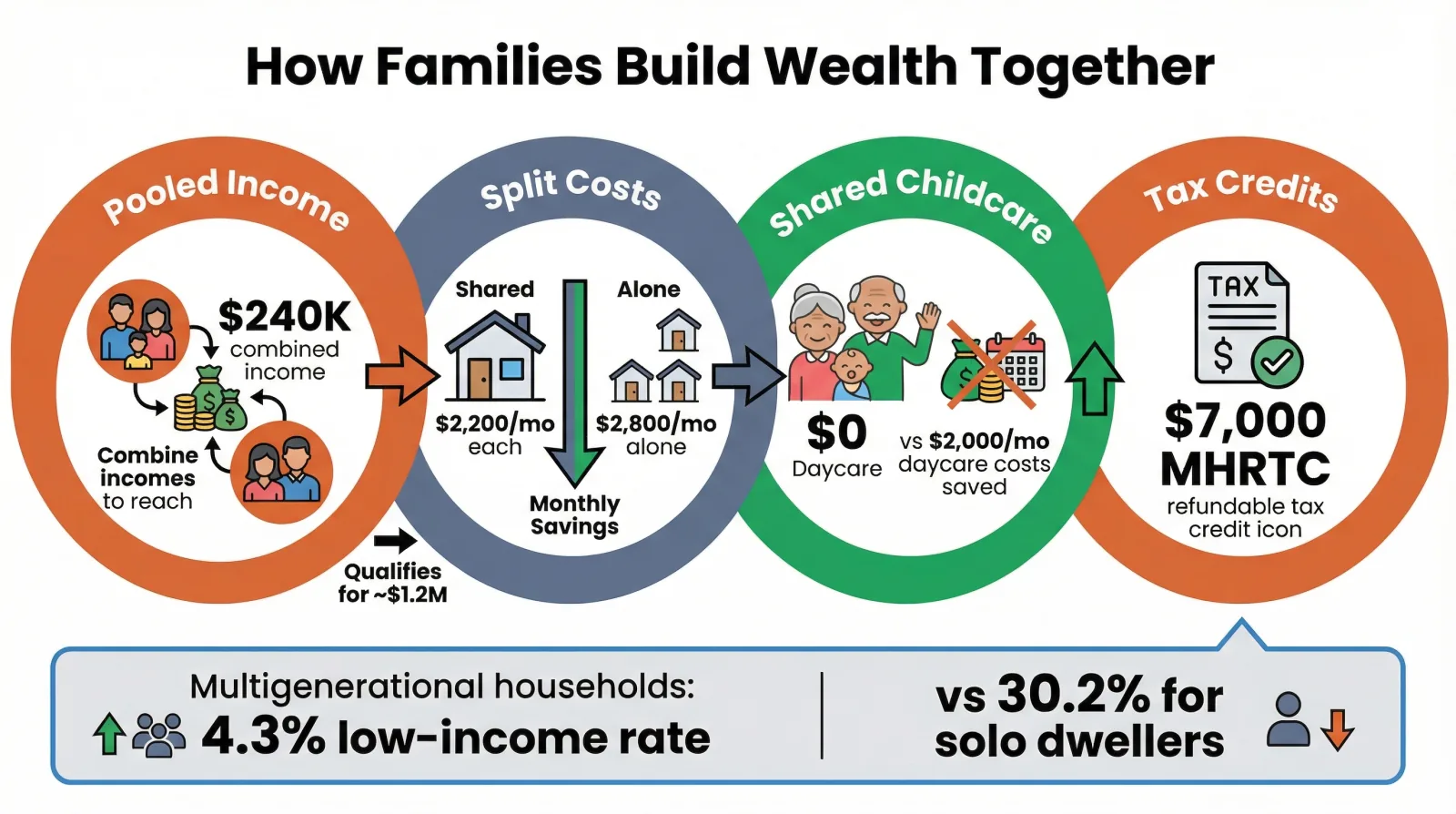
Ground-floor units with no stairs, wide doorways, and family upstairs. Statistics Canada data shows only 4.3% of people in multigenerational homes fall below the low-income threshold, compared to 30.2% of solo dwellers.
Bill 44 Made It Legal
Before June 2024, most BC lots were zoned for one home. Now you can build 4 units on a standard lot, 6 near transit. A family that couldn't afford one $1.88M detached home can split a fourplex four ways.
Why Families Pool Resources
A single household earning $120K qualifies for roughly $550K. Two households earning $120K each, buying a duplex together? That's a different conversation entirely.
| Scenario | Household Income | Approx. Buying Power | What You Get | Monthly per Family |
|---|---|---|---|---|
| Single family, alone | $120K | ~$550K | 1BR condo, no yard | $2,800/mo |
| Two families, duplex | $240K combined | ~$1.2M | 2 × 3BR units, shared yard | $2,200/mo each |
| Three families, triplex | $360K combined | ~$1.8M | 3 units, private entrances | $1,900/mo each |
| Parents + adult child | $180K combined | ~$900K | 2 units, one lot | $2,000/mo each |
Estimates based on CMHC qualification rules (GDS 39%, TDS 44%) at ~4.5% mortgage rate, 25-year amortization. Actual qualification depends on debts, credit, and lender. Rental income offsets not included.
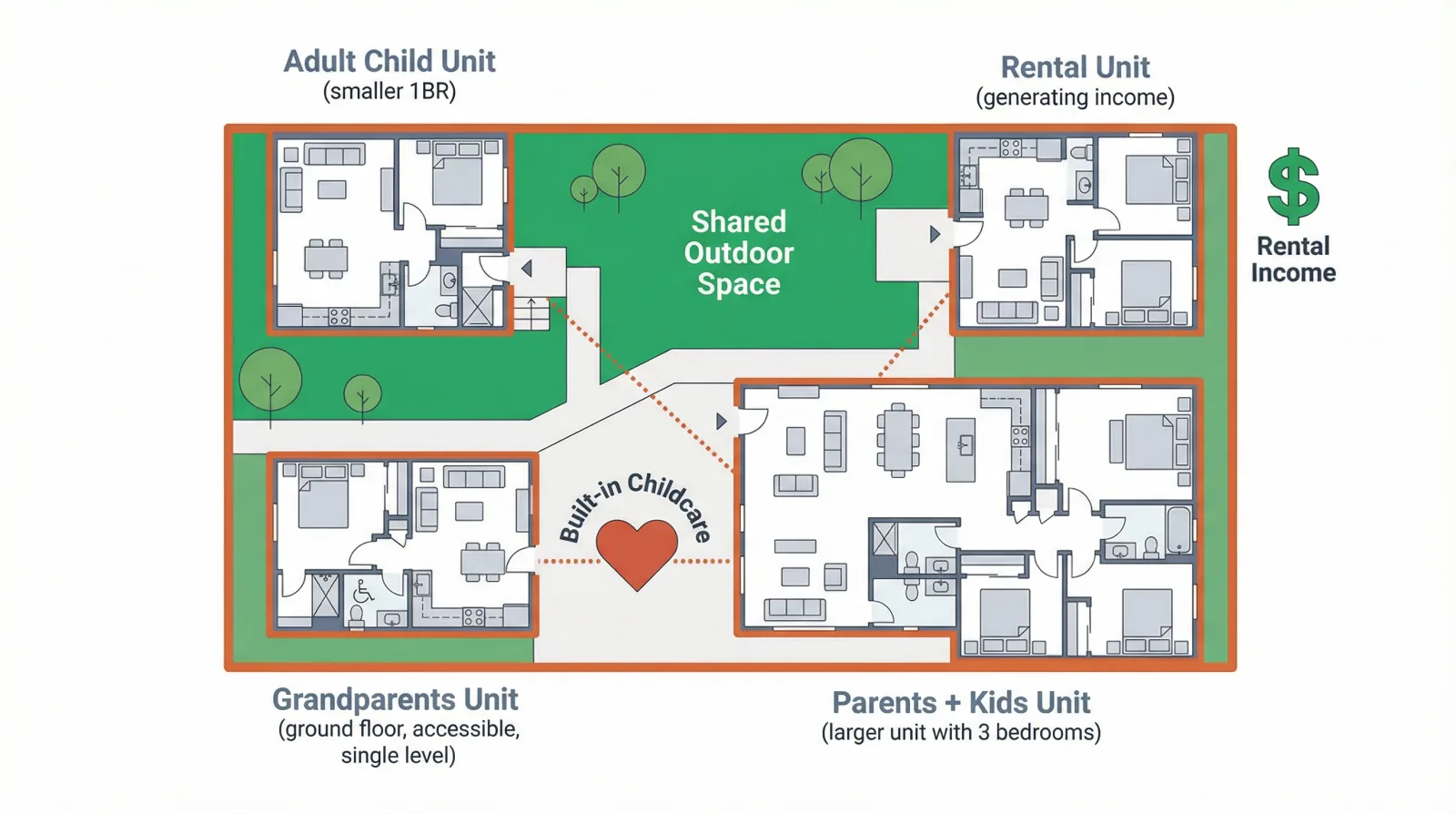
Which Layout Fits Your Family?
Every multiplex splits up space a little differently. Here's how the three main layouts compare for a family buying together — all of them brand new, all move-in ready.
Duplex — Two Units, One Lot
Two full homes side by side, each with its own front door, yard space, and title. One family takes each side. This works well for two generations who want to be close but keep completely separate households — parents on one side, an adult child's family on the other.
Best for: two generations, full independenceFourplex — A Unit for Each Household
Four separate units on one lot, often arranged with an accessible ground-floor unit for grandparents, a larger unit for the family with kids, and a smaller one for a single adult child. One unit can even be rented out to help cover the mortgage while the family grows into it.
Best for: three or more households, mixed needsGround-Floor Accessible Unit
Most new multiplexes include at least one unit with no stairs to the front door, wider hallways, and a walk-in shower. If an aging parent is moving in, ask about this unit specifically when you tour — it's the difference between a home that works for them at 70 and one that still works at 85.
Best for: aging parents, long-term comfortEvery unit type above is brand new construction — not a renovation or an add-on suite. Browse active multiplex listings to see current layouts, or talk to our team about what fits your family.
Programs That Help Multi-Gen Families
The federal Multigenerational Home Renovation Tax Credit provides a refundable 15% credit on up to $50,000 in renovation costs to add a secondary unit for a senior (65+) or person with a disability. This applies to renovating an existing home, not buying a multiplex unit that's already built with separate units — most MultiLiving buyers won't need it, but it's worth knowing if a grandparent is moving in later.
CRA, 2026 tax yearTD allows up to 4 family members across 2 generations on a single mortgage. All incomes count toward qualification. RBC has a similar Family Financing Program with enhanced lending limits for multigenerational applications.
TD Bank / RBC, 2026For owner-occupied multiplexes, CMHC allows lenders to add up to 50% of projected rental income from non-owner units to your qualifying income. On a triplex with $4,700/mo in rents, that's $2,350/mo added to your application.
CMHC, updated late 2024Every BC municipality must allow 4 units on lots over 280m², and 6 units near frequent transit. For a multigenerational family, that means building separate units for each generation on a single lot — legally, without rezoning.
BC Gov, effective June 2024Financing Together
Families buying a multiplex together have more mortgage options than they might expect. Most major lenders allow up to four co-borrowers on a single mortgage, so two generations combining income can qualify for significantly more than either household could on its own.
Vancity's Mixer Mortgage is designed specifically for co-ownership situations in BC, with flexible terms that accommodate non-traditional household structures and shared ownership agreements. For families who want each generation on a separate title, strata units can each carry an independent mortgage — no shared debt required.
CMHC mortgage insurance is available for owner-occupied multiplex purchases up to $1.5M: as little as 5% down on the first $500K when each generation buys its own strata unit, or 10% down if the family buys a whole three- or four-unit building together. And for families where some buyers are purchasing their first home, eligible first-time buyers can each access the FHSA (up to $40,000 per person, tax-free) and the RRSP Home Buyers' Plan (up to $60,000 per person). Stack those with the GST rebate on a qualifying new multiplex and a group of co-purchasing first-time buyers can access up to $125,000 in combined savings per eligible person.
For a deeper look at how the numbers work for families buying together, see the Buying With Family guide and the full Tax Rebates & Savings Guide.
How Families Structure Ownership
Strata Title
Each unit is separately owned with its own title. Each family buys their unit independently, gets their own mortgage, and can sell without the others. Clean and simple. Most new multiplexes use this structure.
Best for: families who want full independenceTenants in Common
One property title, shared between families with defined percentage interests (e.g., 60/40). The BCREA recommends a written co-ownership agreement covering buyout terms, dispute resolution, and what happens if someone wants out.
Best for: families buying an existing property togetherJoint Tenancy
Equal ownership with right of survivorship — if one owner dies, their share goes to the others automatically. Simpler estate planning, but less flexible. You can't hold unequal shares, and you can't will your portion to someone else.
Best for: spouses or partners co-buyingSources: Segev LLP, BCREA Legally Speaking. Get independent legal advice before choosing a structure — family dynamics and tax implications vary.
Multigenerational Households in BC
Is a Multiplex Right for Your Family?
Before you start touring, walk through these five questions together. The more you answer yes, the stronger the fit.
Does everyone want their own front door?
If your family wants to share meals sometimes but not a hallway every day, a multiplex — where each household has a separate entrance — fits better than one big house with a finished basement.
Can you agree on how to split the cost?
Two or three households pooling a down payment need to agree on the split before they start touring, not after they fall in love with a property. See the ownership structures below for how other families have done this.
Does someone in the family need a no-stairs entrance?
If a parent or grandparent has mobility needs now or in the next few years, prioritize a unit with a ground-floor, no-step entrance. Ask about this specifically when booking a tour.
Would rental income help the numbers work?
If the family doesn't need every unit right away, a fourplex or triplex where one unit is rented out can lower everyone's monthly cost until a family member is ready to move in.
Are you buying to live there long-term?
Multiplexes work best for families planning to stay for years, not a quick flip. The upfront work of setting up ownership pays off over a decade of shared holidays and built-in childcare, not a single season.
Answered mostly yes? Talk to our team about what's available, or start with the Buying With Family guide.
This guide is part of the MultiLiving Playbook — our complete collection of guides for buying, financing, and living in a multiplex in BC.
The bottom line
Multi-generational living is one of the smartest moves a family can make in Metro Vancouver. Shared childcare, split costs, someone to water the plants when you're away — and a built-in support network that most homeowners only dream about. The families doing this well start with one thing: a clear co-ownership agreement drafted by a BC real estate lawyer (budget $2,000-$4,000) that covers buyouts, disputes, and life changes. The BCREA recommends it for good reason — it turns good intentions into a solid foundation.
The financial advantages are substantial. Statistics Canada data shows multigenerational households have a 4.3% low-income rate versus 30.2% for solo dwellers. The MHRTC gives you $7,000 back for creating a secondary family unit. TD's Generational Mortgage lets up to 4 family members pool income. And with Bill 44 now allowing 4-6 units per lot, each generation can have their own front door on a single property.
A multiplex is genuinely the best structure for families buying together. Separate entrances mean separate lives. Shared land means shared costs. Strata title gives each household an independent deed they can sell on their own terms. The 2021 Census shows 441,750 Canadian households have already figured this out — and that number is growing fast.
If your family is ready to explore this path, talk to our team. We help multi-generational families find the right multiplex, understand the ownership structures, and make the move with confidence.
Data: Statistics Canada 2021 Census multigenerational households, CRA MHRTC guidelines, BCREA co-ownership guidance.
Be first to see new projects coming soon
Get the free Buyer Guide and early access to new multiplex projects in Greater Vancouver, before they're publicly listed.
Key Takeaways
- 4.7% of Metro Vancouver households are multigenerational — 9.6% in Surrey alone.
- TD Generational Mortgage allows up to 4 family members across 2 generations to co-borrow.
- The federal MHRTC provides up to $7,500 back for creating a secondary family unit in an existing home.
- Multigenerational households have a 4.3% low-income rate vs. 30.2% for solo dwellers.
- Bill 44 allows 4-6 units per lot, enabling separate units for each generation on one property.
- BCREA recommends a written co-ownership agreement covering buyout terms and dispute resolution.
Frequently Asked Questions
Can family members co-own a multiplex in BC?
Yes. Families can co-own via strata title (each unit separately owned), tenants in common (shared title with defined percentage interests), or joint tenancy (equal shares with survivorship). TD's Generational Mortgage allows up to four co-borrowers across two generations on a single mortgage.
The ownership structure you choose affects taxes, estate planning, and what happens when someone wants out. Strata title is the cleanest option for new multiplexes — each family holds their own title, gets their own mortgage, and can sell independently. Tenants in common works for existing properties but demands a co-ownership agreement drafted by a BC real estate lawyer. Without one, you are exposed if a co-owner goes through a divorce, bankruptcy, or simply wants to sell at a bad time. Budget $2,000-$4,000 for the legal work. Joint tenancy is simpler but inflexible — you cannot hold unequal shares, and the survivorship clause means your share passes to the other owners on death, bypassing your will entirely. Talk to a lawyer before committing.
What is the MHRTC tax credit?
The federal Multigenerational Home Renovation Tax Credit provides a refundable 15% credit on up to $50,000 in renovation costs to create a secondary unit for a family member aged 65 or older or with a disability. The maximum credit is $7,500 per qualifying individual, lifetime.
The secondary unit must have a private entrance, kitchen, and bathroom — basically a self-contained suite. This credit is for renovating an existing home to add that kind of suite. If you're buying a brand-new multiplex where the units are already separate and move-in ready, you won't need it — the credit exists for families doing the work themselves, not buying a home where the work is already done. It's worth knowing about if you're weighing a multiplex purchase against renovating a family member's current house. The credit is refundable, meaning you get the money even if you owe zero tax that year, and you claim it on the return for the year the renovation is substantially completed. One catch: the $7,500 is a lifetime limit per qualifying individual, not per year.
How many multigenerational households are in Metro Vancouver?
About 4.7% of Metro Vancouver households are multigenerational, nearly double the national average. In Surrey, the rate reaches 9.6%, the highest in the region. Canada-wide, 441,750 multigenerational households were counted in the 2021 Census, up 21% since 2011.
These numbers almost certainly undercount the reality. The Census defines multigenerational as three or more generations under one roof, which misses two-generation arrangements like parents and adult children sharing a property. In South Asian, Chinese, and Filipino communities across Metro Vancouver, multi-generational living is the norm rather than the exception — the housing market just had not offered a product that fit until multiplexes. Surrey's 9.6% rate reflects this cultural reality. The 21% growth since 2011 is driven by both affordability pressure and deliberate family choice. Expect the 2026 Census to show an even bigger jump, especially as Bill 44 multiplexes start reaching families who previously had to cram into single-family homes not designed for multiple households.
What's the best ownership structure for family co-buying?
Strata title is cleanest for new multiplexes — each family owns their unit independently with a separate mortgage. For existing properties, tenants in common with a written co-ownership agreement is recommended by the BCREA. Budget $2,000-$4,000 for a BC real estate lawyer to draft it.
The co-ownership agreement is where families either protect themselves or set up future conflict. It should cover what happens if one party wants to sell, how to handle a buyout (and at what valuation method), who pays for major repairs, how shared costs are split, and what happens in the event of divorce, death, or job loss. Do not use a template from the internet. Get a BC real estate lawyer who has done multi-party agreements before. Also discuss the Property Transfer Tax implications — in BC, adding or removing a name on title triggers PTT unless an exemption applies. Families sometimes assume they can shuffle ownership later without tax consequences. They usually cannot. Sort the structure before you sign anything.
What happens to the mortgage if one family member wants to sell?
This is the question every family avoids until it is too late. If you co-own via strata title, the selling family can list their unit independently. If you hold as tenants in common on a single title, the remaining family must refinance to buy out the departing member's share.
The exit scenario is where ownership structure really matters. With strata title, each unit has its own mortgage and its own title — one family can sell without affecting the others at all. Clean and simple. With tenants in common, selling a percentage interest in a shared property is much harder. Most buyers do not want to purchase a 40% undivided interest in a building with strangers. In practice, the remaining family needs to either refinance and buy out the departing member's equity, or the entire property gets sold. This is why the BCREA strongly recommends a written co-ownership agreement that covers buyout terms, valuation methods (independent appraisal vs. formula), timelines (90-180 days is typical), and right of first refusal. Budget $2,000-$4,000 for a BC real estate lawyer to draft it. Do this before you buy, not after someone announces they are leaving. Refinancing in a down market can also mean the remaining family faces a lower appraisal, which may require additional cash to close the gap.
How do families split costs when one unit is bigger than another?
Most families use proportional cost sharing based on square footage or assessed value. In a strata-titled multiplex, unit entitlement (set at registration) determines each owner's share of common expenses. In tenants-in-common arrangements, you define the split in your co-ownership agreement.
This is one of those conversations that feels awkward but prevents serious conflict later. In a strata, the developer sets unit entitlement at registration — typically based on square footage, so a 1,400-sqft unit pays proportionally more than a 900-sqft unit for shared costs like insurance, landscaping, and roof maintenance. That formula is baked into the strata plan and applies automatically. For tenants in common, nothing is automatic. If one family occupies 60% of the building, does that family pay 60% of the property tax? What about utilities on shared meters? What about capital repairs to the roof that benefits everyone equally? The co-ownership agreement should spell out a formula — square footage ratio is the most common, but some families use BC Assessment's allocated values for each unit. Also decide upfront how to handle unequal contributions: if one family paid a larger down payment, do they get a proportional ownership stake or is it treated as a loan? Get these answers in writing before anyone signs a mortgage.
More from The Playbook
Why Multiplex
The case for ground-oriented living
ExploreBuying Guide
From discovery to closing
ExploreFinancing
Mortgages, programs & more
ExploreMarket Reports
Data, trends & analysis
ExploreLiving
What ownership looks like
ExploreWhere to Buy (Van)
Vancouver neighbourhood data
ExploreWhere to Buy (Burnaby)
Burnaby neighbourhood data
ExploreStrata Guide
Bylaws, governance & ownership
ExploreTalk to a Multiplex Expert
Whether you're buying, building, or exploring your options, our team can help you navigate the process with confidence.
Ready to find your multiplex?
Browse duplexes, triplexes, and fourplexes across Greater Vancouver and BC.