Co-Development Explained
You own the lot. A developer brings the capital and expertise. Together, you build a multiplex — you keep a unit (or more), and the developer sells the rest. Co-development turns a $1.8M bungalow into a $5.6M property without you needing $2M+ in construction financing.
Key Topics
What Co-Development Is
A partnership where the homeowner contributes their land and the developer funds design, permits, and construction. Profits or units are split by agreement — no two deals look the same.
Deal Structures & Profit Splits
Area-sharing, revenue-sharing, or hybrid models. Your land equity is your stake. Some homeowners keep a unit at cost, others take a cash payout, and some do both.
The Legal Framework
Joint venture agreements, limited partnerships, bare trusts, and development management contracts. Each structure has different liability exposure, tax treatment, and control levels.
Timeline & Phases
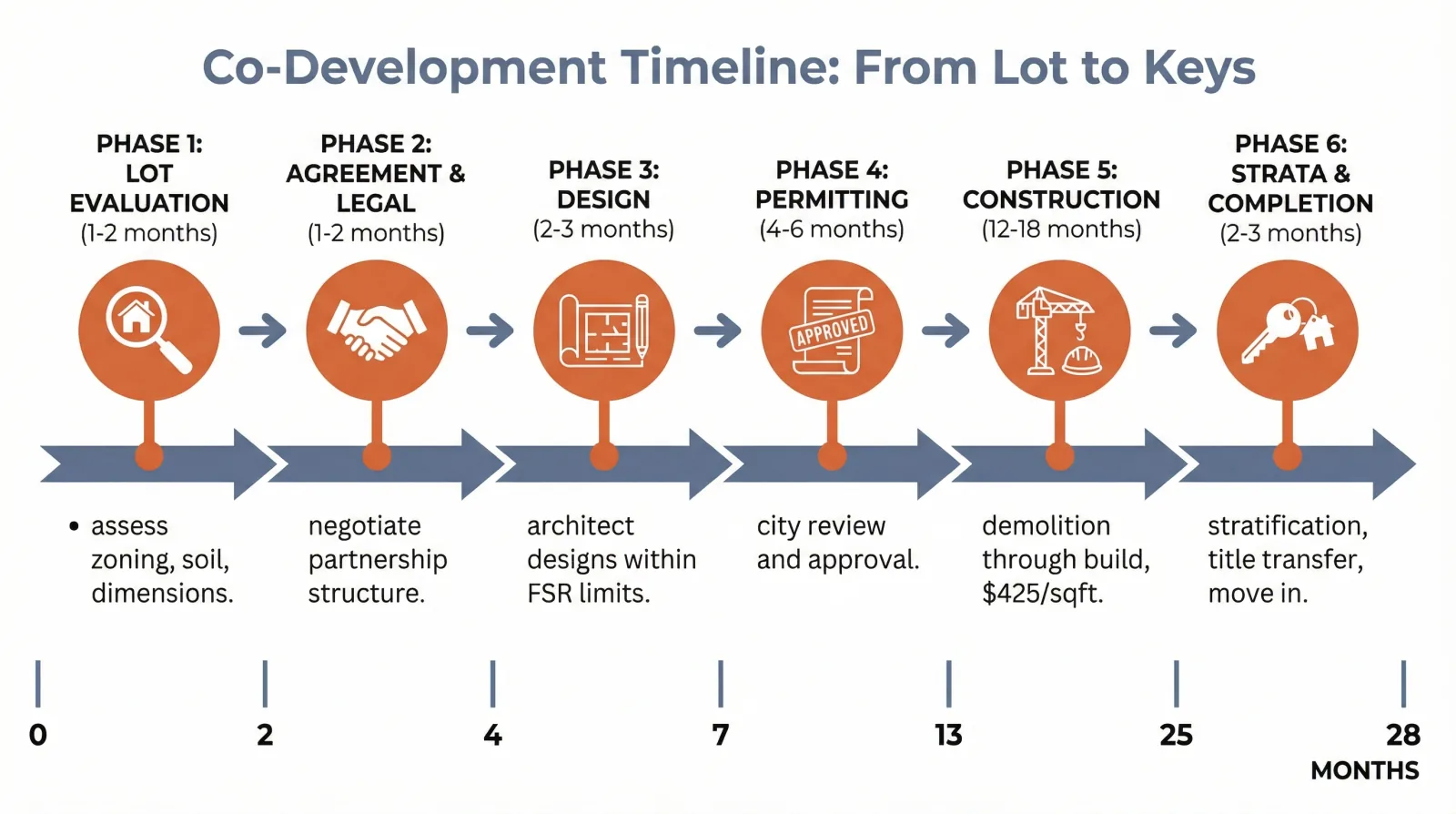
From lot evaluation to stratification: expect 18–28 months across feasibility, design, permitting, construction, and sales. Plan temporary housing for the full duration.
Tax & Financial Implications
Principal residence exemption, capital gains on change of use, GST on new construction, property transfer tax on strata subdivision — the tax picture is complex and needs professional advice.
Risks & How to Protect Yourself
Cost overruns, permit delays, market shifts, and developer disputes. Limited partnerships, fixed-price contracts, and independent legal counsel are your shields.
How Co-Development Works
From initial lot evaluation to handing you the keys to your new unit. Here's what actually happens, in order.
Lot Evaluation
1–2 monthsThe developer assesses your lot's zoning, dimensions, soil conditions, and servicing capacity. Under Bill 44, most former single-family lots in BC allow 3–6 units. Vancouver lots with 33+ feet of frontage typically support a fourplex; 49.5+ feet can go up to a sixplex. This is where you find out if your lot's economics actually work.
Agreement & Legal Structure
1–2 monthsBoth parties hire independent lawyers. You negotiate the deal: limited partnership, joint venture, or development management contract. The agreement defines land contribution value, profit split, which unit you keep, design approval rights, cost overrun responsibility, and exit terms. Do not skip independent legal counsel — this document governs a multi-million dollar project.
Design & Architecture
2–3 monthsArchitects design the multiplex within your lot's FSR, height, and setback limits. Vancouver's base FSR is 0.70 with bonus density up to 1.0. You'll review floor plans and select your preferred unit. Pre-approved designs from the federal Housing Design Catalogue (published March 2025) can cut this phase shorter.
Permitting
4–6 monthsThe developer submits development and building permits. Vancouver cut processing to 4–6 months in early 2025 through a streamlined combined pathway. If your lot is in First Shaughnessy or a heritage area, expect longer. The developer typically handles all municipal interactions — this is one of the main things you're paying them for.
Demolition & Construction
12–18 monthsYour existing home comes down, and the multiplex goes up. Wood-frame construction costs average $425/sf in Q1 2026 Vancouver. A typical fourplex at 5,200 total sqft runs roughly $2.25M in hard costs. You need to be living somewhere else for this entire period — plan temporary housing before demolition day, not after.
Strata Subdivision & Completion
2–3 monthsAfter final inspections, the building is stratified into individual titles. Each unit gets its own strata lot number, and you receive title to your agreed-upon unit. The developer lists and sells the remaining units. Some agreements let you move in before all units sell; others wait until the strata plan is fully registered.
Sources: City of Vancouver multiplex permit data. VanPlex market analysis, Q4 2025. BC Construction Association cost index, Q1 2026.
Four Ways to Structure the Deal
Each structure changes who bears risk, who controls decisions, and how taxes work. There is no one-size-fits-all — your lawyer and accountant should weigh in before you choose.
| Structure | Your Role | Liability | Control | Best For |
|---|---|---|---|---|
| Limited Partnership | Limited partner (land contributor) | Capped at land value | Design approval only | Most homeowners — hands-off with downside protection |
| General Partnership | Full partner | Unlimited personal liability | Shared 50/50 | Experienced homeowners with construction knowledge |
| Joint Venture (Corp) | Shareholder in new entity | Limited to share investment | Board-level decisions | Complex projects or multiple landowners |
| Dev Management | Full owner, developer is hired contractor | You bear all project risk | Full control | Homeowners with capital and strong project management skills |
Sources: Castle Law LLP, Vancouver partnership structuring. Peacock Law P.C., co-development agreements. Baker Tilly, co-development opportunity identification.
Co-Development vs. Market Sale
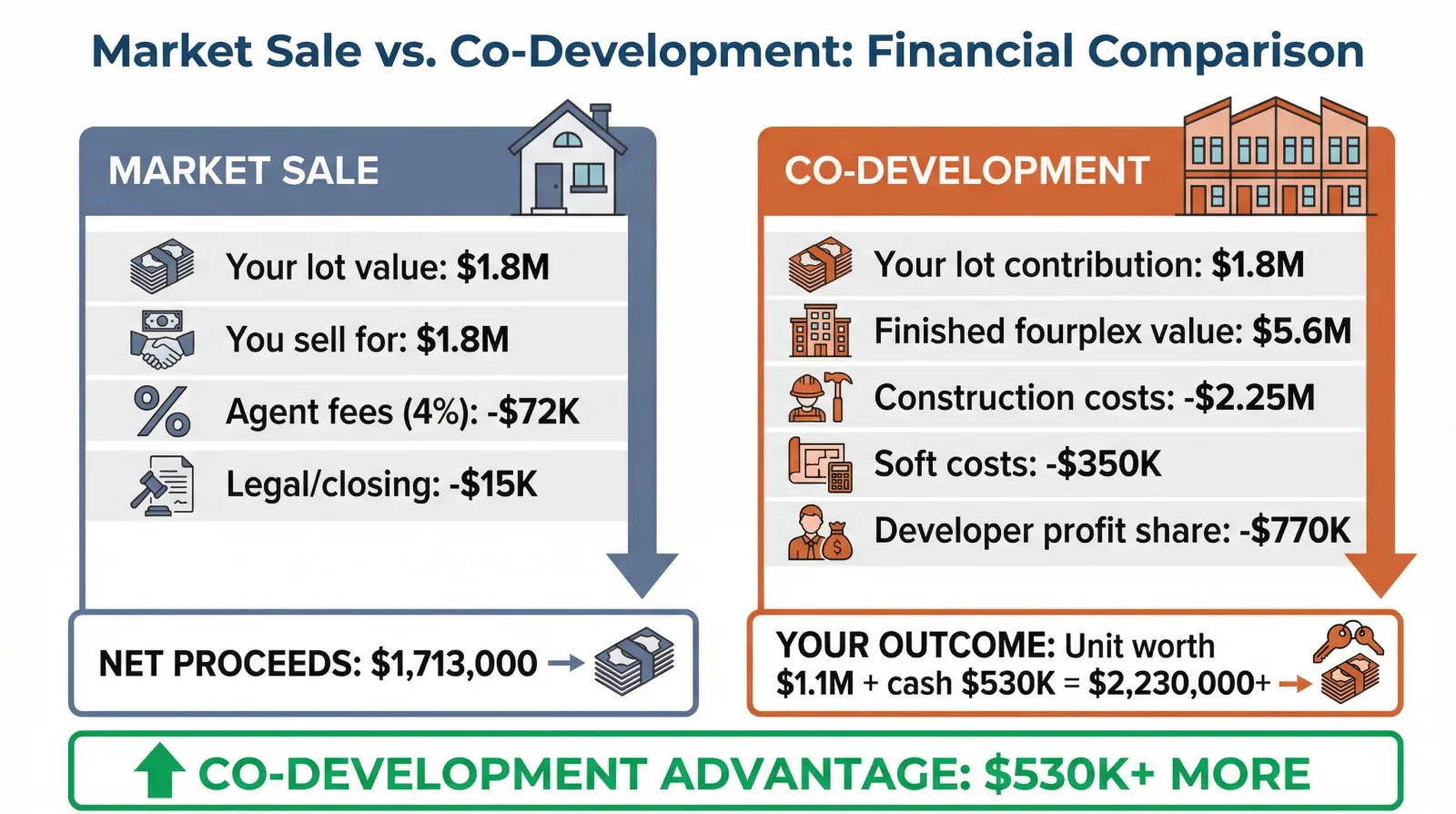
A worked example for a typical East Vancouver 33-foot lot with a $1.8M bungalow. These are illustrative figures — your numbers will differ based on lot size, location, and market conditions.
Option A: Sell Your Lot
Option B: Co-Develop a Fourplex
Illustrative example based on VanPlex proforma data, Q1 2026. Actual results vary significantly by lot, market, and agreement terms. Always run your own feasibility study with professional advisors.
How the Money Works
Your land is your equity. The developer typically secures construction financing. But when you keep a unit, you'll need your own mortgage at completion.
Your Land Equity
Your lot's appraised value is your capital contribution. In Vancouver, multiplex-zoned lots traded at $1.4M–$2.2M in 2024-2025. If your lot is worth $1.8M and you're buying back a unit at $900K, your land equity covers the full purchase price and then some.
Construction Financing
The developer secures a construction mortgage — typically at 6.0–7.0% in Q1 2026. This is their responsibility in most co-development structures. The loan covers hard costs ($425/sf for wood-frame), soft costs, and contingency. Construction loans draw down in stages tied to inspection milestones.
Your Take-Out Mortgage
When your unit is finished and stratified, you need a conventional mortgage for your share. CMHC insures your owner-occupied unit up to $1.5M with 5% down on the first $500K and 10% on the rest. First-time buyers get 30-year amortization on new builds. Lenders count 50% of projected rental income toward qualification.
Sources: CMHC Multi-Unit Mortgage Insurance, 2026. VanPlex construction financing data. REBGV land transaction data, 2024–2025.
Tax Implications You Can't Ignore
Co-development triggers several tax events that a simple home sale would not. This section outlines what you'll face — but get an accountant before making any decisions.
Principal Residence Exemption (PRE)
When you demolish your home and enter a co-development agreement, CRA treats this as a "change of use" — your property shifts from a principal residence to a development project. You can claim the PRE on the gain up to the point of change-of-use, but any additional appreciation during construction is taxable. The land under 0.5 hectares is covered; anything larger needs justification.
Capital Gains vs. Business Income
If CRA views the development as a business venture (which co-development usually is), the gain is taxed as business income — at 100% inclusion — not as a capital gain at 50% inclusion. This is a massive difference. A $500K gain taxed as business income costs roughly $125K more in tax than the same gain as a capital gain. The distinction depends on your intent, scale, and how you structured the deal.
GST on New Construction
New residential construction is subject to 5% GST. If you're buying your unit from the co-development entity, GST applies to the purchase price. The GST New Housing Rebate can return up to $6,300 on homes under $350K, with a partial rebate up to $450K. Above $450K — which is essentially every Vancouver multiplex unit — no federal rebate. BC's PST doesn't apply to real property, but the GST bill on a $900K unit is $45K.
Property Transfer Tax (PTT)
Strata subdivision creates a new title, and transferring that title to you triggers BC's Property Transfer Tax: 1% on the first $200K, 2% on $200K–$2M, and 3% above $2M. On a $900K unit, that's $16,000. The newly built home exemption can eliminate PTT for properties up to $500K (partial exemption up to $525K) if you're a first-time buyer. Transfers made in the course of strata subdivision may qualify for an exemption if you meet specific criteria — consult a lawyer.
Sources: CRA Principal Residence Exemption guidelines. BC Property Transfer Tax Act. Smythe LLP, subdivision of former principal residence. Always consult a qualified tax professional — this is not tax advice.
Choosing the Right Developer
Your developer choice is the single most consequential decision in this process. Here's what to look for and what should make you walk away.
Green Flags
- Completed 3+ multiplex projects in Metro Vancouver in the past 2 years
- Invites you to visit active construction sites — transparency about quality
- Provides references from previous homeowner co-development partners
- Offers fixed-price or guaranteed-maximum-price contracts with clear change-order terms
- Has a licensed architect and structural engineer on retainer
- Carries comprehensive builder's liability insurance and warranty coverage
- Clear communication about timeline, budget, and decision milestones
- Encourages you to get independent legal and financial advice
Red Flags
- Won't let you see construction in progress or visit current project sites
- Hesitant to provide references from past co-development partners
- Pushes general partnership structure that exposes you to unlimited liability
- Vague about cost breakdowns — "we'll figure it out as we go"
- No fixed-price option — only cost-plus with uncapped overruns
- Pressures you to sign quickly without independent legal review
- No experience with multiplexes — only single-family or large condo projects
- Requests you to personally guarantee the construction loan
Sources: Alair Homes Vancouver, evaluating multiplex builders. BCBusiness, inside B.C.'s multiplex challenge.
What Can Go Wrong — and How to Protect Yourself
| Risk | Likelihood | Impact | Mitigation |
|---|---|---|---|
| Cost overruns (10–25% common) | High | High | Fixed-price or GMP contract with defined contingency (typically 10%) |
| Permit delays (2–6 extra months) | Medium | Medium | Use pre-approved designs from the Housing Design Catalogue; budget timeline buffer |
| Market value drop during construction | Medium | High | Ensure your agreement protects your unit ownership regardless of remaining unit sale prices |
| Developer insolvency mid-project | Low | Severe | Performance bond requirement; land stays in your name until strata subdivision |
| Material cost spikes (tariffs, supply) | Medium | Medium | Fixed-price contract or pre-purchased materials clause; 3–5% tariff buffer already in Q1 2026 pricing |
| Family disputes about terms | Medium | High | Written agreements before construction begins — family financial disputes are common and preventable |
| Temporary housing costs exceed budget | Medium | Low | Budget $3,000–$4,000/month for 20+ months; negotiate a rental unit credit in the agreement |
Sources: BCBusiness, million-dollar multiplex headaches. Western Investor, BC multiplex challenges.
Who Should — and Shouldn't — Co-Develop
Good Fit
- Homeowners on oversized or well-located lots — if your lot supports 4–6 units, the economics favour co-development over a straight sale
- Multi-generational families — parents keep one unit, adult children another, and 1–2 units sell to fund the build
- Homeowners with flexible housing — if you can live elsewhere for 20+ months without financial strain
- Retirees looking to downsize but stay in the neighbourhood — co-develop, keep a smaller unit, and unlock equity from the remaining units
Poor Fit
- Homeowners who need immediate cash — co-development takes 18–28 months before you see any proceeds
- Lots with complications — heritage restrictions, contaminated soil, narrow frontage under 33 feet, or easements can kill the economics
- Risk-averse homeowners with no financial buffer — if a 6-month delay would cause financial hardship, the uncertainty isn't worth it
- People who can't handle construction stress — honest assessment: 18 months of construction involves noise, surprises, delays, and decisions that affect a multi-million dollar project
The bottom line
Co-development is one of the most powerful wealth-building tools available to Vancouver homeowners right now. You keep your neighbourhood, move into a brand-new unit, and unlock hundreds of thousands more than a straight market sale. That Hastings-Sunrise homeowner who netted $530K more through co-development? That's the kind of outcome that changes a family's financial trajectory for a generation.
The opportunity is real — and it's growing. Bill 44 opened the door for virtually every single-family lot in BC to become a multiplex. Vancouver has streamlined permits to 4–6 months. Construction costs have stabilized. And a new wave of multiplex-specialist builders has emerged who know exactly how to structure these deals so homeowners come out ahead.
That said, co-development is a sophisticated real estate transaction — not a weekend renovation. It involves legal agreements, tax planning, construction timelines, and financing coordination. The homeowners who get the best outcomes are the ones who work with experienced professionals from day one: a multiplex-focused developer, an independent real estate lawyer, and a tax advisor who understands change-of-use implications.
That's where we come in. At MultiLiving, we connect homeowners with vetted developers and the professional network you need to navigate co-development with confidence. Whether you're exploring the idea for the first time or you've already had a builder approach you, talk to our team — we'll help you understand your lot's potential and connect you with the right people to make it happen.
Your land is your biggest asset. Co-development is how you make it work harder for you and your family.
Data: VanPlex market analysis, Q1 2026. CMHC Rental Market Report Oct 2025. BC Construction Association cost index Q1 2026.
General information only. The construction financing figures, mortgage examples, and Property Transfer Tax calculations on this page are illustrative and based on rates and rules as of the dates noted. They are not financial, tax, or legal advice, and not a guarantee of any outcome. Rates, tax thresholds, and lending policies change frequently. Every co-development arrangement is different: always work with an independent real estate lawyer, a tax advisor, and a licensed mortgage broker before signing any agreement.
Be first to see new projects coming soon
Get the free Buyer Guide and early access to new multiplex projects in Greater Vancouver, before they're publicly listed.
Key Takeaways
- Co-development lets homeowners build a multiplex without fronting $2M+ in construction costs.
- Your land equity — often $1.4M–$2.2M in Vancouver — is your contribution to the deal.
- Limited partnerships minimize personal liability; general partnerships expose you to full financial risk.
- Expect 18–28 months from agreement signing to move-in; plan temporary housing for the full period.
- Tax implications are complex — principal residence exemption, capital gains, GST, and PTT all apply differently.
- Always hire independent legal counsel before signing any co-development agreement.
Frequently Asked Questions
What is co-development in multiplex housing?
Co-development is a partnership where a homeowner contributes their land and a developer funds the design, permitting, and construction of a multiplex. The homeowner keeps one or more units, and the developer sells the remaining units to recoup costs and profit.
The arrangement works because it solves problems for both parties. The homeowner has a valuable lot but lacks the $2M+ needed to build a multiplex. The developer has capital and expertise but faces steep land acquisition costs — in Vancouver, multiplex-zoned lots traded at $1.4M–$2.2M in 2024-2025. By teaming up, the homeowner avoids selling their property at a discount, and the developer avoids tying up millions in land acquisition. The specific terms — who keeps which units, how profits split, who controls design decisions — are all negotiable and defined in the co-development agreement. No two deals are identical, which is why independent legal counsel is non-negotiable.
How much can a homeowner make from co-development vs selling their lot?
In one documented Vancouver example, a homeowner in Hastings-Sunrise pocketed over $530,000 more through co-development than they would have from a straight market sale of their single-family lot.
The math depends on your lot size, location, zoning, and market conditions. A typical calculation: your lot is worth $1.8M as a single-family property. A developer could buy it outright for $1.8M and you walk away. Or you co-develop — the finished fourplex is worth $5.6M total, construction costs $2.25M, soft costs (design, permits, fees) run $350K, and you split the remaining value. Even after the developer takes their profit margin, you end up with a unit worth $900K–$1.2M plus cash, totalling more than the $1.8M market sale. The risk is that construction costs can overrun, the market can shift, or the project can stall — which is why the developer bears most of the financial risk in a well-structured deal.
How long does a co-development multiplex project take?
From signing the co-development agreement to moving into a completed unit, expect 18 to 28 months. Vancouver permit processing averaged 6.2 months in Q4 2025, and construction typically runs 12–18 months.
The timeline breaks down roughly as follows: feasibility and lot evaluation takes 1–2 months, design development 2–3 months, permit applications and processing 4–6 months (Vancouver cut multiplex permits to 4–6 months in 2025 through a streamlined pathway), construction 12–18 months depending on complexity and weather, and strata subdivision and sales 2–3 months. The biggest variable is permitting — straightforward projects on standard lots move fastest, while heritage sites or lots needing rezoning can add months. Plan temporary housing for at least 20 months from demolition day. Weather delays, supply chain issues, and inspection scheduling can all push timelines out.
What legal structure should I use for co-development?
A limited partnership is safest for most homeowners — it caps your liability at your land contribution and lets the developer manage day-to-day construction. General partnerships expose you to unlimited financial liability.
The four main structures are: limited partnership (you contribute land, developer manages everything, your liability is capped), general partnership (both parties share management and unlimited liability), joint venture through a new corporate entity (clean separation but more complex setup), and development management agreement (developer acts as your contractor for a fee, you retain full ownership and risk). Most multiplex-focused builders in Vancouver now prefer limited partnerships because they are straightforward and protect the homeowner. Bare trusts are sometimes used for tax planning but add complexity. Whatever structure you choose, the agreement must specify: capital contributions, profit-sharing formula, decision-making authority, dispute resolution, exit rights, and what happens if the project stalls or costs overrun. Never sign a co-development agreement without independent legal review — the developer's lawyer works for the developer, not for you.
More from The Playbook
Why Multiplex
The case for ground-oriented living
ExploreBuying Guide
From discovery to closing
ExploreFinancing
Mortgages, programs & more
ExploreMarket Reports
Data, trends & analysis
ExploreLiving
What ownership looks like
ExploreMulti-Gen
Families buying together
ExploreWhere to Buy (Van)
Vancouver neighbourhood data
ExploreWhere to Buy (Burnaby)
Burnaby neighbourhood data
ExploreStrata Guide
Bylaws, governance & ownership
ExploreTalk to a Multiplex Expert
Whether you're buying, building, or exploring your options, our team can help you navigate the process with confidence.
Ready to find your multiplex?
Browse duplexes, triplexes, and fourplexes across Greater Vancouver and BC.