Living in a Multiplex
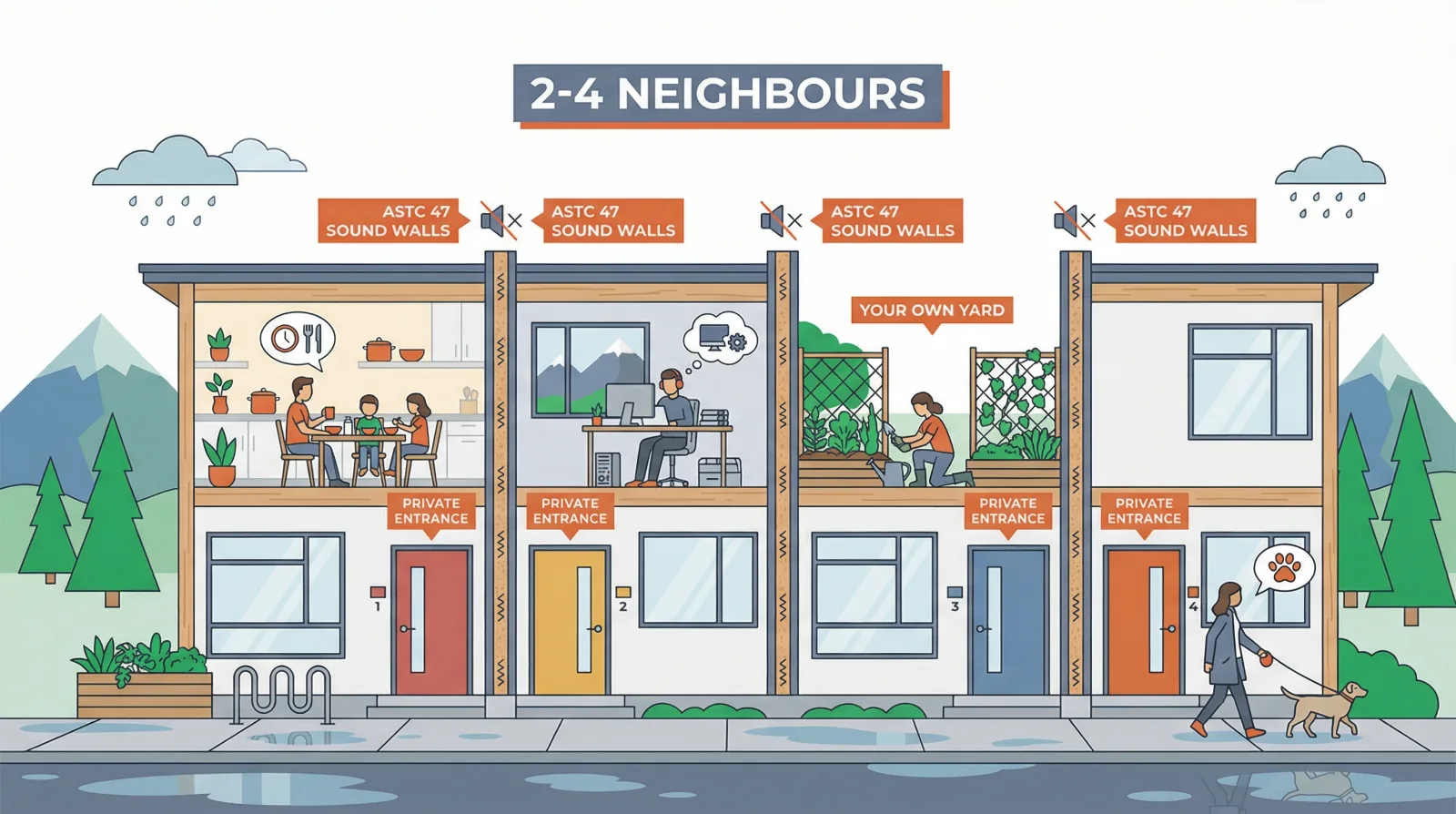
Shared walls, separate front doors, 2-4 neighbours instead of 200. Multiplex living lands somewhere between a condo and a detached home — with real trade-offs on both sides. Here's what the day-to-day actually looks like in Greater Vancouver.
Key Topics
1,000–1,500 sqft Per Unit
A fourplex on Vancouver's standard 33x122-ft lot yields roughly 1,200 sqft per unit at 1.0 FSR. Larger lots or Passivhaus designs with a 1.2 FSR bonus push that higher. One-bedrooms in mixed configurations start around 600 sqft.
ASTC 47 Sound Separation
The BC Building Code requires party walls between dwelling units to hit an Apparent Sound Transmission Class of 47 — or an STC of 50 with specific flanking provisions. That's noticeably better than older wood-frame apartments.
Strata Governance from Day One
Every strata-titled multiplex is governed by the BC Strata Property Act. In a building with fewer than 4 lots, all owners sit on council automatically — no election needed. You and your neighbours are the board.
EV-Ready by Code
All new residential builds in BC must be 100% EV-ready — that means a Level 2 outlet at every parking space. No strata vote needed. No retrofit. The infrastructure is there on move-in day.
Pets Are a Strata Decision
Standard strata bylaws actually ban pets except aquarium fish. Most new multiplexes amend this before sale, but always check the bylaws. Guide dogs and service dogs are legally exempt from any pet restriction.
Lower Strata Fees Than Condos
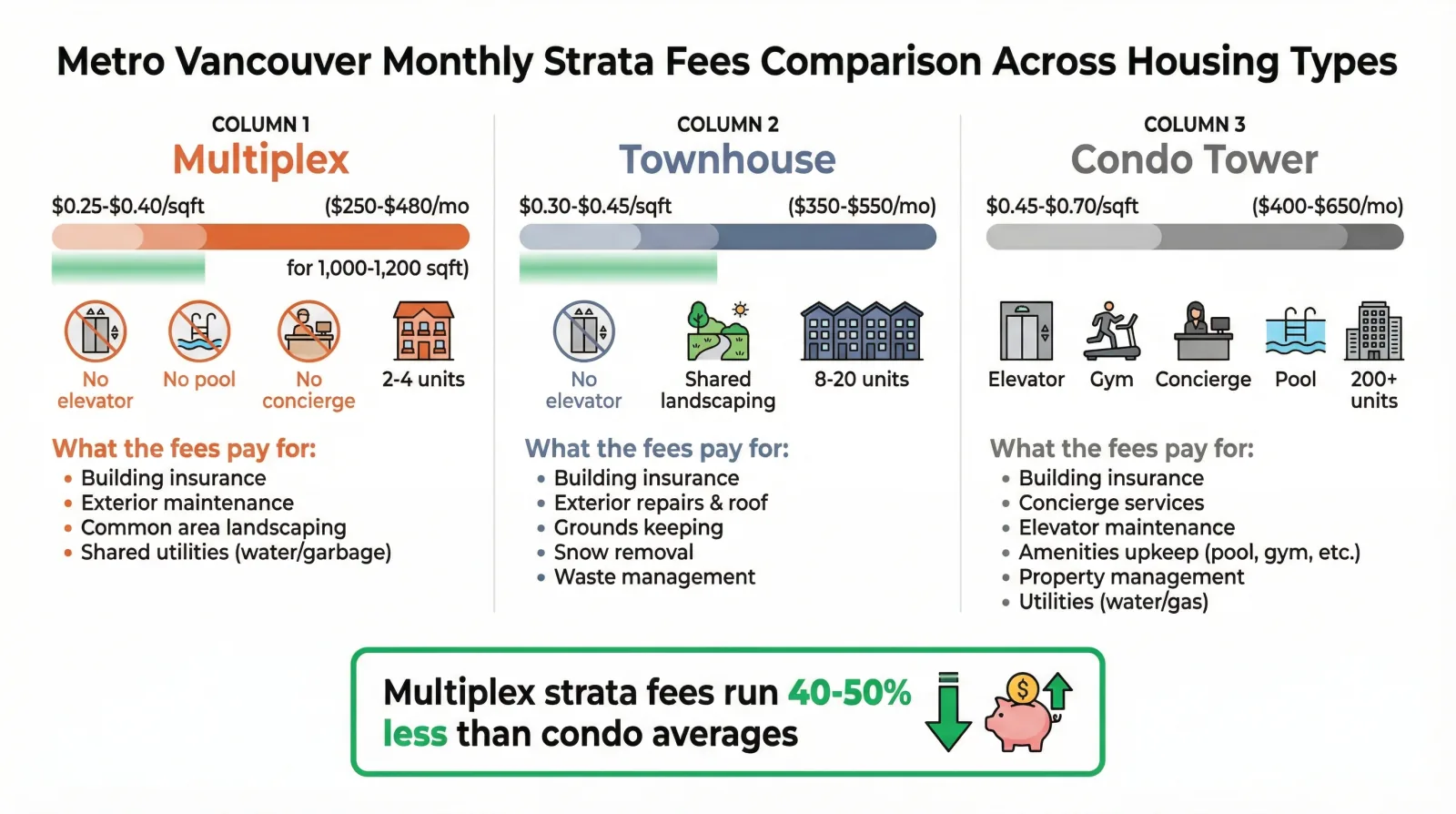
New townhouse-style multiplexes typically run $0.25–$0.40/sqft per month — well below condo averages of $0.45–$0.70/sqft. No elevator, no pool, no concierge. Less shared infrastructure means lower shared costs.
What the Walls Actually Do
The biggest question people ask about shared walls: will I hear my neighbour? Short answer — a lot less than you'd expect in a modern build, but it's not a detached house.
| Sound Metric | New Multiplex | Older Apartment | Detached Home |
|---|---|---|---|
| Party Wall Rating | ASTC 47 / STC 50+ | STC 40–45 typical | N/A — no shared walls |
| Flanking Paths | Code-required mitigation | Usually unaddressed | N/A |
| Impact Noise (footsteps) | Managed via assembly design | Common complaint | N/A |
| Loud Conversation | Generally inaudible | Often audible | N/A |
| TV / Music at Volume | Faint or inaudible | Clearly audible | N/A |
| Code Standard | 2024 BC Building Code | Pre-2015 standards | Part 9 residential |
Sources: BC Building Code 2024, Section 5.8 (Sound Transmission). BKL Consultants acoustics analysis. ASTC 47 measures real-world performance including flanking paths — not just lab-tested partition performance.
What You Actually Pay
Strata fees for new multiplexes run lower than condos — but there are other costs that catch people off guard.
Sources: StrataCalc Metro Vancouver fee averages (2025 update). BC Strata Property Act, s. 93 (contingency reserve fund). Developer-set initial budgets may be lower in year one — the Act penalizes developers if the shortfall exceeds a threshold.
How a 3-Unit Strata Actually Works
Forget what you know about condo strata councils with dozens of owners. In a small multiplex, governance is intimate — and sometimes that's the hard part.
All Owners = The Council
Under the Strata Property Act, if a strata plan has fewer than 4 lots, every single owner sits on the council. No elections, no volunteering — you're on it by default. That means a triplex has a three-person board where each person holds one or more officer roles (president, treasurer, secretary).
Annual General Meetings
You still need formal AGMs. Budgets, bylaw changes, special levies — all the same rules apply as a 200-unit tower. The difference? Your AGM might happen around a kitchen table with two other people. Quorum is typically one-third of eligible voters or the number of council members, whichever is greater.
Bylaws Can Be Amended
The standard bylaws are a starting template. A three-quarter vote at a general meeting can amend almost anything — pet rules, noise restrictions, rental limits, short-term rental bans. With 3 owners, that means you need at least 2 to agree. Changes get filed in the Land Title Office.
Depreciation Reports Required
Even a fourplex needs a depreciation report within the first two years, then updated every five years. As of October 2025, more professionals can now prepare these reports — including architectural technologists — which should bring costs down for small stratas.
Sources: BC Strata Property Act, ss. 25, 26, 93, 94. Gov.bc.ca Strata Councils guide. Changes to depreciation report providers effective October 27, 2025.
Pets, Parking, Tenants & the Rest
| Topic | What the Law Says | What It Means in Practice |
|---|---|---|
| Pets | Standard bylaws ban all pets except fish. Strata can amend by 3/4 vote. Guide/service dogs always exempt. | Most new multiplex developers amend pet bylaws before first sale. Always read the filed bylaws — not the marketing brochure. |
| Renting Your Unit | BC banned rental restriction bylaws in Nov 2022. Stratas cannot limit your right to rent. | You can rent out your unit or a suite. Tenants are governed by the BC Residential Tenancy Act, not strata bylaws directly. |
| Rent Increases | Max increase capped at 3% (2025) and 2.3% (2026), tied to inflation. 3 months written notice required. | If you rent a suite in your multiplex, you're a landlord under the RTA. You must use the RTB portal for all notices as of 2025. |
| Eviction Notice | 4 months notice for landlord-use eviction (up from 2 months). Must genuinely intend to occupy for 12+ months. | This applies if you buy a multiplex with an existing tenant. You can't just issue notice to renovate without RTB approval. |
| EV Charging | All new BC residential builds must be 100% EV-ready — Level 2 outlet at every parking space. | No strata vote needed for new builds. Older stratas need an Electrical Planning Report by late 2026 (Metro Van). |
| Parking | Typically 1 space per unit for new multiplexes. Some Vancouver projects get parking relaxation. | On a standard 33-ft lot, parking is tight. Many fourplexes use tandem spots or a shared driveway. |
Sources: BC Strata Property Act (pet bylaws, rental restrictions removed Nov 2022). BC Residential Tenancy Act (rent cap: Gov.bc.ca 2025, CBC 2026 announcement at 2.3%). BC Hydro EV-ready requirements (Jan 2025). Gov.bc.ca strata EV charging guide.
This guide is part of the MultiLiving Playbook — our complete collection of guides for buying, financing, and living in a multiplex in BC.
The bottom line
Multiplex living gives you something rare in Metro Vancouver: a home with a front door, a yard, and neighbours you actually know — at a price point that works. ASTC 47 sound separation means shared walls are genuinely quiet. EV charging comes built in. And strata fees run 40-50% less than condos because there's no elevator, no pool, and no concierge salary to cover.
The governance model is one of the biggest advantages. In a 3-unit strata, every owner sits on council. Decisions happen over a kitchen table, not through a property management bureaucracy. Questions like fence repairs, insurance deductibles, and short-term rental rules get resolved directly — quickly and personally. For people who want a say in how their building runs, this is ownership at its most hands-on.
If you're renting out a suite, the income is real and predictable: the RTB sets clear rules, and the 2.3% annual rent cap gives tenants stability while you build equity. The sound separation in a 2024 code building is dramatically better than anything built before 2015. And with BC's rental restriction ban, you have full flexibility to rent your unit whenever you choose.
Multiplex living is built for people who want to be both a homeowner and a neighbour in the best sense — connected to their community, in control of their space, and paying less for the privilege. If that sounds like you, talk to our team and we'll help you find the right fit.
Data: BC Building Code 2024, BC Strata Property Act, BC Residential Tenancy Act, StrataCalc 2025, BC Hydro EV-ready requirements, Gov.bc.ca strata guides.
Be first to see new projects coming soon
Get the free Buyer Guide and early access to new multiplex projects in Greater Vancouver, before they're publicly listed.
Key Takeaways
- BC Building Code requires ASTC 47 sound separation between multiplex units.
- Strata fees run $0.25-$0.40/sqft monthly — roughly 40-50% less than condo averages.
- In stratas under 4 units, all owners automatically sit on council with no election.
- BC banned rental restriction bylaws in November 2022 — you can rent your unit freely.
- All new BC residential builds must be 100% EV-ready with Level 2 at every parking space.
Frequently Asked Questions
Can you hear your neighbours in a multiplex?
New BC multiplexes must meet an ASTC 47 sound rating, which significantly reduces audible transfer through party walls. Loud conversation is generally inaudible, and TV or music at volume is faint. It is noticeably better than pre-2015 wood-frame apartments, though not as silent as a detached home.
ASTC 47 is a field-tested rating, not a lab number — it accounts for flanking paths where sound travels around walls through floors, ceilings, and outlets. Older apartments typically hit STC 40-45 in the lab but perform worse once installed. The practical difference is noticeable. You will probably hear a heavy subwoofer or someone dropping something on a hard floor above you. Normal conversation, TV at regular volume, and kitchen noise are generally not an issue. If sound sensitivity is a priority, look for units with party walls that exceed code — some builders spec STC 55+ assemblies. Side-by-side configurations also tend to perform better than stacked units since footfall impact is the hardest noise to block.
How much are strata fees for a multiplex?
New townhouse-style multiplexes in Metro Vancouver typically run $0.25 to $0.40 per square foot per month, or roughly $250 to $480 for a 1,000-1,200 sqft unit. That is well below condo averages of $0.45 to $0.70 per square foot because there is no elevator, pool, or concierge.
Be cautious about year-one budgets set by developers. They are sometimes set artificially low to make the listing more attractive. The BC Strata Property Act requires at least 10% of annual operating costs to go into the contingency reserve fund, and that number needs to reflect actual long-term maintenance. After year one, expect fees to adjust upward by 5-15% once the strata council does its first real budget. Also factor in your own unit's insurance deductible (typically $25,000-$50,000 for water damage in BC) and any special levies for unexpected repairs. The smaller the strata, the bigger each owner's share of any surprise cost — in a fourplex, you are covering 25% of everything.
Can I have pets in a multiplex?
Standard BC strata bylaws ban all pets except aquarium fish. However, most new multiplex developers amend pet bylaws before the first sale. Guide dogs and service dogs are always legally exempt. Always read the filed bylaws at the Land Title Office before purchasing.
Do not rely on the developer's marketing materials — check the actual bylaws filed at the Land Title Office or ask your realtor for a copy. Some developments allow dogs under a weight limit (often 15-25 kg) while others have no restrictions at all. In a small strata, changing pet bylaws after purchase requires a three-quarter vote at a general meeting. With only 3-4 owners, one pet-averse neighbour can block an amendment. If pets are non-negotiable for you, confirm the bylaws in writing before you remove subjects. Also worth knowing: even in stratas that ban pets, the BC Human Rights Code protects emotional support animals with proper documentation from a healthcare provider, in addition to the guide dog exemption.
Who makes decisions in a small strata?
Under the BC Strata Property Act, if a strata plan has fewer than four lots, every owner automatically sits on the council. There are no elections. A triplex has a three-person board handling budgets, bylaws, and maintenance decisions at annual general meetings.
This sounds simple but has real implications. In a 3-unit strata, two owners agreeing on something is already a majority. One owner who disagrees with a maintenance decision or a bylaw change has limited recourse. Personality conflicts become governance problems fast. On the flip side, decision-making is quick — no waiting months for a property management company to schedule a vote among 200 unit holders. You need a formal AGM at least once per year, and you still need to follow proper notice periods and quorum rules. Many small stratas skip hiring a property manager to save costs, which works fine until a dispute arises. Budget $1,500-$3,000 annually if you do want professional management for a 3-4 unit building.
What's it actually like living next to your tenants?
It depends entirely on the building design and your boundaries. Separate entrances, separate utilities, and STC 50 party walls make a huge difference. You will still hear your neighbours sometimes — doors closing, footsteps on stairs — but it is manageable if you set expectations early.
The people who do this well treat it like a business relationship from day one. Separate entrances are non-negotiable — if you share a front door or a hallway, the landlord-tenant boundary gets blurry fast. Most new multiplexes are designed with fully separate entries, which helps enormously. Sound-wise, STC 50 walls block normal conversation and most TV noise, but you will hear impact sounds like footsteps on hard floors or a heavy door closing. If your tenant has a subwoofer, you will know about it. Set ground rules in the lease about quiet hours and hard flooring. The biggest adjustment is psychological, not physical. You will see your tenant taking out the garbage. You will know when they have guests over. Some people find this comforting — you know who is in your building. Others find it claustrophobic. Be honest with yourself about which camp you fall into before you buy. The financial upside is real, but not everyone is wired to be a live-in landlord.
How do you handle strata decisions when there are only 3-4 owners?
Every owner sits on council automatically in stratas under 4 lots. Decisions happen fast — no property management bureaucracy — but disagreements get personal quickly. A 3/4 vote is needed for bylaw changes, which means one holdout in a fourplex can block almost anything.
Small strata governance is the most under-discussed aspect of multiplex ownership. In a triplex, two owners agreeing is a majority. In a fourplex, you need three out of four for a 3/4 vote on bylaw amendments, special levies, and major maintenance decisions. An even number of owners creates deadlock risk — if two want to repaint the exterior and two do not, nothing happens until someone changes their mind. The BC Strata Property Act provides dispute resolution through the Civil Resolution Tribunal, but that process takes months and costs money. The practical solution is picking your neighbours carefully during the buying process. If you are purchasing pre-sale, attend the developer's events and meet the other buyers. If you are buying resale, ask to meet the strata council before you remove subjects. Budget for professional strata management ($1,500-$3,000/year for a small building) even if you think you do not need it — having a neutral third party handle financials and meeting minutes prevents a lot of interpersonal friction.
Living Articles
More from The Playbook
Why Multiplex
The case for ground-oriented living
ExploreBuying Guide
From discovery to closing
ExploreFinancing
Mortgages, programs & more
ExploreMarket Reports
Data, trends & analysis
ExploreMulti-Gen
Families buying together
ExploreWhere to Buy (Van)
Vancouver neighbourhood data
ExploreWhere to Buy (Burnaby)
Burnaby neighbourhood data
ExploreStrata Guide
Bylaws, governance & ownership
ExploreTalk to a Multiplex Expert
Whether you're buying, building, or exploring your options, our team can help you navigate the process with confidence.
Ready to find your multiplex?
Browse duplexes, triplexes, and fourplexes across Greater Vancouver and BC.