Leaving Your High-Rise for a Multiplex Home
You're paying $480/month in strata fees to share a building with 200+ strangers, using a balcony four months a year, and storing your bike in a locker two floors down. Here's what actually changes when BC condo owners make the move to ground-oriented multiplex living — and who should and shouldn't do it.
Key Topics
Your Own Front Door
Every multiplex unit has a private entrance at grade — no lobbies, no elevators, no shared hallways. That's a different kind of ownership than a condo, where you rent your front door from the strata.
Strata Fees Drop 30–50%
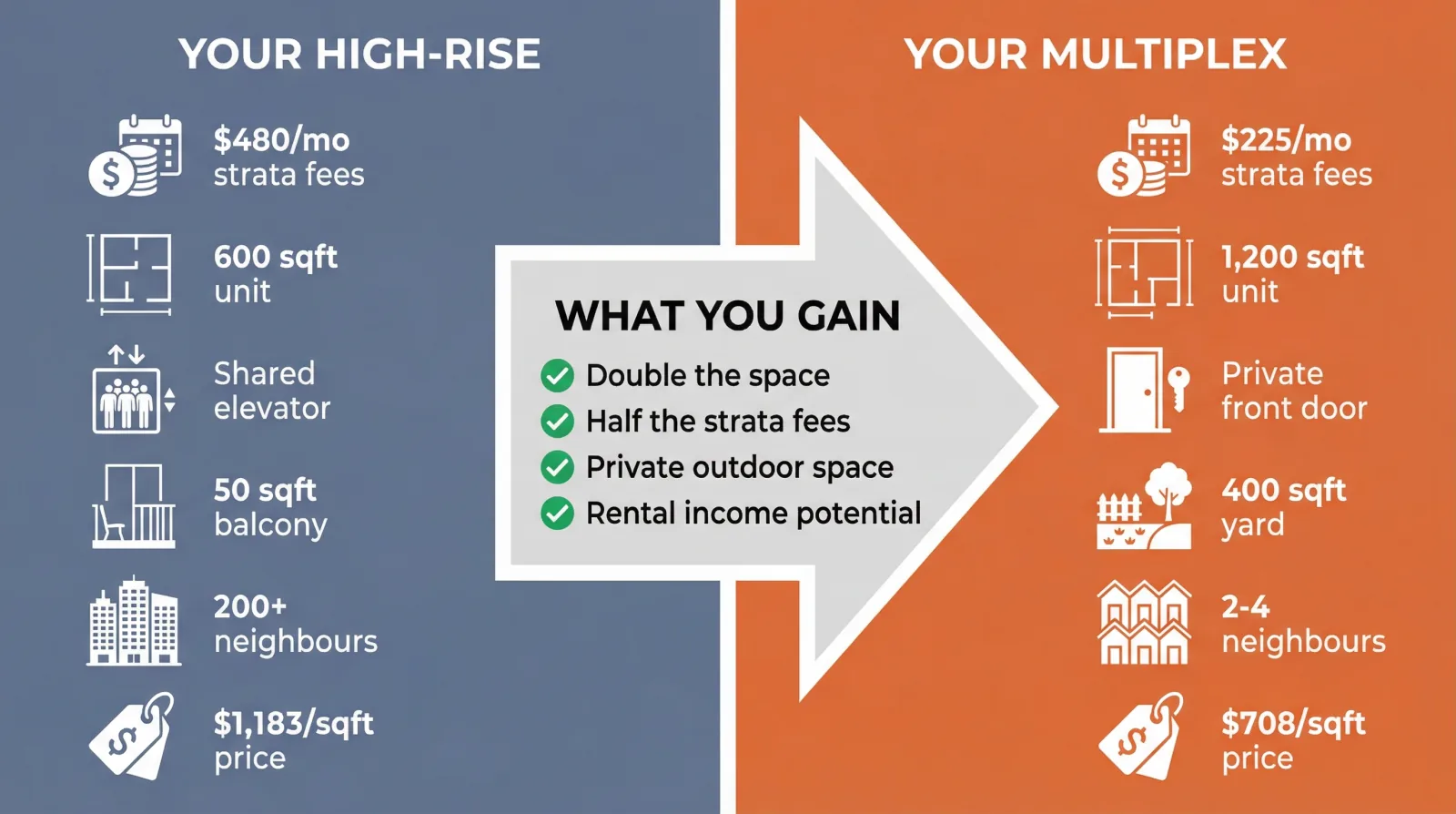
High-rise concrete condos in Metro Vancouver average $480/month in strata fees (stratacalc.ca, 2025). New-build multiplexes with no elevator, no gym, and no concierge run $150–$300/month — the same obligation, far fewer shared systems to maintain.
Outdoor Space You'll Actually Use
A backyard patio or garden plot, not a 6×10 balcony facing another tower. For families with kids, pets, or any interest in growing food, this is the most immediate lifestyle difference.
Less Noise, More Control
High-rise concrete has better sound isolation than wood-frame — that's true. But multiplex construction today uses mass timber and IIC-rated assemblies that meet BC Building Code requirements. You share walls, not ceilings and floors.
2–4 Neighbours Instead of 200
The strata AGM in a duplex is a conversation between two households, not a proxy war between 120 unit owners. Decisions on maintenance, pets, and renovations happen at human scale.
Bill 44 Created the Supply
Since June 2024, BC law requires municipalities to allow 3–4 units on former single-family lots. That's why new multiplex inventory exists at all. Without it, you'd be competing for a handful of older stratas with deferred maintenance.
High-Rise Condo vs Multiplex Unit
Both are strata ownership. That's where the similarity ends. Here's what actually differs day to day.
| Feature | High-Rise Condo | Multiplex Unit |
|---|---|---|
| Avg. strata fee | $400–$650/mo (concrete tower) | $150–$300/mo (new build) |
| Price per sqft | ~$1,100–$1,400/sqft (downtown) | ~$650–$850/sqft (East Van/Burnaby) |
| Outdoor space | 6–10 sqft balcony, shared rooftop | Private yard or patio, 200–600 sqft |
| Parking | 1 stall, sometimes extra $30K–$50K | 1–2 stalls at grade or lane access |
| Noise profile | Ceiling/floor impact noise, elevator hum | Shared walls only, no stacked living |
| Building age | Mix of 1980s–2020s; many aging | Mostly 2024–present under Bill 44 |
| Community scale | 200–400+ units, anonymous | 2–6 households on one lot |
| Pet policy flexibility | Often restricted — weight/breed limits | Strata of 2 can agree to anything |
Sources: stratacalc.ca Average Strata Fees (Aug 2025); REBGV MLS® HPI Dec 2025; BC Building Code STC/IIC requirements; BC Strata Property Act.
What Actually Changes When You Move
The numbers are one thing. The lived experience is another. Here's what shifts — day one and year two.
The elevator is gone
This sounds trivial until you move in. No waiting for a shared elevator with a stroller, a bike, or groceries. No proximity to 200 people's schedules and habits. Your front door opens to the street. You step outside and you're outside — not in a lobby, not in a parkade, not in a hallway that smells faintly of someone else's dinner. For families with kids and people who work from home, the absence of elevator-as-bottleneck is one of the first things they mention when asked what changed.
The strata politics shift completely
In a large strata, decisions on special levies, bylaw changes, and contractor selection often become entrenched conflicts between owner-occupiers and investor landlords who never show up to AGMs. A two-unit duplex strata has exactly two parties. You can resolve a fence dispute over a text message. You can agree to skip strata fees for one month to cover an unexpected repair without a formal vote. The BC Strata Property Act applies to both, but the practical governance of a two-household building is categorically different from a 200-unit tower.
Outdoor space is genuinely usable
The average high-rise balcony in Metro Vancouver is 50–80 sqft and faces another building. It's fine for a morning coffee. A ground-level multiplex patio or yard — typically 200–600 sqft — is somewhere you can actually put a table, chairs, a BBQ, and a garden bed. In BC's climate, that's usable from April through October. For households with dogs, kids, or any interest in cooking outdoors, the difference is not marginal. It's the reason people move.
Sound is different, not necessarily better
High-rise concrete construction absorbs airborne sound exceptionally well. You rarely hear neighbours talking through concrete walls. What you do hear is impact noise — footsteps, dropped objects, furniture scraping — transmitted through the building structure. In wood-frame multiplexes, airborne sound transmission through shared walls is more noticeable, particularly for voices and music. What you gain is the absence of ceiling-impact noise from the unit above. The trade depends entirely on your neighbours and your own noise profile. There's no objective winner; there are different failure modes.
Four Profiles, One Decision
Most people don't plan to leave their condo — something changes. Here are the four triggers we see most often.
The Growing Family
“Second kid on the way, no backyard”
A 700 sqft condo worked fine for two adults and a dog. It stops working fast when a toddler and infant share one bedroom. The elevator, the stroller storage, the no-running-in-the-hallway problem — at some point the math changes. A multiplex unit at 1,100–1,400 sqft with a private backyard is roughly the same purchase price as upsizing to a larger condo in the same neighbourhood, but the outdoor space is genuinely usable and the strata fees are roughly half. For families who want to stay in Metro Vancouver and aren't ready to move to a detached house in the suburbs, a ground-oriented multiplex is the missing middle option that Bill 44 finally made available.
The Remote Worker
“Needs a home office that doesn't face a neighbour's window”
When your office is 4 feet from your bedroom and your Zoom background is the building across the alley, the calculus changes. Multiplex units typically offer an extra bedroom that functions as a real office, lane-facing aspect for privacy, and the ability to step outside without an elevator ride. The 2020–2022 remote work shift pushed a lot of condo owners to start looking at ground-oriented options — that trend has not fully reversed. A dedicated room, a back patio, and the ability to walk to a park without entering a lobby are quality-of-life upgrades that many remote workers are willing to pay a price premium for.
The Downsizer
“Selling a big house, not interested in a tower”
Plenty of people leaving a 2,500 sqft detached home don't want to land in a 38th-floor box. A single-level multiplex unit with a garden patio, two bedrooms, and a lock-and-leave lifestyle hits a different note. You're still on the ground, still have outdoor space, still have a front door. You just don't have a furnace to service, a leaky roof to repair, or 3,000 sqft of weekend maintenance. The strata handles exterior upkeep. For retirees or empty nesters who want to stay in their neighbourhood without a full house to manage, a ground-floor duplex or triplex unit is often the right size and the right structure.
The Investor-Owner
“Wants to own and rent in the same building”
Live in one unit, rent the others. CMHC's 2025 rental market data shows average 2BR purpose-built rents in Vancouver at $2,363/month. On a fourplex, that's potentially $7,089/month from three rental units — which offsets the mortgage significantly. CMHC allows lenders to count 50% of projected rental income toward mortgage qualification, so on a three-unit rental income that's $3,545/month added to your qualifying income. The strata fees on a four-unit building are shared four ways, the building is new under warranty, and the property tax is assessed as residential. For buyers who are comfortable being landlords and want to build equity while offsetting costs, this model is hard to replicate in a high-rise condo.
Monthly Cost of Ownership: Side by Side
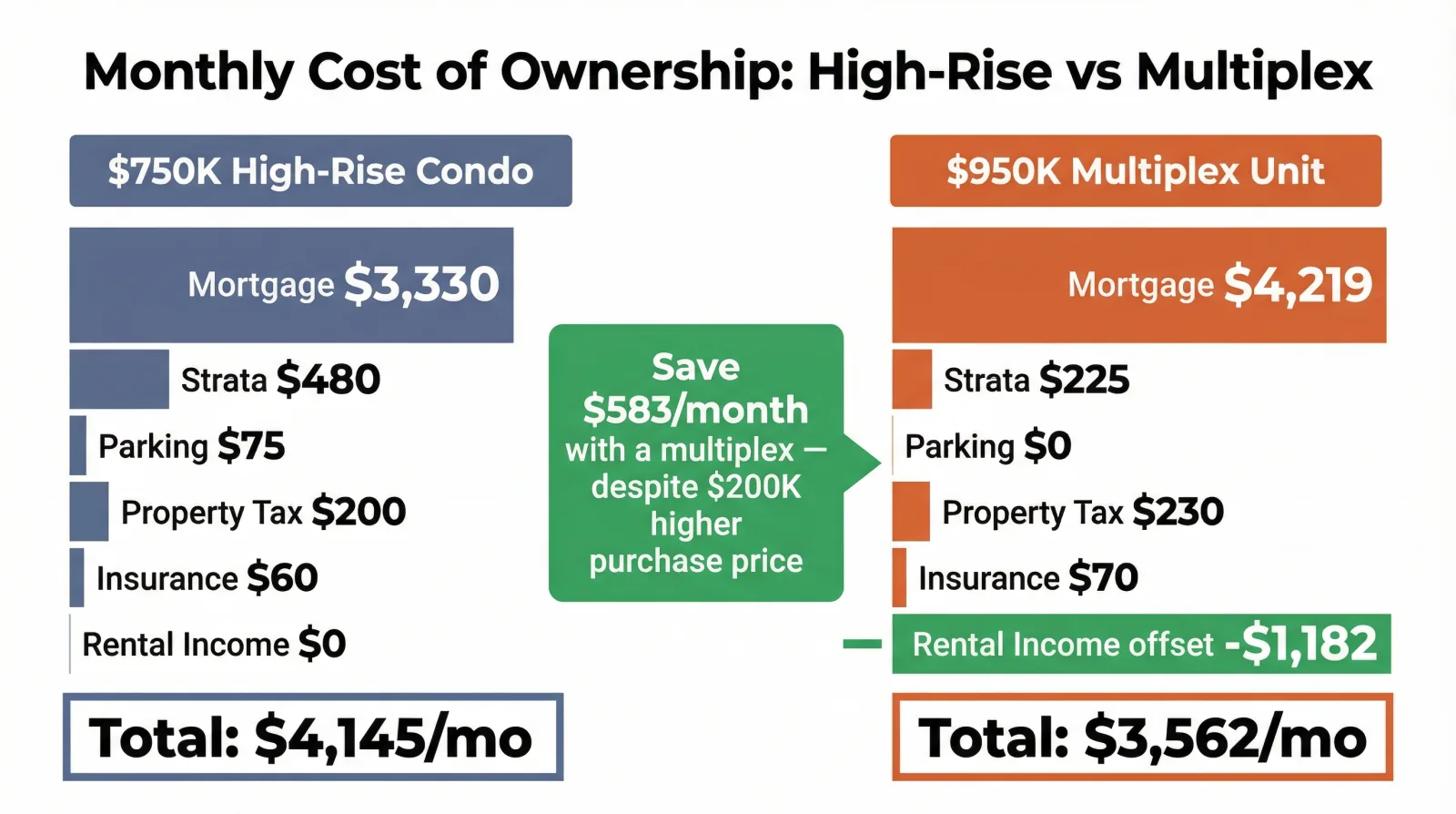
A $750K high-rise condo vs a $950K multiplex unit — same buyer, same 20% down, 25-year amortization at 5.2% (typical posted 5-year fixed, Q1 2026).
$750K High-Rise Condo
~600 sqft, concrete tower, downtown/Burrard
$950K Multiplex Unit
~1,200 sqft, new build, East Van/Burnaby
The multiplex costs $583/month less to carry — despite costing $200K more to buy.
Assumes one adjacent unit rented at $2,363/month (CMHC 2025 Vancouver 2BR average). Lender counts 50% of rental income toward qualification. Actual returns depend on vacancy, tenant mix, and lender policy. Not financial advice — model the numbers with your own mortgage broker before deciding.
Sources: Mortgage at 5.2% posted 5-yr fixed, 25yr amortization, 20% down. High-rise strata from stratacalc.ca (2025). Multiplex strata estimated from comparable new-build small stratas. Rental income from CMHC Rental Market Report 2025 (Vancouver 2BR purpose-built average: $2,363/month).
This guide is part of the MultiLiving Playbook — our complete collection of guides for buying, financing, and living in a multiplex in BC.
The bottom line
The numbers tell a compelling story. A multiplex unit costs $583/month less to carry than a comparable high-rise condo — despite a higher purchase price — thanks to strata fees that run 30-50% lower and rental income that offsets your mortgage. At ~$708/sqft versus ~$1,183/sqft for a high-rise, you get nearly double the space per dollar, plus a private entrance, a real yard, and 2-4 neighbours instead of 200.
What makes this moment different is supply. Before Bill 44 came into effect in June 2024, new-build multiplex inventory in Metro Vancouver barely existed. Now it does, and the options are growing every month. A buyer who had no viable ground-oriented choice in 2022 has real options in 2026 — new construction, modern sound separation, EV-ready infrastructure, and strata governance at human scale.
For growing families, remote workers, downsizers, and investor-owners, the multiplex is the housing form that matches how you actually live. More space, lower carrying costs, outdoor access from day one, and the ability to build equity through rental income. The high-rise served its purpose — but if you've been waiting for something better to come along, it's here.
Ready to explore what's available? Talk to our team — we help condo owners navigate the transition and find the right multiplex for their next chapter.
Data: stratacalc.ca (2025), CMHC Rental Market Report (2025), REBGV MLS® HPI (Dec 2025), BC Bill 44 (effective June 2024).
Be first to see new projects coming soon
Get the free Buyer Guide and early access to new multiplex projects in Greater Vancouver, before they're publicly listed.
Key Takeaways
- High-rise concrete strata fees average $480/month in Vancouver — 50–100% more than new multiplex stratas.
- Multiplex units price at ~$708/sqft vs ~$1,183/sqft for a comparable high-rise condo.
- Ground-level living adds outdoor space, private entrance, and direct street access without an elevator.
- Multiplex stratas are 2–6 households — decisions are faster, disputes are rarer, reserves are simpler.
- Bill 44 (June 2024) unlocked new multiplex supply across BC — this inventory didn't exist three years ago.
- Who should NOT move: people who rely on building amenities, need 24/7 concierge, or want city views.
Frequently Asked Questions
Is buying a multiplex cheaper than staying in a high-rise condo in Vancouver?
The purchase price is usually higher, but the monthly cost of ownership is often lower. High-rise strata fees average $480/month in Vancouver (stratacalc.ca, 2025). A comparable new-build multiplex strata runs $150–$300/month — a saving of $180–$330 every month.
The full picture requires looking beyond the purchase price. A $950K multiplex unit compared to a $750K high-rise condo seems like a worse deal until you account for monthly carrying costs. The high-rise buyer pays $480/month in strata fees for a building with elevators, gym, concierge, and a reserve fund built for a 30-storey structure. The multiplex owner pays $150–$300/month for a four-unit building where the shared costs are a roof, a lane, and an insurance policy. Over a 25-year mortgage, that $200–$330/month difference compounds to $60,000–$99,000 in savings — before accounting for the rental income offset that multiplex owners can use in mortgage qualification. CMHC allows lenders to count 50% of projected rental income from non-owner units, which on a fourplex with three rental units at $2,363/month (CMHC 2025 Vancouver 2BR average) adds $3,545/month in qualifying income to your application. That's not a minor adjustment — it's the difference between qualifying and not qualifying for many buyers.
What do you give up when you leave a high-rise for a multiplex?
You lose building amenities: gym, rooftop, concierge, and city views. High-rise concrete also has better airborne sound isolation than wood-frame. If you rely on the gym or commute downtown on foot, factor those trade-offs in before you move.
The amenity loss is real and underestimated by people who have never lived without it. A high-rise gym you use three times a week is worth roughly $60–$120/month in foregone gym membership. A concierge who accepts packages matters if you buy online constantly or travel frequently. City views from a 25th floor are not replaceable with a garden. These aren't superficial conveniences — for a certain buyer profile, they're the reason the high-rise was purchased in the first place. On the acoustic side, concrete construction genuinely does perform better on airborne sound transmission than wood-frame. A concrete tower between you and a loud neighbour absorbs more than a wood-stud wall. That said, modern wood-frame multiplexes built to BC Building Code meet minimum STC and IIC ratings, and shared-wall construction (as opposed to stacked floors and ceilings) eliminates the ceiling-impact-noise problem that plagues many high-rise owners. You'll still hear a neighbour who plays guitar at 11pm through a shared wall. You won't hear footsteps from above. The trade is contextual.
How do multiplex strata fees compare to high-rise condo fees in BC?
High-rise concrete condos in Metro Vancouver cost $0.55–$0.70/sqft in strata fees — roughly $480/month for a 750 sqft unit (stratacalc.ca, 2025). New multiplex stratas with no elevator or amenities typically run $150–$300/month regardless of unit size.
The fee gap comes down to what you're collectively maintaining. A 30-storey concrete tower has elevators serviced quarterly, a commercial boiler, a gym with equipment, underground parking with ventilation systems, a concierge desk staffed 16 hours a day, and a contingency reserve fund calculated over a 40-year building lifecycle. The strata fees pay for all of it — typically $0.55–$0.70 per square foot per month, which on a 750 sqft unit is $413–$525/month. A four-unit wood-frame multiplex built in 2025 has a roof, exterior cladding, a shared lane, landscaping, and an insurance policy. The strata fees cover those items plus contributions to a much smaller contingency reserve. Even a generous reserve contribution on a $3M four-unit building runs $300–$400/month total — split four ways, that's $75–$100/unit. Add insurance and a property manager and you're at $150–$250/month per unit. That said, older multiplexes — wood-frame buildings from the 1970s and 1980s — can carry strata fees comparable to newer high-rises if deferred maintenance has accumulated. The age of the building matters more than the building type when evaluating fees.
How long does it take to buy a multiplex in BC after deciding to move?
Resale multiplexes close in 30–90 days like any strata purchase. Pre-sale units require a 15–20% deposit on signing and close when construction completes — typically 12–18 months after. Factor in 30–60 days to find and negotiate the right unit.
The timeline differs significantly between resale and pre-sale. A resale multiplex moves like any other strata property: you find it, make an offer with a subject removal period of 5–10 business days for inspection and financing, then close 30–60 days later. The process is familiar to anyone who has bought a condo. Pre-sale is more complex. You're contracting to buy a unit that doesn't exist yet — you review the disclosure statement, sign the contract, and pay an initial deposit (typically 5–10%). The developer collects additional deposits at construction milestones (another 5–10% each), and the full purchase completes when the building receives its occupancy permit. Construction timelines in Metro Vancouver for multiplex projects are running 12–18 months from permit issuance, but permit delays add time before that clock starts. Budget a realistic 18–24 months from contract signing to possession on a new pre-sale multiplex. One practical note: REDMA (the Real Estate Development Marketing Act) gives pre-sale buyers a 7-day rescission period after receiving the disclosure statement with no financial penalty. That cooling-off window doesn't exist in the same form for resale — the 3-business-day rescission on resale costs 0.25% of the purchase price if exercised.
More from The Playbook
Why Multiplex
The case for ground-oriented living
ExploreBuying Guide
From discovery to closing
ExploreFinancing
Mortgages, programs & more
ExploreMarket Reports
Data, trends & analysis
ExploreLiving
What ownership looks like
ExploreMulti-Gen
Families buying together
ExploreWhere to Buy (Van)
Vancouver neighbourhood data
ExploreWhere to Buy (Burnaby)
Burnaby neighbourhood data
ExploreStrata Guide
Bylaws, governance & ownership
ExploreTalk to a Multiplex Expert
Whether you're buying, building, or exploring your options, our team can help you navigate the process with confidence.
Ready to find your multiplex?
Browse duplexes, triplexes, and fourplexes across Greater Vancouver and BC.