Heritage Houses & Multiplex Conversion
Vancouver has roughly 12,000 pre-1940 character homes. About 600 get demolished every year. The city's own policy gives builders 0.85 FSR for retaining a character home — and 1.0 FSR for tearing it down. Here's what buyers and builders need to know about heritage conversions, retention incentives, and the real math behind keeping (or losing) these homes.
Key Topics
Character Home Defined
The City of Vancouver defines a character home as a single-detached house built before 1940 with original massing, roof form, front porch, cladding, and decorative details still intact. About 12,000 meet this criteria citywide.
The FSR Gap Problem
Retain a pre-1940 home with infill and you get 0.85 FSR. Demolish it and build a new multiplex and you get 1.0 FSR. That 15% density gap means builders often make more money tearing down than preserving.
Conversion Options
Character homes can be converted to multiple units (0.75 FSR), kept as a single with a suite (0.65 FSR), or retained with an infill building behind (0.85 FSR). Heritage Revitalization Agreements can unlock even more.
Heritage Revitalization Agreements
An HRA is a legal deal between the owner and the City: you restore and protect the heritage features, and the City varies density, use, and siting rules beyond what zoning normally allows. Powerful but slow.
Renovation vs. Rebuild Costs
Mid-range renovation runs $150-$300/sqft in Vancouver. A full demolish-and-rebuild is $250-$500/sqft plus $10K-$25K for demolition. Conversion falls somewhere in between, depending on structural condition.
Permit Timeline Reality
Standard multiplex permits average 6+ months in Vancouver. Heritage conversions with an HRA can take 12-18 months due to the negotiation process and public hearing requirements. Budget your timeline accordingly.
Retain vs. Demolish: What the Numbers Say
Vancouver's R1-1 zoning creates two distinct paths for pre-1940 character home lots. The density gap between them drives most demolition decisions.
| Factor | Retain Character Home | Demolish & Rebuild |
|---|---|---|
| Max FSR | 0.85 (with infill) | 1.0 (standard multiplex) |
| Buildable Area (4,000 sqft lot) | ~3,400 sqft total | ~4,000 sqft total |
| Max Units | 2-3 in home + infill units | Up to 6 strata / 8 rental |
| Permit Complexity | Higher — heritage review required | Standard multiplex permit |
| Avg. Permit Timeline | 8-18 months (with HRA) | 6-8 months |
| Construction Cost/sqft | $150-$400 (renovation) | $250-$500 (new build) |
| Heritage Incentives | Eligible for HRA, density bonus | None — standard R1-1 rules |
| Neighbourhood Character | Preserved | New construction replaces existing |
Sources: City of Vancouver R1-1 zoning guidelines (2025), Character Home Retention Incentives Program, Walker General Contractors renovation cost data (2025).
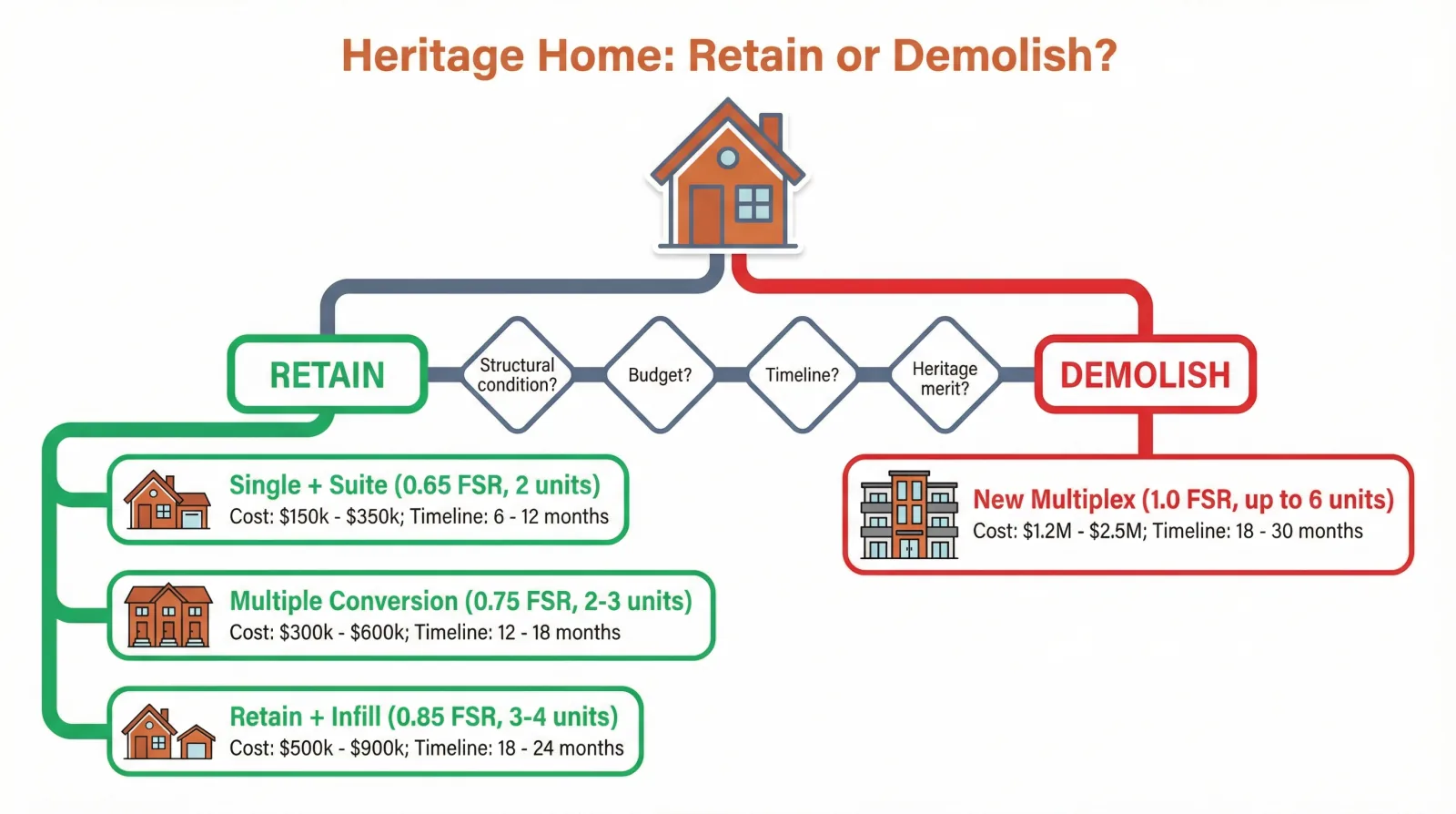
Four Paths for a Character Home Lot
Each path trades off density, cost, timeline, and heritage preservation differently. The right choice depends on the home's condition, your budget, and what you want to live in.
Single + Suite Retention
Keep the character home, add a secondary suite inside or below. Lowest density but simplest permit path. Good for owner-occupiers who want rental income from one suite without a major renovation.
Multiple Conversion
Internally convert the character home into multiple dwelling units. Requires significant renovation — reconfiguring layouts, adding kitchens, separate entrances — while keeping the exterior largely intact.
Retain + Infill
Keep the character home at the front of the lot and build a new infill structure behind it. This is the City's preferred retention pathway — it maximizes density while preserving street-facing heritage character.
Demolish + New Multiplex
Tear down the character home and build a purpose-built multiplex from scratch. Maximum density, modern building code compliance, no heritage constraints. This is the path most builders take — and the one heritage advocates want to see disincentivized.
Sources: City of Vancouver Character Home Retention Incentives Program, R1-1 zoning guidelines (March 2025), Shape Your City FAQ.
Cost Comparison: Convert vs. Demolish
Estimated costs for a typical 33' x 120' Vancouver lot with an existing 2,500 sqft pre-1940 character home. These are ballpark ranges — actual costs vary significantly by condition.
Heritage Conversion Path
Demolish & Rebuild Path
Sources: Walker General Contractors (2025), Odima Construction rebuild guide (2025), Elevation Vancouver renovation cost data (2025). Ranges reflect mid-to-high-end finishes. Heritage-specific costs from Vancouver Heritage Foundation estimates.
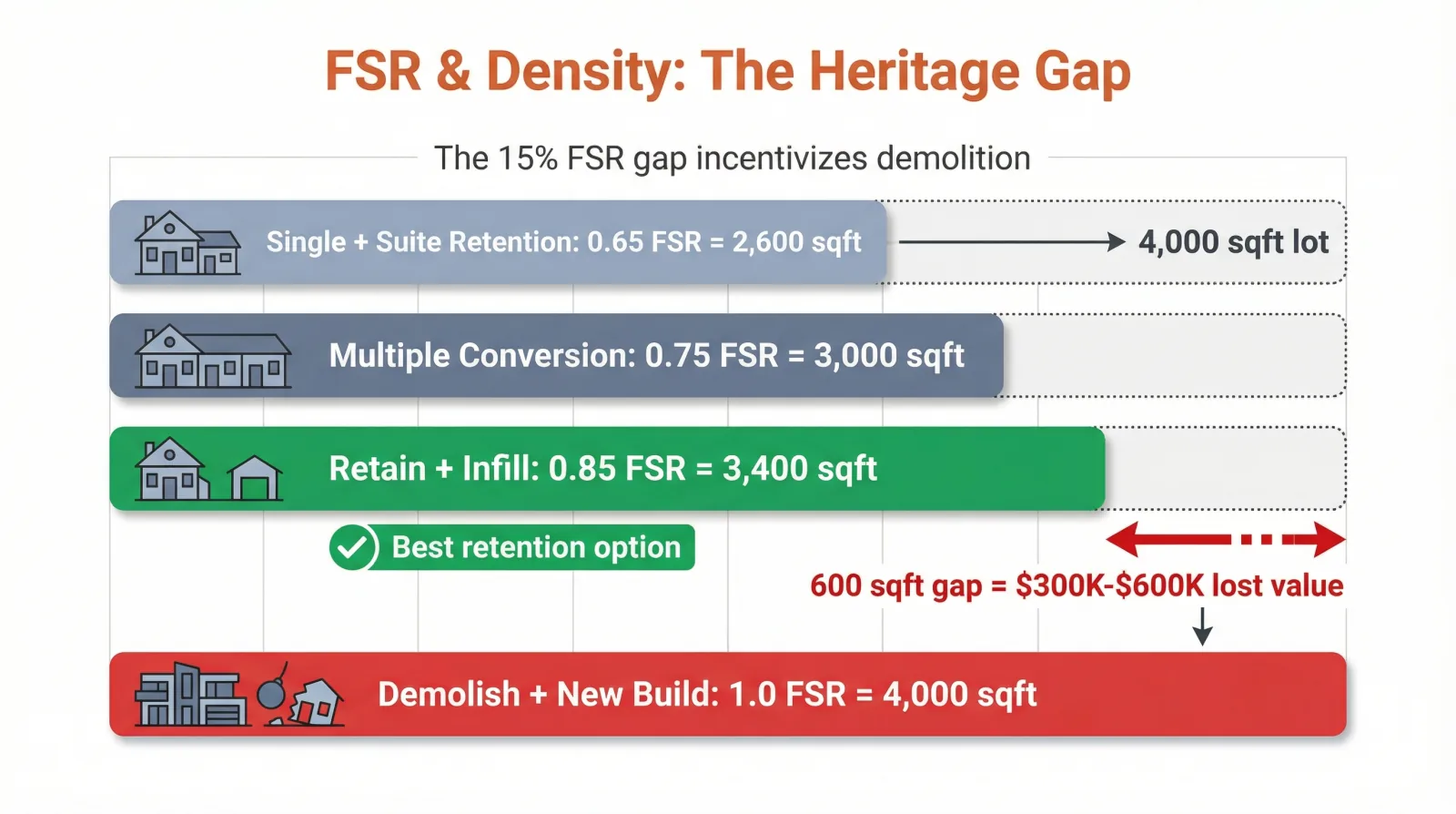
Why the FSR Gap Kills Heritage Homes
On a standard 4,000 sqft Vancouver lot, the difference between 0.85 and 1.0 FSR is 600 sqft of buildable area. At current new-build pricing, that gap is worth real money.
Baseline — what you get for preserving the character home
The extra buildable area gained by demolishing — at $500-$1,000/sqft sale price, this gap is worth hundreds of thousands
What builders get for tearing down — plus simpler permits, modern code compliance, no heritage constraints
The quiet part out loud: On paper, Vancouver's Character Home Retention Incentives encourage preservation. In practice, the 15% FSR gap between retention (0.85) and demolition (1.0) creates a six-figure financial incentive to tear down heritage homes. Storeys reported that heritage experts say City policies “encourage character house teardowns” — and the numbers back it up. About 600 homes are demolished per year, with at least two-thirds built before 1940.
Sources: Storeys, “Vancouver Policies Encourage Character House Teardowns” (2025). Mountain Doodles, “Multiplex reforms — the details matter” (Aug 2025). City of Vancouver R1-1 memo (May 2025).
Vancouver's Demolition Trend
The bottom line
Heritage multiplex conversions represent one of the most exciting opportunities in Vancouver real estate right now. Bill 44 unlocked the density that makes these projects viable, and a well-converted character home on a multiplex lot is genuinely special — original fir floors, period millwork, craftsman porches with a warmth and texture that no new-build can replicate. Converted character homes with heritage features are commanding premium per-square-foot prices from buyers who value authenticity.
The Heritage Revitalization Agreement path is the standout opportunity here. It can unlock density that exceeds even the demolish-and-rebuild option — more liveable space, more units, and a finished product that stands out in the market. Builders with 1.0 FSR for demolition get raw square footage; builders who retain character homes through an HRA can get even more, plus a distinctive product that buyers are willing to pay a premium for.
Success comes down to working with the right team. Renovation variables — asbestos abatement, knob-and-tube rewiring, foundation work — are all manageable with experienced trades and a realistic budget. Permit timelines for heritage work can stretch to 18 months, so plan accordingly. Researcher Jens von Bergmann has documented how implementation details produce different outcomes, and Heritage Vancouver's 2024 Endangered Watch List underscores how much opportunity exists for builders who choose retention over demolition.
The builders who are getting heritage conversions right are creating some of the most desirable homes in Kitsilano, Mount Pleasant, and East Vancouver. If you're interested in owning a piece of Vancouver's architectural history reimagined for modern living, talk to our team — we track every heritage conversion project in the city and can connect you with the right opportunities. You'll also find related guides in our Playbook.
Data: Heritage Vancouver 2024 Watch List, Storeys character home analysis, Mountain Doodles multiplex reform research (Aug 2025), City of Vancouver R1-1 memo (May 2025), ConstructConnect Metro Vancouver demolition statistics.
Be first to see new projects coming soon
Get the free Buyer Guide and early access to new multiplex projects in Greater Vancouver, before they're publicly listed.
Key Takeaways
- Vancouver gives 0.85 FSR for retaining a character home but 1.0 FSR for demolishing it.
- About 12,000 pre-1940 character homes remain in Vancouver, with ~600 demolished yearly.
- Heritage Revitalization Agreements can unlock density beyond standard zoning limits.
- Renovation costs $150-$300/sqft vs. demolish-rebuild at $250-$500/sqft in Vancouver.
- Heritage Vancouver listed character homes on its 2024 Top 10 Endangered Watch List.
- Bill 44 does not override municipal heritage designations but limits how cities use them.
Frequently Asked Questions
Can you convert a heritage house into a multiplex in Vancouver?
Yes. Under Vancouver's R1-1 zoning, pre-1940 character homes can be converted into multiple dwelling units at 0.75 FSR, or retained alongside a new infill building at 0.85 FSR. A Heritage Revitalization Agreement can unlock additional density beyond those limits.
The conversion path depends on the home's structural condition and heritage merit. A character home in good shape can be internally reconfigured into two or three units while preserving the exterior. The City's Character Home Retention Incentives Program provides the density bonus as a reward for keeping the original massing, roof form, and front porch intact. If you go the HRA route, you negotiate directly with the City — agreeing to restore specific heritage features in exchange for custom density, use, and siting relaxations. The HRA process requires a public hearing and typically adds 6-12 months to your timeline, but the density upside can be substantial. For example, the Hotel Georgia HRA granted 5.81 FSR in bonus density to compensate for restoration costs. Residential projects won't see that scale, but the principle applies: the City trades density for preservation.
Why are character homes still being demolished in Vancouver?
The primary driver is a density gap in current policy. Demolishing a pre-1940 home and building a new multiplex yields 1.0 FSR, while retaining the character home maxes out at 0.85 FSR. That 15% difference often tips the financial math toward demolition for builders.
Heritage advocates and urban researchers have flagged this as a perverse incentive. Storeys reported that heritage experts say City policies actually encourage character house teardowns — the retention cap of 0.85 FSR plus additional permit complexity makes demolition the easier and more profitable option. Heritage Vancouver placed character homes on its 2024 Top 10 Endangered Watch List specifically because of this dynamic. The City's earlier Character Home Zoning Review attempted to address the problem by proposing to restrict the size of replacement homes as a deterrent to teardowns, but the proposal was shelved after opposition from architects and builders. Meanwhile, roughly 600 homes are demolished per year, with at least two-thirds built before 1940. The net effect: Vancouver's policy intends to preserve character homes but structurally incentivizes their demolition.
What is a Heritage Revitalization Agreement in Vancouver?
An HRA is a legally binding deal between a property owner and the City of Vancouver. The owner agrees to restore and protect heritage features. In return, the City varies zoning rules — allowing more density, different uses, or relaxed setbacks beyond what standard R1-1 zoning permits.
HRAs are the most flexible heritage tool Vancouver has. Unlike standard zoning incentives, which have fixed FSR caps, an HRA is negotiated case by case. The agreement is registered on title and runs with the land, so it binds future owners too. The process involves a formal application, staff review, and a public hearing at Council. Typical timelines run 12-18 months from application to approval. The City has used HRAs on everything from single-family heritage homes to large commercial buildings. For residential properties, the practical upside is that you can often achieve more buildable area than either the retention pathway (0.85 FSR) or the standard multiplex pathway (1.0 FSR) — but you must genuinely restore the heritage building to conservation standards. That means professional heritage assessments, conservation plans, and ongoing maintenance obligations. It's not a shortcut; it's a trade.
Does Bill 44 affect heritage homes in Vancouver?
Bill 44 requires municipalities to allow 3-4 units on former single-family lots, but it does not override formal municipal heritage designations. However, it limits how cities can use heritage tools to block densification, creating tension between heritage preservation and housing supply goals.
The nuance matters. A home that is formally designated on the Vancouver Heritage Register has legal protections that Bill 44 respects — the province explicitly exempted designated heritage properties from mandatory upzoning. But a 'character home' that merely meets the pre-1940 criteria without formal designation has no such protection. It can be demolished and rebuilt as a multiplex under standard R1-1 rules. Heritage Vancouver's 2024 Watch List flagged this gap: the Missing Middle Housing policy and R1-1 zoning make it more appealing to demolish and rebuild than to preserve. The City has responded with retention incentives (the 0.65-0.85 FSR bonuses for keeping character homes), but critics argue the gap between 0.85 FSR for retention and 1.0 FSR for demolition undermines those incentives. First Shaughnessy's Heritage Conservation Area required separate amendments to permit multiplex development on non-heritage lots within the district.
How much does it cost to convert a heritage home into a multiplex?
Conversion costs in Vancouver typically range from $150 to $400 per square foot depending on scope, plus $50K-$150K for heritage-specific work like seismic upgrades, foundation repairs, and exterior restoration. A full project on a 2,500 sqft home might run $500K-$1.2M total.
The spread is wide because every character home is different. A structurally sound 1920s Craftsman with good bones might need $150-$200/sqft for internal reconfiguration into two or three units. A neglected 1910 house with a failing foundation, knob-and-tube wiring, and asbestos siding could easily hit $350-$400/sqft once you factor in seismic upgrades, full rewiring, plumbing replacement, and asbestos abatement. Heritage-specific costs add up fast: a professional heritage assessment runs $5K-$15K, conservation plans $10K-$25K, and the actual restoration of heritage features (original windows, decorative brackets, period-appropriate siding) costs significantly more than modern equivalents. Compare that to a clean demolish-and-rebuild at $250-$500/sqft on a cleared lot with no heritage constraints. The math only favours conversion when the retention FSR bonus and the character of the finished product create enough market value to offset the premium.
How many character homes are left in Vancouver?
The City of Vancouver estimates roughly 12,000 pre-1940 homes with character merit remain citywide. About 600 houses are demolished per year, with at least two-thirds built before 1940. At that pace, thousands more will disappear in the next decade without stronger retention incentives.
The 12,000 figure comes from the City's own Character Home Retention Incentives program, which identified pre-1940 homes meeting character merit criteria including original massing, roof form, porches, cladding, and decorative details. But that number has been shrinking steadily. Nearly 30,000 single-family homes were demolished across Metro Vancouver between 2012 and 2023, according to ConstructConnect data. Vancouver proper accounts for a disproportionate share. Daily Hive reported that demolitions are projected to increase to roughly 750 per year by 2025 and could reach 1,300 per year by 2035 as upzoning policies incentivize redevelopment. Heritage Vancouver and the Vancouver Heritage Foundation have documented the loss extensively, but without binding legal protection — which only formal heritage designation provides — most character homes have no guaranteed future.
More from The Playbook
Why Multiplex
The case for ground-oriented living
ExploreBuying Guide
From discovery to closing
ExploreFinancing
Mortgages, programs & more
ExploreMarket Reports
Data, trends & analysis
ExploreLiving
What ownership looks like
ExploreMulti-Gen
Families buying together
ExploreWhere to Buy (Van)
Vancouver neighbourhood data
ExploreWhere to Buy (Burnaby)
Burnaby neighbourhood data
ExploreStrata Guide
Bylaws, governance & ownership
ExploreTalk to a Multiplex Expert
Whether you're buying, building, or exploring your options, our team can help you navigate the process with confidence.
Ready to find your multiplex?
Browse duplexes, triplexes, and fourplexes across Greater Vancouver and BC.