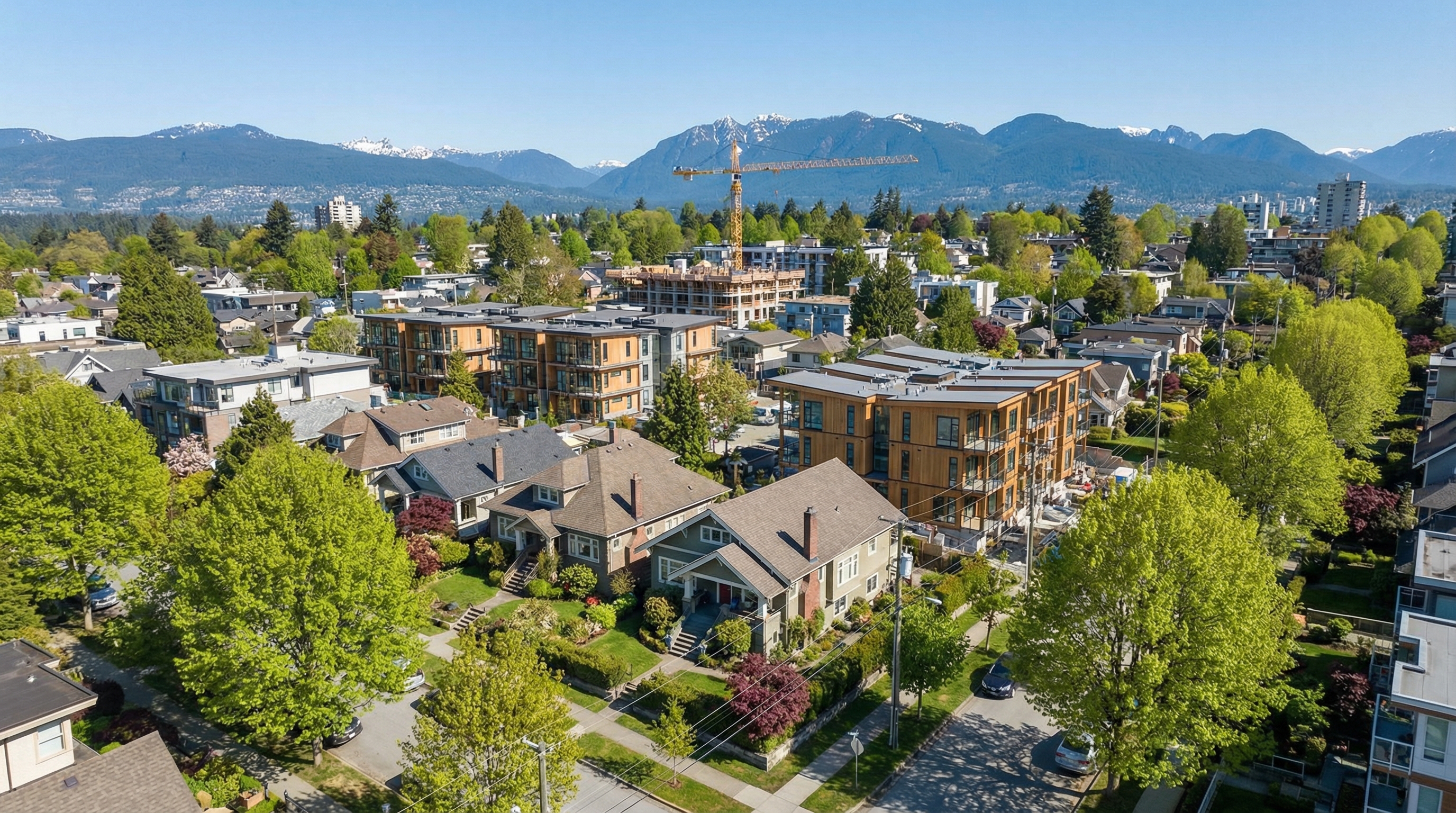
Why Multiplex Sales Are Picking Up Across Greater Vancouver
Multiplex land sales dropped 63% in 2025 — but permit applications surged past 400. Here's what's really happening with BC's multiplex market after Bill 44, and what it means for buyers and developers.
By MultiLiving Editorial · March 28, 2026
The Numbers: From 124 Sales to 46 — and Why That's Not Bad News
Let's start with the headline number that's making people nervous: multiplex land sales in Metro Vancouver dropped from 124 transactions in 2024 to just 46 in 2025, according to CBRE data. Total land value fell from $303 million to $114 million.
That looks like a crash. It isn't.
What happened in 2024 was a land rush. Bill 44 passed in late 2023, and every developer with capital and a site finder started scrambling for lots that suddenly had triple or quadruple their previous development potential. Prices spiked. Competition was fierce. Some buyers paid premiums of 10-20% above what the house alone would justify, banking on the future value of what they could build.
By 2025, the frenzy cooled — and that's healthy. CBRE themselves noted that "the slowdown was both expected and healthy" and that "the initial policy-driven surge has passed, and the market is now transitioning into a more sustainable phase." The people buying multiplex land now are doing it with actual pro formas and construction timelines, not FOMO.
Meanwhile, the building permits tell a different story entirely. Over 400 multiplex permit applications were submitted across Metro Vancouver by late 2025. These are projects moving from land speculation to actual construction. The sales numbers dropped, but the building pipeline grew.
Bill 44 Changed the Rules — Here's What Actually Happened
For anyone who missed it: in November 2023, the BC government passed Bill 44, officially the Housing Statutes Amendment Act. The small-scale multi-unit housing policy required municipalities across BC to update their zoning bylaws to allow:
- 3-4 units on lots in areas served by frequent transit
- Up to 6 units on larger lots near transit hubs
- Secondary suites in most residential zones
The intent was straightforward: unlock "missing middle" housing on single-family lots without waiting for massive rezoning battles. And the municipalities moved — Vancouver, Burnaby, North Vancouver, and most of the Lower Mainland updated their bylaws through 2024.
But implementation hasn't been uniform. According to Business in Vancouver, cities are diverging on key details: Burnaby, for example, requires many multiplex projects to be 100% rental to qualify under their updated bylaws. That single rule completely changes the economics for buyers who want to own a strata unit in a new multiplex — because those units won't exist in Burnaby's pipeline.
Vancouver has been more permissive, allowing both strata and rental multiplexes under its R1-1 zoning updates. The city has also reduced parking requirements for multiplexes near transit, which lowers construction costs and makes projects pencil out on smaller lots.
Where the Action Is: Vancouver, Burnaby, North Van
Not every lot in Greater Vancouver makes sense for a multiplex. The economics favour specific conditions:
- Lot width of 50+ feet — narrower lots (33 feet is standard in East Van) can still work for a triplex, but fourplexes typically need more frontage for the building to function well
- Lot depth of 120+ feet — deeper lots allow for better unit layouts and outdoor space, which matters for the end buyer
- Lane access — rear lanes make construction staging easier and allow for ground-level parking without sacrificing the front setback
- Transit proximity — lots within 400m of frequent transit qualify for higher density under Bill 44, and the reduced parking requirements improve project economics
Vancouver's east side — Renfrew, Hastings-Sunrise, Killarney, Victoria-Fraserview — has the most activity. These neighbourhoods have the right lot sizes, lane access, and relatively lower land costs. You're seeing older bungalows on 50-foot lots being replaced by four-unit buildings.
North Vancouver is interesting because land is scarce, but the demand is strong. Lots near Lonsdale and along Marine Drive are attracting multiplex developers despite higher land costs, because the finished units command premium prices from buyers who want to stay on the North Shore without paying $2.5 million for a detached house.
According to BIV reporting, even Vancouver's high-end west side is feeling the effect — luxury listings are wobbling as multiplex zoning blurs the line between "single-family lot" and "development site." A $3 million property that could become a $5.6 million fourplex project gets valued differently than one that can only hold one house.
The Lending Bottleneck Nobody Talks About
Here's the part of the multiplex story that gets less attention: lenders are still figuring this out.
Building a multiplex is expensive. Construction costs in Metro Vancouver run $350-$450 per square foot, and a four-unit building on a $1.5 million lot can easily require $3-4 million in total project cost. Most developers need construction financing, and most construction lenders require 50% or more in pre-sales before they'll fund the project.
But here's the problem: buyers are hesitant to commit to pre-sale strata multiplex units at premium prices when the product type is still new. They want to see finished examples. They want to tour a unit, not look at renderings. And they want to know what the strata fees will actually be, not what the developer's marketing brochure projects.
This creates a chicken-and-egg situation. Developers can't build without pre-sales. Buyers won't pre-buy without seeing finished product. The result is that many of the 400+ permit applications filed by late 2025 are still sitting — approved but not yet under construction.
The developers who are building successfully tend to be the ones who can self-finance the first phase — either through their own capital or through partnerships that don't require traditional pre-sale thresholds. These early projects become the proof points that unlock the next wave of construction financing.
The Bank of Canada's decision to hold its rate at 2.25% on March 18, 2026 helps, but it doesn't solve the pre-sale challenge. What will help is more completed projects hitting the market — every finished fourplex that sells well makes it easier for the next developer to get financing.
What This Means If You're Buying (or Building)
For Buyers
The opportunity is real but requires patience and homework. New multiplex inventory is still thin — there aren't hundreds of units to choose from. The ones that are available tend to sell through the developer directly rather than hitting MLS, so you need to be plugged into the local multiplex market or work with an agent who is.
Pricing is favourable compared to detached houses. A unit in a new East Vancouver fourplex runs $850K-$1.2M for 1,200+ square feet. That's less than half the price of the detached house that used to sit on the same lot. Owner-occupied buyers can put as little as 5% down on the first $500K of a single unit (10% for a whole 3-4 unit building) with CMHC insurance, and up to 50% of projected rental income from other units counts toward mortgage qualification.
The main risk: you're buying a new product type in a new market. Resale values for multiplex strata units don't have a deep track record yet. If you need to sell in two years, you may not have many comparable sales to support your asking price.
For Developers
The land rush is over, and that's good news — it means you can buy development sites at rational prices instead of bidding wars. Lots that traded at 20% premiums in 2024 are more realistically priced now.
The challenge is still financing. If you can self-fund or partner creatively, you have a window to build the early inventory that the market needs. Finished projects with actual sales data will become the comps that unlock institutional lending for the broader market.
Focus on locations with strong fundamentals: 50+ foot lots, lane access, transit proximity. Build units that buyers actually want to live in — good sound insulation, individual utility metering, private outdoor space, thoughtful layouts. The developers who treat these as homes rather than investment widgets will do better at the sales table.
Key Takeaways
- Multiplex land sales dropped from 124 (2024) to 46 (2025) — reflecting a healthy normalization after the post-Bill 44 rush, not a market decline
- Over 400 multiplex permit applications were submitted by late 2025, showing strong building pipeline growth
- City implementations vary — Burnaby requires many projects to be 100% rental, while Vancouver allows both strata and rental multiplexes
- The biggest bottleneck is lending: 50%+ pre-sale requirements collide with buyer hesitancy to commit to an unproven product type
- Buyers benefit from CMHC's low minimum down payments for owner-occupied multiplexes (from 5% on the first $500K of a single unit) and favourable pricing relative to detached homes
- The Bank of Canada rate holds at 2.25% (March 2026), keeping financing costs well below the 2023 peak
Frequently Asked Questions
Are multiplex sales declining in Vancouver?
Land sales dropped from 124 in 2024 to 46 in 2025, but this reflects normalization after the initial Bill 44 rush, not weakening demand. Building permit applications have grown to 400+ across Metro Vancouver, indicating the market is shifting from land speculation to actual construction.
What did Bill 44 change for multiplex housing in BC?
Bill 44 (2023) required BC municipalities to allow 3-4 units on residential lots near frequent transit, and up to 6 units on larger lots near transit hubs. This unlocked thousands of single-family lots for multiplex development across Greater Vancouver without requiring individual rezoning applications.
Why aren't more multiplexes being built despite the zoning changes?
The primary bottleneck is construction financing. Most lenders require 50%+ pre-sales before funding a project, but buyers are hesitant to commit to pre-sale units in a new product category. Developers who can self-finance are building first, and their completed projects will help unlock lending for the broader market.
Where are the best areas to buy a multiplex unit in Greater Vancouver?
Vancouver's east side (Renfrew, Hastings-Sunrise, Killarney, Victoria-Fraserview) has the most activity due to favourable lot sizes and lower land costs. North Vancouver near Lonsdale is a premium market. Surrey offers the most affordable entry points at $650K-$950K for new multiplex units.