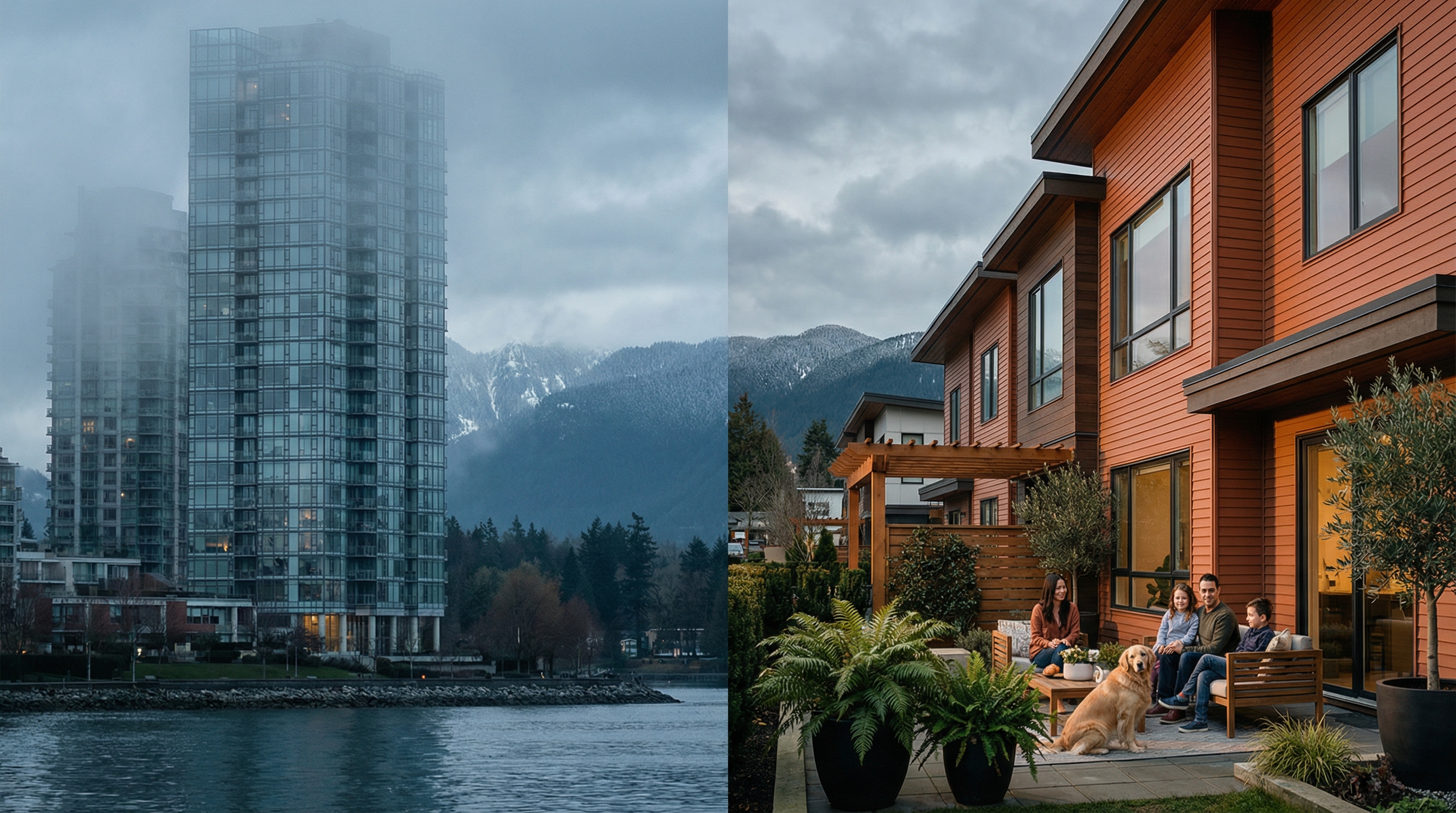
From High-Rise to Multiplex: What the Numbers Show
High-rise strata fees average $480/month. New multiplex stratas run $150–$300. Price per sqft is 30–40% lower. A complete breakdown of the numbers, monthly cost model, who's making the move, what you give up, tax implications, and how the purchase works in BC.
By MultiLiving Lifestyle · March 24, 2026
High-rise condo ownership in Vancouver has a well-worn arc. You buy a 600 sqft unit in your late 20s, enjoy the views, pay $480/month in strata fees, and tell yourself the gym membership built into those fees is worth it. Then something shifts — a second bedroom becomes necessary, a dog enters the picture, or you start working from home and realize your office is also your bedroom, living room, and kitchen.
For most of the past two decades, the only exit from a high-rise was a $3M detached house in East Vancouver or a townhouse development in Langley. Neither worked for the buyer who wanted to stay in the city, keep a reasonable commute, and not spend every weekend on home maintenance. The missing middle — ground-oriented housing priced between a condo and a detached house — simply wasn't available at meaningful scale in Metro Vancouver.
Bill 44, which came into effect in June 2024, changed that calculation. BC municipalities are now required to permit 3–4 units on former single-family lots across the province, and 6 units near frequent transit stops. That policy shift has created real new-build multiplex inventory in Metro Vancouver neighbourhoods where ground-oriented options barely existed before. For the first time, leaving a high-rise doesn't mean sacrificing location or financial sanity.
This article breaks down exactly what changes — financially, practically, and structurally — when BC condo owners make the move to ground-oriented multiplex living.
The Strata Fee Gap: $54,000–$99,000 Over 25 Years
Concrete high-rise condos in Metro Vancouver average $480/month in strata fees, according to stratacalc.ca's 2025 data — roughly $0.55–$0.70 per square foot per month. That money maintains elevators serviced quarterly, a commercial boiler, a gym with equipment, underground parking ventilation systems, a concierge desk staffed 16 hours a day, and a contingency reserve fund calculated over a 40-year building lifecycle. You're also paying for the time of a property management company handling the daily logistics of a 300-unit structure.
A new-build four-unit multiplex strata runs $150–$300/month per unit. The shared costs are a roof, exterior cladding, a lane, landscaping, and an insurance policy. Even a generous reserve contribution on a $3M four-unit building runs $300–$400/month total — split four ways, that's $75–$100/unit. Add insurance and a part-time property manager and you land at $150–$250/month per unit.
The gap — $180 to $330 per month — compounds to $54,000–$99,000 over a 25-year mortgage. That's not a rounding error. For context, $54,000 is roughly a 6–7% down payment on a $900K property. The strata fee savings alone, reinvested, represent meaningful equity.
One important caveat: older multiplexes from the 1970s and 1980s can carry strata fees comparable to newer high-rises if deferred maintenance has accumulated. Rotting wood siding, aging flat roofs, and outdated electrical all generate special levies and inflated reserve fund contributions. Building age matters more than building type when evaluating fees. For new-build multiplexes completed after Bill 44, the fee gap is consistent and reliable.
What High-Rise Fees Actually Pay For
- Elevator maintenance and insurance: Quarterly servicing, annual inspections, liability coverage — typically $15,000–$40,000/year for a tower, shared across all units
- Concierge and security: For buildings with staffed lobbies, this line item alone can run $200,000+/year building-wide
- Gym and amenity upkeep: Equipment replacement, pool chemicals, locker room maintenance — costs that don't exist in a four-unit multiplex
- Property management fees: Typically 4–8% of total strata budget, charged by the management company for administration, owner communication, and maintenance coordination
- Reserve fund contributions: Based on a depreciation report projecting every major component's remaining life — roofs, parkade membranes, pipe replacements
Price Per Square Foot: The 30–40% Gap
REBGV MLS HPI data from December 2025 shows benchmark pricing for high-rise condos in Metro Vancouver running $1,100–$1,400/sqft in downtown-adjacent areas — Coal Harbour, Yaletown, West End, Brentwood. New-build multiplex units in East Vancouver, Burnaby, and Surrey are pricing at $650–$850/sqft. That's a 30–40% discount per square foot, and it compounds with every additional room.
A buyer spending $950K on a multiplex unit in Mount Pleasant or Renfrew-Collingwood gets roughly 1,100–1,400 sqft with a private entrance, a patio, and at-grade parking. The same $950K in a concrete tower buys 700–850 sqft, a shared lobby, and a balcony you'll use four months of the year.
Add a private outdoor area — typically 200–600 sqft in new multiplexes — and the space gap becomes impossible to ignore for families. The average high-rise balcony in Metro Vancouver is 50–80 sqft and faces another building. A ground-level patio is usable from April through October in BC's climate: a table, chairs, a BBQ, a garden bed, a space for kids to play without an elevator ride. For households with children, dogs, or any interest in cooking outdoors, this single difference is what drives the decision.
Neighbourhood Price Benchmarks (December 2025)
- East Vancouver (Hastings-Sunrise, Renfrew): New multiplex units $700–$800/sqft; comparable high-rise condos in Brentwood ~$1,100/sqft
- Burnaby (Metrotown, Edmonds): New multiplex units $650–$780/sqft; Metrotown high-rise benchmark ~$1,050/sqft
- Surrey (Whalley, Guildford): New multiplex units $550–$700/sqft; Surrey Central high-rise ~$850/sqft
- Mount Pleasant / Main Street: Premium ground-oriented units $850–$950/sqft; comparable rental-zone condos ~$1,200/sqft
Source: REBGV MLS HPI benchmarks, December 2025; active listing price analysis.
Monthly Cost of Ownership: The Full Model
Purchase price comparisons only tell half the story. Monthly carrying costs tell the rest. Here's a direct comparison: a $750K high-rise condo versus a $950K multiplex unit. Same buyer, same 20% down payment ($150K vs $190K), 25-year amortization at 5.2% (typical posted 5-year fixed rate, Q1 2026).
$750K High-Rise Condo — Monthly Breakdown
- Mortgage (20% down, 25yr @ 5.2%): $3,330/month
- Strata fee (concrete high-rise average): $480/month
- Parking (if separately billed): $75/month
- Property tax (City of Vancouver estimate): $200/month
- Building insurance (unit only): $60/month
- Rental income offset: $0
- Total: $4,145/month
$950K Multiplex Unit — Monthly Breakdown
- Mortgage (20% down, 25yr @ 5.2%): $4,219/month
- Strata fee (4-unit new-build): $225/month
- Parking (at-grade, included in purchase): $0
- Property tax (estimate): $230/month
- Building insurance (unit only): $70/month
- Rental income offset (50% of $2,363 CMHC avg): −$1,182/month
- Total: $3,562/month
The multiplex costs $583/month less to carry — despite costing $200K more to buy. Over five years, that's $34,980 in saved carrying costs. The rental income offset is the key variable: it only applies if you're open to being a landlord in your own building. If not, the comparison narrows but the strata fee savings still tilt the monthly math toward the multiplex.
Source: Mortgage calculated at 5.2% posted 5-year fixed, 25-year amortization, 20% down. High-rise strata from stratacalc.ca (2025). Multiplex strata estimated from comparable new-build small stratas. Rental income from CMHC Rental Market Report 2025 (Vancouver 2BR purpose-built average: $2,363/month). CMHC underwriting guideline: 50% of rental income from non-owner units counts toward qualifying income.
Who's Making This Move — and Why
Four buyer profiles dominate the high-rise-to-multiplex transition in Metro Vancouver. Each is driven by a specific life-stage trigger, not just financial optimization.
1. Families with Young Children
A 700 sqft condo stops working fast when a toddler and infant share one bedroom. The elevator, the stroller-in-the-lobby problem, the no-running-in-hallways constraint — at some point the friction becomes daily. A multiplex unit at 1,100–1,400 sqft with a private backyard is often the same purchase price as upsizing to a larger condo in the same neighbourhood, but with a yard, half the strata fee, and a front door the kids can open themselves.
For families committed to staying in Metro Vancouver — not moving to Abbotsford or Langley — ground-oriented multiplex units in established neighbourhoods like Kensington-Cedar Cottage, Grandview-Woodland, and Burnaby's Edmonds area are now a realistic option that didn't exist at scale two years ago.
2. Remote Workers Who Need a Real Office
When your office is four feet from your bedroom and your Zoom background is the building across the alley, the calculus shifts. Multiplex units typically offer an extra bedroom functioning as a dedicated office, a lane-facing aspect for visual privacy, and the ability to step outside without an elevator ride. Many remote workers describe the outdoor access as disproportionately valuable — a 10-minute walk to a park without navigating a lobby resets focus in a way a building rooftop doesn't.
The remote work transition of 2020–2022 pushed a significant cohort of condo owners to start looking at ground-oriented options. That cohort hasn't fully moved yet — many are watching the new Bill 44 supply come to market and evaluating timing.
3. Downsizers Leaving Detached Houses
People leaving 2,500 sqft detached homes don't typically want a 38th-floor box. A single-level multiplex unit with a garden patio, two bedrooms, and a lock-and-leave lifestyle occupies a different category. You're still at grade. You still have outdoor space. You still have your own front door. You just don't have a furnace to service, a leaky roof to manage, or 3,000 sqft of weekend maintenance competing with your weekends. The strata handles exterior upkeep; the building is under 2-5-10 new home warranty.
4. Investor-Owners Who Want to Live and Rent in the Same Building
Live in one unit, rent the others. CMHC's 2025 Rental Market Report puts average Vancouver 2BR purpose-built rents at $2,363/month. Three rental units in a fourplex is $7,089/month gross. A lender counts 50% of that — $3,545/month — as qualifying income on your mortgage application. The strata fees are shared four ways, the building is new under warranty, and the property tax is assessed as residential rather than commercial.
This ownership model doesn't have a condo equivalent. You cannot buy one unit in a 300-unit tower and use the rental income from two adjacent units to qualify for a larger mortgage on your owner-occupied unit. The multiplex structure makes the income offset possible in a way that is structurally unavailable in high-rise ownership.
What You're Actually Giving Up — No Sugarcoating
The trade-offs deserve honest treatment because they're real, and underestimating them is how buyers end up dissatisfied.
Acoustic Performance
High-rise concrete construction genuinely does isolate airborne sound better than wood-frame. You'll hear more through shared walls in a multiplex — voices, music, TV — than through the concrete shared between you and a tower neighbour. What you won't hear is impact noise from above: footsteps, dropped items, furniture scraping. The failure modes are different, not absent. If you're a light sleeper or a musician, or if your prospective neighbour is, this trade is worth thinking through before you commit.
Modern wood-frame multiplexes built to BC Building Code meet minimum STC and IIC ratings, and builders increasingly spec acoustic batting and mass timber assemblies that perform above minimums. But concrete is still concrete. The gap is real and context-dependent.
Building Amenities
A high-rise gym you use three times a week is worth $60–$120/month in foregone gym membership. A concierge who accepts packages matters if you travel frequently or receive large deliveries. A rooftop terrace with city views is not replaceable with a garden. These aren't superficial conveniences — for a specific buyer profile, they're the reason the high-rise made sense in the first place. Honest accounting means pricing the loss, not pretending it doesn't exist.
Location and Walkability
Most new multiplex supply under Bill 44 is in East Vancouver, Burnaby, New Westminster, and Surrey — not Yaletown, Coal Harbour, or the West End. Buyers who walk to downtown jobs need to run the commute math carefully. A 25-minute SkyTrain commute from Metrotown is workable for most people. A 45-minute bus commute from South Surrey is a materially different lifestyle decision. Walk Score differences between downtown condo locations and East Van multiplex neighbourhoods are real and worth checking before you fall in love with a unit.
The Landlord Reality
The carrying-cost advantage assumes you're renting adjacent units and managing tenants under BC's Residential Tenancy Act. That Act is tenant-friendly by design: eviction for personal use requires four months' notice and one month's rent as compensation, disputes go through the Residential Tenancy Branch (wait times: 3–6 months), and rent increases are capped at 3% in 2025 regardless of what happened to your mortgage rate. If you're not prepared to be a landlord — or if you actively dislike the idea — the financial case narrows significantly. The strata fee savings remain, but the rental income offset that drives the monthly math disappears.
How the Purchase Actually Works in BC
Resale Multiplexes
Buying a resale multiplex unit in BC works identically to buying a resale condo. Get pre-approved, find the unit, make an offer with a subject removal period (typically 5–10 business days), use that window for inspection, financing confirmation, and strata document review, then close 30–60 days later. The Form B Information Certificate — mandatory for the strata to provide within 7 business days of request — shows the strata budget, bylaws, contingency reserve fund balance, pending special levies, and any active litigation. Read it carefully; it's your primary due-diligence document.
For small stratas (2–6 units), review the depreciation report if one exists, or ask why it doesn't (BC law requires depreciation reports for stratas of 5+ units on a rolling basis; smaller stratas are exempt but can commission one voluntarily). Check the contingency reserve fund balance against the building age and condition.
Pre-Sale Multiplexes
Most of the new Bill 44 multiplex supply is pre-sale. You're contracting to buy a unit that doesn't yet exist — you review the disclosure statement (a legal document describing the project, strata bylaws, and estimated fees), sign the contract of purchase and sale, and pay deposits in stages. REDMA (the Real Estate Development Marketing Act) gives you a 7-day rescission period after receiving the disclosure statement, free of charge. After that window closes, subject removal works as normal.
Typical deposit structure: 5–10% on signing, another 5–10% at construction milestones (framing, drywalling), balance on completion. Your deposits are held in trust — not released to the developer until completion. Construction timelines for Metro Vancouver multiplexes are running 12–18 months from permit issuance; budget 18–24 months from contract to possession to account for permit processing time before construction begins.
Tax Implications
Property Transfer Tax: 1% on the first $200K of fair market value, 2% on $200K–$2M. On a $950K purchase that's $17,000 for resale — due on completion day, not rollable into the mortgage. New builds under the newly built home exemption are PTT-exempt up to $1.1M, covering most Metro Vancouver multiplex units. First-time buyers purchasing resale are exempt up to $835K (partial exemption to $860K).
GST: 5% applies to new construction. Owner-occupiers can claim back up to $6,300 via the federal GST New Housing Rebate if the purchase price is under $450K (partial rebate to $450K–$510K). Above that, no rebate — budget the full 5% GST as a closing cost on pre-sale new builds above $510K.
Rental income: If you rent adjacent units, that income is taxable under CRA rules. You can deduct mortgage interest (on the rental portion), strata fees (rental portion), property tax (rental portion), insurance, and depreciation. Keep clean records from the first tenant.
Frequently Asked Questions
Is it cheaper to buy a multiplex than a high-rise condo in Metro Vancouver?
The purchase price per unit is usually higher for a multiplex, but the monthly cost of ownership is often lower. High-rise strata fees average $480/month in Vancouver. A new-build multiplex strata runs $150–$300/month — a saving of $180–$330 every month. Add the CMHC 50% rental income offset if you rent adjacent units, and a $950K multiplex can carry $583/month cheaper than a $750K condo. The PTT exemption on new builds (up to $1.1M) also narrows the upfront cost gap significantly versus resale condos.
What do you lose when you move from a high-rise to a multiplex in BC?
You lose building amenities (gym, concierge, rooftop), city views, and the acoustic performance of concrete construction — wood-frame shares airborne sound through walls more than concrete shares impact noise through floors. You also trade walkability if the multiplex is in East Van or Burnaby rather than downtown. And if you're not renting adjacent units, the monthly cost advantage shrinks. None of these are dealbreakers for most families with kids or dogs — but they're real trade-offs for single professionals who rely on the gym and walk to work.
How does BC's Bill 44 affect multiplex availability in Metro Vancouver?
Bill 44 came into effect June 30, 2024, and requires all BC municipalities to permit 3–4 residential units on former single-family and duplex lots, and 6 units on lots within 400m of frequent transit. This eliminated the most common zoning barrier to small-scale multiplex development. The result: meaningful new-build duplex, triplex, and fourplex inventory in Metro Vancouver neighbourhoods where ground-oriented options barely existed before — East Van, Burnaby, Surrey, New Westminster, and Port Moody. The supply curve has shifted, though it will take 2–3 more years for the full pipeline to clear.
How long does it take to buy a multiplex in BC after deciding to move?
Resale multiplexes close in 30–90 days from accepted offer — identical to a condo purchase. Pre-sale multiplexes require 15–20% in staged deposits and close when construction completes, typically 18–24 months from contract signing. Budget 30–60 days to find the right unit, then another 30–60 days to close on resale. On pre-sale, the deposit phases mean your cash is partially committed for up to two years before you take possession.
Can rental income from a multiplex help me qualify for a larger mortgage?
Yes — this is one of the most significant financial advantages of multiplex ownership over a condo. CMHC underwriting guidelines allow lenders to count 50% of projected rental income from non-owner-occupied units in a multiplex toward your qualifying income. On a fourplex where three units rent at $2,363/month (CMHC 2025 Vancouver 2BR average), that's $3,545/month added to your qualifying income — enough to materially increase your maximum mortgage. This offset is not available on a single condo unit.
Key Takeaways
- High-rise concrete strata fees average $480/month in Metro Vancouver — 50–100% more than new multiplex stratas ($150–$300/month). Over 25 years, that gap is $54,000–$99,000.
- Multiplex units price at $650–$850/sqft in East Van and Burnaby versus $1,100–$1,400/sqft for downtown high-rises — 30–40% less per square foot for more total space.
- A $950K multiplex can cost $583/month less to carry than a $750K condo once CMHC's 50% rental income offset is applied, despite costing $200K more at purchase.
- Bill 44 (effective June 2024) unlocked ground-oriented multiplex supply across BC — the inventory that makes this comparison real simply didn't exist at scale before 2024.
- The trade-offs are real: wood-frame shares airborne sound through walls, building amenities disappear, and most supply is not in downtown-walkable locations.
- New builds are PTT-exempt up to $1.1M and carry a 2-5-10 new home warranty — two cost advantages over resale condos that partially offset the higher purchase price.
- Pre-sale multiplexes require 18–24 months from contract to possession. Resale closes in 30–90 days. Know which timeline fits your situation before you start searching.
The Complete Guide
For the full side-by-side feature comparison, monthly ownership model, persona breakdowns, and an honest assessment of who should not make this move, see the comprehensive guide: Transitioning from High-Rise to Multiplex Living in BC.
Related Resources
Multiplex vs Condo
Side-by-side comparison for buyers
Multiplex vs Condo vs Townhouse
Three-way comparison
Vancouver Listings
All multiplex types for sale
Burnaby Listings
All multiplex types for sale
Multi-Generational Living
How BC families buy multiplexes together
Browse All Listings
Multiplex homes across BC