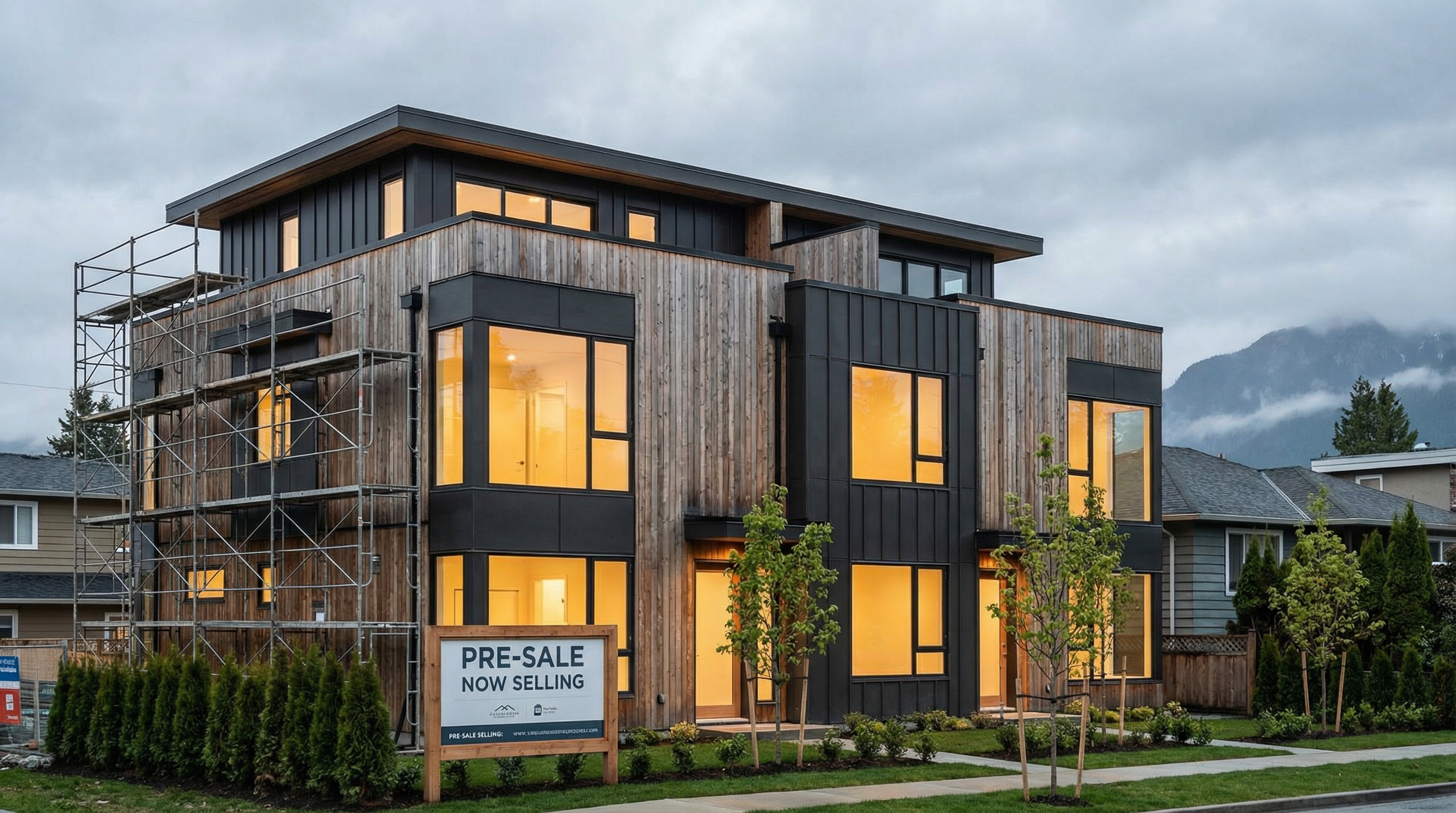
Why Buying Pre-Sale Is the Smartest Way In
Pre-sale multiplex purchases offer staged deposits, strong BC buyer protections under REDMA, full 2-5-10 warranty coverage, and modern energy-efficient construction — here's why the math works.
By MultiLiving Editorial · March 26, 2026
The Pre-Sale Window Is Wide Open
Here's a thing most buyers don't realize about the Vancouver multiplex market right now: developers are hungry. Pre-sale launches slowed dramatically through 2025, and builders who are still active are offering better terms than we've seen in years — flexible deposit schedules, finishing allowances, and in some cases, pricing below what comparable resale units are fetching.
That's a reversal from 2022-2023, when you'd be lucky to get a callback from a sales centre. The multiplex market in Metro Vancouver is stabilizing around 40 to 50 transactions per year as a baseline, according to market data tracked by VanPlex. Builders need committed buyers to secure construction financing, and that gives you leverage.
If you've been watching the multiplex space from the sidelines, this is worth paying attention to. The advantages of buying pre-sale go well beyond getting a new-build smell.
Lock In Today's Price, Pay Over Time
The single biggest draw of a pre-sale purchase: you're buying at today's price, but you don't need the full down payment upfront. Most pre-sale multiplexes in BC require a deposit of 10% to 25% of the purchase price, paid in stages over 12 to 24 months. A typical structure looks like 5% at signing, another 5% at 6 months, and the balance at completion.
That staged payment schedule is a real advantage for buyers who are saving aggressively but don't have the full amount sitting in an account today. You're essentially reserving a unit at a fixed price while continuing to build your financial position.
And here's the part that makes pre-sale math compelling: new-construction multiplex units on Vancouver's West Side closed at $1,150,000 for an 850 sq ft unit and $1,550,000 for 1,400 sq ft in January 2026, based on transaction data tracked by VanPlex. If prices move up even 3-5% during the construction period — which is typical for a 9 to 12 month multiplex build — you've gained equity before you've even moved in.
BC's Buyer Protections Are Unusually Strong
This is where buying pre-sale in BC is genuinely different from most other provinces. The Real Estate Development Marketing Act (REDMA) creates a safety net that's hard to find elsewhere in Canada.
First, your deposit money is held in trust. It doesn't go to the developer — it sits in a trust account regulated by the BC Financial Services Authority (BCFSA) until the project completes or is cancelled. If the project falls through, you get your full deposit back plus any interest earned.
Second, you get a 7-day rescission period. After signing a pre-sale contract, you have seven calendar days to cancel for any reason — no penalty, no fee, full deposit returned. That's governed by REDMA, and it applies to all new residential construction in BC. You could sign on Saturday, spend the week getting a lawyer's opinion and running numbers, and still walk away clean on Friday.
The developer must also provide a Disclosure Statement before the rescission clock starts. This document lays out everything: the developer's track record, the project timeline, what's included in the unit, strata fees, parking, and any encumbrances on the land. It's a forced transparency mechanism, and it's one of the strongest in the country.
The 2-5-10 Warranty Isn't a Marketing Line — It's Law
Every new home built in BC comes with mandatory home warranty insurance, commonly called the 2-5-10 warranty. This isn't an optional add-on or a developer perk. It's required by the Homeowner Protection Act and administered through BC Housing.
Here's what it covers:
- 2 years on materials and labour — things like defective fixtures, leaky taps, cracked tiles, faulty wiring. For strata units (which multiplexes often are), common property gets 15 months of coverage and individual units get 12 months.
- 5 years on the building envelope — the exterior shell that keeps water out. If your roof leaks or your windows let in moisture in year 4, you're covered.
- 10 years on structural defects — foundation problems, load-bearing failures, anything that compromises the building's structural integrity.
For multiplex strata units, the coverage limits are the lesser of the purchase price or $100,000 per unit for individual claims, and up to $100,000 multiplied by the number of units (max $2.5 million) for common property claims. That's serious coverage for a building with 4 to 6 units.
Compare that to buying a 30-year-old resale property where you're inheriting someone else's deferred maintenance. With pre-sale, you're starting fresh with legal protection baked in.
Modern Building Standards Mean Lower Operating Costs
A multiplex built in 2026 isn't the same animal as one built in 2010. BC's building codes have gotten significantly more demanding on energy performance, and that's actually great news for buyers.
Since March 2025, all new residential construction in BC must comply with Step 3 of the BC Energy Step Code, plus Level 1 of the Zero Carbon Step Code. In plain terms, that means better insulation, tighter air sealing, high-performance windows, and a requirement to report operational carbon emissions. The province is pushing toward Step 5 (net-zero energy ready) by 2032, so buildings going up today are already well ahead of the older housing stock.
What does that mean for your wallet? Lower heating and cooling bills, better soundproofing between units (a real concern in multi-unit buildings), and a home that holds its value better as energy performance becomes a bigger factor in buyer decisions. It also means the building is more likely to be all-electric or electric-ready, which sidesteps future carbon pricing costs on natural gas.
Customization You Can't Get on Resale
Buying pre-sale often means you get a say in finishes. Depending on the developer and how early you buy, that could range from choosing cabinet colours and flooring to selecting fixture packages or upgrading appliances.
Some developers in the current market are going further — offering decorating allowances or credits as incentives. That's a direct benefit of buying in a slower market. When sales centres are busy, you take what's offered. When they're not, you negotiate.
There's also a practical angle: with a pre-sale unit, your layout is purpose-built for current living standards. Open plans, in-unit laundry, modern HVAC, EV-ready parking — things that are expensive to retrofit into older buildings but standard in new construction.
The Math: Pre-Sale vs. Resale
Let's lay this out with real numbers. Say you're looking at a 3-bed, 1,200 sq ft multiplex unit in East Vancouver.
Pre-sale scenario: Purchase price $1,250,000. Deposit of $125,000 (10%) paid over 12 months. Construction period: 9-12 months. Move-in cost: mortgage on $1,125,000. You get a brand new unit, full 2-5-10 warranty, current building code compliance, and likely some equity gain by completion.
Resale scenario: Purchase price $1,200,000 for a 5-year-old comparable unit. Full down payment needed at closing (typically 20% = $240,000). No warranty remaining on materials. Unknown maintenance history. Possible need for $30-50K in updates within 5 years to match current standards.
The sticker price on the resale might look lower, but once you factor in the smaller initial outlay, the warranty coverage, the lower operating costs, and the avoided renovation spend, pre-sale often comes out ahead on total cost of ownership over the first 10 years.
What to Watch Out For
Pre-sale isn't risk-free, and we'd be doing you a disservice to pretend otherwise.
- Completion delays happen. Multiplex builds are faster than towers (9-12 months vs. 3-4 years), but permitting delays, weather, and supply issues can push timelines. Make sure your financing approval window accounts for this.
- You're buying from plans. The finished unit might differ from the show suite or renderings. Read the Disclosure Statement carefully — it details exactly what's included and what's an upgrade.
- Developer risk. Not all builders are equal. Check their track record, look at their previous projects, and talk to owners in their completed buildings. REDMA protects your deposit, but a project cancellation still costs you time and opportunity.
- Interest rate changes. You'll lock your mortgage at completion, not at signing. If rates move against you during the build, your carrying costs could be higher than projected.
Key Takeaways
- Pre-sale multiplex purchases let you lock in today's price with a staged deposit structure (typically 10-25% over 12-24 months), making it more accessible than the upfront cash needed for resale.
- BC's REDMA provides strong buyer protections: deposits held in trust, a 7-day no-penalty rescission period, and mandatory disclosure statements.
- Every new multiplex in BC comes with mandatory 2-5-10 warranty coverage — 2 years on materials, 5 on building envelope, 10 on structure.
- New builds comply with BC's Step 3 Energy Step Code (as of March 2025), translating to lower utility bills and better long-term value retention.
- The current market favours buyers — developers are offering better terms, and construction timelines for multiplexes are short (9-12 months).
Frequently Asked Questions
How much deposit do I need for a pre-sale multiplex in BC?
Most pre-sale multiplexes require 10% to 25% of the purchase price, paid in stages over 12 to 24 months. A common structure is 5% at signing, 5% at 6 months, and the remainder at completion. Your deposit is held in trust under REDMA.
Can I cancel a pre-sale purchase in BC?
Yes. BC law gives you a 7-day rescission period after signing. You can cancel for any reason within those seven calendar days with no penalty and receive your full deposit back. After the rescission period, cancellation terms depend on your contract.
What warranty comes with a new multiplex in BC?
All new homes in BC are covered by mandatory 2-5-10 home warranty insurance: 2 years on materials and labour, 5 years on the building envelope (water penetration), and 10 years on structural defects. This is required by law under the Homeowner Protection Act.
How long does it take to build a multiplex?
A typical wood-frame multiplex in Metro Vancouver takes 9 to 12 months from construction start to completion. This is significantly faster than condo towers (3-4 years), which means less time between signing and moving in.