Sound, Privacy & Shared Walls in a Multiplex
The honest truth about multiplex living — sound insulation, shared walls, neighbour proximity, and what separates a well-built unit from a noisy nightmare. BC Building Code STC ratings explained.
By MultiLiving Editorial · April 4, 2026
Why Sound Matters More in a Multiplex Than a Condo Tower
In a 200-unit concrete condo tower, the person making noise above you is anonymous. You file a complaint with the strata council. Maybe the building manager sends a letter. Life goes on.
In a four-unit multiplex, the person making noise is your neighbour — someone you see taking out the garbage, someone whose kids play with yours. Sound complaints in a multiplex are personal. They affect relationships. And because the building governance is four people, not a council of twelve, there's no bureaucratic buffer.
This is why sound insulation quality is the single most important livability factor in a multiplex, and it's the one that too many buyers overlook. They check the kitchen finishes, the floor plan, the parking. They don't ask about wall assemblies. They should.
BC Building Code Requirements: The Minimum Standard
The BC Building Code, Division B, Part 9 sets minimum sound transmission requirements for walls and floors between dwelling units. The key metric is STC — Sound Transmission Class.
What STC Means
STC is a single-number rating that measures how well a wall or floor assembly blocks airborne sound (speech, music, television). Higher numbers mean better isolation:
- STC 40: Normal speech clearly audible. Loud speech easily heard. This is like a standard interior wall — completely inadequate between dwelling units.
- STC 45: Normal speech faintly audible. Loud speech understood. Still inadequate for comfortable living.
- STC 50: Normal speech inaudible. Loud speech faintly heard but not understood. This is the BC Building Code minimum between dwelling units.
- STC 55: Normal speech completely inaudible. Loud speech barely perceptible. The National Research Council of Canada rates this as "good" isolation.
- STC 60+: Excellent isolation. Most sounds are imperceptible. This is the standard for luxury condos and recording studios.
The Code Minimum: STC 50
BC Building Code requires a minimum STC 50 for walls and floor/ceiling assemblies between dwelling units. That rating must be achieved in the field (the actual installed assembly), not just in a laboratory test. The distinction matters because laboratory tests are conducted under ideal conditions — perfect sealing, no penetrations, no flanking paths. Real-world performance is always lower.
To account for the gap between lab and field performance, the code uses the ASTC (Apparent Sound Transmission Class) criterion of 47 for field measurements. If a building inspector tests the actual installed wall and measures ASTC 47, the wall meets code. But ASTC 47 is noticeably worse than STC 50 in a lab — it's a concession to practical construction realities.
Let's be direct: STC 50 / ASTC 47 is adequate but not good. At this level, you won't hear normal conversation from the next unit. But you will hear loud music, home theatre bass, a barking dog, or an argument. For many people, that's an acceptable tradeoff at a given price point. For others — light sleepers, remote workers on calls all day, parents with napping infants — it's not enough.
What Good Sound Isolation Actually Looks Like
The National Research Council of Canada recommends STC 55 as the minimum for good acoustic privacy and STC 60+ for excellent privacy. The BKL acoustics research confirms that the perceptible difference between STC 50 and STC 55 is significant — those 5 points represent roughly a 50% reduction in perceived sound transmission.
Getting from STC 50 to STC 55 doesn't require exotic construction. It requires better detailing:
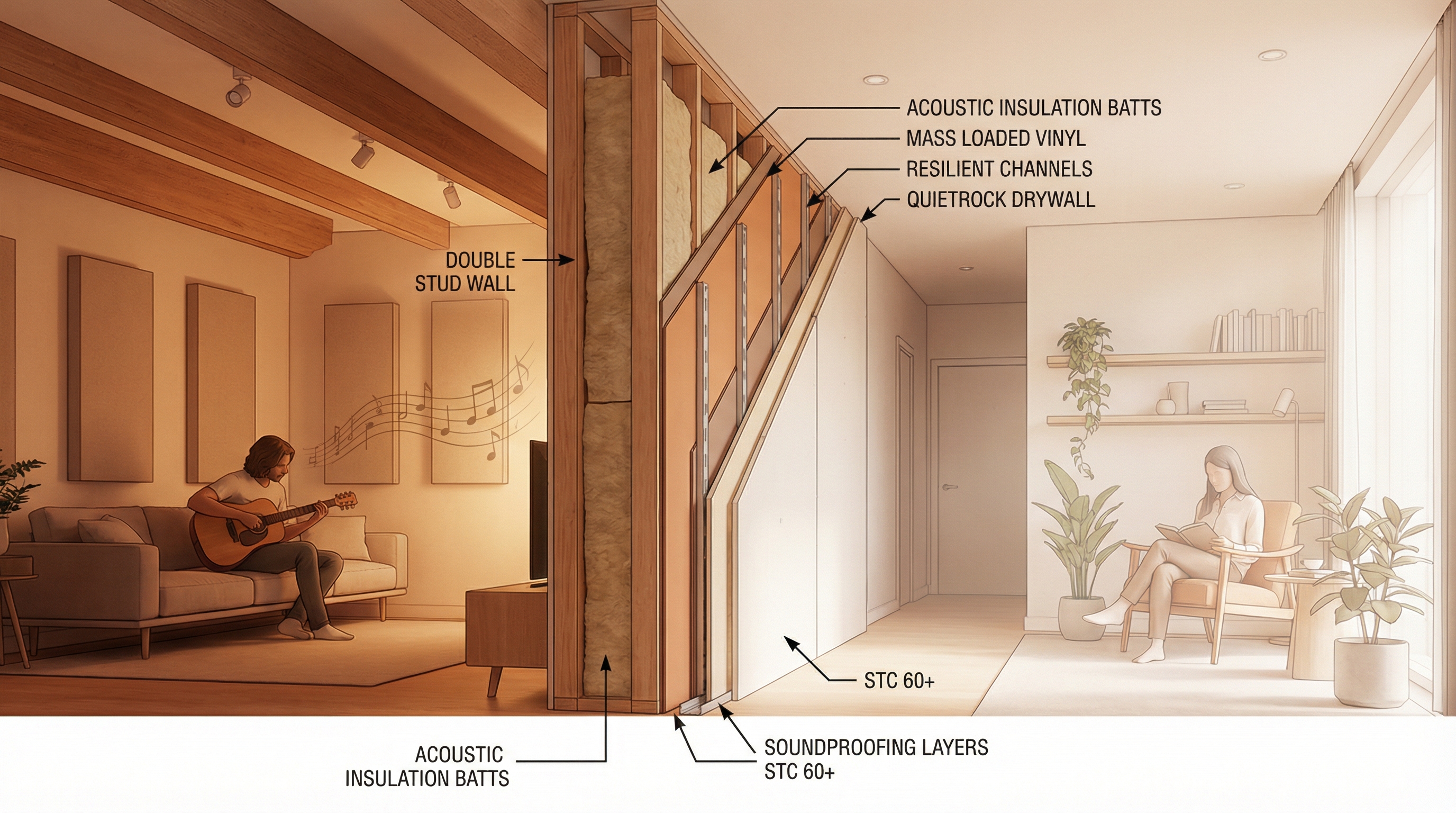
Double Stud Walls vs. Single Stud
A standard single wood stud wall with resilient channels and batt insulation can achieve STC 50-52 in laboratory conditions. A double stud wall — two separate rows of studs with an air gap between them, each row independently supported — achieves STC 56-62 depending on configuration.
The cost difference is modest: a double stud wall adds approximately $8-$12 per square foot of wall area compared to a single stud wall. For a shared wall in a fourplex that might be 400 square feet, that's $3,200-$4,800 per wall. For the entire building, the double-stud upgrade might add $15,000-$25,000 to construction costs. That's roughly $4,000-$6,000 per unit — money that directly improves every resident's quality of life.
The Resilient Channel Question
Resilient channels (RC-1) are metal strips that decouple the drywall from the studs, reducing sound vibration transfer. They're a standard component of STC 50 wall assemblies. But here's the problem: resilient channels are installation-sensitive. If a screw misses the channel flange and connects the drywall directly to the stud, the channel is short-circuited and performance drops dramatically.
Double stud walls avoid this problem entirely because the two sets of studs are physically separate — there's no vibration path from one side to the other. This is why acoustics consultants generally prefer double stud assemblies for multiplex shared walls: the performance is more robust and less dependent on perfect installation.
Flanking Noise: Sound Travels Around Walls, Not Just Through Them
Here's the part that catches most buyers off guard: a perfectly built STC 60 wall can be undermined by sound traveling around it.
Flanking noise is sound that bypasses the primary wall or floor assembly by traveling through secondary paths:
- Floor continuity: If the floor structure runs continuously through the shared wall (i.e., the subfloor passes under the wall without a break), impact sounds from one unit transmit to the other through the floor.
- Ceiling cavity: If both units share a continuous ceiling plenum (the space above the ceiling drywall and below the roof or floor above), sound can travel over the wall through this cavity.
- HVAC ducts: Shared ductwork between units is an acoustic highway. Sound travels directly through metal ducts with almost no attenuation.
- Electrical boxes: Back-to-back electrical outlets on a shared wall create direct sound paths. Outlets should be offset by at least 24 inches and sealed with acoustic putty.
- Windows: If both units have windows on the same wall (common in stacked configurations), exterior noise from one unit's open window enters the other unit's open window.
According to the SLR Consulting noise separation study, flanking paths can reduce the effective sound isolation by 5-15 STC points — enough to take a well-designed STC 60 wall assembly down to STC 45-55 in real-world performance. The wall assembly doesn't matter if sound goes around it.
Impact Noise: The Floor Problem
Airborne sound (voices, music, TV) is measured by STC. Impact sound — footsteps, dropped objects, moving furniture — is measured by a different metric: IIC (Impact Insulation Class).
BC Building Code requires a minimum IIC 50 for floor/ceiling assemblies between dwelling units. As with STC, IIC 50 is adequate but not generous. Footsteps from the unit above will be faintly audible. Dropped objects will be noticeable. Children running will be clearly heard.
Wood-frame construction is inherently worse for impact noise than concrete. A concrete slab floor achieves IIC 55-65 depending on the topping and underlayment. A wood-frame floor needs careful detailing to reach IIC 50:
- Acoustic underlayment: A rubber or cork mat under the finished flooring adds 5-10 IIC points.
- Resilient ceiling: Resilient channels or clips supporting the ceiling drywall below decouple it from the floor joists, adding 5-8 IIC points.
- Insulation in joist cavity: Standard fiberglass or mineral wool batt between the joists adds 3-5 IIC points.
- Concrete topping: A 1.5-inch lightweight concrete topping over the subfloor adds mass and significantly improves both IIC and STC. This is the highest-performance option but adds weight (requiring larger joists) and cost.
In a stacked multiplex (units above and below each other), the floor/ceiling assembly is as important as the shared walls. Ask builders specifically about their floor assembly — not just the STC/IIC rating, but the actual components and their installation sequence.
What to Ask During an Inspection or Pre-Sale Review
Whether you're buying pre-sale or inspecting a finished unit, these questions separate informed buyers from naive ones:
- "What is the STC rating of the shared wall assemblies?" If the builder can't answer, or says "code minimum," push for the actual assembly specification. STC 50 is the legal minimum; you want STC 55+.
- "Are the shared walls single stud or double stud?" Double stud is significantly better and indicates the builder takes acoustics seriously.
- "How is flanking noise controlled?" Look for breaks in floor and ceiling continuity at shared walls, sealed electrical penetrations, and separate HVAC systems for each unit.
- "What is the IIC rating of the floor/ceiling assemblies?" For stacked units, this determines whether you'll hear footsteps. IIC 55+ is good; IIC 50 is bare minimum.
- "Are the HVAC systems independent for each unit?" Shared ductwork means shared noise. Independent systems (separate furnaces or heat pumps per unit) are better for both sound and temperature control.
- "Was an acoustics consultant involved in the design?" If yes, ask for the acoustics report. If no, proceed with caution — the builder relied on generic code assemblies rather than optimized solutions.
The Cost of Doing It Right
Upgrading from code-minimum sound insulation (STC 50) to good sound insulation (STC 55+) costs approximately $15,000-$30,000 per unit in additional construction cost. That covers double stud walls, improved floor assemblies, acoustic sealant at all penetrations, and separate HVAC systems.
Is that worth it? Consider this: if you buy a multiplex unit and the sound insulation is inadequate, you can't retrofit the shared walls without major disruption and cost. You're stuck with whatever the builder installed. If you sell, the next buyer will discover the same issue during their inspection or, worse, after they move in — and your unit's reputation suffers.
Sound insulation is one of those investments that costs relatively little during construction and is extraordinarily expensive to fix after the fact. Buyers should treat acoustic quality as a non-negotiable evaluation criterion, not a nice-to-have.
What Living Next to Shared Walls Is Really Like
We've talked to residents of new multiplex buildings across East Vancouver, and the consistent feedback breaks into two camps:
Residents in buildings with STC 55+ shared walls and independent HVAC report that they rarely hear their neighbours. "I know they're home because I see their lights on, but I never hear them," said one Hastings-Sunrise fourplex owner. These residents describe their noise experience as comparable to a well-built townhome or a quiet condo.
Residents in buildings with code-minimum STC 50 walls report a different experience. "I can hear their TV in the evening — not the words, but the bass and the general noise. It's not terrible, but it's there," said a Renfrew-Collingwood unit owner. For most people, this is livable. For light sleepers or those who work from home, it's a source of ongoing mild frustration.
The pattern is clear: the 5-point gap between STC 50 and STC 55 is the difference between "I hear my neighbours" and "I don't." That gap costs $15,000-$30,000 during construction. After construction, fixing it costs $50,000+ and requires temporarily vacating the unit.
Key Takeaways
- BC Building Code minimum is STC 50 (ASTC 47 in field testing) — adequate for normal speech but not for loud sounds, music, or home theatre
- The NRC recommends STC 55 minimum for good privacy, STC 60+ for excellent — target these levels when evaluating a multiplex purchase
- Double stud shared walls (STC 56-62) significantly outperform single stud walls (STC 50-52) for a modest cost increase of $4,000-6,000 per unit
- Flanking noise through floors, ceilings, ducts, and electrical outlets can reduce effective isolation by 5-15 STC points — the wall assembly alone isn't the full picture
- Impact noise (IIC rating) matters as much as airborne noise (STC) in stacked multiplex configurations
- Ask builders for specific STC/IIC ratings and assembly details — if they can't provide them, proceed with caution
Frequently Asked Questions
What is STC 50 and is it good enough for a multiplex?
STC 50 is the BC Building Code minimum for walls between dwelling units. At this level, normal speech is inaudible but loud sounds are faintly perceptible. It's legally adequate but not great — most acoustics professionals recommend STC 55+ for comfortable multiplex living.
Can I improve sound insulation after buying a multiplex unit?
Technically yes, but it's expensive ($50,000+) and disruptive, requiring access to shared wall and floor cavities. Sound insulation is far cheaper to do right during construction. Always evaluate acoustics before purchasing.
What causes the most noise complaints in multiplexes?
Impact noise (footsteps, dropped objects) from units above is the most common complaint, followed by bass from music or home theatre systems. Both are harder to block than airborne speech. Adequate IIC ratings and separate HVAC systems address the most frequent sources.